Crypto Staking License Vietnam: Complete Guide for 2026
Vietnam has emerged as a dynamic hub for blockchain and cryptocurrency innovation, with a rapidly growing community of retail and institutional investors. However, the regulatory environment for crypto staking services remains complex and evolving. As of 2026, Vietnam does not have a dedicated crypto staking license, but businesses offering staking-as-a-service must navigate existing laws on securities, investment, and anti-money laundering. Consulting24 advises and coordinates with local legal experts to help you structure your staking operations compliantly, whether you choose to set up in Vietnam or compare it with established licensing regimes like Panama.
This guide provides a factual overview of the current regulatory environment, the steps to legally offer staking services, and the key considerations for founders. We focus on what is known and where to seek tailored advice, as exact requirements depend on your business model and the evolving stance of Vietnamese authorities.
Overview: What Is a Crypto Staking License in Vietnam?
A crypto staking license in Vietnam is not a single formal license but a combination of regulatory approvals and registrations required to operate a staking business. Staking involves locking up cryptocurrencies to support a blockchain network and earn rewards. In Vietnam, the State Bank of Vietnam (SBV) and the Ministry of Finance (MoF) have not issued specific regulations for staking. Instead, activities may fall under existing laws on virtual assets, securities, or investment advisory. As of 2026, there is no dedicated licensing regime, meaning businesses must rely on legal opinions and registrations like an Enterprise Registration Certificate and, if dealing with securities tokens, a securities license. Consulting24 helps you assess whether Vietnam is the right jurisdiction for your staking venture or if a more established regime like Panama offers clearer rules.
Who Needs a Crypto Staking License in Vietnam?
Any entity that offers staking services to customers in Vietnam likely needs to comply with local regulations. This includes:
- Crypto exchanges that provide staking pools for users.
- Independent staking-as-a-service providers.
- DeFi protocols that onboard Vietnamese residents.
- Funds that stake assets on behalf of investors.
If your business holds customer assets, manages staking rewards, or provides advice on staking strategies, you may be subject to licensing requirements under the Law on Credit Institutions or the Securities Law. Consulting24 advises on structuring your entity to minimise regulatory risk, whether you operate from Vietnam or serve Vietnamese clients from a licensed entity in Panama or Lithuania.
License Type & Regulator
As of 2026, Vietnam has no single regulator for crypto staking. The relevant authorities include:
- State Bank of Vietnam (SBV): Oversees payment services and may classify staking as a payment intermediary if it involves fiat currency.
- Ministry of Finance (MoF): Regulates securities and investment services. If staking rewards are considered securities, a securities license may be required.
- Ministry of Information and Communications (MIC): May have oversight if the service involves data processing or telecoms.
Most staking businesses register as a limited liability company or joint stock company under the Enterprise Law. They then apply for an Enterprise Registration Certificate. If they handle customer assets, they may need a license under the Law on Credit Institutions. Consulting24 coordinates with local counsel to determine the exact registration path for your business model.
Cost & Timeline
The cost and timeline for setting up a crypto staking operation in Vietnam vary widely based on the chosen structure and the need for legal opinions. Below is an indicative table based on typical scenarios:
| Item | Estimated Cost (EUR) | Timeline |
|---|---|---|
| Company registration (Enterprise Registration Certificate) | 500 - 1,500 | 2 - 4 weeks |
| Legal opinion on staking legality | 3,000 - 8,000 | 4 - 8 weeks |
| Bank account opening | 0 - 500 | 2 - 6 weeks |
| AML/KYC compliance setup | 2,000 - 5,000 | 2 - 4 weeks |
| Total estimated (without licensing) | 5,500 - 15,000 | 2 - 4 months |
Exact pricing is confirmed in a consultation, as costs depend on the complexity of your service and the need for additional permits. For a fixed-price alternative, consider a Panama crypto license at EUR 6,000 flat, which provides a clear regulatory framework for staking.
Capital Requirement
Vietnam does not impose a specific minimum capital requirement for crypto staking businesses. However, the Enterprise Law requires companies to have charter capital sufficient to cover their intended operations. For a limited liability company, the charter capital is declared by the founders and must be adequate for the business scope. In practice, authorities may expect at least EUR 10,000 - 20,000 for a service company. If a securities license is needed, the minimum capital is higher (e.g., EUR 100,000+). Consulting24 advises on setting appropriate capital levels based on your business plan and the risk of being classified as a securities firm.
Tax Treatment
Vietnam taxes corporate income at a standard rate of 20%. For crypto staking, the tax treatment of rewards is unclear. The General Department of Taxation has not issued specific guidance. Generally, income from staking may be treated as:
- Corporate income: Taxable at 20% if the business is considered to be providing a service.
- Capital gains: If staking rewards are seen as capital appreciation, they may be taxed as capital gains (subject to 20% corporate rate).
- Value-added tax (VAT): Staking fees may be subject to 10% VAT if considered a service.
Given the ambiguity, many staking businesses choose to operate from jurisdictions with clear tax rules, such as Panama (territorial tax, no tax on foreign-source income) or Estonia (0% tax on retained profits). Consulting24 can help you compare tax outcomes across jurisdictions.
Allowed Activities
Under current Vietnamese law, the following activities are generally allowed for a registered company, subject to legal opinion:
- Operating a staking pool for proof-of-stake blockchains (e.g., Ethereum, Solana, Cardano).
- Offering staking-as-a-service to non-resident clients (if no solicitation in Vietnam).
- Providing technical staking infrastructure (nodes, validators).
- Managing staking rewards distribution (if not deemed collective investment).
Prohibited or restricted activities include:
- Accepting deposits from the public (banking activity).
- Issuing tokens that qualify as securities without a license.
- Guaranteeing fixed returns (may be considered a deposit).
Consulting24 recommends obtaining a legal opinion that explicitly lists permitted activities and any conditions.
Step-by-Step Process
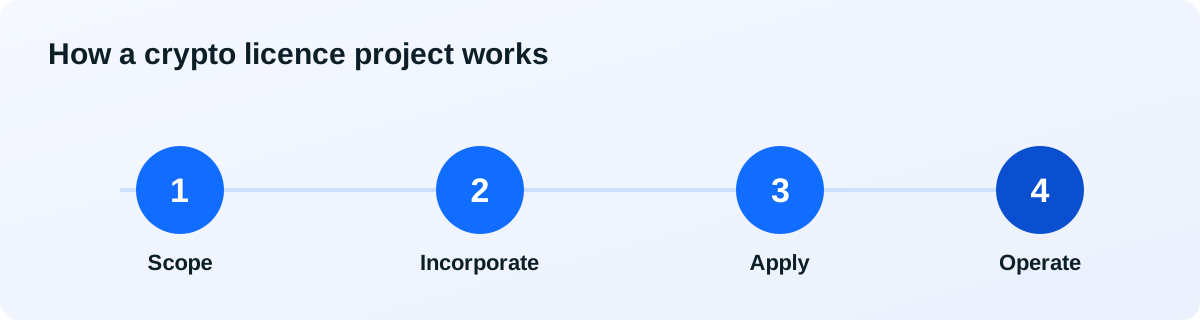
- Business structure choice: Decide between a limited liability company (LLC) or joint stock company (JSC). Most foreign founders choose LLC.
- Company registration: Submit an application for an Enterprise Registration Certificate to the Department of Planning and Investment. Provide charter capital, business lines, and shareholder details.
- Legal opinion: Engage a local law firm to draft an opinion on whether staking is permissible and whether any additional licenses are needed.
- AML/KYC program: Implement a compliance program aligned with Vietnam's AML law and FATF recommendations.
- Bank account: Open a corporate bank account in Vietnam or a jurisdiction like Panama for international operations.
- Tax registration: Register for corporate income tax and VAT with the tax authority.
- Ongoing compliance: File annual reports, tax returns, and maintain records of staking transactions.
Consulting24 coordinates each step with local partners, ensuring your application is complete and compliant.
Banking & Payments
Opening a bank account for a crypto staking business in Vietnam is challenging. Most local banks are cautious about crypto-related activities due to the SBV's stance that cryptocurrencies are not legal tender. However, some banks may accept accounts for non-crypto operational expenses (rent, salaries) if the business does not process crypto transactions through the bank. For crypto-to-fiat conversions, many firms use third-party payment processors or offshore accounts. Consulting24 can assist with opening accounts in jurisdictions with crypto-friendly banks, such as Panama, Lithuania, or the Czech Republic. See our guide on best country for crypto license for banking options.
Benefits of a Crypto Staking License in Vietnam
- Growing market: Vietnam has a high crypto adoption rate, providing a large user base for staking services.
- Low initial costs: Company registration is inexpensive compared to EU jurisdictions.
- Skilled workforce: Access to technical talent for blockchain development.
- No specific staking license: Avoids lengthy licensing processes; a legal opinion may suffice.
However, the lack of clear regulation is a double-edged sword. Many founders prefer the legal certainty of a dedicated license in Panama or Lithuania, where staking is explicitly allowed under a CASP license.
Compliance & Trust
To build trust with customers and regulators, your staking business must demonstrate strong compliance. Key elements include:
- Anti-Money Laundering (AML): Implement customer due diligence, transaction monitoring, and suspicious activity reporting.
- Know Your Customer (KYC): Verify the identity of all customers, especially if they are Vietnamese residents.
- Data protection: Comply with Vietnam's Law on Cybersecurity and Personal Data Protection.
- Transparent disclosures: Clearly communicate staking rewards, risks, and lock-up periods.
This is general guidance, not legal advice. Consulting24 recommends working with local compliance experts to tailor your program.
Common Mistakes
Founders often make these errors when entering the Vietnamese market:
- Assuming no regulation: Believing that because there is no specific license, no compliance is needed. This can lead to fines or closure.
- Using personal accounts: Mixing business and personal funds for staking operations, which violates AML rules.
- Ignoring tax obligations: Not registering for VAT or corporate tax, risking penalties.
- Overpromising returns: Guaranteeing fixed staking yields may be seen as an unlicensed deposit-taking activity.
Consulting24 helps you avoid these pitfalls by structuring your entity correctly from the start.
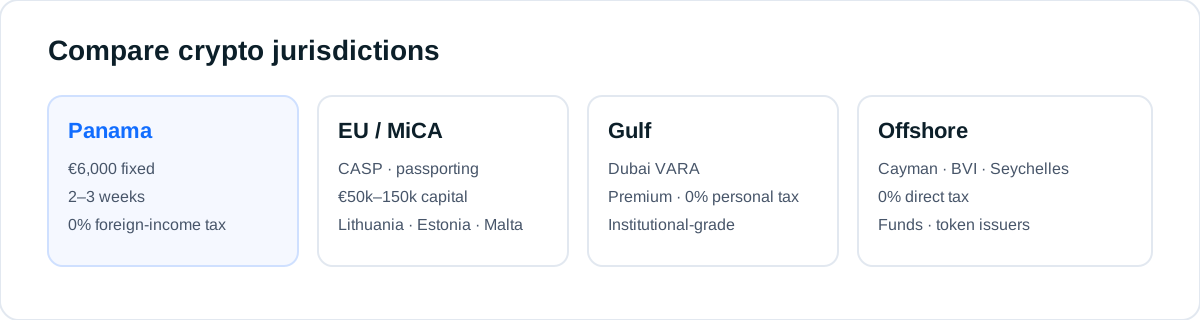
Alternatives: Vietnam vs. Panama and Other Jurisdictions
Vietnam offers a low-cost entry but with regulatory ambiguity. Compare with these alternatives:
| Jurisdiction | License Type | Cost (EUR) | Clarity | Tax |
|---|---|---|---|---|
| Vietnam | Company registration + legal opinion | 5,500 - 15,000 | Low | 20% CIT + 10% VAT |
| Panama | Crypto license (FinTech Law) | 6,000 flat | High | Territorial (0% on foreign income) |
| Lithuania | CASP license (MiCA) | 5,000 - 15,000 | High | 15% CIT |
| Estonia | Virtual asset service provider license | 3,000 - 10,000 | Medium | 20% CIT (0% on retained profits) |
For founders seeking regulatory certainty and a clear path for staking, Panama's license is a compelling option. Consulting24 delivers Panama licenses directly and advises on all other jurisdictions.
Why Choose Consulting24 for Your Crypto Staking License?
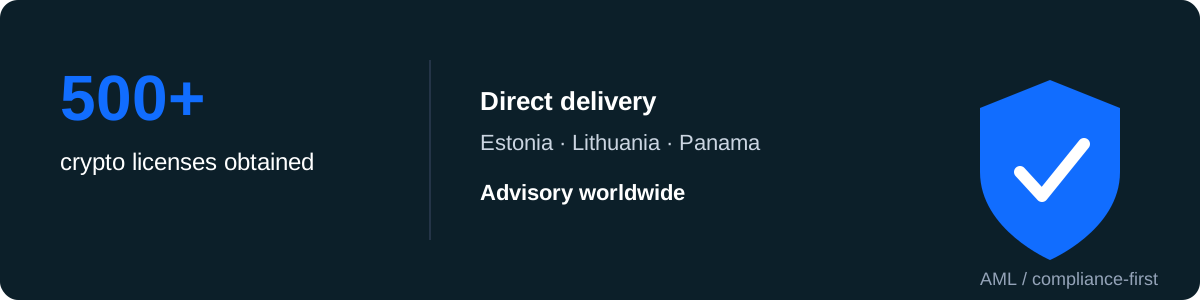
Consulting24 (X24Consulting OU, Tallinn, Estonia) has obtained over 500 crypto licenses worldwide. We deliver directly in Estonia, Lithuania, and Panama, and advise and coordinate in all other jurisdictions, including Vietnam. Our team of legal and compliance experts will:
- Assess your business model and recommend the best jurisdiction.
- Coordinate with local lawyers in Vietnam for legal opinions and company registration.
- Provide a fixed-price Panama license if that suits your needs better.
- Offer ongoing compliance support to keep your license valid.
Contact us today on WhatsApp or book a consultation to discuss your project.
Frequently asked questions
Is there a specific crypto staking license in Vietnam?
No, as of 2026 Vietnam does not have a dedicated crypto staking license. Businesses must register as a company and obtain legal opinions to ensure compliance with existing laws on securities, investment, and AML. Consulting24 advises on the best structure.
What is the minimum capital required for a staking business in Vietnam?
There is no official minimum capital for staking, but charter capital should be sufficient for operations. Typically, EUR 10,000-20,000 is expected. If a securities license is needed, capital requirements are higher. Exact figures depend on your business scope.
How long does it take to set up a staking operation in Vietnam?
Company registration takes 2-4 weeks. Obtaining a legal opinion may take 4-8 weeks. Total setup time is usually 2-4 months. Consulting24 can expedite the process with local partners.
Can I offer staking to Vietnamese residents?
Offering staking to Vietnamese residents may subject you to local regulations, including AML and possibly securities laws. A legal opinion is essential to determine if your service is compliant. Many firms serve Vietnamese clients from a licensed entity abroad.
What are the tax implications for crypto staking in Vietnam?
Corporate income tax is 20%. Staking rewards are likely taxable as income. VAT at 10% may apply to service fees. However, specific guidance is lacking. Consulting24 recommends tax planning with a local advisor.
Is Panama a better alternative for a crypto staking license?
Panama offers a clear regulatory framework for crypto services, including staking, with a flat fee of EUR 6,000 and territorial tax (0% on foreign income). It is often preferred for its legal certainty and lower ongoing costs.
What activities are prohibited for staking businesses in Vietnam?
Prohibited activities include accepting deposits from the public, issuing securities tokens without a license, and guaranteeing fixed returns. Staking services should avoid these to stay compliant.
Do I need a bank account in Vietnam for my staking business?
A local bank account is useful for operational expenses, but many crypto firms use offshore accounts for crypto-to-fiat conversions. Vietnamese banks may be reluctant to serve crypto businesses. Consulting24 can help open accounts in crypto-friendly jurisdictions.
Can Consulting24 help me obtain a license in Vietnam?
Consulting24 advises and coordinates with local legal experts in Vietnam for company registration and compliance. We do not directly deliver licenses in Vietnam but guide you through the process and can recommend alternative jurisdictions if needed.
What ongoing compliance is required for a staking business in Vietnam?
Ongoing compliance includes annual tax filings, AML reporting, and maintaining records of transactions. If a securities license is obtained, additional reporting to the MoF may be required. Consulting24 offers compliance support packages.
Official sources
Related jurisdictions

Talk to a crypto-licensing expert
500+ licenses across Estonia, Lithuania, Panama and beyond. Tell us your model and we'll map the right route, honestly.
💬 Talk to an expertFree consultationGeneral guidance, not legal advice. Rules and fees evolve, and we confirm current requirements for your case.