Crypto Fund License Vietnam: A Complete Guide for 2026
Vietnam has emerged as a dynamic hub for blockchain and cryptocurrency innovation, but its regulatory framework for crypto funds remains in development. If you are looking to establish a crypto fund in Vietnam, understanding the current licensing environment is critical. This guide covers the crypto fund license Vietnam process, including the relevant regulator, capital requirements, tax treatment, and allowed activities.
As of 2026, Vietnam does not have a dedicated crypto fund license. Instead, fund managers typically operate under existing securities laws or register as a virtual asset service provider (VASP) if the activity falls under evolving regulations. Consulting24 advises and coordinates with local partners to help you navigate this complex environment, ensuring compliance while minimising delays.
Overview: What Is a Crypto Fund License in Vietnam?
A crypto fund license in Vietnam is not a single, standalone permit. Rather, it refers to the combination of registrations and approvals needed to manage a collective investment scheme that invests in digital assets. Currently, the State Securities Commission of Vietnam (SSC) oversees fund management activities under the Law on Securities, while the State Bank of Vietnam (SBV) regulates payment-related crypto services. The government has signalled plans to introduce a pilot regulatory sandbox for crypto assets, but as of 2026, no formal crypto fund license exists.
For practical purposes, setting up a crypto fund in Vietnam involves either:
- Registering as a fund management company with the SSC and obtaining a securities business certificate.
- Applying for a VASP registration if the fund engages in custody or exchange activities (subject to ongoing legal developments).
Consulting24 coordinates with local legal experts to structure your fund in compliance with current rules, whether you choose Vietnam or a more established jurisdiction like Panama.
Who Needs a Crypto Fund License in Vietnam?
Any entity that pools capital from investors to invest in cryptocurrencies, tokens, or blockchain-based assets and charges a management fee or performance fee requires some form of authorisation. This includes:
- Hedge funds, venture capital funds, and private equity funds focused on crypto.
- Fund managers offering discretionary portfolio management in digital assets.
- Staking pools or yield farming funds that operate as collective investment schemes.
If you plan to raise funds from Vietnamese residents or market your fund locally, you must comply with securities laws. Foreign fund managers looking to access Vietnamese investors may also need to establish a local presence or use a licensed fund management company. Consulting24 advises on the most suitable structure, including comparing Vietnam with other jurisdictions.
License Type and Regulator
The primary regulator for fund management in Vietnam is the State Securities Commission (SSC) under the Ministry of Finance. The relevant license type is the Fund Management Company License (Giấy phép thành lập và hoạt động công ty quản lý quỹ). This license allows the holder to establish and manage securities investment funds. For crypto-focused funds, the SSC currently treats digital assets as securities only if they meet the legal definition of securities under Vietnamese law.
Additionally, if the fund involves crypto custody or exchange, the State Bank of Vietnam (SBV) may require a VASP registration under the amended Law on Credit Institutions. As of 2026, the SBV has not issued detailed guidance for crypto VASPs, but a sandbox is expected. Consulting24 monitors these developments and coordinates with local counsel to ensure your application aligns with the latest SSC and SBV requirements.
Cost and Timeline for a Crypto Fund License in Vietnam
The cost and timeline for obtaining a fund management company license in Vietnam vary based on complexity. Below is an estimated range:
| Item | Estimated Cost (EUR) | Timeline |
|---|---|---|
| Company registration & license application | 5,000 - 15,000 | 2 - 4 months |
| Legal fees and compliance setup | 10,000 - 25,000 | 1 - 3 months |
| Capital contribution (minimum charter capital) | EUR 50,000 - 100,000 (depending on fund type) | On incorporation |
| Ongoing annual compliance | 3,000 - 8,000 | Annual |
Exact pricing is confirmed during a consultation. For a fixed-cost alternative, consider Panama at EUR 6,000 flat. Consulting24 provides a detailed breakdown after assessing your fund structure.
Capital Requirements
Vietnam imposes minimum charter capital requirements for fund management companies. As of 2026, the legal capital for a fund management company is typically VND 25 billion (approx. EUR 1 million) for domestic firms. However, for foreign-invested companies, the requirement may be higher or subject to approval by the Ministry of Planning and Investment. For crypto funds, the SSC may apply additional capital buffers based on the risk profile of the assets managed.
If the fund itself is structured as a securities investment fund, the fund must have a minimum capital of VND 50 billion (approx. EUR 2 million) for open-ended funds and VND 10 billion (approx. EUR 400,000) for closed-ended funds. These figures are subject to change and should be verified with local authorities. Consulting24 advises on capital planning and can help you compare with jurisdictions like Estonia where capital starts at EUR 12,000.
Tax Treatment for Crypto Funds in Vietnam
Vietnam's tax regime for crypto funds is still evolving. As of 2026, the following general principles apply:
- Corporate Income Tax (CIT): Standard CIT rate is 20% on net profits. Crypto trading gains are generally taxable as ordinary income.
- Withholding Tax: No specific withholding tax on crypto distributions, but dividends paid to foreign investors may be subject to 0-10% under double tax treaties.
- Value Added Tax (VAT): Management fees are subject to 10% VAT. Crypto transactions may be exempt if classified as financial services.
- Personal Income Tax: Investors are taxed on capital gains at progressive rates up to 35%, though crypto gains are not explicitly defined.
Consulting24 recommends a detailed tax review with local advisors. For a clearer tax environment, many funds choose Panama, which offers territorial taxation (no tax on foreign-source income).
Allowed Activities Under a Crypto Fund License
A fund management company license in Vietnam permits a range of activities, including:
- Establishing and managing open-ended and closed-ended funds.
- Portfolio management for individual and institutional clients.
- Investment advisory services.
- Custody of securities (but not yet explicitly for crypto assets).
For crypto-specific activities such as direct trading of unregistered tokens, staking, or DeFi participation, the license may not provide explicit coverage. The SSC currently limits fund investments to securities listed on recognised exchanges. Crypto assets that do not qualify as securities may fall outside the permitted scope. Consulting24 helps structure your fund to comply with these restrictions, often using a company setup in a more crypto-friendly jurisdiction alongside a Vietnamese advisory entity.
Step-by-Step Application Process
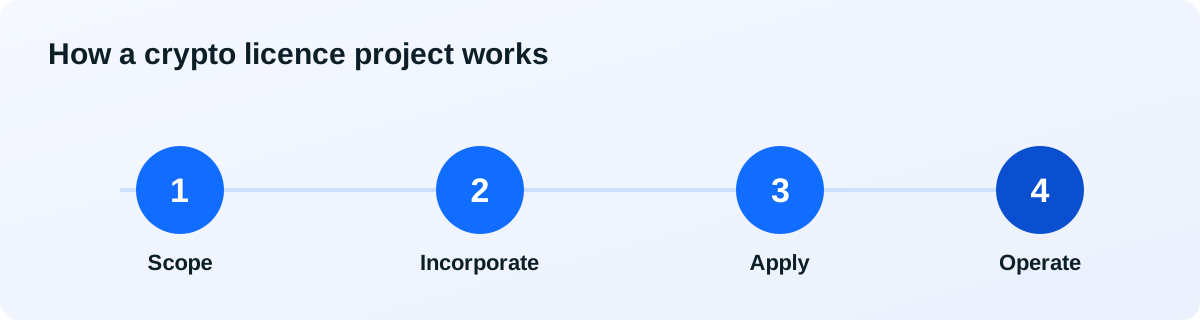
The process to obtain a fund management company license in Vietnam involves several stages:
- Pre-incorporation: Prepare legal documents, including a business plan, charter, and proof of capital. Engage a local law firm.
- Company registration: Register with the Department of Planning and Investment (DPI) to obtain an Enterprise Registration Certificate.
- License application: Submit the application to the SSC, including details of shareholders, directors, and compliance policies.
- Capital contribution: Deposit the minimum charter capital in a blocked bank account and obtain a certificate of capital contribution.
- Approval: The SSC reviews the application within 30-60 days. Additional information may be requested.
- Post-licensing: Register for tax, open a corporate bank account, and comply with ongoing reporting.
Consulting24 coordinates each step with local partners, ensuring a smooth process. For a faster route, consider Lithuania where the timeline is 2-4 months.
Banking and Payment Services for Crypto Funds
Opening a corporate bank account in Vietnam for a crypto fund can be challenging. Vietnamese banks are cautious about crypto-related businesses due to regulatory uncertainty. Many banks require a valid fund management license and a clear explanation of the fund's activities. As of 2026, only a few banks accept crypto fund clients, and they often impose strict due diligence.
Alternatives include using international payment processors or establishing a subsidiary in a jurisdiction with better banking access, such as Panama. Consulting24 has relationships with banks that understand the crypto space and can assist with account opening. We also advise on multi-jurisdictional structures to separate fund management from banking operations.
Benefits of a Crypto Fund License in Vietnam
Despite the challenges, Vietnam offers several advantages for crypto fund managers:
- Growing market: Vietnam has a high rate of crypto adoption, with a young, tech-savvy population.
- Cost-effective operations: Office rent, salaries, and compliance costs are lower than in Singapore or Hong Kong.
- Strategic location: Proximity to China, Southeast Asia, and emerging markets.
- Government support: The government is gradually developing a regulatory framework, with a sandbox expected to launch soon.
However, the lack of a dedicated crypto fund license means managers must work within existing securities laws. Consulting24 helps you capitalise on these benefits while mitigating risks through proper structuring and compliance.
Compliance and Trust Considerations
Compliance is paramount for any regulated fund. In Vietnam, fund management companies must adhere to the Law on Securities, the Investment Law, and anti-money laundering (AML) regulations. Key requirements include:
- Appointing a compliance officer and a risk management team.
- Implementing AML/KYC procedures for investors.
- Submitting annual audited financial statements and periodic reports to the SSC.
- Maintaining adequate internal controls and record-keeping.
Trust is built through transparency and regulatory adherence. Consulting24 ensures your fund meets all legal obligations, but please note that this is general guidance, not legal advice. Always consult a qualified Vietnamese lawyer for your specific situation.
Common Mistakes When Applying for a Crypto Fund License in Vietnam
Many applicants encounter pitfalls that delay or derail their license. Common mistakes include:
- Underestimating capital requirements: Failing to meet the minimum charter capital can lead to rejection.
- Incomplete documentation: Missing business plans, shareholder details, or compliance policies.
- Ignoring local partner requirements: Foreign-owned fund management companies may need a local partner.
- Misclassifying activities: Offering services that fall outside the license scope, such as direct crypto trading.
- Poor bank selection: Approaching banks without a clear compliance framework.
Consulting24 helps you avoid these errors by providing a checklist and reviewing your application before submission.
Alternatives: Vietnam vs. Panama and Other Jurisdictions
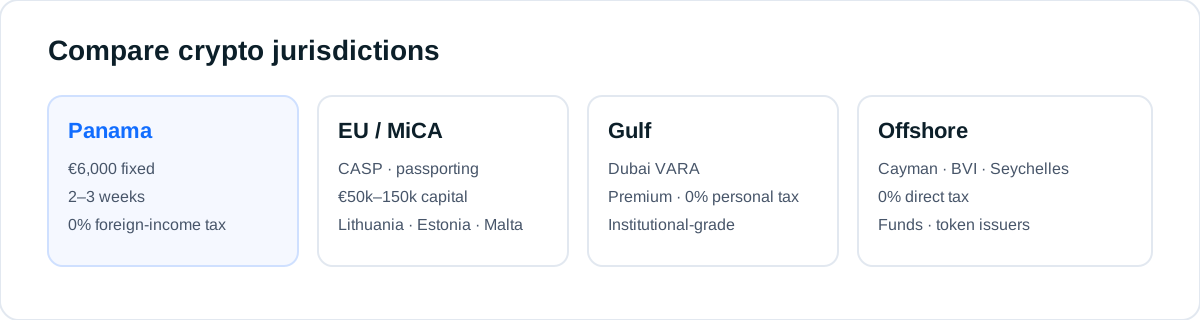
For crypto fund managers, Vietnam is one option among many. Below is a comparison with Panama and two other popular jurisdictions:
| Jurisdiction | License Type | Min. Capital | Tax | Timeline | Cost (EUR) |
|---|---|---|---|---|---|
| Vietnam | Fund Management License | EUR 1M+ | 20% CIT | 4-8 months | 15,000-40,000 |
| Panama | Private Interest Foundation / Corporation (no dedicated crypto fund license) | None | Territorial (no tax on foreign income) | 2-4 weeks | 6,000 flat |
| Estonia | VASP License (for fund management if applicable) | EUR 12,000 | 20% CIT on distributed profits | 2-4 months | 10,000-20,000 |
| Lithuania | CASP License (MiCA compliant) | EUR 50,000 | 15% CIT | 2-4 months | 15,000-25,000 |
Panama offers the fastest and most cost-effective option with no minimum capital and no tax on foreign income. Consulting24 delivers Panama licenses directly and advises on all others.
Why Choose Consulting24 for Your Crypto Fund License?
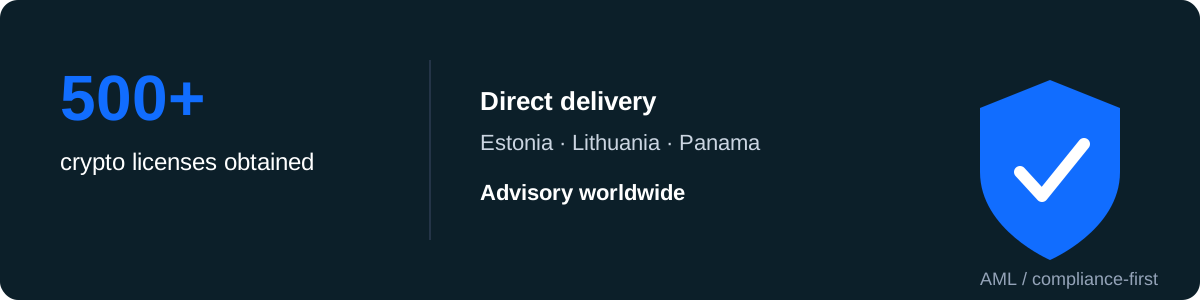
Consulting24 (X24Consulting OU) has obtained over 500 crypto licenses across multiple jurisdictions. We deliver directly in Estonia, Lithuania, and Panama, and advise and coordinate in all other jurisdictions, including Vietnam. Our team of experts provides end-to-end support, from entity structuring and license application to banking and ongoing compliance.
We understand the nuances of the Vietnamese market and work with trusted local partners to ensure your application meets all legal requirements. Whether you choose Vietnam or a more established crypto hub, we help you make an informed decision. Contact us today to discuss your project.
Frequently Asked Questions
Below are answers to common queries about the crypto fund license in Vietnam.
Frequently asked questions
Is there a specific crypto fund license in Vietnam?
No, Vietnam does not yet have a dedicated crypto fund license. Fund managers typically obtain a Fund Management Company License from the State Securities Commission (SSC). Crypto-specific activities may require additional VASP registration once the regulatory sandbox is launched.
What is the minimum capital for a crypto fund in Vietnam?
The minimum charter capital for a fund management company is approximately VND 25 billion (EUR 1 million). For the fund itself, open-ended funds require VND 50 billion (EUR 2 million) and closed-ended funds VND 10 billion (EUR 400,000). These figures are subject to change.
How long does it take to get a fund management license in Vietnam?
The process typically takes 4 to 8 months, including company registration and SSC approval. Delays can occur if documentation is incomplete or if the SSC requests additional information.
Can a foreign company apply for a crypto fund license in Vietnam?
Yes, but foreign-owned fund management companies may face additional requirements, such as a minimum capital contribution and a local partner. The approval process is more stringent and may take longer.
What are the tax implications for a crypto fund in Vietnam?
Corporate income tax is 20% on net profits. Management fees are subject to 10% VAT. Dividends to foreign investors may be subject to withholding tax under double tax treaties. Crypto gains are taxed as ordinary income.
What activities are allowed under a fund management license in Vietnam?
The license permits establishing and managing securities investment funds, portfolio management, and investment advisory. Direct crypto trading or staking may not be covered unless the assets qualify as securities.
Is banking available for crypto funds in Vietnam?
Banking is challenging. Only a few banks accept crypto fund clients, and they require a valid license and strong AML compliance. Consulting24 can assist with bank introductions.
How does Vietnam compare to Panama for a crypto fund?
Panama offers a faster (2-4 weeks), cheaper (EUR 6,000 flat) option with no minimum capital and territorial tax. Vietnam has higher costs and longer timelines but provides local market access. Consulting24 delivers Panama licenses directly.
Can Consulting24 help with a Vietnam crypto fund license?
Yes, Consulting24 advises and coordinates with local partners in Vietnam for fund management license applications. We also provide direct services in Estonia, Lithuania, and Panama.
What are the ongoing compliance requirements for a Vietnam fund?
Annual audited financial statements, periodic reports to the SSC, AML/KYC procedures, and maintaining a compliance officer. Ongoing costs range from EUR 3,000 to EUR 8,000 per year.
Official sources
Related jurisdictions

Talk to a crypto-licensing expert
500+ licenses across Estonia, Lithuania, Panama and beyond. Tell us your model and we'll map the right route, honestly.
💬 Talk to an expertFree consultationGeneral guidance, not legal advice. Rules and fees evolve, and we confirm current requirements for your case.