VASP License Crypto License: The 2026 Guide for Crypto Founders
The VASP license crypto license is the cornerstone of regulated crypto operations in the European Union under the Markets in Crypto-Assets (MiCA) framework. As of 2026, MiCA is fully in force, and any crypto-asset service provider (CASP) operating within the EU must hold a VASP license (or equivalent national license) to offer services like exchange, custody, or transfer of crypto-assets. This comprehensive guide covers everything you need to know: who needs it, the regulator, costs, timeline, capital requirements, tax treatment, and a step-by-step process to obtain your license.
At Consulting24, we have helped over 500 crypto firms secure licenses across multiple jurisdictions, including direct delivery in Estonia, Lithuania, and Panama. For other jurisdictions, we advise and coordinate with local partners. Whether you are a startup or an established exchange, this page will help you understand the VASP environment and choose the right path for your business.
What Is a VASP License Crypto License?
A VASP (Virtual Asset Service Provider) license is a regulatory authorization that allows a company to offer crypto-asset services legally. Under MiCA, the term CASP (Crypto-Asset Service Provider) is used, but many jurisdictions still refer to VASP. The license covers activities such as exchanging crypto for fiat, exchanging crypto for other crypto, custody and administration of crypto-assets, operating a trading platform, and transferring crypto-assets on behalf of clients.
The purpose of the VASP license is to ensure consumer protection, anti-money laundering (AML) compliance, and financial stability. Without it, offering these services is illegal in most regulated markets. The license is issued by the national competent authority (NCA) of the EU member state where the company is registered, subject to MiCA passporting rights across the EU.
Key features of a VASP license under MiCA include: minimum capital requirements based on service type, mandatory AML/KYC procedures, regular reporting to the regulator, and fit-and-proper tests for management. The regime is harmonized across the EU, but national implementation can vary slightly.
Who Needs a VASP License Crypto License?
Any business that provides one or more of the following services in the EU must obtain a VASP license:
- Exchange of crypto-assets for fiat currency
- Exchange of crypto-assets for other crypto-assets
- Custody and administration of crypto-assets on behalf of clients
- Operation of a crypto-asset trading platform
- Execution of orders for crypto-assets on behalf of clients
- Placing of crypto-assets (underwriting)
- Transfer services for crypto-assets on behalf of clients
- Advising on crypto-assets
- Portfolio management of crypto-assets
This includes crypto exchanges, custodians, wallet providers, brokers, and any platform facilitating crypto transactions. Even if your business is based outside the EU, if you actively market or provide services to EU residents, you may need a license. Non-compliance can result in fines, legal action, and reputational damage.
License Type and Regulator
Under MiCA, the license is officially called a Crypto-Asset Service Provider (CASP) license. However, many national regulators still use the term VASP. The regulator is the national competent authority (NCA) of the EU member state where the company is registered. For example, in Lithuania, it is the Bank of Lithuania; in Estonia, the Financial Intelligence Unit (FIU); in Malta, the Malta Financial Services Authority (MFSA).
The license is passportable across the EU, meaning once you obtain it in one member state, you can provide services in all other EU/EEA countries without additional licensing. This makes it a powerful tool for accessing the entire European market of over 450 million people.
For non-EU jurisdictions like Panama, the regulator is the Superintendencia de Bancos de Panama (SBP) or the Superintendencia del Mercado de Valores (SMV) depending on the service. Panama does not have a specific crypto law but allows crypto-related activities under existing financial regulations.
Cost and Timeline for a VASP License
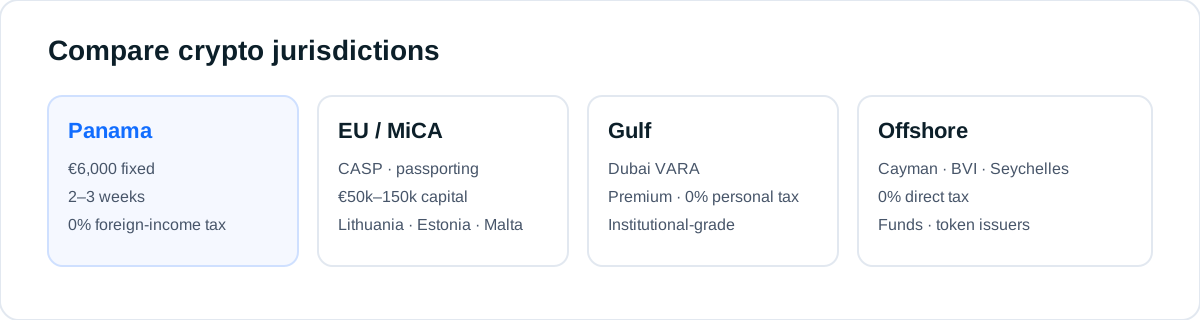
The cost and timeline for obtaining a VASP license vary significantly by jurisdiction. Below is a comparison table based on our direct experience and current 2026 data. Note that exact pricing is subject to change and should be confirmed in a consultation.
| Jurisdiction | License Cost (EUR) | Timeline | Ongoing Costs |
|---|---|---|---|
| Lithuania | ~25,000 - 40,000 | 3-6 months | ~10,000/year |
| Estonia | ~20,000 - 35,000 | 3-6 months | ~8,000/year |
| Panama | 6,000 (flat) | 2-4 weeks | ~2,000/year |
| Malta | ~50,000 - 80,000 | 6-12 months | ~20,000/year |
| Cyprus | ~30,000 - 50,000 | 4-8 months | ~15,000/year |
Capital Requirements for a VASP License
Under MiCA, minimum capital requirements are tiered based on the type of services offered. As of 2026, the tiers are:
- EUR 50,000 for services such as execution of orders, placing of crypto-assets, transfer services, and advice/portfolio management.
- EUR 125,000 for exchange services (crypto-to-fiat and crypto-to-crypto) and operation of a trading platform.
- EUR 150,000 for custody and administration of crypto-assets.
If a company offers multiple service types, the highest applicable capital requirement applies. The capital must be held in liquid assets and is intended to cover operational risks. Some member states may impose additional capital buffers. For non-EU jurisdictions like Panama, there is no specific crypto capital requirement, but general corporate capital requirements apply (typically EUR 10,000 - 50,000).
Tax Treatment for VASP License Holders
Tax treatment of crypto-assets varies by jurisdiction. Under MiCA, there is no harmonized EU tax regime, so each member state applies its own rules. Generally:
- Corporate income tax: Crypto gains are typically treated as taxable income. Rates range from 9% (Hungary) to 25% (Germany). Lithuania offers a 15% corporate tax rate, while Estonia has a 0% tax on retained profits (20% on distributions).
- VAT: Crypto transactions are generally exempt from VAT in the EU (following the EU Court of Justice's Hedqvist ruling). However, services like custody or advisory may be subject to VAT.
- Withholding tax: Some countries impose withholding tax on dividends or interest paid to non-residents.
For Panama, there is no capital gains tax on crypto, and corporate income tax is 25% on local-source income. Panama also has territorial taxation, meaning income from outside Panama is generally not taxed. This makes Panama attractive for international crypto businesses.
Allowed Activities Under a VASP License
A VASP license permits the following activities, as defined by MiCA:
- Exchange of crypto-assets for fiat currency
- Exchange of crypto-assets for other crypto-assets
- Custody and administration of crypto-assets on behalf of clients
- Operation of a crypto-asset trading platform
- Execution of orders for crypto-assets on behalf of clients
- Placing of crypto-assets
- Transfer services for crypto-assets on behalf of clients
- Advice on crypto-assets
- Portfolio management of crypto-assets
Some licenses may restrict certain activities. For example, a license that covers only exchange and custody may not allow operating a trading platform. It is important to define the scope of services at the time of application. Additional activities like staking, lending, or DeFi may require separate authorization under MiCA or national laws.
Step-by-Step Process to Obtain a VASP License
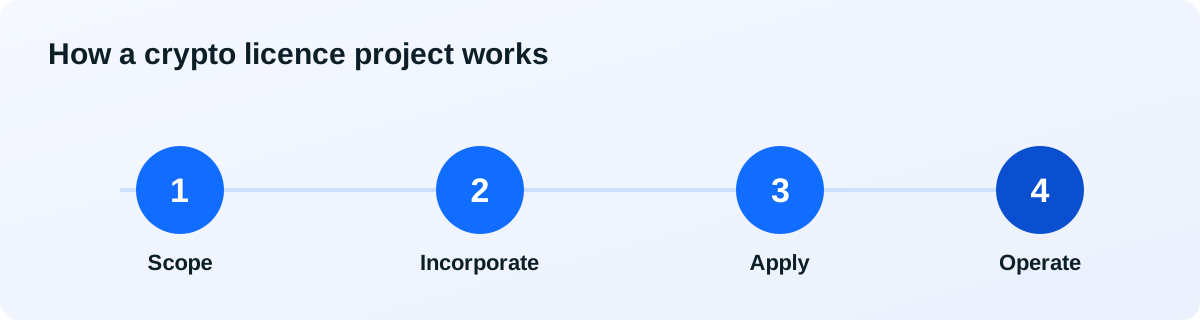
Obtaining a VASP license involves several stages. Below is a general process that applies to most EU jurisdictions. For specific steps in Lithuania or Estonia, see our dedicated pages.
- Pre-application preparation: Define the scope of services, prepare a business plan, AML/KYC policies, risk assessment, and governance structure. Engage a compliance consultant like Consulting24.
- Company incorporation: Register a legal entity in the chosen jurisdiction. Ensure the company has a physical office and local management (varies by country).
- Capital deposit: Deposit the required minimum capital in a bank account and obtain a confirmation letter.
- Submit application: File the application with the regulator, including all required documentation (business plan, AML policies, financial projections, fit-and-proper declarations for directors).
- Regulatory review: The regulator reviews the application, may request additional information, and conducts background checks. This stage can take 2-6 months.
- Interview/meeting: Some regulators require an in-person or virtual meeting with the management team.
- License issuance: Upon approval, the license is granted, and the company is added to the public register.
- Post-licensing compliance: Ongoing reporting, AML audits, and regulatory updates are required.
Banking and Payment Services for VASP License Holders
Access to banking is a critical challenge for crypto firms. Many traditional banks are reluctant to open accounts for VASP license holders due to perceived risks. However, having a regulated license significantly improves your chances. In the EU, licensed VASPs can open accounts with banks that specialize in fintech and crypto, such as LHV Bank (Estonia), PayrNet (Lithuania), or ClearBank (UK).
For Panama, banking is more open, with many international banks accepting crypto-related businesses, especially those with a Panama company structure. Consulting24 can help you navigate banking options in each jurisdiction.
Payment services: VASP license holders can integrate with payment processors like Stripe, PayPal, or local PSPs for fiat on/off ramps. Some licenses also allow issuing e-money or payment accounts under separate licenses.
Benefits of a VASP License
Obtaining a VASP license offers several strategic advantages:
- Legal certainty: Operate with full compliance, avoiding legal risks and potential fines.
- Market access: Passport your license across the EU, reaching 450 million consumers.
- Trust and credibility: A regulated status attracts institutional investors, partners, and customers.
- Banking access: Licensed firms find it easier to open bank accounts and obtain payment services.
- Competitive edge: Many unregulated competitors will be forced out of the market as regulators crack down.
- Future-proofing: MiCA is the global benchmark; having a VASP license positions you for international expansion.
Compliance and Trust: Why It Matters
Compliance is not just a legal requirement; it is a business asset. A VASP license demonstrates to customers, partners, and regulators that you take AML, KYC, and consumer protection seriously. Failure to comply can result in license revocation, fines, and reputational damage.
Key compliance obligations include: implementing strong AML/KYC procedures, conducting regular audits, reporting suspicious transactions, maintaining records for at least 5 years, and ensuring the security of client assets. Many regulators require an annual compliance report and may conduct on-site inspections.
Consulting24 provides ongoing compliance support to ensure you meet all regulatory requirements. General guidance, not legal advice. Always consult with a qualified legal professional for your specific situation.
Common Mistakes When Applying for a VASP License
Many applicants make avoidable errors that delay or derail their license application. Common mistakes include:
- Incomplete documentation: Missing business plans, AML policies, or financial projections.
- Unrealistic business models: Regulators scrutinize revenue projections and source of funds.
- Poorly prepared management: Directors with criminal records or lack of relevant experience.
- Insufficient capital: Not meeting the minimum capital requirement or not proving the source of funds.
- Choosing the wrong jurisdiction: Some jurisdictions have longer timelines or stricter requirements.
- Ignoring local presence: Many regulators require a physical office and local management.
Avoid these pitfalls by working with an experienced consultant like Consulting24, who has guided over 500 firms through the process.
Alternatives and Comparisons: Panama vs. Lithuania vs. Estonia
While the EU VASP license under MiCA is the gold standard for accessing the European market, other jurisdictions offer attractive alternatives. Below is a comparison of Panama, Lithuania, and Estonia.
| Feature | Panama | Lithuania | Estonia |
|---|---|---|---|
| License Cost | EUR 6,000 flat | ~EUR 25,000-40,000 | ~EUR 20,000-35,000 |
| Timeline | 2-4 weeks | 3-6 months | 3-6 months |
| Capital Requirement | None specific | EUR 125,000 (MiCA) | EUR 125,000 (MiCA) |
| Tax on Crypto Gains | 0% (territorial) | 15% corporate tax | 0% on retained profits |
| EU Passport | No | Yes | Yes |
| Banking Access | Moderate | Good | Good |
Panama is ideal for startups seeking a low-cost, fast setup with no crypto-specific capital requirements. However, it does not provide EU market access. Lithuania and Estonia offer EU passporting but require higher capital and longer timelines. Your choice depends on your target market and budget.
How Consulting24 Can Help You Get Your VASP License
Consulting24 is a leading crypto-licensing firm with over 500 licenses obtained. We deliver directly in Estonia, Lithuania, and Panama, and advise and coordinate in all other jurisdictions. Our services include:
- Jurisdiction selection based on your business model and budget
- Company incorporation and bank account setup
- Preparation of application documents (business plan, AML policies, financial projections)
- Liaison with regulators and management of the application process
- Post-licensing compliance support
We offer a flat fee of EUR 6,000 for a Panama company setup. For other jurisdictions, pricing is tailored to your needs. Contact us today to discuss your project.
Frequently asked questions
What is a VASP license crypto license?
A VASP (Virtual Asset Service Provider) license is a regulatory authorization required to offer crypto-asset services in the EU under MiCA. It covers exchange, custody, transfer, and other services. The license is issued by a national competent authority and is passportable across the EU.
Who needs a VASP license?
Any business that provides crypto-asset services to EU residents, including exchanges, custodians, wallet providers, brokers, and trading platforms. Even non-EU firms marketing to EU clients may need a license.
What are the capital requirements for a VASP license?
Under MiCA, minimum capital is EUR 50,000 for certain services, EUR 125,000 for exchange and platform services, and EUR 150,000 for custody. The highest tier applicable to your services must be met.
How long does it take to get a VASP license?
Timelines vary by jurisdiction. In Lithuania and Estonia, it typically takes 3-6 months. In Panama, a company setup can be done in 2-4 weeks, but no specific crypto license exists. Consulting24 can provide exact timelines for your case.
How much does a VASP license cost?
Costs vary widely. In Lithuania, expect EUR 25,000-40,000; in Estonia, EUR 20,000-35,000; in Panama, EUR 6,000 flat for company setup. Ongoing costs include compliance and reporting fees.
Can I use a VASP license to serve all EU countries?
Yes, under MiCA passporting, a VASP license obtained in one EU member state allows you to provide services in all other EU/EEA countries without additional licensing.
What are the tax implications of a VASP license?
Tax treatment depends on the jurisdiction. In the EU, crypto gains are generally subject to corporate income tax. Panama offers territorial taxation with no capital gains tax on crypto. Consult a tax advisor for your specific situation.
Is a VASP license required for DeFi or NFT projects?
DeFi protocols and NFT marketplaces may fall under MiCA if they provide regulated services. The application of MiCA to fully decentralized platforms is still evolving. Consulting24 can help assess your obligations.
What happens if I operate without a VASP license?
Operating without a license in the EU is illegal and can result in fines, criminal charges, and forced closure. Regulators are actively monitoring and enforcing MiCA compliance.
Can Consulting24 help with VASP license applications outside the EU?
Yes, we advise and coordinate for all jurisdictions. We deliver directly in Estonia, Lithuania, and Panama. For others, we work with local partners to ensure a smooth process.
Related jurisdictions

Talk to a crypto-licensing expert
500+ licenses across Estonia, Lithuania, Panama and beyond. Tell us your model and we'll map the right route, honestly.
💬 Talk to an expertFree consultationGeneral guidance, not legal advice. Rules and fees evolve, and we confirm current requirements for your case.