MiCA License Crypto License: Complete Guide for 2026
The Markets in Crypto-Assets Regulation (MiCA) is now fully in force across the European Union. Any company offering crypto services to EU residents must hold a Crypto Asset Service Provider (CASP) license under MiCA. This replaces the patchwork of national VASP regimes with a single passportable license, harmonising capital, conduct, and disclosure rules. Whether you are a startup or an established exchange, understanding the MiCA license requirements is essential for compliance and market access.
This guide covers the MiCA license type, regulator, capital tiers, tax treatment, allowed activities, and the step-by-step process. Consulting24 advises and coordinates MiCA license applications across EU member states, helping you choose the best route for your business. For direct delivery, we also offer licenses in Estonia, Lithuania, and Panama, which we compare below.
What Is a MiCA License Crypto License?
The MiCA license, formally the CASP authorization, is the single EU-wide permission required to provide crypto-asset services. It covers exchanges, wallet providers, custodians, brokers, and advisory services. MiCA was adopted in 2023 and became fully applicable in 2026, replacing national regimes like Estonia's VASP license or Lithuania's crypto license for EU-wide operations. A CASP license obtained in one member state allows passporting to all 27 EU countries without additional licensing.
Key features include mandatory capital requirements, consumer protection rules, market abuse prevention, and transparency obligations. The European Securities and Markets Authority (ESMA) coordinates supervision, but national competent authorities (NCAs) issue the licenses. For example, in Lithuania, the Bank of Lithuania grants the CASP license; in Estonia, the Financial Supervision Authority (FSA) handles it. Consulting24 advises on which NCA to approach based on your business model. The license is designed to create a level playing field and protect investors, while still allowing innovation. As of 2026, all EU member states have transposed MiCA into national law, so there is no more regulatory arbitrage within the bloc.
Who Needs a MiCA License?
Any legal person providing one or more of the following services to EU clients must obtain a CASP license:
- Operation of a crypto-asset trading platform (exchange)
- Exchange of crypto-assets for fiat currency or other crypto-assets
- Custody and administration of crypto-assets on behalf of clients
- Execution of orders for crypto-assets
- Placement of crypto-assets (underwriting or placing)
- Reception and transmission of orders for crypto-assets
- Advice on crypto-assets
- Portfolio management of crypto-assets
If you serve EU residents, even from outside the EU, you likely need a MiCA license. Exemptions exist for fully decentralised services and certain utility tokens, but most commercial crypto businesses fall under CASP requirements. Consulting24 can assess your specific activities during a consultation. For example, a crypto exchange that allows EU users to trade Bitcoin for euros must be licensed. Similarly, a wallet provider that holds private keys for EU clients needs a CASP license. Even non-custodial services may be caught if they facilitate transactions.
License Type and Regulator
The MiCA license is a single authorization called the CASP license. It is not a registration but a full licence subject to ongoing supervision. The regulator is the National Competent Authority (NCA) of the EU member state where the company has its registered office. For example:
| Member State | NCA |
|---|---|
| Lithuania | Bank of Lithuania |
| Estonia | Financial Supervision Authority (FSA) |
| Malta | Malta Financial Services Authority (MFSA) |
| Cyprus | Cyprus Securities and Exchange Commission (CySEC) |
| Germany | BaFin |
ESMA coordinates but does not issue licenses. The NCA will assess your application based on MiCA requirements. Consulting24 advises on which NCA to choose and coordinates the application process. Some NCAs are known for being more efficient: Lithuania and Estonia have streamlined processes, while others like BaFin are more rigorous. The choice of NCA can affect timeline and cost.
Cost and Timeline
The cost of obtaining a MiCA license varies by member state due to different application fees and professional service costs. Below is an indicative table based on 2026 data:
| Item | Estimated Cost (EUR) |
|---|---|
| Application fee (NCA) | 5,000 - 30,000 |
| Legal and compliance advisory | 20,000 - 60,000 |
| Company setup (if needed) | 2,000 - 5,000 |
| AML/CTF compliance program | 5,000 - 15,000 |
| Total estimated range | 32,000 - 110,000 |
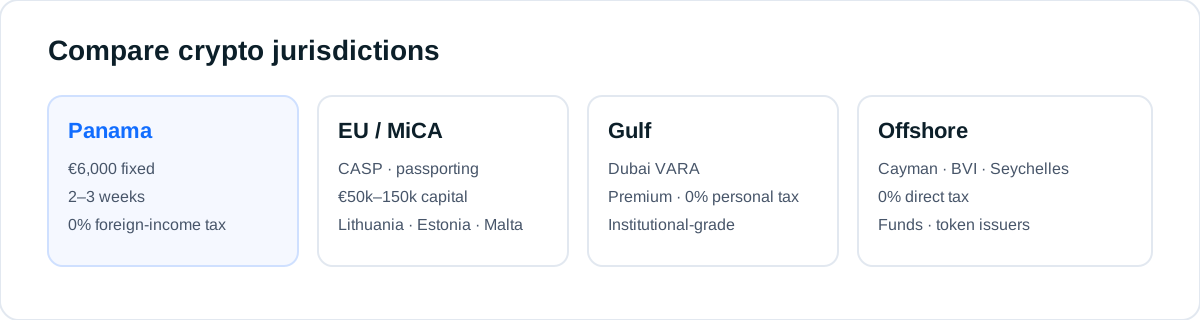
Timeline: 6 to 12 months from application to approval, depending on the NCA's workload and completeness of your submission. Lithuania and Estonia are known for faster processing (3-6 months) but have stricter requirements. Consulting24 provides exact pricing after a detailed assessment of your business. For comparison, a Panama crypto license costs a flat EUR 6,000 and can be obtained in 2-3 months, but it does not provide EU passporting. The MiCA license is a larger investment but opens the entire EU market.
Capital Requirement
MiCA imposes tiered minimum capital requirements based on the type of services offered:
- EUR 50,000 for reception and transmission of orders, execution of orders, advice, portfolio management, and placement (non-underwriting).
- EUR 125,000 for exchange services (crypto-to-fiat or crypto-to-crypto) and custody/administration.
- EUR 150,000 for operating a trading platform.
These are minimums; NCAs may require higher capital based on risk assessment. The capital must be maintained at all times and can be in the form of equity or certain reserves. Consulting24 can help structure your capital to meet these requirements efficiently. For example, if you plan to offer both exchange and custody services, you need EUR 125,000. If you also operate a platform, the EUR 150,000 tier applies. It is possible to hold the capital in a bank account or eligible securities.
Tax Treatment
MiCA does not harmonise tax treatment; taxation remains a national competence. However, many EU member states offer favourable regimes for crypto businesses:
- Lithuania: 15% corporate income tax on profits; no VAT on crypto-to-fiat exchanges; possible exemptions for capital gains on crypto held for more than 12 months.
- Estonia: 0% corporate income tax on retained profits; 20% on distributed profits (dividends); no withholding tax on crypto income.
- Malta: 35% corporate tax but with refunds up to 6/7 for non-residents; no VAT on crypto services.
- Cyprus: 12.5% corporate tax; no capital gains tax on crypto (except for trading).
Tax planning is critical. Consulting24 can connect you with tax advisors who specialise in crypto. Always seek local tax advice as rules can change. For instance, Estonia's deferred tax system can be beneficial for reinvesting profits, while Lithuania offers a straightforward 15% rate.
Allowed Activities Under MiCA
A CASP license permits the following activities, subject to the scope of your authorisation:
- Operating a crypto-asset trading platform (order book, AMM, etc.)
- Exchanging crypto-assets for fiat or other crypto-assets
- Custody and administration of crypto-assets (including wallet services)
- Execution of orders on behalf of clients
- Placement of crypto-assets (with or without firm commitment)
- Reception and transmission of orders
- Providing advice on crypto-assets
- Portfolio management of crypto-assets
Stablecoin issuance (asset-referenced tokens and e-money tokens) requires additional authorisation under MiCA (ART/EMT regime). CASP licensees can also offer ancillary services like staking, lending, and borrowing if properly disclosed. Consulting24 can help define your service scope to match your business plan. For example, if you want to offer staking as a service, you must include it in your application and have appropriate risk disclosures.
Step-by-Step Application Process
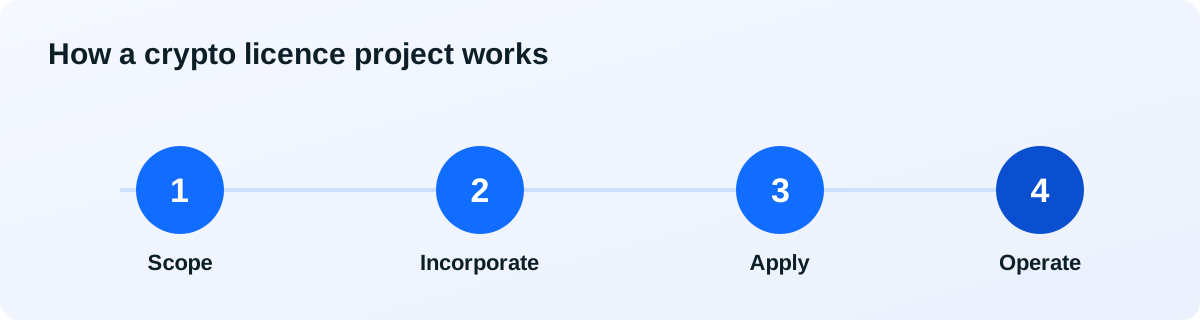
Obtaining a MiCA license involves several stages. Consulting24 advises and coordinates each step:
- Pre-application assessment: Review your business model, services, and target markets to determine the appropriate NCA and capital tier.
- Company incorporation: Establish a legal entity in the chosen EU member state with a registered office and local directors (if required).
- Compliance program: Develop AML/CTF policies, risk assessment, internal controls, and a business continuity plan.
- Capital deposit: Ensure minimum capital is held in a bank account or eligible assets.
- Application submission: Prepare and submit the application form, including governance documents, financial projections, and compliance manuals.
- Review and interview: The NCA reviews the application, may request additional information, and sometimes interviews management.
- Approval and licensing: If successful, the CASP license is granted, and you are added to ESMA's register.
- Ongoing compliance: Submit periodic reports, maintain capital, and undergo audits.
Consulting24 manages the entire process, liaising with the NCA and local advisors. For example, in Lithuania, we have established relationships with the Bank of Lithuania to streamline submissions. The process typically takes 3-6 months in Lithuania, compared to 6-12 months in Germany.
Banking and Payment Services
One of the biggest challenges for crypto firms is securing a bank account. Under MiCA, CASP licensees are considered regulated entities, which makes it easier to open accounts with EU banks. However, many banks still have risk-averse policies. Options include:
- Traditional banks in the licensing country (e.g., Swedbank in Lithuania, LHV in Estonia)
- EMI (Electronic Money Institution) accounts
- Payment service providers (PSPs) like Stripe or Adyen for fiat on/off ramps
- Crypto-friendly banks in Malta, Cyprus, or Germany
Consulting24 can introduce you to banking partners and help prepare the necessary documentation. We also advise on setting up segregated client accounts and custodial arrangements. For instance, many CASP licensees use a combination of a traditional bank for operational accounts and an EMI for faster payment processing. It is important to have a banking relationship before applying, as some NCAs require proof of a bank account.
Benefits of a MiCA License
The MiCA license offers several advantages over national licenses:
- EU-wide passporting: Serve all 27 member states from a single license.
- Harmonised rules: One set of compliance requirements across the EU, reducing complexity.
- Investor confidence: A regulated status attracts institutional clients and partners.
- Access to banking: Easier to open accounts and process payments.
- Legal clarity: Clear rules on stablecoins, market abuse, and disclosures.
- Competitive advantage: First-mover advantage in a regulated market.
Compared to non-EU jurisdictions like Panama, a MiCA license provides credibility and access to a large market. However, the cost and time are higher. Consulting24 helps you weigh the trade-offs. For example, a Panama license costs EUR 6,000 flat and can be obtained quickly, but it does not allow you to serve EU clients without additional registration. Many firms choose Panama for non-EU operations and a MiCA license for EU expansion.
Compliance and Trust
Ongoing compliance under MiCA includes:
- Regular reporting to the NCA (financial, operational, and AML)
- Maintaining minimum capital and own funds
- Conducting annual audits
- Implementing market abuse surveillance (if operating a platform)
- Client asset segregation and custody rules
- Transparency on fees, risks, and conflicts of interest
Failure to comply can result in fines, suspension, or revocation of the license. Consulting24 provides ongoing compliance support and can coordinate with local auditors. This is general guidance, not legal advice. Always consult a qualified lawyer for your specific situation. For example, a common compliance requirement is to have a local AML officer. We help you recruit or train staff to meet this requirement.
Common Mistakes to Avoid
Many applicants make avoidable errors. Here are the most common:
- Underestimating capital requirements: Choosing the wrong capital tier can delay approval. For example, if you plan to offer custody but apply under the EUR 50,000 tier, your application will be rejected.
- Incomplete AML policies: NCAs require detailed, operational AML procedures, not generic templates. Your policies must include customer due diligence, transaction monitoring, and suspicious activity reporting.
- Poor governance structure: Having inexperienced directors or lack of local presence can be a red flag. Many NCAs require at least one local director.
- Ignoring tax obligations: Not planning for VAT, corporate tax, or withholding tax can lead to penalties.
- Choosing the wrong NCA: Some NCAs are backlogged or have stricter interpretations. Consulting24 helps you select the most suitable jurisdiction.
We have seen applications fail due to missing documents or unrealistic business plans. Our pre-application assessment catches these issues early.
Alternatives and Comparisons
While the MiCA license is the gold standard for EU operations, other jurisdictions offer compelling alternatives:
- Panama: A flat fee of EUR 6,000, no minimum capital, and a 2-3 month timeline. Panama is ideal for non-EU clients and as a holding company. However, it does not provide EU passporting. Many firms use Panama for international operations and a MiCA license for Europe.
- Estonia: Estonia's VASP license was popular pre-MiCA, but now it is being phased out for EU-wide CASP. Estonia offers a digital-first environment and fast processing. Consulting24 delivers directly in Estonia.
- Lithuania: Lithuania has a mature crypto licensing regime and is now a popular choice for MiCA CASP applications. The Bank of Lithuania is efficient and transparent. Consulting24 delivers directly in Lithuania.
For a full list of options, see our jurisdictions page. Consulting24 can help you compare and choose the best route for your business. If you are targeting EU clients, a MiCA license is essential. For global operations, a Panama license combined with a MiCA license may be optimal.
Frequently asked questions
What is the difference between a MiCA license and a national VASP license?
A MiCA license (CASP) is an EU-wide passportable license that replaces national VASP regimes. While national VASP licenses only allow you to operate in one country, a CASP license lets you serve all 27 EU member states. MiCA also harmonises capital, conduct, and disclosure rules, making compliance simpler across borders.
How much does a MiCA license cost in total?
Total costs range from EUR 32,000 to EUR 110,000, including application fees (EUR 5,000-30,000), legal advisory (EUR 20,000-60,000), company setup (EUR 2,000-5,000), and AML program development (EUR 5,000-15,000). Exact pricing depends on the member state and complexity of your business. Consulting24 provides a detailed quote after assessment.
What is the minimum capital for a MiCA license?
Minimum capital tiers are EUR 50,000 for basic services (order reception, advice), EUR 125,000 for exchange and custody, and EUR 150,000 for operating a trading platform. These are minimums; NCAs may require more based on risk. Capital must be maintained at all times.
How long does it take to get a MiCA license?
Typically 6 to 12 months from application to approval. In Lithuania or Estonia, processing can be faster (3-6 months) due to efficient NCAs. The timeline depends on the completeness of your application and the NCA's workload. Consulting24 can expedite the process with proper preparation.
Can I use a MiCA license to offer services in all EU countries?
Yes, a CASP license obtained in one EU member state allows passporting to all 27 EU countries. You do not need additional licenses in each country. However, you must notify the NCA of your home member state about your intention to passport.
Do I need a local office for a MiCA license?
Yes, you need a registered office in the EU member state where you apply. Some NCAs also require local directors or a local compliance officer. Consulting24 can help you set up a physical presence and meet these requirements.
What are the tax benefits of a MiCA license in Lithuania?
Lithuania offers a 15% corporate income tax rate, no VAT on crypto-to-fiat exchanges, and potential capital gains exemptions for crypto held over 12 months. This makes it attractive for crypto businesses. Always consult a tax advisor for your specific situation.
Can I get a MiCA license if I am a non-EU company?
Yes, non-EU companies can apply by establishing a subsidiary in an EU member state. The subsidiary must have its registered office and central administration in that state. Consulting24 assists with company incorporation and the application process.
What happens if I operate without a MiCA license in the EU?
Operating without a CASP license when required is illegal and can result in fines, criminal penalties, and being banned from providing services in the EU. NCAs actively monitor and enforce MiCA rules. It is essential to obtain a license before offering services to EU residents.
How does a Panama license compare to a MiCA license?
A Panama license costs a flat EUR 6,000, has no minimum capital, and can be obtained in 2-3 months. However, it does not allow EU passporting. A MiCA license is more expensive and time-consuming but provides access to the entire EU market. Many firms use both: Panama for non-EU operations and MiCA for Europe.
What ongoing compliance is required after obtaining a MiCA license?
Ongoing compliance includes periodic financial and AML reporting, maintaining minimum capital, annual audits, market abuse surveillance (if applicable), and client asset segregation. Failure to comply can lead to fines or license revocation. Consulting24 offers ongoing compliance support.
Can I offer staking or lending with a MiCA license?
Yes, staking, lending, and borrowing can be offered as ancillary services if properly disclosed in your application and risk disclosures. These activities must be clearly described in your compliance policies. Consulting24 can help you include these services in your license scope.
Official sources
Related jurisdictions

Talk to a crypto-licensing expert
500+ licenses across Estonia, Lithuania, Panama and beyond. Tell us your model and we'll map the right route, honestly.
💬 Talk to an expertFree consultationGeneral guidance, not legal advice. Rules and fees evolve, and we confirm current requirements for your case.