Crypto OTC Desk License in Luxembourg (2026): Cost & Setup Desk License Luxembourg: Complete 2026 Guide
Luxembourg has established itself as a leading hub for regulated crypto services in Europe, particularly for institutional-grade over-the-counter (OTC) trading desks. The crypto OTC desk license Luxembourg is a specific authorization under the EU's Markets in Crypto-Assets Regulation (MiCA), fully in force since 2025. This license allows firms to operate an OTC desk for crypto assets, matching buyers and sellers off-exchange, with the credibility of a top-tier financial jurisdiction.
Whether you are a startup or an established financial institution, obtaining a crypto OTC desk license in Luxembourg requires managing the regulatory framework of the Commission de Surveillance du Secteur Financier (CSSF). This page provides a comprehensive overview of the license type, costs, timeline, capital requirements, and step-by-step process. Consulting24 advises and coordinates applications for this license, using our experience across multiple jurisdictions including Panama and other jurisdictions.
What Is a Crypto OTC Desk License in Luxembourg?
A crypto OTC desk license in Luxembourg is a regulatory authorization that permits a company to operate an over-the-counter trading desk for crypto assets. Unlike exchange-based trading, OTC desks facilitate direct trades between counterparties, often for large volumes. Under MiCA, this activity falls under the category of "execution of orders on behalf of clients" or "dealing on own account," depending on the business model. The CSSF is the competent authority responsible for licensing and supervision.
This license is essential for firms that want to offer crypto OTC services to institutional clients, high-net-worth individuals, or other businesses. It demonstrates compliance with anti-money laundering (AML) regulations, capital adequacy, and operational standards. Luxembourg's regulatory environment is particularly attractive due to its stability, EU passporting rights, and reputation as a global financial center. For example, a firm executing large block trades for pension funds would use this license to ensure regulatory compliance and client trust.
Who Needs a Crypto OTC Desk License in Luxembourg?
Any entity that wishes to provide OTC crypto trading services to clients in Luxembourg or across the EU should consider this license. Typical applicants include:
- Fintech startups focusing on institutional crypto trading
- Existing brokerage firms expanding into digital assets
- Family offices or asset managers offering crypto OTC services
- Banks and investment firms diversifying into crypto
If your business involves matching buyers and sellers of crypto assets off-exchange, or if you act as a principal in crypto trades, you likely need this license. Even if you operate from outside the EU, serving EU clients triggers the requirement under MiCA. Consulting24 can help assess whether this license suits your business model. For instance, a US-based OTC desk serving European institutional clients would need a Luxembourg license to comply with MiCA.
License Type and Regulator
The crypto OTC desk license in Luxembourg is a type of Crypto-Asset Service Provider (CASP) authorization under MiCA. The specific service classification is typically "execution of orders on behalf of clients" (Article 3(1)(9) of MiCA) or "dealing on own account" (Article 3(1)(10)). The regulator is the Commission de Surveillance du Secteur Financier (CSSF), which oversees all financial services in Luxembourg.
The CSSF has implemented MiCA requirements, including fit and proper assessments of management, operational resilience, and investor protection measures. The license is passportable across the EU, meaning once obtained, you can serve clients in other member states without additional licensing. This makes Luxembourg an excellent base for pan-European OTC operations. The CSSF also requires firms to have a local presence, including a registered office and at least one director resident in Luxembourg.
Cost and Timeline
The cost and timeline for a crypto OTC desk license in Luxembourg vary based on complexity and the applicant's readiness. Below is an indicative table based on current 2026 figures:
| Item | Estimated Cost (EUR) | Timeline |
|---|---|---|
| Application fee to CSSF | 3,000 - 5,000 | Upfront |
| Professional fees (legal, compliance, advisory) | 30,000 - 60,000 | Throughout process |
| Capital requirement (minimum) | 50,000 - 150,000 (depends on service class) | Held continuously |
| Total estimated cost (excluding capital) | 35,000 - 70,000 | 4 - 8 months |
Exact pricing is confirmed during a consultation. The timeline depends on the completeness of documentation and CSSF review. Consulting24 advises and coordinates the application to streamline the process. For example, a well-prepared application with all documents in order could be approved in 4 months, while complex cases may take up to 8 months.
Capital Requirement
Under MiCA, the minimum capital requirement for CASPs depends on the type of services provided. For crypto OTC desks, the relevant tiers are:
- EUR 50,000 for execution of orders on behalf of clients (if no custody of client funds)
- EUR 125,000 for dealing on own account
- EUR 150,000 for combined services including custody
These are minimums; the CSSF may require higher capital based on the volume and risk profile. Capital must be held in liquid assets and is subject to ongoing monitoring. Consulting24 can help structure your capital allocation to meet regulatory expectations. For instance, a firm dealing on own account with high trading volumes may need to hold EUR 200,000 or more to satisfy the CSSF's risk assessment.
Tax Treatment
Luxembourg offers a favorable tax regime for crypto OTC desks. Corporate income tax is generally 24.94% (including solidarity surcharge). However, specific tax treatment depends on the nature of income (trading gains, fees, etc.). Crypto-to-crypto trades may be subject to VAT exemption under EU VAT rules for financial services. Luxembourg has also introduced a specific tax framework for crypto assets, treating them as intangible assets for corporate tax purposes.
It is essential to obtain local tax advice to optimize your structure. Consulting24 coordinates with local tax experts to ensure compliance. Note that tax laws are subject to change; always consult a professional. For example, trading gains from crypto assets held for less than six months may be treated as ordinary income, while longer-term holdings could qualify for capital gains treatment.
Allowed Activities
The crypto OTC desk license in Luxembourg permits the following activities under MiCA:
- Execution of orders for crypto assets on behalf of clients (matching buyers and sellers)
- Dealing on own account (trading as principal)
- Reception and transmission of orders (if ancillary)
- Providing custody of crypto assets (if included in the license scope)
Activities not covered include operating a crypto exchange (order book matching), which requires a separate license. Additionally, the license does not permit offering derivatives or securities unless the firm holds a relevant MiFID license. The CSSF may impose conditions on the scope of activities. For example, a firm licensed for execution of orders cannot also operate a custody service without amending its license.
Step-by-Step Application Process
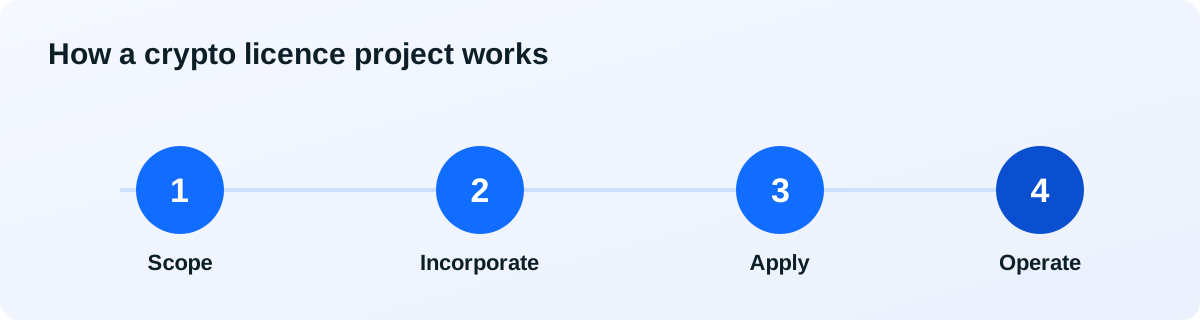
Obtaining a crypto OTC desk license in Luxembourg involves several stages. Consulting24 advises and coordinates each step:
- Pre-assessment: Evaluate your business model, identify the correct service classification, and assess readiness.
- Company incorporation: Set up a Luxembourg company (SARL or SA) with a registered office and local management.
- Documentation: Prepare a business plan, AML/CFT policies, risk management framework, and operational procedures.
- Fit and proper checks: Submit personal questionnaires for directors and shareholders.
- Capital verification: Deposit the required capital in a Luxembourg bank account.
- Application submission: File the application with CSSF including all supporting documents.
- CSSF review: The regulator may request additional information or clarifications.
- Approval: Once satisfied, the CSSF grants the license. The entire process typically takes 4-8 months.
Consulting24 provides end-to-end support, from company setup to regulatory liaison. For example, we help draft the AML policy and coordinate with local notaries for incorporation.
Banking and Payment Services
Opening a bank account for a crypto OTC desk in Luxembourg can be challenging due to compliance concerns. However, Luxembourg has several banks that are crypto-friendly, including Banque de Luxembourg, BIL, and some fintech-focused banks. Requirements typically include:
- Proof of license or application status
- AML/CFT policies
- Source of funds documentation
- Business plan and financial projections
Consulting24 can introduce you to banking partners and assist with account opening. Additionally, payment service providers (PSPs) like Satispay or Modulr can be integrated for fiat on/off ramps. For example, a client may open a corporate account with Banque de Luxembourg after submitting the CSSF application, ensuring smooth fiat operations.
Benefits of a Luxembourg Crypto OTC Desk License
Choosing Luxembourg for your crypto OTC desk offers several advantages:
- EU passporting: Serve clients across the EU without additional licenses.
- Regulatory credibility: CSSF supervision is highly regarded globally.
- Stable legal environment: Luxembourg has a well-established financial regulatory framework.
- Tax efficiency: Competitive corporate tax rate and potential VAT exemptions.
- Access to talent: Luxembourg has a skilled workforce in finance and technology.
These benefits make Luxembourg a top choice for institutional crypto OTC operations. Compared to other jurisdictions like Panama, Luxembourg offers a more regulated and passportable license, albeit at a higher cost. For firms targeting EU clients, the passporting benefit alone can justify the investment.
Compliance and Ongoing Obligations
Once licensed, crypto OTC desks must adhere to ongoing compliance requirements:
- Annual AML/CFT audits and reporting
- Regular capital adequacy monitoring
- Transaction reporting to the CSSF
- Annual financial statement submission
- Fit and proper updates for management changes
Failure to comply can result in fines or license revocation. Consulting24 provides ongoing compliance support to ensure you meet all obligations. This information is general guidance, not legal advice. For example, firms must submit quarterly transaction reports detailing volumes and counterparties, which we help prepare.
Common Mistakes to Avoid
Applicants often make these errors when applying for a crypto OTC desk license in Luxembourg:
- Underestimating capital requirements: Ensure you have sufficient liquid capital.
- Inadequate AML policies: CSSF scrutinizes AML frameworks closely.
- Poor documentation: Incomplete or inconsistent applications cause delays.
- Ignoring local presence: You need a registered office and local management.
- Choosing the wrong service class: Misclassification can lead to rejection.
Consulting24 helps you avoid these pitfalls by providing expert guidance throughout the process. For instance, we have seen applications rejected because the business plan did not clearly define the service class.
Alternatives and Comparisons
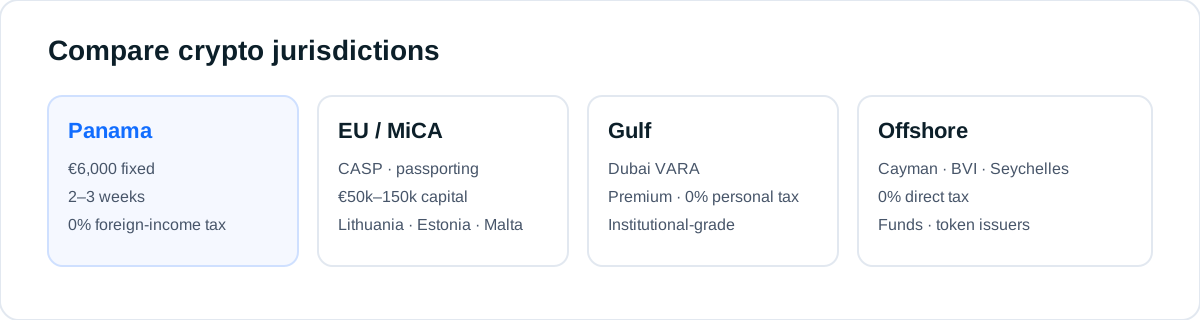
While Luxembourg is a strong choice, other jurisdictions may suit different needs. Here is a comparison:
| Jurisdiction | License Type | Minimum Capital | Timeline | Cost (approx.) |
|---|---|---|---|---|
| Luxembourg | CASP (OTC desk) | EUR 50,000 - 150,000 | 4-8 months | EUR 35,000 - 70,000 |
| Panama | No specific crypto license | None | 2-4 weeks | EUR 6,000 flat |
| Lithuania | CASP (under MiCA) | EUR 125,000 | 3-6 months | EUR 20,000 - 40,000 |
Panama offers a faster and cheaper option but without EU passporting. Lithuania is another EU alternative with lower costs but a less established reputation. Consulting24 can advise on the best fit for your business. For more details, see our comparison with Lithuania and Lithuania crypto license page.
Frequently asked questions
What is the difference between a crypto OTC desk license and a crypto exchange license in Luxembourg?
An OTC desk license allows off-exchange matching of buyers and sellers, typically for large volumes, while an exchange license permits order-book trading. Under MiCA, these are separate service classifications. The OTC desk license is suitable for institutional block trades, whereas an exchange license is for retail or continuous trading.
How long does it take to get a crypto OTC desk license in Luxembourg?
The process typically takes 4 to 8 months from application to approval, depending on the completeness of documentation and CSSF review. Pre-incorporation and document preparation can add 1-2 months. Consulting24 can help streamline the process.
What is the minimum capital required for a crypto OTC desk license in Luxembourg?
Under MiCA, the minimum capital is EUR 50,000 for execution of orders (no custody), EUR 125,000 for dealing on own account, and EUR 150,000 for combined services including custody. The CSSF may require higher capital based on risk profile.
Can I passport the Luxembourg crypto OTC desk license to other EU countries?
Yes, once licensed by the CSSF, you can provide services across the EU under the MiCA passporting regime without additional licensing. This is a key advantage of Luxembourg.
What are the ongoing compliance obligations after obtaining the license?
Obligations include annual AML audits, capital adequacy monitoring, transaction reporting to the CSSF, financial statement submissions, and fit and proper updates for management changes. Non-compliance can lead to fines or revocation.
Is it possible to apply for a crypto OTC desk license without a local presence in Luxembourg?
No, you must have a registered office in Luxembourg and at least one director resident in the country. The CSSF requires a local physical presence for supervision purposes.
What activities are not allowed under a crypto OTC desk license?
Operating a crypto exchange (order book matching), offering derivatives or securities (requires MiFID license), and providing custody without authorization are not permitted. The license scope is limited to OTC trading activities.
How does the tax treatment differ for crypto OTC desks in Luxembourg compared to Panama?
Luxembourg has a corporate tax rate of 24.94% and VAT exemptions for financial services, while Panama has no corporate tax on offshore income and no capital gains tax. However, Panama lacks EU passporting and regulatory credibility. The choice depends on your target market.
Can Consulting24 help with the application if I am not based in the EU?
Yes, Consulting24 advises and coordinates applications for non-EU clients. We help with company incorporation, documentation, and liaison with the CSSF. We also assist with banking and local presence requirements.
What is the success rate for crypto OTC desk license applications in Luxembourg?
The success rate is high for well-prepared applications. Common reasons for rejection include incomplete documentation, inadequate AML policies, and insufficient capital. Consulting24's expertise minimizes these risks.
Are there any restrictions on the types of crypto assets that can be traded under this license?
Under MiCA, only crypto assets that qualify as "crypto-assets" (not securities or e-money) can be traded. Stablecoins and utility tokens are generally permitted, but security tokens may require a MiFID license. The CSSF provides guidance on asset classification.
How does the cost of a Luxembourg crypto OTC desk license compare to other EU jurisdictions?
Luxembourg is more expensive than Lithuania (EUR 20,000-40,000) but offers a stronger reputation and faster processing in some cases. Estonia and Malta have lower costs but may have longer timelines. Consulting24 can provide a detailed cost comparison.
Official sources
Related jurisdictions

Talk to a crypto-licensing expert
500+ licenses across Estonia, Lithuania, Panama and beyond. Tell us your model and we'll map the right route, honestly.
💬 Talk to an expertFree consultationGeneral guidance, not legal advice. Rules and fees evolve, and we confirm current requirements for your case.