Portugal Crypto License: A Complete Guide for 2026
Portugal has become a sought-after destination for crypto businesses due to its favorable tax regime and clear regulatory framework. As of 2026, the country operates under the EU's Markets in Crypto-Assets (MiCA) regulation, which harmonizes licensing across member states. This page provides a comprehensive overview of the Portugal crypto license, covering the regulator, capital requirements, tax treatment, allowed activities, and the step-by-step application process.
Whether you are a startup or an established exchange, understanding the nuances of Portugal's regime is critical. Consulting24 advises and coordinates crypto licensing in Portugal, using our experience from 500+ successful licenses in other jurisdictions. We help you get through the requirements and compare Portugal with other options like Panama and Lithuania.
What Is the Portugal Crypto License?
The Portugal crypto license is a regulatory authorization required for crypto-asset service providers (CASPs) operating in or from Portugal. Under MiCA, which is fully in force in 2026, all EU member states including Portugal must license CASPs under a harmonized framework. The license is issued by the Banco de Portugal (the central bank) as the competent authority, with additional oversight from the Portuguese Securities Market Commission (CMVM) for certain activities.
This license replaces the previous regime where firms only registered with the Banco de Portugal without a full licensing process. Now, CASPs must meet strict capital, governance, and operational requirements to obtain and maintain the license. The license allows firms to offer services such as custody, exchange, and transfer of crypto-assets across the EU under passporting rights. For example, a Portuguese-licensed exchange can serve clients in Germany or France without needing separate licenses, as long as it complies with local consumer protection rules.
Portugal's approach under MiCA is seen as balanced, offering regulatory clarity while encouraging innovation. The Banco de Portugal has issued guidelines on how it interprets MiCA provisions, including specific expectations for risk management and cybersecurity. Firms must also adhere to the EU's Travel Rule for crypto transfers, requiring the collection and sharing of originator and beneficiary information for transactions above a certain threshold.
Who Needs a Portugal Crypto License?
Any legal entity that provides crypto-asset services to clients in Portugal or from Portugal needs this license. This includes:
- Crypto exchanges (fiat-to-crypto and crypto-to-crypto)
- Custodial wallet providers
- Crypto-asset transfer services
- Platforms for crypto-asset trading (order books, DEXs if they have control)
- Advisors or portfolio managers dealing with crypto-assets
- Issuers of asset-referenced tokens or e-money tokens (also subject to CMVM)
Foreign firms targeting Portuguese clients must also obtain a license or passport from another EU member state. If you are unsure whether your activities fall under the scope, Consulting24 can review your business model and advise on the best jurisdictions for your needs. For instance, a company offering non-custodial wallet software may not need a license if it does not hold client keys, but providing a hosted wallet service would require one.
Even businesses that do not directly serve Portuguese clients but have a branch or marketing activities in Portugal may trigger licensing requirements. The Banco de Portugal has indicated that it will assess substance and actual operations, not just legal registration.
License Type and Regulator
The Portugal crypto license is a CASP license under MiCA. The primary regulator is the Banco de Portugal, responsible for authorization and supervision of most crypto-asset services. The CMVM oversees services that involve asset-referenced tokens or e-money tokens. The application is submitted via the Banco de Portugal's online portal, which was updated in early 2026 to handle MiCA applications.
The license is valid throughout the EU once granted, thanks to the MiCA passport. Firms must also comply with anti-money laundering (AML) and counter-terrorist financing (CTF) obligations, which are enforced by the Banco de Portugal and the Financial Intelligence Unit. The regulator conducts ongoing supervision, including periodic reporting and on-site inspections.
Portugal has also established a sandbox for innovative fintech solutions, but for most commercial operations, the full CASP license is required. Consulting24 coordinates the application process, ensuring that all regulatory expectations are met. Our team has extensive experience with the Banco de Portugal's requirements, having handled multiple applications in other EU jurisdictions.
Cost and Timeline
The cost of obtaining a Portugal crypto license varies depending on the complexity of the application, the services offered, and the need for external consultants. Below is a typical breakdown:
| Item | Estimated Cost (EUR) |
|---|---|
| Application fee (Banco de Portugal) | 2,000 - 5,000 |
| Legal and compliance setup | 10,000 - 30,000 |
| AML/CTF program development | 5,000 - 15,000 |
| Business plan and financial projections | 3,000 - 8,000 |
| IT security audit and documentation | 5,000 - 15,000 |
| Total estimated cost | 25,000 - 73,000 |
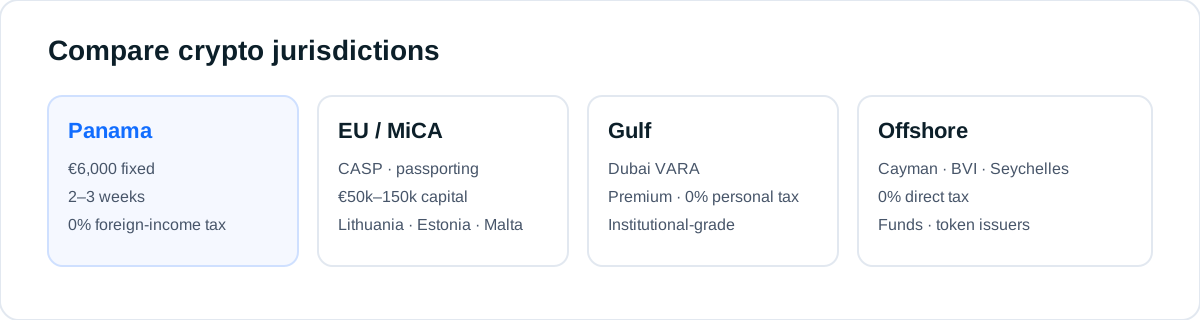
The timeline from preparation to approval is typically 6 to 12 months, depending on the completeness of the application and the regulator's workload. Consulting24 coordinates the process, ensuring all documents are in order to avoid delays. For exact pricing based on your specific case, book a consultation. In comparison, Panama offers a flat fee of EUR 6,000 with a 2-4 month timeline, making it a faster and cheaper alternative.
Capital Requirement
Under MiCA, Portugal applies tiered capital requirements based on the services offered:
- EUR 50,000 for simple services like custody and transfer of crypto-assets
- EUR 125,000 for exchange services (fiat-to-crypto or crypto-to-crypto)
- EUR 150,000 for more complex services including trading platforms and portfolio management
These amounts must be maintained as own funds throughout the license period. Capital can be in cash or high-quality liquid assets, such as government bonds. The regulator may require additional capital if the firm's risk profile is higher, for example, if it handles large volumes or complex derivatives. Firms must also have professional indemnity insurance or a similar guarantee for at least EUR 1 million per claim, which is a separate cost.
Consulting24 can help structure your capital to meet these requirements efficiently. We advise on the optimal mix of equity and reserves, and assist in preparing the capital adequacy documentation required by the Banco de Portugal.
Tax Treatment
Portugal offers a favorable tax regime for crypto businesses and investors. As of 2026, capital gains from crypto-assets held for more than one year are tax-exempt for individuals. For businesses, corporate income tax (IRC) applies at a standard rate of 21%, with reduced rates for small and medium enterprises (17% on the first EUR 50,000 of taxable income). VAT is generally not applied to crypto-asset transactions, as they are treated as exempt financial services.
However, tax treatment can vary based on the specific activity and entity structure. For example, mining income may be treated as business income, while staking rewards could be considered capital gains. Portugal also has a participation exemption regime that can apply to dividends and capital gains from subsidiaries. Consulting24 recommends consulting with a local tax advisor to optimize your tax position. We can connect you with trusted partners in Portugal who specialize in crypto taxation.
Allowed Activities
A Portugal crypto license permits the following activities under MiCA:
- Custody and administration of crypto-assets on behalf of clients
- Operation of a trading platform for crypto-assets
- Exchange of crypto-assets for fiat currency or other crypto-assets
- Execution of orders for crypto-assets on behalf of clients
- Placement of crypto-assets
- Receiving and transmitting orders for crypto-assets
- Providing advice on crypto-assets
- Portfolio management of crypto-assets
- Transfer services for crypto-assets
Each activity may require additional permissions or compliance measures. For instance, operating a trading platform may require market abuse surveillance systems. Firms can apply for multiple service categories, but the capital requirement will be based on the highest tier among the services offered. Consulting24 can help define your service scope to match the license and ensure you do not inadvertently offer unlicensed services.
Step-by-Step Application Process
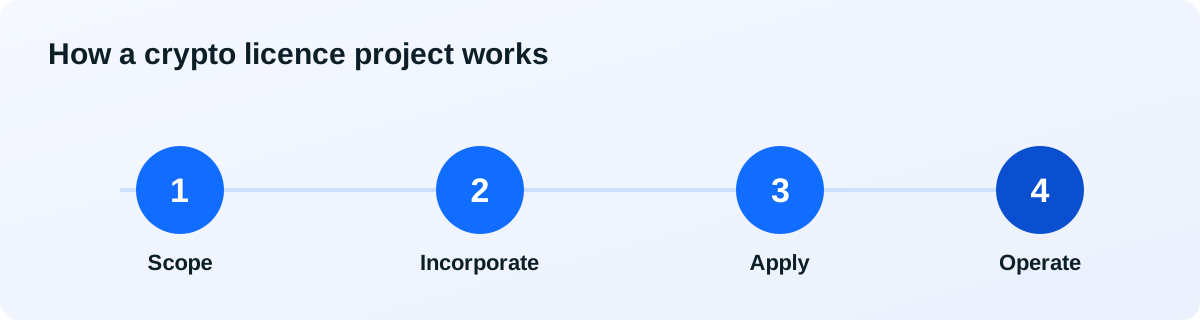
The process to obtain a Portugal crypto license involves several stages:
- Pre-application preparation: Define your business model, prepare a detailed business plan, AML/CTF policies, risk assessment, and governance structure. This stage takes 2-4 months.
- Submission of application: Submit the application via the Banco de Portugal's online platform, including all required documentation and payment of the application fee. The regulator acknowledges receipt within 10 business days.
- Review and due diligence: The regulator reviews the application, conducts background checks on key personnel, and may request additional information. This phase typically takes 3-6 months.
- On-site inspection (if required): The Banco de Portugal may conduct an on-site visit to verify operational readiness, including IT systems and physical premises.
- Decision: The regulator issues a decision within 6-12 months of submission. If approved, the license is granted with conditions, such as reporting obligations.
- Post-licensing compliance: Ongoing reporting, AML/CTF compliance, and capital maintenance are required. Annual fees apply, typically EUR 1,000-3,000.
Consulting24 advises and coordinates each step, ensuring a smooth process. We also offer support for company setup in Portugal, including registered address and local director services.
Banking and Payments
Opening a bank account for a crypto business in Portugal can be challenging, but several banks now accept licensed CASPs. Major banks like Millennium BCP, Santander, and Novo Banco have crypto-friendly policies for licensed entities. Additionally, Portugal has a growing number of fintech and payment institutions that offer dedicated crypto business accounts, such as ClearBank and Railsbank.
Consulting24 can assist in introducing you to banking partners and preparing the necessary documentation, including the license certificate, business plan, and AML policies. We also advise on alternative payment solutions such as e-money institutions and crypto-friendly neobanks. For example, a Portuguese-licensed exchange can integrate with SEPA for fiat transfers, which is essential for serving European clients.
If banking proves difficult, some firms choose to operate with a payment institution license in addition to the CASP license. Consulting24 can advise on the best approach for your specific needs.
Benefits of a Portugal Crypto License
Choosing Portugal for your crypto license offers several advantages:
- Favorable tax regime: Exemption on long-term capital gains for individuals and competitive corporate tax rates (21% standard, 17% for SMEs).
- EU passporting: License allows operations across all EU member states without additional licensing.
- Stable regulatory environment: Clear rules under MiCA with a proactive regulator that provides guidance.
- Growing crypto ecosystem: Portugal has a vibrant community of crypto startups, events like the Lisbon Blockchain Conference, and a skilled workforce.
- Quality of life: High standard of living, good infrastructure, and attractive for talent, with a relatively low cost of living compared to other Western European countries.
Compared to other jurisdictions, Portugal offers a balanced mix of regulatory clarity and tax efficiency. For a simpler and faster option, consider Panama with a flat fee of EUR 6,000 and no capital requirement. However, Panama does not offer EU passporting.
Compliance and Trust
Maintaining a Portugal crypto license requires ongoing compliance with AML/CTF regulations, regular reporting to the Banco de Portugal, and periodic audits. Firms must appoint a compliance officer, conduct employee training, and implement transaction monitoring systems. Non-compliance can lead to fines, suspension, or revocation of the license. The regulator has the power to impose penalties of up to EUR 5 million or 10% of annual turnover for serious breaches.
Consulting24 provides compliance advisory services to help you meet these obligations. We emphasize that this is general guidance, not legal advice, and recommend engaging local legal counsel for specific compliance matters. Our track record of 500+ licenses demonstrates our commitment to regulatory excellence. We also offer ongoing compliance support, including AML training and reporting templates.
Common Mistakes to Avoid
When applying for a Portugal crypto license, avoid these common pitfalls:
- Incomplete documentation: Failing to provide a comprehensive business plan or AML policies can cause delays. Ensure all documents are translated into Portuguese if required.
- Underestimating capital requirements: Ensure you have the required capital in place before applying, and that it is held in a suitable form.
- Ignoring tax obligations: Even with exemptions, proper tax reporting is mandatory. Portugal has a strict tax authority (Autoridade Tributária) that audits crypto firms.
- Choosing the wrong service scope: Select the correct license category for your activities. Adding services later may require a new application.
- Poor governance: Regulators scrutinize the fitness of directors and shareholders. Ensure all key personnel have clean backgrounds and relevant experience.
- Not preparing for on-site inspections: The Banco de Portugal may visit your premises. Have your IT systems and physical security ready.
Consulting24 helps you avoid these mistakes by preparing a thorough application package and conducting a pre-submission audit.
Alternatives and Comparison
Portugal is one of several options for crypto licensing. Below is a comparison with other popular jurisdictions:
| Jurisdiction | Capital Required | Timeline | Tax | EU Passport |
|---|---|---|---|---|
| Portugal | EUR 50,000 - 150,000 | 6-12 months | Favorable (21% CIT, capital gains exemption) | Yes |
| Panama | None (EUR 6,000 flat fee) | 2-4 months | Territorial tax (no tax on foreign income) | No |
| Lithuania | EUR 125,000 (MiCA) | 3-6 months | 15% CIT | Yes |
| Estonia | EUR 100,000 (MiCA) | 3-6 months | 20% CIT (distributed profits) | Yes |
For firms that prioritize speed and low cost, Panama is an excellent alternative. For EU market access, Lithuania offers a faster timeline than Portugal, while Estonia has a unique tax system on distributed profits. Consulting24 can help you compare these options and choose the best fit for your business. We deliver directly in Estonia, Lithuania, and Panama, and advise on Portugal.
Why Choose Consulting24 for Portugal Crypto Licensing?
Consulting24 has obtained over 500 crypto licenses across multiple jurisdictions, including Estonia, Lithuania, and Panama. While we do not directly handle Portugal applications, we advise and coordinate with local partners to ensure a smooth process. Our services include:
- Initial assessment of your business model and suitability for Portugal
- Preparation of application documents, including business plans and AML policies
- Liaison with Banco de Portugal and local legal counsel
- Post-licensing compliance support
- Comparison with other jurisdictions to find the most cost-effective route
We believe in transparency and will provide a fixed quote after an initial consultation. Our team is available on WhatsApp for quick questions. Book a consultation to discuss your project.
Frequently asked questions
What is the minimum capital required for a Portugal crypto license?
Under MiCA, the minimum capital is EUR 50,000 for custody and transfer services, EUR 125,000 for exchange services, and EUR 150,000 for trading platforms and portfolio management. These amounts must be maintained as own funds.
How long does it take to get a Portugal crypto license?
The typical timeline is 6 to 12 months from application submission to approval. This includes preparation, review, and potential on-site inspections. Consulting24 can help streamline the process.
What taxes apply to crypto businesses in Portugal?
Corporate income tax is 21% (17% for SMEs on first EUR 50,000). Capital gains for individuals are tax-exempt if held over one year. VAT is generally not applied to crypto transactions.
Can I passport a Portugal crypto license to other EU countries?
Yes, under MiCA, a Portugal CASP license allows you to provide services across the EU without additional licensing, subject to notification requirements.
What activities are allowed under a Portugal crypto license?
Allowed activities include custody, exchange, transfer, order execution, advice, portfolio management, and operation of trading platforms. Each activity may have specific requirements.
Is Portugal a good jurisdiction for crypto startups?
Yes, due to its favorable tax regime, EU passporting, and growing ecosystem. However, the timeline and capital requirements may be higher than alternatives like Panama.
Does Consulting24 handle Portugal crypto license applications directly?
Consulting24 advises and coordinates Portugal applications through local partners. We deliver directly in Estonia, Lithuania, and Panama. We help you choose the best jurisdiction.
What are the ongoing compliance obligations for a Portugal crypto license?
Ongoing obligations include AML/CTF reporting, annual audits, capital maintenance, and periodic regulatory submissions. Non-compliance can result in fines or license revocation.
Can I open a bank account for my crypto business in Portugal?
Yes, licensed CASPs can open accounts with banks like Millennium BCP and Santander. Consulting24 can assist with introductions and documentation.
How does Portugal compare to Panama for crypto licensing?
Portugal offers EU passporting and a favorable tax regime but requires higher capital (EUR 50k-150k) and takes longer (6-12 months). Panama costs EUR 6,000 flat, no capital, and takes 2-4 months, but no EU passport.
Official sources

Talk to a crypto-licensing expert
500+ licenses across Estonia, Lithuania, Panama and beyond. Tell us your model and we'll map the right route, honestly.
💬 Talk to an expertFree consultationGeneral guidance, not legal advice. Rules and fees evolve, and we confirm current requirements for your case.