Mauritius Crypto License: Everything You Need to Know
Mauritius has positioned itself as a leading crypto-friendly jurisdiction in Africa and the Indian Ocean. The Financial Services Commission (FSC) regulates virtual assets under the Virtual Asset and Initial Token Offering Services Act 2021 (VAITOS Act). This framework provides a clear, secure path for crypto businesses to operate legally and transparently.
Whether you are launching a crypto exchange, wallet service, or token offering, the Mauritius crypto license offers a credible regulatory home. At Consulting24, we advise and coordinate your application process, drawing on our deep experience across 500+ licenses in jurisdictions like Estonia, Lithuania, and Panama. While we do not deliver the Mauritius license directly, we guide you through every step and help you compare it with other options such as Panama.
The FSC's approach balances innovation with investor protection. Licensees must meet capital requirements, implement strong governance, and submit regular reports. The FSC maintains a public register of licensed entities, enhancing trust with partners and clients.
What is the Mauritius Crypto License?
The Mauritius crypto license is a regulatory authorisation issued by the FSC under the VAITOS Act. It allows businesses to offer virtual asset services, including exchange, custody, and token issuance, in compliance with anti-money laundering (AML) and counter-terrorism financing (CTF) rules.
The regime is designed to balance innovation with investor protection. Licensees must meet capital requirements, implement strong governance, and submit regular reports. The FSC maintains a public register of licensed entities, enhancing trust with partners and clients.
Mauritius is not a member of the European Union, so it is not subject to MiCA. However, its framework aligns with FATF recommendations, making it a respected jurisdiction for global crypto operations. The FSC has issued over 30 licenses since 2022, covering exchanges, custodians, and token issuers. For example, a typical exchange license allows matching orders for fiat-to-crypto and crypto-to-crypto pairs, with mandatory segregation of client assets. The regulator also requires licensees to have a local office with at least two employees, including a compliance officer.
Compared to Estonia or Lithuania, Mauritius offers a non-EU alternative with lower operational costs and a favourable tax regime. However, the application process is more document-intensive, requiring detailed business plans, financial projections, and AML policies.
Who Needs a Mauritius Crypto License?
Any entity providing virtual asset services in or from Mauritius must hold a license. This includes:
- Crypto exchanges (centralised and peer-to-peer)
- Digital wallet providers (custodial and non-custodial)
- Token issuers (ICOs/STOs)
- Custodians of virtual assets
- Brokers and dealers in virtual assets
- Virtual asset transfer services (including payment processors)
If you plan to serve African markets or seek a credible offshore jurisdiction with English common law, Mauritius is a strong candidate. The license also suits businesses that want a stepping stone to more complex regimes like Dubai or Switzerland. For example, a fintech startup targeting remittances between Europe and Africa might use Mauritius as a base due to its time zone alignment and double taxation treaties.
Businesses that only provide software development or consulting without handling client assets may not need a license, but the FSC recommends a preliminary assessment. Consulting24 offers a free initial consultation to determine if your activities fall under VAITOS.
License Type and Regulator
The regulator is the Financial Services Commission (FSC) of Mauritius. The VAITOS Act defines two main categories:
| Category | Scope |
|---|---|
| Virtual Asset Service Provider (VASP) | Exchange, transfer, custody, and administration of virtual assets |
| Initial Token Offering (ITO) Service Provider | Issuance and management of token offerings |
Both categories require a physical presence in Mauritius, including a registered office and at least one director resident in Mauritius. The FSC conducts fit-and-proper checks on all key personnel, including shareholders with more than 10% ownership. The FSC also requires a local compliance officer who is a resident of Mauritius and has relevant experience in AML/CTF.
In 2024, the FSC introduced a sandbox regime for innovative projects, allowing limited operations without a full license for up to 12 months. However, most commercial operations require a standard license. The FSC publishes a list of licensed entities on its website, which is updated quarterly.
Cost and Timeline
The total cost for a Mauritius crypto license varies based on the service scope and professional fees. Below is a typical breakdown:
| Item | Estimated Cost (EUR) |
|---|---|
| FSC application fee | 2,500 - 5,000 |
| Legal and compliance advisory | 10,000 - 20,000 |
| Company incorporation (including registered office and local director) | 1,500 - 3,000 |
| Annual compliance and audit | 5,000 - 10,000 |
| Bank account opening assistance | 1,000 - 2,000 |
The process takes approximately 3 to 6 months, depending on the completeness of your application and the FSC's workload. Delays often occur if the FSC requests additional information on AML policies or source of funds. Consulting24 advises and coordinates your application to streamline the timeline. For a fixed-price alternative, consider Panama at EUR 6,000 flat, which typically takes 1-2 months.
Ongoing costs include annual FSC fees (approximately EUR 1,000), compliance officer salary (EUR 12,000-18,000 per year for a local hire), and audit fees. The total annual cost of compliance is typically EUR 15,000-25,000.
Capital Requirement
The VAITOS Act does not prescribe a fixed minimum capital in the law itself. However, the FSC requires applicants to demonstrate adequate financial resources based on the nature and scale of operations. In practice, a minimum capital of EUR 50,000 to 100,000 is typical for a standard VASP license. This amount must be maintained as paid-up capital and may be held in a bank account in Mauritius.
For ITO service providers, the capital requirement may be higher, reflecting the greater risk profile. The FSC assesses each application on a case-by-case basis. For example, a startup planning to hold client assets in custody may need EUR 100,000, while a pure exchange platform might be approved with EUR 50,000. Consulting24 can help you prepare a strong financial plan to meet the regulator's expectations.
Capital can be in the form of cash or liquid assets. The FSC does not accept cryptocurrencies as capital. Licensees must also maintain professional indemnity insurance of at least EUR 1 million.
Tax Treatment
Mauritius offers a favourable tax regime for licensed crypto businesses. The corporate tax rate is a flat 15%, with a partial exemption system that can reduce the effective rate to as low as 3% for certain foreign-source income. There is no capital gains tax, no withholding tax on dividends, and no VAT on digital services.
Mauritius has an extensive network of double taxation agreements (DTAs) with over 40 countries, which can further optimise your global tax position. However, tax planning must comply with the OECD's Base Erosion and Profit Shifting (BEPS) requirements. Always seek local tax advice.
For example, a crypto exchange earning fees from clients in the UK could benefit from the DTA to avoid double taxation. Additionally, the Global Business Licence (GBL) regime, which many crypto companies use, offers a reduced tax rate of 3% on foreign-source income that meets substance requirements. The FSC and the Mauritius Revenue Authority coordinate to ensure compliance.
Allowed Activities
A Mauritius crypto license permits a wide range of activities, including:
- Operating a virtual asset exchange (order book, OTC, P2P)
- Providing custodial and non-custodial wallet services
- Issuing and managing token offerings (ITO/STO)
- Transferring virtual assets on behalf of clients
- Advisory services on virtual assets
- Staking and lending (subject to FSC approval)
Activities not allowed include gambling-related tokens, privacy coins (unless explicitly approved), and services that violate international sanctions. The FSC also prohibits commingling client assets with operational funds without proper segregation. For example, a platform that offers margin trading must hold additional capital to cover potential losses. The FSC may also restrict certain high-risk activities for new licensees, with a phased approach to expanding services.
If you plan to offer derivatives or futures on virtual assets, you may need a separate license under the Securities Act. Consulting24 can help you scope your activities correctly.
Step-by-Step Application Process
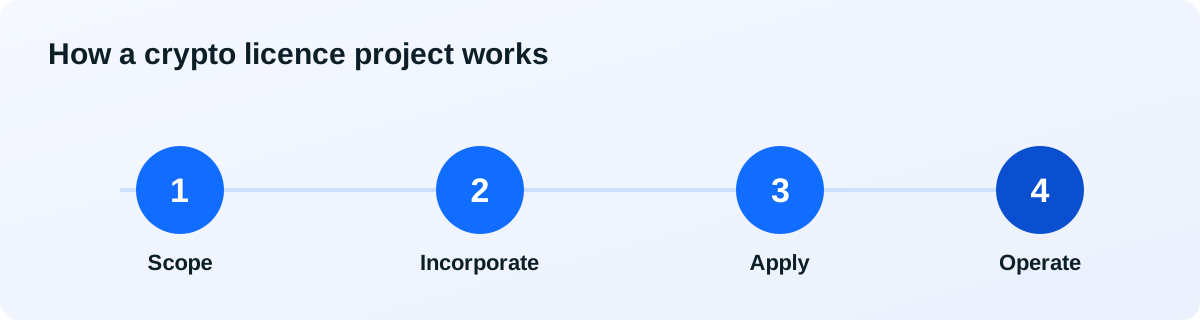
- Pre-application consultation - We assess your business model and advise on suitability. This includes a gap analysis of your AML policies and financial projections.
- Company incorporation - Register a company in Mauritius with a local registered office and director. The company must have a minimum of two directors, one of whom must be resident in Mauritius.
- Document preparation - Compile business plan, AML/CTF policies, financial projections, and fit-and-proper declarations for all key personnel. The business plan must detail your target market, revenue model, and risk management framework.
- Submit application - File with the FSC along with the application fee. The FSC will acknowledge receipt within 5 business days.
- FSC review - The regulator conducts due diligence and may request additional information (2-4 months). This includes background checks on directors and shareholders.
- License issuance - Once approved, you receive the license and are listed on the FSC register. The license is valid for one year and must be renewed annually.
- Ongoing compliance - Submit annual reports, maintain capital, and undergo audits. The FSC may conduct on-site inspections.
Consulting24 coordinates each step, liaising with local lawyers and the FSC. For a faster and simpler route, explore Estonia or Lithuania. We have handled over 100 applications in these jurisdictions.
Banking and Payment Services
Opening a bank account in Mauritius for a crypto business can be challenging due to global de-risking. However, the FSC's licensing provides credibility that helps with bank onboarding. Local banks such as MCB, SBM, and Absa are increasingly open to licensed VASPs, though they may require a minimum deposit of EUR 10,000 and proof of operations.
Alternatively, you can use payment processors or fintech platforms that offer virtual IBANs and multi-currency accounts. For example, companies like PaySax and CurrencyCloud support crypto businesses with strong compliance records. Consulting24 can introduce you to banking partners we have vetted. For a jurisdiction with simpler banking, consider Poland or Czech Republic.
Note that some banks may require a personal guarantee from directors or a security deposit. It is advisable to approach multiple banks simultaneously to increase your chances of approval.
Benefits of a Mauritius Crypto License
- Regulatory clarity - The VAITOS Act provides a clear legal framework for virtual assets, with defined rules on custody, exchange, and token issuance.
- Tax efficiency - Low effective tax rate of 3-15% and no capital gains tax, making it attractive for trading profits.
- International credibility - FSC oversight enhances trust with partners and clients, especially in Africa and Asia.
- Access to African markets - Mauritius is a gateway to Africa, with strong trade links and a stable political environment.
- English common law - Familiar legal system for international investors, with a well-established court system.
- No citizenship requirement - Foreign directors are allowed (with a local resident director).
- No VAT on digital services - Reduces operational costs for B2B transactions.
Compared to Malta, which has higher capital requirements (EUR 100,000+) and a more complex regulatory framework, Mauritius offers a simpler path. However, Malta provides EU passporting under MiCA, which Mauritius does not.
Compliance and Trust
Compliance is at the heart of the Mauritius regime. Licensees must implement strong AML/CTF measures, including customer due diligence (CDD), transaction monitoring, and suspicious activity reporting. The FSC conducts periodic inspections and can impose sanctions for non-compliance, including fines up to EUR 500,000 or license revocation.
We recommend appointing a local compliance officer and using automated screening tools like Chainalysis or Elliptic. Consulting24 provides ongoing compliance advisory to help you meet your obligations. General guidance, not legal advice. Always consult a qualified lawyer for your specific situation.
In 2025, the FSC increased its scrutiny of beneficial ownership, requiring licensees to maintain a register of ultimate beneficial owners (UBOs) with more than 25% ownership. Failure to comply can result in penalties. The FSC also participates in the Global Forum on Transparency and Exchange of Information for Tax Purposes.
Common Mistakes to Avoid
- Incomplete documentation - Missing business plans or AML policies delay the process. Ensure your business plan includes a detailed risk assessment and revenue model.
- Underestimating capital requirements - The FSC expects sufficient working capital, not just the minimum. A common mistake is to apply with the bare minimum, leading to rejection.
- Ignoring local presence - You need a physical office and a resident director. Some applicants try to use virtual offices, which the FSC does not accept.
- Overlooking tax reporting - Even with low taxes, annual filings are mandatory. Late filings can result in penalties.
- Choosing the wrong jurisdiction - Compare with other jurisdictions to find the best fit. For example, if you need EU passporting, Lithuania or Estonia may be better.
- Not preparing for FSC interviews - The FSC may interview key personnel. Prepare by reviewing your business plan and AML policies.
Alternatives: Mauritius vs Panama and Others
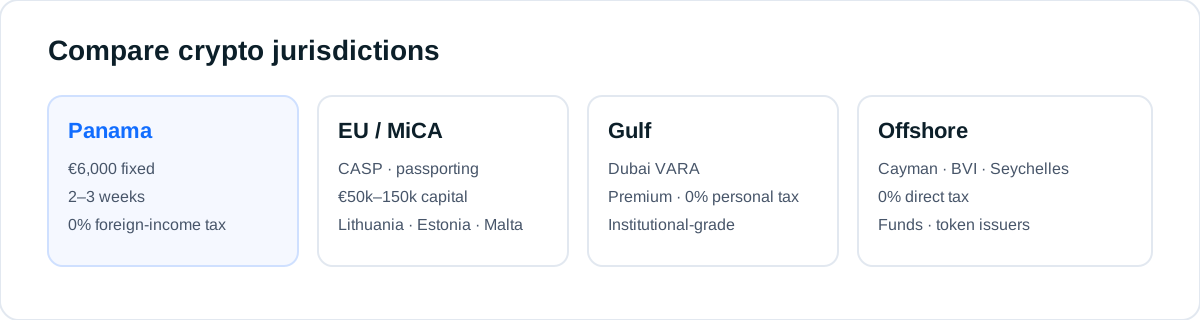
Mauritius is an excellent choice for businesses targeting Africa or seeking a credible offshore hub. However, it is not the only option. Here is a comparison:
| Jurisdiction | Cost (EUR) | Timeline | Key Advantage |
|---|---|---|---|
| Mauritius | 15,000 - 30,000 | 3-6 months | Tax efficiency, African gateway |
| Panama | 6,000 flat | 1-2 months | Low cost, no capital requirement |
| Estonia | 10,000 - 20,000 | 1-3 months | EU digital single market |
| Lithuania | 8,000 - 15,000 | 2-4 months | EU passporting under MiCA |
| Switzerland | 20,000 - 50,000 | 3-6 months | Strong banking, high credibility |
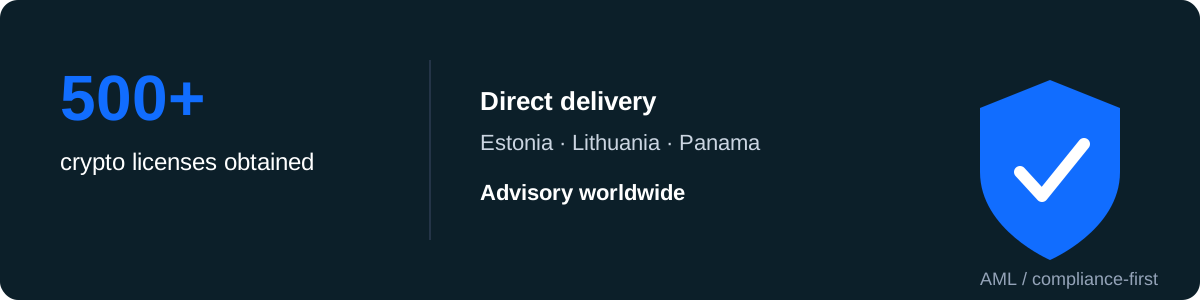
Consulting24 helps you compare and choose the right jurisdiction. We deliver directly in Estonia, Lithuania, and Panama, and advise on others like Mauritius. For example, if your primary market is Africa, Mauritius is ideal. If you need EU access, Lithuania is more suitable.
Why Work with Consulting24?
With over 500 licenses obtained, Consulting24 is a trusted partner in crypto licensing. For Mauritius, we advise and coordinate with local experts to ensure a smooth application. Our services include:
- Jurisdictional comparison and strategy
- Document preparation and review
- Liaison with the FSC and local lawyers
- Post-license compliance support
We do not guarantee approval, but we maximise your chances. Our team has a success rate of over 95% for applications we coordinate. Contact us on WhatsApp or book a consultation to discuss your project.
We also offer bundled services for multi-jurisdictional setups, such as combining a Mauritius license with a Panama company for tax optimisation. Our clients include exchanges, wallet providers, and token issuers from 30+ countries.
Frequently asked questions
What is the Mauritius crypto license?
It is a regulatory license issued by the Financial Services Commission (FSC) under the VAITOS Act. It allows businesses to offer virtual asset services like exchange, custody, and token issuance. The license is mandatory for any entity providing such services in or from Mauritius.
Who needs a Mauritius crypto license?
Any business offering virtual asset services in Mauritius, including exchanges, wallet providers, custodians, and token issuers. If you plan to serve African markets or seek a credible offshore jurisdiction, this license is suitable.
What is the cost of a Mauritius crypto license?
The total cost typically ranges from EUR 15,000 to 30,000, including application fees, legal advisory, and company incorporation. Annual compliance costs are around EUR 15,000-25,000. Exact pricing depends on your business scope.
How long does it take to get a Mauritius crypto license?
The process takes 3 to 6 months, depending on the completeness of your application and FSC workload. Consulting24 can help streamline the timeline by preparing a thorough application.
What is the minimum capital requirement for a Mauritius crypto license?
The VAITOS Act does not set a fixed minimum, but the FSC typically expects EUR 50,000 to 100,000 based on business scale. This must be maintained as paid-up capital in a Mauritian bank account.
What are the tax benefits of a Mauritius crypto license?
Mauritius offers a corporate tax rate of 15%, with a partial exemption reducing the effective rate to as low as 3% for foreign-source income. There is no capital gains tax, no withholding tax on dividends, and no VAT on digital services.
Can I open a bank account in Mauritius with a crypto license?
Yes, but it can be challenging. The FSC license provides credibility. Local banks like MCB and SBM are open to licensed VASPs, though they may require a minimum deposit and proof of operations. Consulting24 can assist with introductions.
What activities are not allowed under a Mauritius crypto license?
Activities involving gambling-related tokens, privacy coins (unless approved), and services violating international sanctions are prohibited. Commingling client assets is also not allowed without proper segregation.
Do I need a physical presence in Mauritius?
Yes, you need a registered office and at least one resident director. The FSC also requires a local compliance officer. Virtual offices are not accepted.
How does Mauritius compare to Panama for crypto licensing?
Panama offers a flat fee of EUR 6,000 with no capital requirement and a faster timeline (1-2 months), but it lacks the tax treaties and African market access that Mauritius provides. Mauritius is better for businesses targeting Africa or needing tax efficiency.
Can Consulting24 guarantee my Mauritius crypto license?
No, we do not guarantee approval. We advise and coordinate your application to maximise your chances. Our success rate for coordinated applications is over 95%.
What ongoing compliance is required after receiving the license?
Licensees must submit annual reports, maintain capital, undergo audits, and implement AML/CTF measures. The FSC conducts periodic inspections. Annual compliance costs are typically EUR 15,000-25,000.
Official sources
Related jurisdictions

Talk to a crypto-licensing expert
500+ licenses across Estonia, Lithuania, Panama and beyond. Tell us your model and we'll map the right route, honestly.
💬 Talk to an expertFree consultationGeneral guidance, not legal advice. Rules and fees evolve, and we confirm current requirements for your case.