Crypto NFT Marketplace License Vietnam: A Complete Guide for 2026
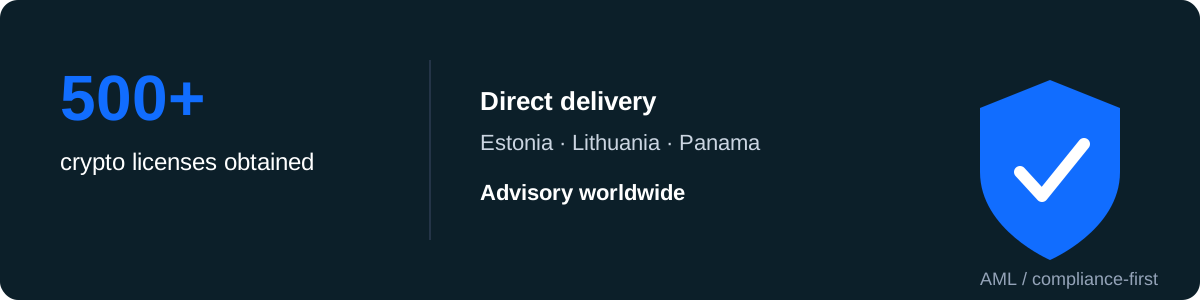
Vietnam is emerging as a dynamic hub for blockchain and NFT innovation, but its regulatory environment for crypto businesses remains in flux. As of 2026, Vietnam does not have a dedicated crypto license or NFT marketplace license. Instead, companies must navigate a patchwork of laws, including the Law on Cybersecurity, the Law on Information Technology, and the Civil Code. The State Bank of Vietnam (SBV) has consistently warned against crypto as a payment method, and the Ministry of Finance is still drafting a legal framework for digital assets. For founders seeking a clear, regulated path, jurisdictions like Panama offer a more straightforward licensing process. Consulting24 advises and coordinates for Vietnam, but our core delivery is in Estonia, Lithuania, and Panama, where we have obtained over 500 licenses.
This page provides an overview of the current environment for crypto NFT marketplace licenses in Vietnam, including regulatory challenges, alternative jurisdictions, and practical steps. We focus on helping you compare Vietnam with established licensing regimes such as Panama, Lithuania, and Estonia. Whether you plan to operate in Vietnam or use it as a base for NFT trading, understanding the legal risks and opportunities is essential.
Overview: What Is a Crypto NFT Marketplace License in Vietnam?
Vietnam currently lacks a specific license category for crypto or NFT marketplaces. The government has not yet enacted a comprehensive digital asset law. Instead, crypto activities fall under general business registration, subject to restrictions on using crypto as payment. The State Bank of Vietnam prohibits the issuance, supply, and use of virtual currencies as legal tender. However, owning and trading crypto as a commodity or asset is not explicitly illegal, creating a grey area.
For NFT marketplaces, the legal status is similarly uncertain. NFTs are often treated as digital assets under the Law on Information Technology, but no specific licensing regime exists. This means that operating a crypto NFT marketplace in Vietnam carries regulatory risk, including potential crackdowns. Many founders therefore choose to incorporate in a licensed jurisdiction like Panama, where a flat fee of EUR 6,000 covers company setup and license application, with a clear regulatory framework.
In contrast, regulated jurisdictions such as Lithuania under MiCA require a CASP license with capital tiers of EUR 50,000 to EUR 150,000. Estonia's VASP license requires EUR 12,000 paid-up capital. These frameworks offer legal certainty and access to banking, which Vietnam cannot provide. Consulting24 can help you evaluate which jurisdiction aligns with your business model.
Who Needs a Crypto NFT Marketplace License in Vietnam?
Any business that facilitates the trading, minting, or exchange of NFTs and cryptocurrencies should consider licensing. This includes:
- NFT marketplaces allowing peer-to-peer trading of digital art, collectibles, or virtual real estate.
- Platforms that accept crypto payments for NFT transactions.
- Exchanges that list NFTs as trading pairs.
- Launchpads for NFT projects.
- Gaming platforms that use NFTs as in-game assets.
In Vietnam, even if no license is required, companies must comply with anti-money laundering (AML) regulations, cybersecurity laws, and tax obligations. For those seeking legal certainty, obtaining a license in a regulated jurisdiction like Lithuania or Panama is recommended. Consulting24 can advise on the best structure for your business, whether you target Vietnamese users or operate globally. For example, a Vietnamese NFT marketplace might incorporate in Panama to avoid regulatory risk while serving the local market remotely.
License Type and Regulator in Vietnam
Vietnam does not have a single regulator for crypto assets. The State Bank of Vietnam oversees payment-related activities, while the Ministry of Finance handles securities and investment. The Ministry of Information and Communications regulates digital content. For NFT marketplaces, the key regulator is the Ministry of Finance, which is drafting a decree on digital assets. As of 2026, no official license type exists.
In contrast, Panama offers a clear structure under the Superintendencia de Bancos de Panamá (SBP) for crypto-related businesses. Panama's license allows for exchange, custody, and NFT marketplace operations. Consulting24 has helped over 500 clients obtain licenses in Panama, Estonia, and Lithuania. For Vietnam, we advise on compliance best practices and alternative jurisdictions. If you are considering Vietnam, we recommend monitoring the draft decree and preparing a compliance framework in advance.
Cost and Timeline for a Crypto NFT Marketplace License
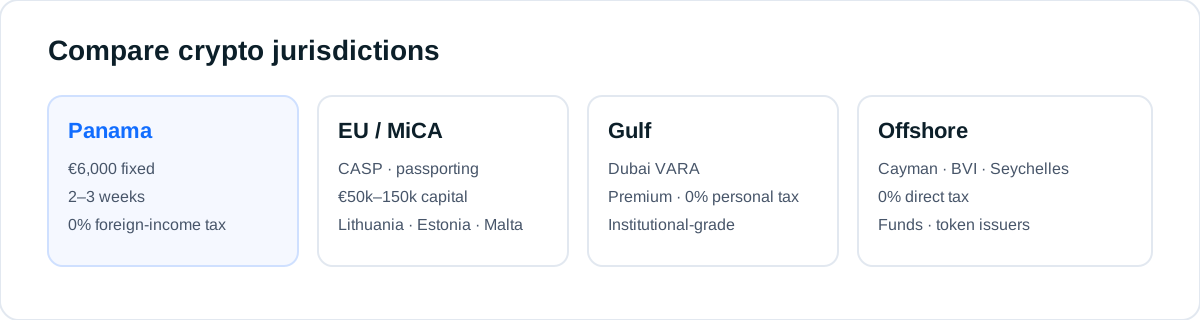
Since Vietnam has no formal license, there is no official fee. However, costs for legal compliance, company registration, and AML program setup can range from EUR 5,000 to EUR 15,000. The timeline for establishing a compliant presence is typically 2-4 months, but regulatory uncertainty may cause delays. Below is a comparison of costs and timelines across jurisdictions:
| Jurisdiction | Cost (EUR) | Timeline | License Type |
|---|---|---|---|
| Vietnam (no license) | 5,000 - 15,000 (compliance) | 2-4 months | N/A |
| Panama | 6,000 flat | 4-8 weeks | Crypto License (Exchange, Custody, NFT) |
| Lithuania | 5,000 - 10,000 | 3-6 months | CASP (MiCA-compliant) |
| Estonia | 3,000 - 8,000 | 2-4 months | Virtual Asset Service Provider |
Panama offers the fastest and most cost-effective route with a fixed price. Lithuania and Estonia provide EU market access but require higher capital and longer timelines. Consulting24 can provide exact pricing for your specific needs during a consultation.
Capital Requirements
Vietnam imposes no specific minimum capital for crypto businesses, but general company law requires a charter capital sufficient for operations. For an NFT marketplace, this might be around VND 1-3 billion (EUR 40,000 - 120,000). However, this is not a regulatory requirement but a practical consideration.
In contrast, Panama requires no minimum capital for the crypto license. Lithuania, under MiCA, requires EUR 50,000 for basic services and up to EUR 150,000 for advanced services. Estonia requires EUR 12,000 paid-up capital for a VASP license. Consulting24 can provide exact figures during a consultation. For example, a marketplace offering custody services would need the higher tier in Lithuania, while Panama has no such requirement.
Tax Treatment for NFT Marketplaces in Vietnam
Vietnam taxes corporate income at 20% and VAT at 10% (0% for exported services). Crypto transactions are not explicitly exempt, so revenue from NFT sales may be subject to standard taxes. Personal income tax on crypto gains is unclear, but capital gains from securities are taxed at 0.1% of sale price. For businesses, it is advisable to consult a local tax advisor.
Panama offers territorial taxation: only income sourced within Panama is taxed. Offshore companies pay no tax on foreign-sourced income. Lithuania taxes corporate income at 15% (0% for small companies under certain conditions). Estonia has a 20% corporate income tax, but only on distributed profits. Consulting24 can help structure your business to optimize tax efficiency. For instance, a Panama entity serving global customers would pay 0% tax on foreign income, while a Lithuanian entity would pay 15% on worldwide income.
Allowed Activities Under a Vietnam Crypto NFT Marketplace License
Since no license exists, allowed activities are limited by general law. You can technically operate an NFT marketplace, but you cannot use crypto as payment for goods or services. The SBV prohibits banks from processing crypto transactions. Therefore, NFT marketplaces must use fiat on-ramps and avoid direct crypto-to-fiat conversions.
In Panama, a crypto license permits exchange, custody, and NFT marketplace operations. Lithuania's CASP allows exchange, transfer, and custody of virtual assets, including NFTs. Estonia's VASP license covers exchange and wallet services. For a comprehensive list of allowed activities, consult our jurisdictions page. For example, a Panama-licensed marketplace can offer fiat-to-crypto on-ramps, while a Vietnam-based one cannot.
Step-by-Step Process to Obtain a Crypto NFT Marketplace License
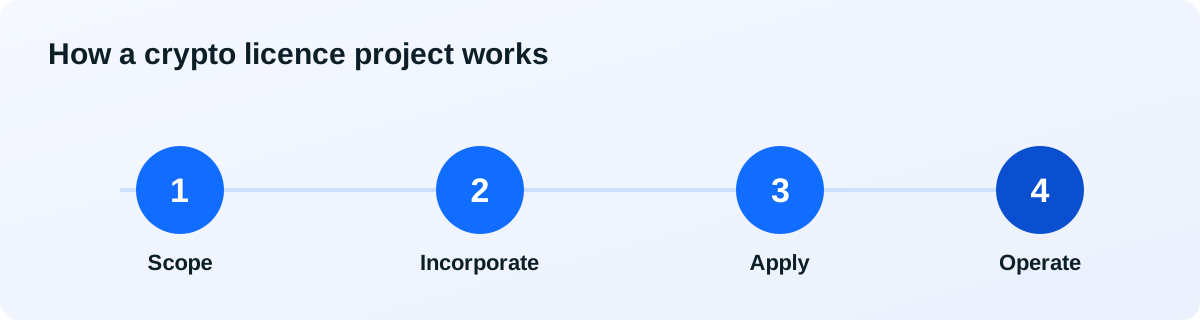
For Vietnam, there is no formal process. However, to operate compliantly, follow these steps:
- Register a company in Vietnam (e.g., limited liability company).
- Obtain a business registration certificate with appropriate codes (e.g., information technology services).
- Implement AML/KYC procedures as required by the Law on Anti-Money Laundering.
- Ensure compliance with cybersecurity law (data localization).
- Consult with a local lawyer to monitor regulatory developments.
For Panama, the process is straightforward: Consulting24 handles company setup and license application within 4-8 weeks. We also assist with Lithuania and Estonia licenses. Contact us for a step-by-step guide tailored to your business. For example, the Panama process involves incorporating a company, drafting AML policies, and submitting to the SBP.
Banking and Payment Integration
Vietnamese banks generally do not support crypto-related businesses. Opening a corporate bank account for an NFT marketplace can be challenging. Many founders use international payment processors or crypto-friendly banks in Singapore or Hong Kong. Panama offers better banking options, with many banks accepting crypto license holders. Lithuania and Estonia also have a growing number of fintech-friendly banks.
Consulting24 can introduce you to banking partners in Panama and the Baltics. For Vietnam, we advise on alternative payment gateways such as Stripe or PayPal for fiat transactions. However, these may not be fully compliant with local regulations. A regulated license in Panama or Lithuania provides access to traditional banking and payment rails.
Benefits of a Regulated Crypto NFT Marketplace License
Even though Vietnam lacks a license, obtaining one in a regulated jurisdiction offers several advantages:
- Legal certainty and protection against regulatory changes.
- Ability to partner with banks and payment processors.
- Enhanced credibility with users and investors.
- Access to the European market under MiCA (via Lithuania or Estonia).
- Tax optimization in territorial regimes like Panama.
Operating without a license in Vietnam exposes you to risks of sudden bans or fines. A regulated license is a long-term investment in your business's stability. For example, a Panama-licensed marketplace can easily integrate with global exchanges and wallets, while a Vietnam-based one faces constant uncertainty.
Compliance and Trust: Anti-Money Laundering Requirements
Vietnam's AML law requires virtual asset service providers to register and implement AML programs. However, the definition of VASPs is vague. To be compliant, NFT marketplaces should:
- Conduct customer due diligence (CDD).
- Monitor transactions for suspicious activity.
- Report suspicious transactions to the State Bank.
- Maintain records for at least 5 years.
In Panama, AML compliance is mandatory under Law 23 of 2015. Lithuania and Estonia have strong AML frameworks aligned with EU directives. Consulting24 provides AML policy templates and compliance support. Note: This is general guidance, not legal advice. Always consult a qualified lawyer. For instance, a Panama-licensed marketplace must appoint a compliance officer and conduct ongoing monitoring.
Common Mistakes When Seeking a Vietnam Crypto License
Founders often make these errors:
- Assuming Vietnam's grey market is safe: regulatory changes can happen overnight.
- Neglecting AML compliance: even without a license, AML laws apply.
- Using personal bank accounts for business transactions: risky and potentially illegal.
- Not seeking professional advice: local expertise is crucial.
- Choosing Vietnam over regulated jurisdictions without understanding the trade-offs.
To avoid these pitfalls, consider a licensed jurisdiction first. Consulting24 can help you compare options. For example, a founder who ignored AML requirements in Vietnam faced fines and account freezes, while a Panama-licensed competitor grew without issues.
Alternatives: Vietnam vs Panama, Lithuania, and Estonia
Vietnam offers a large user base and low operational costs, but regulatory uncertainty is high. Panama provides a flat EUR 6,000 license with no capital requirement and territorial tax. Lithuania, as an EU member, offers MiCA compliance and access to the European market. Estonia has a streamlined e-residency program and a mature crypto ecosystem.
For NFT marketplaces, Panama is often the most cost-effective and fastest option. Lithuania is ideal for those seeking EU passporting. Estonia is suitable for early-stage startups. Consulting24 delivers directly for Panama, Lithuania, and Estonia. For Vietnam, we advise and coordinate. Contact us to discuss which jurisdiction fits your needs.
Why Choose Consulting24 for Your Crypto License
Consulting24 has obtained over 500 crypto licenses across multiple jurisdictions. We deliver directly in Estonia, Lithuania, and Panama, and advise on others. Our team provides end-to-end support, from company setup to AML compliance. We offer transparent pricing: Panama company setup and license for a flat EUR 6,000.
We understand the nuances of each jurisdiction. For example, we know which banks in Panama accept crypto license holders and how to structure your business for tax efficiency. Contact us on WhatsApp to book a consultation and start your licensing journey.
Frequently asked questions
Does Vietnam have a specific crypto license for NFT marketplaces?
No, Vietnam does not have a specific license for crypto or NFT marketplaces as of 2026. The government is still drafting a legal framework for digital assets. Businesses operate in a grey area, subject to general laws on cybersecurity, AML, and information technology.
Can I operate an NFT marketplace in Vietnam legally?
Technically yes, but with restrictions. You cannot use crypto as payment for goods or services, and banks are prohibited from processing crypto transactions. You must comply with AML and cybersecurity laws. However, regulatory risk remains high due to potential crackdowns.
What is the cost of setting up a crypto NFT marketplace in Vietnam?
There is no official license fee, but compliance costs including company registration, AML program setup, and legal advice typically range from EUR 5,000 to EUR 15,000. The timeline is 2-4 months, but delays are common.
What are the capital requirements for a crypto business in Vietnam?
Vietnam does not impose a specific minimum capital for crypto businesses. However, general company law requires charter capital sufficient for operations, often around VND 1-3 billion (EUR 40,000-120,000). This is a practical consideration, not a regulatory requirement.
How are NFT marketplace revenues taxed in Vietnam?
Corporate income tax is 20%, and VAT is 10% (0% for exported services). Crypto transactions are not explicitly exempt, so NFT sales revenue is likely subject to standard taxes. Personal income tax on crypto gains is unclear. Consult a local tax advisor.
What are the advantages of Panama over Vietnam for an NFT marketplace?
Panama offers a flat EUR 6,000 license with no capital requirement, territorial tax (0% on foreign income), and a clear regulatory framework. Banking is easier, and the timeline is 4-8 weeks. Vietnam lacks legal certainty and banking support.
Can Consulting24 help me obtain a license in Vietnam?
We advise and coordinate for Vietnam, but we do not deliver licenses there directly. Our core delivery is in Panama, Lithuania, and Estonia, where we have obtained over 500 licenses. We can help you compare jurisdictions and choose the best route.
What AML requirements apply to NFT marketplaces in Vietnam?
Vietnam's AML law requires virtual asset service providers to register, conduct customer due diligence, monitor transactions, and report suspicious activity. Record-keeping for 5 years is mandatory. However, enforcement is inconsistent.
Is it better to license in Lithuania or Panama for an NFT marketplace?
It depends. Panama is cheaper (EUR 6,000 flat) and faster (4-8 weeks) with no capital requirement. Lithuania offers EU market access under MiCA but requires EUR 50,000-150,000 capital and takes 3-6 months. Consulting24 can help you decide.
What are the risks of operating a crypto business in Vietnam without a license?
Risks include sudden regulatory bans, fines, account freezes, and legal liability. The grey area may disappear once the digital asset law is enacted. Founders may face difficulties with banking and investor trust.
How long does it take to get a Panama crypto license?
The Panama crypto license process typically takes 4-8 weeks with Consulting24. This includes company incorporation, AML policy drafting, and license application. The flat fee is EUR 6,000.
Can I use a Panama-licensed company to serve Vietnamese customers?
Yes, you can operate remotely. Panama's territorial tax means foreign-sourced income is tax-free. However, you must ensure compliance with Vietnamese laws if you have a physical presence or target Vietnamese users directly.
Official sources
Related jurisdictions

Talk to a crypto-licensing expert
500+ licenses across Estonia, Lithuania, Panama and beyond. Tell us your model and we'll map the right route, honestly.
💬 Talk to an expertFree consultationGeneral guidance, not legal advice. Rules and fees evolve, and we confirm current requirements for your case.