Crypto NFT Marketplace License (2026): Cost, Process Marketplace License: Your Complete Guide for 2026
If you are launching a platform where users can buy, sell, or trade non-fungible tokens using cryptocurrencies, you need a crypto NFT marketplace license. In 2026, regulatory clarity is essential: the EU's Markets in Crypto-Assets Regulation (MiCA) is fully in force, and many other jurisdictions have updated their frameworks. This page explains what the license covers, who needs it, and how to obtain one efficiently.
At Consulting24, we have helped over 500 crypto firms secure licenses. We deliver directly in Estonia, Lithuania, and Panama, and advise on all other jurisdictions. Whether you are a startup or an established exchange, our team ensures your crypto NFT marketplace license application meets all requirements. Contact us via WhatsApp or book a consultation to start your journey.
What Is a Crypto NFT Marketplace License?
A crypto NFT marketplace license is a regulatory authorisation that allows a platform to facilitate the exchange of NFTs for cryptocurrencies or fiat money. Under MiCA, such activity falls under the Crypto Asset Service Provider (CASP) regime, specifically the operation of a trading platform for crypto assets. The license ensures compliance with anti-money laundering (AML) rules, consumer protection, and operational standards.
Without a license, operating an NFT marketplace that accepts crypto payments or allows peer-to-peer trading may be illegal in many jurisdictions. The license is not just a legal requirement; it builds trust with users and partners. It signals that your platform adheres to high standards of security, transparency, and financial integrity.
As of 2026, the EU's MiCA regulation harmonises licensing across member states, meaning a CASP license in one country is valid across the EU. This is a major advantage for NFT marketplaces targeting a European audience. For example, a license obtained in Lithuania allows you to serve customers in France, Germany, and Spain without additional local registrations. This passporting right reduces administrative overhead and speeds up market entry.
The license also imposes ongoing obligations: regular reporting to the regulator, independent audits, and maintenance of a compliance function. Failure to comply can result in fines or revocation of the license. Therefore, choosing the right jurisdiction and partner is critical.
Who Needs This License?
Any business operating an online marketplace where NFTs are traded against crypto or fiat needs a crypto NFT marketplace license. This includes:
- Primary NFT minting platforms that sell collections for cryptocurrency.
- Secondary marketplaces enabling peer-to-peer NFT resales.
- Platforms that offer fractional NFT ownership or NFT lending.
- Marketplaces that accept crypto payments for NFT purchases.
- NFT gaming platforms where players trade in-game assets as NFTs.
If your platform only displays NFTs without facilitating transactions (e.g., a gallery or portfolio tracker), you may not need a license. However, once any exchange of value occurs, the license is mandatory. Even if you are based outside the EU, if you serve EU customers, MiCA applies to you. For example, a US-based NFT marketplace with European users must comply with MiCA or risk being blocked by EU regulators. Consulting24 can help you determine your exact obligations through a free initial assessment.
License Type and Regulator
The crypto NFT marketplace license under MiCA is classified as a CASP license for operating a trading platform. The regulator varies by EU member state; for example, in Lithuania it is the Bank of Lithuania, in Estonia the Financial Supervisory Authority (FSA), and in Malta the Malta Financial Services Authority (MFSA). In Panama, the regulator is the Superintendencia de Bancos de Panamá (SBP) for crypto-related activities, though Panama does not have a specific crypto license yet.
Consulting24 delivers directly in Estonia, Lithuania, and Panama. For other jurisdictions, we advise and coordinate with local experts. The license type is typically a 'Virtual Asset Service Provider' (VASP) registration in non-EU countries, but under MiCA it is a formal CASP authorisation. The application process involves a thorough review of the company's governance, AML policies, and financial stability. Regulators also assess the 'fit and proper' status of directors and beneficial owners, including background checks and interviews.
Cost and Timeline
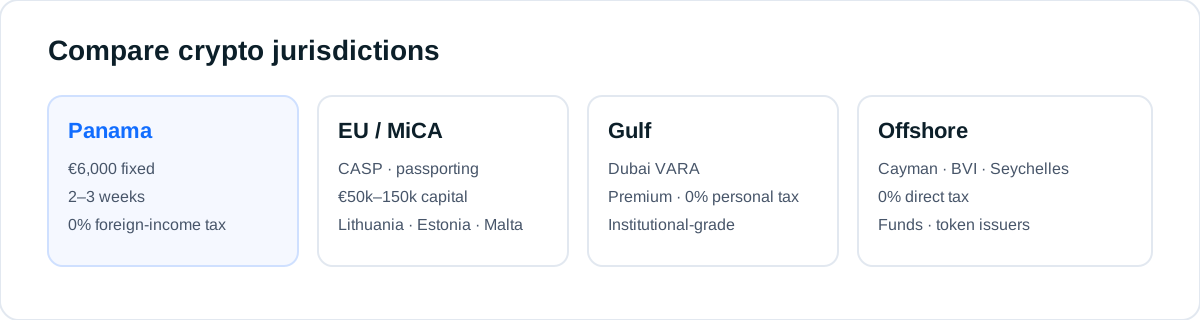
Costs for a crypto NFT marketplace license vary by jurisdiction. Below is a summary based on 2026 figures. Exact pricing is confirmed during a consultation.
| Jurisdiction | License Cost (EUR) | Timeline | Ongoing Annual Costs (EUR) |
|---|---|---|---|
| Panama (company setup + license) | €6,000 flat | 4-6 weeks | €2,000 - €5,000 |
| Lithuania (CASP) | €15,000 - €25,000 | 3-6 months | €10,000 - €20,000 |
| Estonia (CASP) | €10,000 - €20,000 | 2-4 months | €8,000 - €15,000 |
| Other EU (via MiCA) | €20,000 - €50,000 | 6-12 months | €15,000 - €30,000 |
Ongoing compliance costs include AML officer fees, audit, and reporting. Panama offers a cost-effective entry point with a flat fee of €6,000, making it attractive for startups. However, Panama does not provide EU passporting, so if you plan to serve the European market, a MiCA license in Lithuania or Estonia may be more suitable despite higher costs. Consulting24 provides transparent pricing with no hidden fees.
Capital Requirement
Under MiCA, capital requirements for a crypto NFT marketplace license depend on the services offered. As of 2026, the tiers are:
- €50,000 for simple custody and transfer services.
- €125,000 for exchange services (including NFT marketplaces).
- €150,000 for full-service trading platforms with order books.
In Panama, there is no specific minimum capital for crypto activities, but a company setup typically requires at least €10,000 in paid-up capital. Consulting24 can advise on the exact amount needed for your business model. It is important to note that capital must be held in a bank account and cannot be used for operational expenses until the license is granted. Some regulators also require a surety bond or insurance. We help you structure the capital efficiently.
Tax Treatment
Tax treatment for NFT marketplaces varies widely. In the EU, corporate income tax rates range from 9% (Hungary) to 15% (Lithuania) to 25% (Germany). VAT on NFT transactions is a grey area; most EU countries treat NFTs as digital services subject to VAT if the seller is a business. In Panama, there is no capital gains tax on crypto, and corporate tax is 25% on local-source income. Consulting24 recommends structuring your crypto NFT marketplace license in a tax-efficient jurisdiction. Always consult a tax advisor for your specific situation. For example, a platform that earns revenue from transaction fees may benefit from Lithuania's 15% corporate tax rate and its extensive double tax treaty network. Panama offers tax advantages for non-resident companies, as income from outside Panama is generally tax-exempt.
Allowed Activities
A crypto NFT marketplace license typically permits the following activities:
- Operating a trading platform for NFTs (primary and secondary).
- Exchanging NFTs for crypto or fiat.
- Custody of NFTs and crypto assets.
- Providing order matching and settlement.
- Offering NFT staking or lending (if regulated separately).
- Facilitating auctions and fixed-price sales.
Activities not allowed include operating a derivatives exchange (requires MiFID license) or issuing unbacked stablecoins. The exact scope depends on the license conditions set by the regulator. Some regulators may restrict the types of NFTs that can be traded (e.g., excluding securities tokens). Consulting24 ensures your license application clearly defines the permitted activities to avoid scope creep.
Step-by-Step Application Process
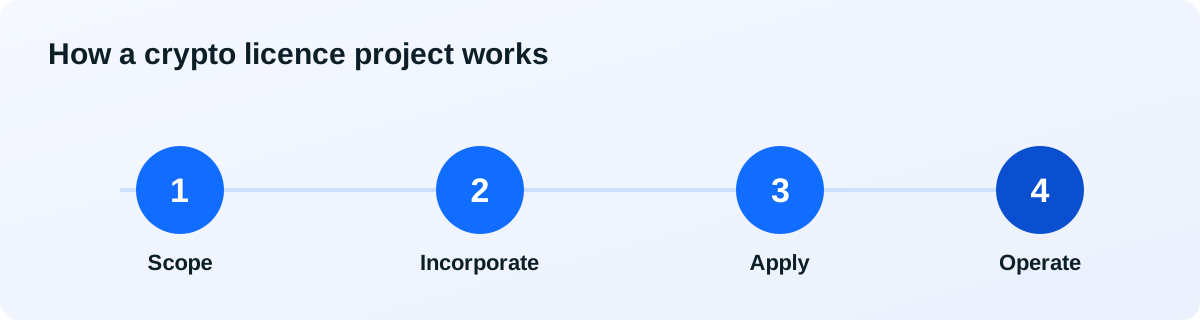
Obtaining a crypto NFT marketplace license involves several steps. Consulting24 guides you through each:
- Jurisdiction selection: Choose between EU (MiCA) or Panama. We help evaluate costs, timeline, and regulatory burden. For example, if you need EU passporting, Lithuania or Estonia are preferred.
- Company incorporation: Register a legal entity in the chosen jurisdiction. Panama company setup is included in the €6,000 fee. We handle all paperwork, including registered address and nominee services if required.
- Documentation: Prepare AML policies, business plan, risk assessment, governance framework, and financial projections. This is the most time-consuming part; we provide templates and review.
- Capital deposit: Meet the minimum capital requirement (e.g., €125,000 for EU exchange). We help open a bank account or use a licensed custodian.
- Application submission: File with the regulator. In Lithuania, this is via the Bank of Lithuania; in Panama, via the SBP. We submit and track progress.
- Review and interview: Regulator assesses fit and properness of directors and beneficial owners. We prepare you for interviews.
- Approval: License granted. Ongoing reporting and audits required. We provide compliance support.
Timelines vary from 4 weeks (Panama) to 6 months (EU). Consulting24 handles the entire process, reducing your administrative burden.
Banking and Payment Solutions
One of the biggest challenges for NFT marketplaces is obtaining a bank account. Many traditional banks are wary of crypto. With a crypto NFT marketplace license, you can open accounts with crypto-friendly banks in Lithuania, Estonia, or Panama. Consulting24 has partnerships with payment processors that support fiat on-ramps and off-ramps, including SEPA, SWIFT, and local payment methods. We also advise on integrating stablecoin payments to reduce banking friction. Panama offers a more flexible banking environment with no capital controls, allowing free movement of funds. For EU-licensed platforms, we recommend banks like LHV (Estonia) or Revolut Business. We also help with merchant accounts for credit card payments, which is essential for NFT marketplaces that accept fiat.
Benefits of Getting Licensed
Securing a crypto NFT marketplace license offers multiple advantages:
- Legal certainty: Operate without fear of regulatory action. In 2026, unlicensed platforms face fines and shutdowns.
- User trust: Users prefer licensed platforms for security. A license badge increases conversion rates.
- Access to banking: Licensed firms find it easier to open accounts and integrate payment providers.
- EU passporting: A MiCA license allows serving all EU markets from one base, saving on multiple registrations.
- Partnerships: Licensed platforms can integrate with custodians, auditors, and other regulated entities, enabling features like NFT lending or staking.
Without a license, you risk fines, shutdown, and reputational damage. Investing in compliance upfront saves costs later. For example, a licensed platform can attract institutional investors who require regulated counterparts.
Compliance and Trust
Compliance is the backbone of a crypto NFT marketplace license. Regulators require strong AML/CFT procedures, including KYC, transaction monitoring, and suspicious activity reporting. You must appoint a compliance officer and conduct regular audits. Consulting24 provides ongoing compliance support to ensure you meet all obligations. Note: this is general guidance, not legal advice. Your specific compliance framework should be tailored to your business model and jurisdiction. For example, NFT marketplaces must verify the identity of both buyers and sellers, and monitor for wash trading or money laundering through high-value NFTs. We help implement blockchain analytics tools like Chainalysis or Elliptic to detect suspicious patterns.
Common Mistakes to Avoid
When applying for a crypto NFT marketplace license, avoid these pitfalls:
- Incomplete documentation: Missing business plans or risk assessments cause delays. Many applicants underestimate the detail required.
- Underestimating capital: Ensure you have the required funds ready. Some applicants fail because they cannot prove the source of funds.
- Ignoring tax implications: Plan your tax structure early. For example, operating in a high-tax jurisdiction without proper planning can erode profits.
- Choosing the wrong jurisdiction: Some countries have long processing times or high ongoing costs. For instance, Malta has a reputation for thorough but slow reviews.
- Not using an advisor: DIY applications often fail due to lack of regulatory familiarity. Consulting24's pre-application review can pre-empt issues.
Learn from others' mistakes and work with experts. We have seen applications rejected due to poorly written AML policies or insufficient governance structures.
Alternatives and Comparisons
When comparing jurisdictions for your crypto NFT marketplace license, consider these options:
- Panama vs. Lithuania: Panama offers a flat €6,000 fee and no capital gains tax, but no EU passport. Lithuania has a higher cost (€15,000+) but access to the EU single market. For a startup focused on Latin America, Panama may be better; for European expansion, Lithuania wins.
- Panama vs. Estonia: Estonia's e-Residency program is attractive, but its CASP license costs €10,000+ and requires physical presence. Panama is cheaper and faster. However, Estonia offers a digital ecosystem that appeals to tech founders.
- Panama vs. Malta: Malta has a strong regulatory framework but high costs (€30,000+) and longer timelines. Panama is more accessible for startups. Malta's reputation may attract institutional clients.
Consulting24 advises on the best fit for your business. For a detailed comparison, read our jurisdictions guide. We also help with hybrid structures, such as a Panama holding company with an EU operating subsidiary.
Why Choose Consulting24?
With over 500 licenses obtained, Consulting24 is the trusted partner for your crypto NFT marketplace license. We deliver directly in Estonia, Lithuania, and Panama, and advise on all other jurisdictions. Our services include company setup, document preparation, regulatory liaison, and ongoing compliance. We offer transparent pricing: Panama company setup and license for a flat €6,000. Our team of former regulators and compliance experts ensures your application is complete and error-free. We also provide post-license support, including AML officer outsourcing and audit preparation. Contact us via WhatsApp or book a consultation to discuss your project.
Frequently asked questions
What is the difference between a CASP license and a VASP registration?
A CASP (Crypto Asset Service Provider) license is the EU term under MiCA, requiring full compliance with capital, governance, and AML rules. A VASP (Virtual Asset Service Provider) registration is used in non-EU countries like Panama, which may have lighter requirements. However, Panama's VASP regime is still evolving. Consulting24 can help you choose the right framework.
Can I use a Panama company to serve EU customers?
Yes, but if you actively solicit EU customers, you may need a MiCA license or face regulatory action. Panama does not have an EU passport. A common strategy is to use Panama for non-EU clients and a separate EU entity for European users. Consulting24 advises on compliant structures.
How long does it take to get a crypto NFT marketplace license in Panama?
Panama company setup and license application typically take 4-6 weeks. This is faster than most EU jurisdictions. However, the timeline depends on the completeness of your documentation and the regulator's workload. Consulting24 streamlines the process.
What are the ongoing compliance costs for a licensed NFT marketplace?
Ongoing costs include AML officer fees (EUR 5,000-15,000/year), audit fees (EUR 3,000-10,000/year), and regulatory reporting costs. In Panama, annual costs are lower, around EUR 2,000-5,000. Consulting24 offers compliance packages to manage these.
Do I need a physical office in the jurisdiction?
Most EU regulators require a local registered office and sometimes a physical presence. Panama allows virtual offices. Consulting24 provides registered address services in all jurisdictions we operate in.
Can I transfer an existing NFT marketplace to a licensed entity?
Yes, but it requires careful planning to avoid business interruption. You may need to migrate users, contracts, and assets. Consulting24 has experience with such transitions and can manage the process.
What happens if I operate without a license?
Penalties vary by jurisdiction. In the EU, unlicensed CASP activity can result in fines up to 5% of annual turnover or EUR 5 million, whichever is higher. In Panama, fines are lower but the platform may be shut down. Licensing is the only safe path.
Does the license cover NFTs that are securities?
No. If an NFT qualifies as a financial instrument (e.g., representing shares), it falls under securities laws (MiFID). A CASP license does not cover securities. Consulting24 can help you classify your NFTs and obtain the correct license if needed.
Can I apply for a license if my company is not yet incorporated?
Yes. Consulting24 can incorporate the company first and then apply for the license. In Panama, the EUR 6,000 fee includes company setup. We handle both steps smoothly.
What is the success rate of license applications with Consulting24?
We have a strong success record across the applications we handle. Our pre-application review identifies and fixes issues before submission. We also provide interview preparation for directors.
Official sources
Related jurisdictions

Talk to a crypto-licensing expert
500+ licenses across Estonia, Lithuania, Panama and beyond. Tell us your model and we'll map the right route, honestly.
💬 Talk to an expertFree consultationGeneral guidance, not legal advice. Rules and fees evolve, and we confirm current requirements for your case.