Crypto NFT Marketplace License in El Salvador (2026): Cost Salvador Crypto License for NFT Marketplace: Complete Guide 2026
El Salvador has emerged as a pioneering jurisdiction for digital assets, being the first country to adopt Bitcoin as legal tender. For entrepreneurs seeking a crypto NFT marketplace license El Salvador, the regulatory framework offers a clear path to operate legally. The central bank (Banco Central de Reserva, BCR) oversees the licensing of Bitcoin service providers, including NFT marketplaces that facilitate transactions with Bitcoin or other digital assets.
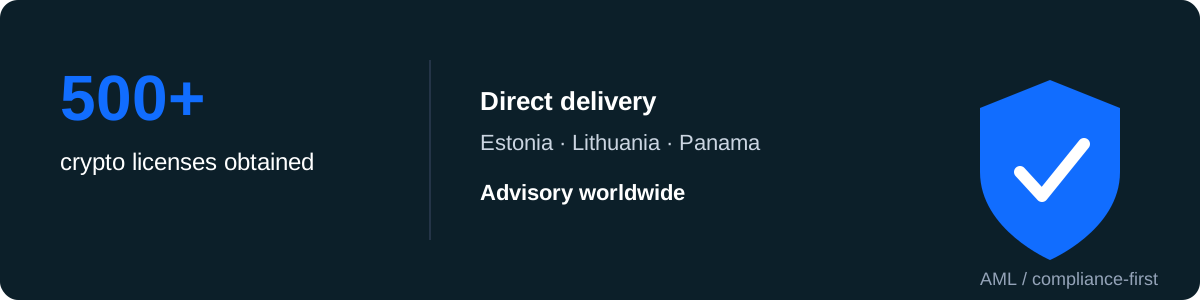
This page provides a detailed overview of the requirements, costs, and process to obtain an El Salvador crypto license for NFT marketplace operations. Whether you are a startup or an established exchange, understanding the local regulations is critical. Consulting24 advises and coordinates licensing in El Salvador, using our experience from over 500 licenses across multiple jurisdictions.
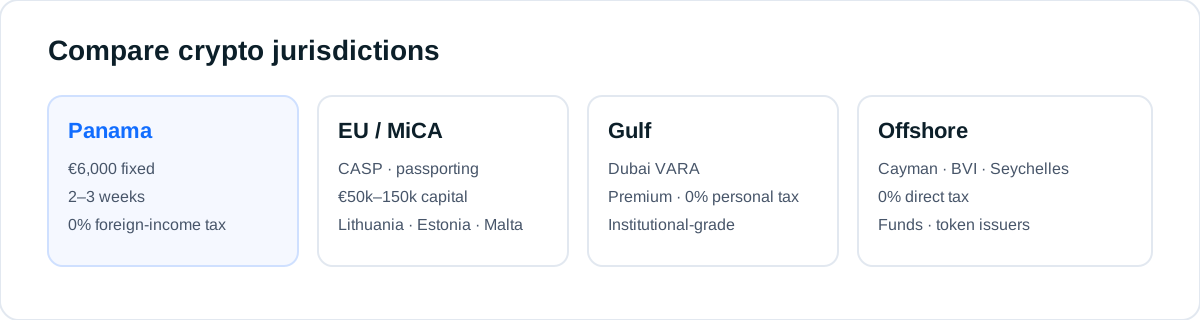
If you are considering a Panama alternative, note that Panama offers a flat-fee license for crypto businesses, while El Salvador provides a unique Bitcoin-centric environment. Compare both options to decide which suits your NFT marketplace best. For a broader view of global options, visit our jurisdictions page.
What Is the El Salvador Crypto License for NFT Marketplaces?
The El Salvador crypto license, officially a registration as a Bitcoin Service Provider (BSP), is required for any entity offering services related to Bitcoin or other digital assets, including NFT marketplaces that use Bitcoin for transactions. The license is issued by the Banco Central de Reserva (BCR) under the Bitcoin Law (2021) and subsequent regulations. It allows legal operation within the country, subject to compliance with anti-money laundering (AML) and know-your-customer (KYC) requirements.
Key features of the license include:
- No minimum capital requirement (as of 2026).
- 0% capital gains tax on Bitcoin profits.
- Full legal recognition of Bitcoin as legal tender.
- Ongoing reporting obligations to the BCR.
This license is distinct from the traditional financial services license and is tailored specifically for digital asset businesses. The BCR has published detailed guidelines on how BSPs must operate, including requirements for transaction monitoring and record keeping. For example, all transactions above a certain threshold must be reported to the Financial Investigation Unit. The license does not cap the number of users or transaction volume, making it scalable for growing NFT platforms. However, the BCR may impose additional conditions on a case-by-case basis, such as enhanced reporting for high-volume operators. For a comparison with other low-capital jurisdictions, see our requirements page.
Who Needs This License?
Any business that operates an NFT marketplace where users can buy, sell, or trade NFTs using Bitcoin or other digital assets must obtain the El Salvador crypto license. This includes platforms that facilitate peer-to-peer transactions, auction-style sales, or fixed-price listings. The requirement applies to both local and foreign companies that target Salvadoran users or process transactions in Bitcoin.
Typical applicants include:
- NFT marketplace startups.
- Existing crypto exchanges expanding into NFTs.
- Art and collectible platforms integrating crypto payments.
- Gaming platforms that trade in-game NFTs.
- Music and entertainment platforms tokenizing digital content.
If your platform does not handle Bitcoin or other digital assets directly (e.g., only fiat currency transactions), you may not need this license. However, most NFT marketplaces involve crypto transactions, so the license is generally required. For example, a platform that lists NFTs but settles in US dollars via credit card would not need the BSP registration, but if it also allows Bitcoin payments, it must register. Consulting24 can help assess whether your specific business model falls under the BCR's definition of a Bitcoin service provider.
License Type and Regulator
The license is a registration as a Bitcoin Service Provider (BSP) under the supervision of the Banco Central de Reserva (BCR). The BCR is the central bank of El Salvador and is responsible for implementing the Bitcoin Law. The registration process involves submitting an application with detailed information about the business, its beneficial owners, and its AML/KYC policies.
There is no specific sub-category for NFT marketplaces; the license covers all types of Bitcoin service providers, including exchanges, custodians, and payment processors. The BCR evaluates each application on a case-by-case basis. The regulator has the authority to request additional information, conduct on-site inspections, and impose sanctions for non-compliance. As of 2026, the BCR has issued over 100 BSP registrations, with a growing number of NFT-focused platforms. The regulator publishes a public registry of licensed BSPs, which can enhance trust among users and partners. For more details on the application process, visit our application process page.
Cost and Timeline
The cost of obtaining the El Salvador crypto license is relatively low compared to other jurisdictions. The government application fee is minimal, but professional fees for legal and compliance support vary. Below is an indicative table of costs and timelines:
| Item | Amount | Timeline |
|---|---|---|
| Government application fee | Approximately USD 500 - 1,000 | Paid upfront |
| Legal and compliance setup | USD 3,000 - 8,000 (one-time) | 2-4 weeks |
| Company incorporation (if needed) | USD 1,000 - 2,000 | 1-2 weeks |
| Total estimated cost | USD 4,500 - 11,000 | 2-4 months |
| Annual compliance costs | USD 2,000 - 5,000 | Ongoing |
Exact pricing is confirmed during a consultation, as costs vary based on business complexity. For a fixed-price alternative, consider the Panama license at EUR 6,000 flat, which includes company incorporation and legal support. The timeline for El Salvador can extend if the BCR requests additional documentation or if the applicant's AML policies are not up to standard. Consulting24 coordinates with local attorneys to expedite the process.
Capital Requirement
As of 2026, El Salvador imposes no minimum capital requirement for Bitcoin Service Provider registration. This makes it one of the most accessible jurisdictions for startups. However, the BCR expects the business to have sufficient financial resources to operate and meet its obligations. In practice, you should demonstrate a reasonable operational budget to cover initial setup and compliance costs.
This contrasts with EU jurisdictions under MiCA, where capital requirements range from EUR 50,000 to EUR 150,000 depending on service class. For example, a custody service requires EUR 125,000, while an exchange needs EUR 150,000. El Salvador's zero capital requirement is a significant advantage for early-stage NFT marketplaces. However, the BCR may ask for a business plan showing projected revenues and expenses to ensure the entity is viable. Consulting24 recommends having at least USD 10,000 in working capital to cover initial legal fees, company incorporation, and the first year of compliance costs. For a comparison with other low-capital jurisdictions, see our requirements page.
Tax Treatment
El Salvador offers a highly favorable tax regime for digital asset businesses. Key points include:
- 0% capital gains tax on profits from Bitcoin and other digital assets.
- No VAT on Bitcoin transactions (as per the Bitcoin Law).
- Corporate income tax applies to other business income at the standard rate of 30% (but gains from crypto are exempt).
- No withholding tax on dividends paid to foreign shareholders.
- No wealth tax or net worth tax.
This tax treatment is a major advantage for NFT marketplaces that generate revenue from transaction fees or trading profits. For example, if your marketplace charges a 2.5% fee on each NFT sale, that fee income is subject to corporate income tax, but any gains from holding Bitcoin are tax-free. However, you should consult a tax advisor to ensure compliance with your home country's tax laws, as many countries tax worldwide income. El Salvador does not have a tax treaty network, so double taxation may occur without proper planning. Consulting24 can connect you with international tax specialists.
Allowed Activities
With an El Salvador crypto license, your NFT marketplace can engage in the following activities:
- Operation of a platform for buying, selling, and trading NFTs.
- Facilitation of peer-to-peer transactions using Bitcoin or other digital assets.
- Custody of digital assets (if applicable).
- Conversion between Bitcoin and US Dollars (the other legal tender).
- Integration with Bitcoin Lightning Network for faster payments.
- Issuance of NFTs (if the platform also creates NFTs).
Activities that are not allowed include offering derivatives, margin trading, or lending without separate authorization. The license is specifically for spot transactions and custody. For a broader scope, consider a license from a jurisdiction like Lithuania under MiCA, which allows a wider range of services including transfer services, exchange between crypto and fiat, and custody of client assets. El Salvador's license is best suited for simple NFT marketplaces that do not offer financial services beyond trading. For a detailed comparison, see our vs Lithuania page.
Step-by-Step Application Process
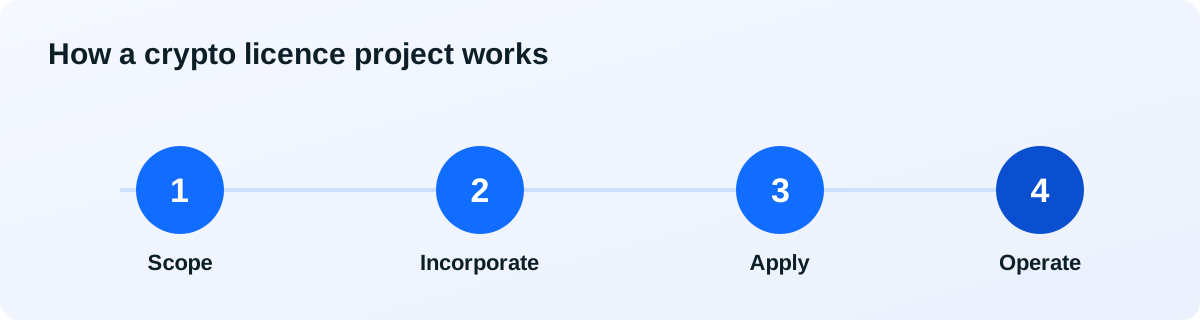
The process to obtain the El Salvador crypto license involves several steps. Consulting24 advises and coordinates each stage:
- Pre-application preparation: Gather corporate documents, AML/KYC policies, and business plan. Estimate cost: USD 1,000-2,000.
- Company incorporation: Register a local company (if not already done). This takes 1-2 weeks.
- Submit application to BCR: File the BSP registration form with supporting documents. Timeline: 1-2 weeks for review.
- BCR review and approval: The BCR may request additional information. Approval typically takes 2-3 months.
- Post-license compliance: Implement ongoing reporting and AML monitoring. Annual cost: USD 2,000-5,000.
For a detailed guide, see our application process page. Consulting24 provides a checklist of required documents, including certified copies of passports for beneficial owners, proof of address, and a detailed AML manual. We also assist with Spanish translations and notarizations. The BCR may conduct a background check on all beneficial owners, so any criminal record could delay or prevent approval. It is advisable to start the process with a clean compliance record.
Banking and Payments
Opening a bank account in El Salvador for a crypto business can be challenging due to perceived risks. However, the Bitcoin Law provides legal clarity, and some local banks accept Bitcoin service providers. Options include:
- Banco Agrícola, Banco Cuscatlán, and others may open accounts with proper documentation.
- International payment processors like Stripe or PayPal may not support crypto businesses.
- Bitcoin Lightning Network can be used for instant, low-cost payments.
- Some banks require a minimum deposit of USD 1,000-5,000.
Consulting24 can assist in identifying banking partners. For jurisdictions with easier banking, consider Lithuania or Estonia, where many banks and fintechs serve crypto clients. In El Salvador, the government has promoted financial inclusion, and the state-owned bank Banco de Desarrollo de El Salvador (BANDESAL) may offer accounts for crypto businesses. However, the process can take 4-8 weeks. We recommend having a backup plan, such as using a crypto-friendly neobank like Mercury or Brex, though these may not accept Salvadoran companies. Alternatively, you can use a multi-currency account from a provider like Wise, but check their crypto policy.
Benefits of the El Salvador Crypto License
The El Salvador crypto license offers several unique benefits for NFT marketplace operators:
- No minimum capital: Ideal for startups with limited funds.
- 0% capital gains tax: Maximizes profitability.
- Bitcoin as legal tender: Provides legal certainty for Bitcoin transactions.
- Fast processing: Approvals in 2-4 months, faster than many EU jurisdictions.
- Low ongoing costs: Annual compliance fees are modest.
- No withholding tax on dividends: Attractive for foreign investors.
These advantages make El Salvador a compelling choice for NFT marketplaces focused on Bitcoin. However, the regulatory framework is still evolving, so professional guidance is essential. The government has been proactive in updating regulations, and new requirements may be introduced. For example, in 2025, the BCR mandated that all BSPs must implement a risk-based approach to AML. Consulting24 monitors regulatory changes to keep clients compliant. Compared to Panama, El Salvador offers a unique Bitcoin-centric environment, while Panama provides a more traditional crypto license with flat fees.
Compliance and Trust
Maintaining compliance with BCR regulations is crucial to avoid penalties or license revocation. Key obligations include:
- Implementing strong AML/KYC procedures.
- Reporting suspicious transactions to the Financial Investigation Unit (FIU).
- Submitting periodic reports to the BCR on transaction volumes and customer data.
- Appointing a local compliance officer.
- Conducting regular audits of AML policies.
Consulting24 provides ongoing compliance support to ensure your NFT marketplace remains in good standing. This is general guidance and not legal advice. For specific legal questions, consult a qualified attorney. The BCR has the power to suspend or revoke licenses for non-compliance, and fines can reach up to USD 50,000. In 2024, the BCR revoked two BSP licenses for failure to submit reports. To avoid such issues, we recommend using automated compliance software that integrates with the BCR's reporting system. Our team can help set up transaction monitoring tools and train your staff. Trust is built through transparency, and being listed on the BCR's public registry adds credibility.
Common Mistakes to Avoid
When applying for the El Salvador crypto license, avoid these common pitfalls:
- Incomplete documentation: Ensure all forms are fully filled and supporting documents are translated into Spanish.
- Underestimating AML requirements: The BCR expects a detailed AML policy. Generic templates may be rejected.
- Ignoring beneficial ownership disclosure: All ultimate beneficial owners must be identified.
- Operating before approval: Starting operations without a license can lead to fines of up to USD 10,000.
- Neglecting ongoing reporting: Failure to submit reports can result in license suspension.
- Choosing the wrong legal structure: A limited liability company (Sociedad de Responsabilidad Limitada) is commonly used.
Working with an experienced advisor like Consulting24 helps avoid these issues. We have seen applications rejected due to missing notarizations or incorrect translations. Another common mistake is not budgeting for annual compliance costs, which can catch startups off guard. We recommend setting aside at least USD 3,000 per year for compliance. For a comprehensive overview, see our blog on common licensing mistakes.
Alternatives and Comparison
El Salvador is not the only option for an NFT marketplace license. Below is a comparison with two popular alternatives: Panama and Lithuania.
| Feature | El Salvador | Panama | Lithuania (MiCA) |
|---|---|---|---|
| Regulator | Banco Central de Reserva (BCR) | Superintendencia de Bancos (SBP) | Bank of Lithuania |
| License type | Bitcoin Service Provider (BSP) | Fintech license (crypto) | CASP under MiCA |
| Minimum capital | None | None (but EUR 6,000 flat fee) | EUR 50,000 - 150,000 |
| Capital gains tax | 0% | 0% on foreign-source income | 15% (standard corporate tax) |
| Timeline | 2-4 months | 1-2 months | 3-6 months |
| Banking | Moderate difficulty | Easier | Easier |
| Ongoing costs | USD 2,000-5,000/year | EUR 1,000-3,000/year | EUR 5,000-15,000/year |
For a detailed comparison with Lithuania, see our vs Lithuania page. Panama is a strong alternative due to its flat fee and fast setup. Consulting24 delivers directly in Panama and Lithuania, and advises on El Salvador. If you need a license quickly and with minimal capital, Panama may be the best choice. However, if you want to use Bitcoin's legal tender status, El Salvador is unique. For EU market access, Lithuania under MiCA is the most comprehensive but costly.
Frequently asked questions
What is the El Salvador crypto license for NFT marketplaces?
It is a registration as a Bitcoin Service Provider (BSP) issued by the Banco Central de Reserva (BCR) under the Bitcoin Law. It allows NFT marketplaces to operate legally in El Salvador, handling Bitcoin and other digital assets. There is no minimum capital requirement, and capital gains tax on Bitcoin is 0%.
Who needs to apply for this license?
Any business operating an NFT marketplace that facilitates transactions using Bitcoin or other digital assets must apply. This includes platforms for peer-to-peer trading, auctions, and fixed-price listings. Both local and foreign companies targeting Salvadoran users or processing Bitcoin transactions are required to register.
How much does the El Salvador crypto license cost?
The total cost typically ranges from USD 4,500 to USD 11,000, including government fees (USD 500-1,000), legal and compliance setup (USD 3,000-8,000), and company incorporation (USD 1,000-2,000). Annual compliance costs are USD 2,000-5,000. Exact pricing is confirmed during a consultation.
What is the timeline for obtaining the license?
The process takes 2-4 months from application to approval. This includes company incorporation (1-2 weeks), application preparation (2-4 weeks), and BCR review (2-3 months). Delays can occur if additional documentation is requested.
Is there a minimum capital requirement?
No, El Salvador imposes no minimum capital requirement for Bitcoin Service Providers as of 2026. However, you must demonstrate sufficient financial resources to operate and meet compliance obligations. A working capital of at least USD 10,000 is recommended.
What are the tax benefits of the El Salvador crypto license?
The main benefits are 0% capital gains tax on Bitcoin profits and no VAT on Bitcoin transactions. Corporate income tax of 30% applies to other business income, but crypto gains are exempt. There is also no withholding tax on dividends paid to foreign shareholders.
Can I open a bank account in El Salvador for my crypto business?
Yes, but it can be challenging. Some local banks like Banco Agrícola and Banco Cuscatlán accept Bitcoin service providers with proper documentation. International payment processors may not support crypto businesses. Consulting24 can assist in identifying banking partners.
What activities are allowed under the license?
Allowed activities include operating an NFT marketplace, facilitating peer-to-peer transactions, custody of digital assets, conversion between Bitcoin and USD, and integration with the Lightning Network. Derivatives, margin trading, and lending are not permitted without separate authorization.
What are the common mistakes to avoid when applying?
Common mistakes include incomplete documentation, underestimating AML requirements, ignoring beneficial ownership disclosure, operating before approval, and neglecting ongoing reporting. Using generic AML templates can lead to rejection. Professional guidance helps avoid these pitfalls.
How does El Salvador compare to Panama for NFT marketplace licensing?
Panama offers a flat-fee license at EUR 6,000 with faster setup (1-2 months) and easier banking. El Salvador has no minimum capital and 0% capital gains tax but a longer timeline (2-4 months). Panama is better for speed and simplicity, while El Salvador is unique for Bitcoin-focused businesses.
Does Consulting24 provide the El Salvador crypto license directly?
Consulting24 advises and coordinates licensing in El Salvador, using our experience from over 500 licenses. We do not deliver directly in El Salvador but provide expert guidance through local partners. For direct delivery, we offer licenses in Panama, Lithuania, and Estonia.
What ongoing compliance is required after obtaining the license?
Ongoing compliance includes implementing AML/KYC procedures, reporting suspicious transactions to the FIU, submitting periodic reports to the BCR, appointing a local compliance officer, and conducting regular audits. Annual compliance costs range from USD 2,000 to USD 5,000.
Official sources
Related jurisdictions

Talk to a crypto-licensing expert
500+ licenses across Estonia, Lithuania, Panama and beyond. Tell us your model and we'll map the right route, honestly.
💬 Talk to an expertFree consultationGeneral guidance, not legal advice. Rules and fees evolve, and we confirm current requirements for your case.