Crypto NFT Marketplace License in BVI (2026): Cost & Setup License for NFT Marketplace: Complete 2026 Guide
The British Virgin Islands (BVI) has become a prominent jurisdiction for crypto and NFT businesses seeking a balanced regulatory framework. For founders operating a crypto NFT marketplace, understanding the BVI crypto license requirements is essential to launch compliantly and attract institutional partners. This guide covers everything from the regulator and capital requirements to tax treatment and step-by-step application process.
As of 2026, the BVI Financial Services Commission (FSC) oversees virtual asset service providers under the Securities and Investment Business Act (SIBA) and the Anti-Money Laundering Regulations. While the BVI does not have a standalone 'crypto license' per se, NFT marketplaces that facilitate trading of tokenised assets typically require a Class I or Class II Investment Business license, depending on the activities. Consulting24 advises and coordinates BVI crypto license applications for NFT marketplaces, ensuring a smooth process from incorporation to approval.
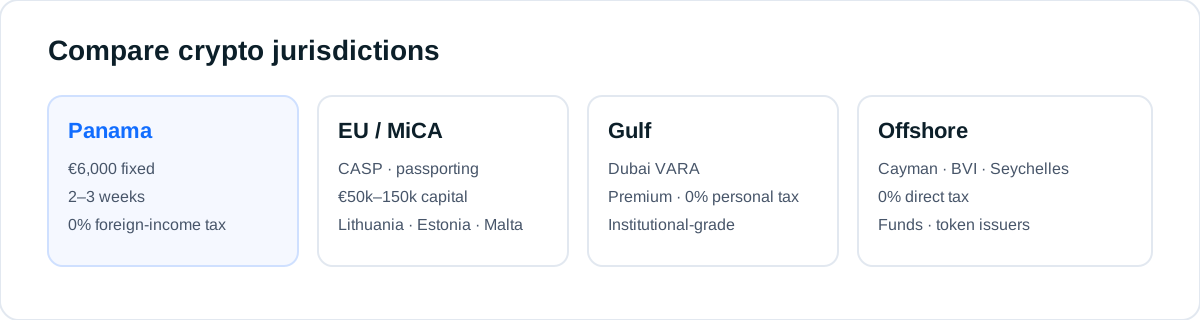
Compared to Panama, which offers a flat EUR 6,000 cost and a simpler VASP regime, the BVI provides a more sophisticated common law framework suitable for institutional-grade NFT platforms. Consulting24 helps you choose the right route and set up where we operate, including Estonia and Lithuania, while advising on other jurisdictions like the BVI.
What Is a BVI Crypto License for NFT Marketplaces?
A BVI crypto license, in the context of an NFT marketplace, refers to the regulatory authorisation required to operate a platform that facilitates the issuance, trading, or exchange of non-fungible tokens (NFTs) and other digital assets. The BVI Financial Services Commission (FSC) regulates such activities under SIBA, treating certain NFTs as 'investments' if they represent securities or collective investment schemes.
For a typical NFT marketplace that allows users to buy, sell, and mint NFTs, the license ensures compliance with anti-money laundering (AML) and counter-terrorist financing (CTF) obligations. The BVI offers a flexible regime that does not impose a blanket ban on crypto activities but requires licensing for specific functions. This makes the BVI an attractive hub for NFT projects that want legal clarity without overly burdensome capital requirements.
Consulting24 helps founders determine whether their NFT marketplace falls under SIBA or the simpler VASP registration, and guides them through the appropriate licensing pathway. For example, a marketplace that only lists digital art without profit-sharing may only need AML registration, while one offering fractionalised NFT investments requires a full Class I license.
Who Needs a BVI Crypto License for an NFT Marketplace?
Any entity that operates an NFT marketplace from or within the BVI, or that solicits business from BVI residents, may need a license. Specifically, the following activities trigger licensing requirements:
- Operating a platform for trading NFTs that are classified as securities or derivatives.
- Providing custody or wallet services for NFTs and associated cryptocurrencies.
- Facilitating the primary issuance of NFTs that represent an investment (e.g., fractionalised real estate or art funds).
- Exchanging NFTs for fiat currency or other digital assets.
If your marketplace only lists non-financial NFTs (e.g., digital art without profit-sharing), you may not require a full investment business license, but you still need to register for AML purposes. Consulting24 can review your business model to confirm the exact licensing scope. For instance, a simple peer-to-peer NFT gallery may only need VASP registration, while a platform offering NFT staking rewards likely needs a Class I license.
License Type & Regulator
The primary regulator for crypto and NFT activities in the BVI is the Financial Services Commission (FSC). Depending on the nature of the NFT marketplace, the applicable license may be:
| License Type | Applicable Activities | Regulator |
|---|---|---|
| Class I Investment Business License | Dealing in investments (e.g., buying/selling NFTs as principal or agent) | FSC |
| Class II Investment Business License | Arranging deals in investments, managing investments, or advising | FSC |
| VASP Registration (under AMLR) | Simple exchange or wallet services not involving securities | FSC |
Most NFT marketplaces that handle multiple tokens and allow trading will require at least a Class I license. The FSC also requires all VASPs to register under the Anti-Money Laundering Regulations, even if exempt from full investment business licensing. For comparison, EU member states under MiCA require a CASP license with capital tiers of EUR 50,000 to 150,000, which is more prescriptive than the BVI's flexible approach.
Cost & Timeline
The cost of obtaining a BVI crypto license for an NFT marketplace varies based on the license type and complexity. Below is an indicative breakdown (exact pricing confirmed in consultation):
| Item | Estimated Cost (USD) | Timeline |
|---|---|---|
| BVI company incorporation (IBC) | 1,500 - 2,500 | 1-2 weeks |
| License application fee (Class I/II) | 5,000 - 10,000 | N/A |
| Legal & compliance advisory | 10,000 - 20,000 | Ongoing |
| Total estimated cost (first year) | 20,000 - 35,000 | 3-6 months |
Timelines depend on the completeness of the application and the FSC's workload. As of 2026, typical processing takes 3 to 6 months. Consulting24 coordinates with local counsel to expedite the process. In contrast, Panama offers a flat EUR 6,000 cost with a faster 2-3 month timeline, but the BVI provides a more established common law framework.
Capital Requirement
The BVI does not prescribe a fixed minimum capital for VASP registration or investment business licenses. Instead, the FSC requires that the company maintains adequate financial resources relative to its business volume and risk profile. For a typical NFT marketplace, the regulator may expect a minimum of USD 50,000 to 100,000 in paid-up capital, but this is assessed on a case-by-case basis.
For comparison, EU member states under MiCA require EUR 50,000 to 150,000 depending on service class. The BVI's flexible approach can be advantageous for startups that want to avoid locking up large sums. Consulting24 advises on structuring your capital to meet FSC expectations without overcapitalising. For example, a marketplace with low trading volumes may only need USD 50,000, while a high-volume platform may require USD 100,000 or more.
Tax Treatment
One of the biggest advantages of the BVI is its tax-neutral regime. BVI business companies (IBCs) are exempt from corporate income tax, capital gains tax, and withholding tax on dividends and interest. There is no VAT or sales tax. The only ongoing government costs are annual registration fees (approximately USD 350 to 1,000 depending on share capital).
However, if the NFT marketplace has a physical presence or management in another jurisdiction, that country may tax the profits. Transfer pricing rules apply if transactions occur with related parties. Consulting24 recommends a tax structure review to ensure global tax compliance. For instance, if your team is based in the UK, you may need to consider UK corporate tax on profits attributable to UK activities.
Allowed Activities Under a BVI Crypto License
A BVI-licensed NFT marketplace can engage in a wide range of activities, subject to the license scope. Typical permitted activities include:
- Operating an NFT trading platform (primary and secondary sales).
- Wallet services for NFTs and cryptocurrencies (custodial and non-custodial).
- Token issuance (minting) of NFTs that are not securities.
- Exchange services between NFTs and other digital assets or fiat.
- Staking or yield farming related to NFTs (if structured as investment).
Activities that are explicitly prohibited include offering derivatives on NFTs without a separate license, and dealing in securities without proper registration. The FSC may also restrict services to professional investors if the license is limited. For example, a Class II license may only allow arranging deals for professional clients, not retail investors.
Step-by-Step Application Process
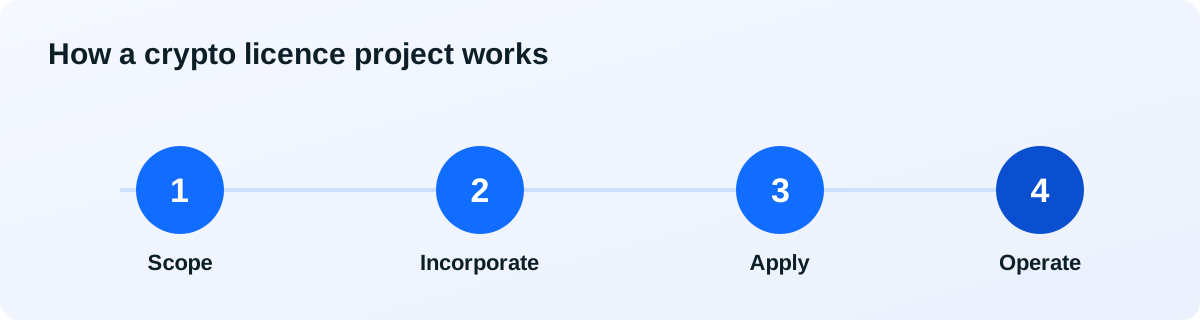
The process to obtain a BVI crypto license for an NFT marketplace involves several stages. Consulting24 advises and coordinates each step:
- Company Incorporation: Incorporate a BVI Business Company (IBC) with a suitable name and share structure.
- Business Plan & Compliance Manual: Prepare a detailed business plan, AML/CFT policy, and risk assessment. The business plan must cover tokenomics, expected trading volumes, and risk management.
- Appoint Local Representatives: Engage a BVI-licensed registered agent and, if required, a local director.
- Submit Application: File the license application with the FSC, including all supporting documents such as audited financials (if any) and background checks.
- Due Diligence: The FSC conducts background checks on directors, shareholders, and beneficial owners. This includes fit-and-proper tests.
- License Issuance: Upon approval, pay the license fee and receive the certificate. The license is valid for one year and must be renewed annually.
- Ongoing Compliance: Submit annual returns, audited accounts, and AML reports. Consulting24 provides ongoing support to maintain compliance.
Consulting24 manages the entire process, liaising with local lawyers and the FSC. For a faster alternative, consider Panama, where the flat fee and simpler process can result in licensing within 2-3 months.
Banking & Payment Processing for NFT Marketplaces
Securing banking for a BVI-licensed NFT marketplace can be challenging due to the perceived risk. However, several international banks and EMI providers accept BVI companies with a valid crypto license. Options include:
- BVI-based banks (e.g., FirstBank, VP Bank) that understand the regulatory environment.
- European EMIs (e.g., Intergiro, Satchel) that support crypto-friendly accounts.
- US-based correspondent banks for USD settlement.
Consulting24 can introduce you to banking partners that have experience with NFT platforms. It is important to have a clear compliance framework and transaction monitoring to satisfy bank due diligence. For example, banks often require proof of AML procedures and a clear source of funds policy. Some EMIs may require a minimum deposit of USD 10,000 to open an account.
Benefits of a BVI Crypto License for NFT Marketplaces
The BVI offers several advantages for NFT marketplace operators:
- Tax neutrality: No corporate tax, capital gains tax, or VAT.
- Regulatory flexibility: No fixed minimum capital, case-by-case assessment.
- Established legal system: English common law, respected globally.
- Confidentiality: Beneficial ownership information is not publicly accessible.
- Speed: License processing in 3-6 months, faster than many EU jurisdictions.
Compared to Panama, which offers a flat EUR 6,000 cost but a different regulatory framework, the BVI is more suited for platforms targeting institutional investors or requiring a common law environment. For EU-focused projects, consider Lithuania or Estonia, which Consulting24 delivers directly.
Compliance & Trust: Ongoing Obligations
Holding a BVI crypto license comes with ongoing compliance duties. The FSC requires:
- Annual audited financial statements.
- Submission of an annual return and compliance report.
- AML/CFT training for staff and regular internal audits.
- Notification of any changes in directors, shareholders, or business activities.
Failure to comply can result in fines or license revocation. Consulting24 provides ongoing compliance support to ensure your NFT marketplace remains in good standing. This is general guidance, not legal advice; always consult a qualified attorney for your specific situation. For example, the FSC may conduct on-site inspections or request additional information if suspicious transactions are detected.
Common Mistakes When Applying for a BVI Crypto License
Founders often make these errors during the application process:
- Incomplete business plan: The FSC expects a detailed plan covering tokenomics, trading volumes, and risk management. A generic plan leads to rejection.
- Inadequate AML controls: A generic AML policy is insufficient; it must be tailored to NFT transactions, including wallet screening and suspicious transaction reporting.
- Ignoring beneficial ownership rules: All ultimate beneficial owners must be disclosed and pass fit-and-proper tests. Hiding ownership can result in denial.
- Choosing the wrong license type: Applying for a Class II license when Class I is needed can delay the process by months. Consulting24 helps you select the correct type.
- Underestimating timeline: Many founders expect 2 months, but 3-6 months is typical. Plan accordingly.
Avoid these pitfalls by working with an experienced advisor like Consulting24. For a simpler alternative, Panama has a straightforward VASP registration with fewer pitfalls.
Alternatives and Comparisons: BVI vs. Panama and Other Jurisdictions
When choosing a jurisdiction for your NFT marketplace license, consider these alternatives:
| Jurisdiction | Cost (First Year) | Timeline | Capital Requirement | Tax |
|---|---|---|---|---|
| BVI | USD 20,000 - 35,000 | 3-6 months | USD 50,000 - 100,000 (case-by-case) | 0% corporate tax |
| Panama | EUR 6,000 (flat) | 2-3 months | None specified | 0% tax on foreign-source income |
| Lithuania | EUR 10,000 - 20,000 | 3-6 months | EUR 50,000 - 150,000 (MiCA) | 15% corporate tax |
| Estonia | EUR 10,000 - 20,000 | 3-6 months | EUR 50,000 - 150,000 (MiCA) | 20% corporate tax (distributed profits) |
Panama is the most cost-effective option with a flat fee and no minimum capital, making it ideal for early-stage NFT marketplaces. The BVI offers a common law framework and tax neutrality, while Lithuania and Estonia provide EU passporting under MiCA. Consulting24 delivers directly in Panama, Lithuania, and Estonia, and advises on the BVI. For a full comparison, visit our jurisdictions page.
Why Choose Consulting24 for Your BVI Crypto License?
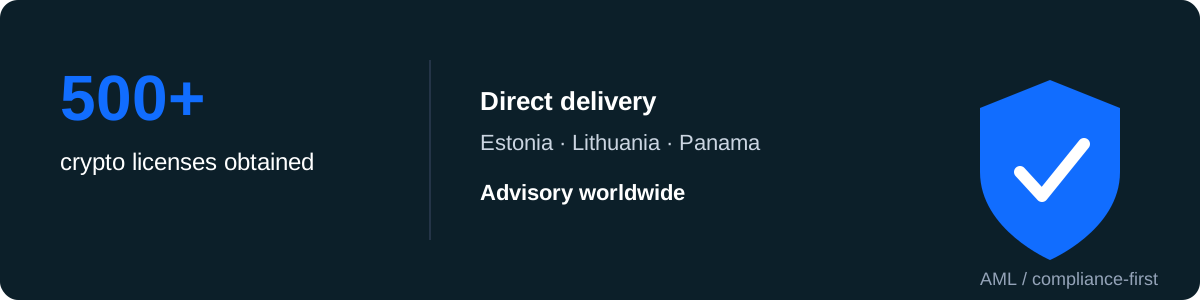
Consulting24 has obtained over 500 crypto licenses across multiple jurisdictions. For the BVI, we advise and coordinate with local legal partners to ensure a smooth application. Our services include:
- Initial assessment of your NFT marketplace business model.
- Preparation of business plan, AML policy, and compliance documentation.
- Liaison with FSC and local registered agents.
- Ongoing compliance support post-license.
We also offer direct delivery in Panama, Lithuania, and Estonia. Contact us on WhatsApp to book a consultation and discuss your project.
Frequently asked questions
What is the difference between a Class I and Class II investment business license in the BVI?
A Class I license allows you to deal in investments as principal or agent, meaning you can buy and sell NFTs on your own behalf or for clients. A Class II license covers arranging deals, managing investments, or advising. Most NFT marketplaces need a Class I license if they execute trades, while a platform that only introduces buyers and sellers may use Class II.
Does the BVI have a specific crypto license for NFT marketplaces?
No, the BVI does not have a standalone crypto license. NFT marketplaces are regulated under the Securities and Investment Business Act (SIBA) or the Anti-Money Laundering Regulations. Depending on the nature of the NFTs traded, you may need a Class I or Class II investment business license, or simply register as a VASP for AML purposes.
What is the minimum capital requirement for a BVI crypto license?
The BVI does not set a fixed minimum capital. The FSC assesses adequacy on a case-by-case basis, typically expecting USD 50,000 to 100,000 for an NFT marketplace. This is lower than the EUR 50,000-150,000 required under MiCA in EU jurisdictions.
How long does it take to get a BVI crypto license for an NFT marketplace?
The process typically takes 3 to 6 months from incorporation to license issuance. Delays can occur if the application is incomplete or if the FSC requires additional information. Consulting24 coordinates with local counsel to expedite the process.
Can I operate an NFT marketplace from the BVI without a license?
If your marketplace only lists non-financial NFTs (e.g., digital art without profit-sharing) and does not handle customer funds, you may only need to register for AML purposes. However, any activity involving securities or investment schemes requires a license. Consulting24 can review your model to determine the exact requirements.
What are the ongoing compliance obligations after obtaining a BVI crypto license?
You must submit annual audited financial statements, an annual return, and AML reports. You also need to conduct regular internal audits and notify the FSC of any changes in directors or shareholders. Consulting24 provides ongoing compliance support to ensure you meet all obligations.
Is the BVI tax-free for NFT marketplace profits?
BVI companies are exempt from corporate income tax, capital gains tax, and VAT. However, if your marketplace has a physical presence or management in another country, that country may tax the profits. You should consult a tax advisor to ensure global compliance.
Can I get a bank account for a BVI-licensed NFT marketplace?
Yes, but it can be challenging. BVI-based banks and European EMIs that accept crypto businesses are options. Consulting24 can introduce you to banking partners with experience in the NFT space. You will need to provide your license, AML policy, and proof of source of funds.
How does the BVI compare to Panama for NFT marketplace licensing?
Panama offers a flat EUR 6,000 cost with a simpler VASP registration and no minimum capital, making it more affordable for startups. The BVI provides a common law framework, tax neutrality, and greater flexibility on capital, but at a higher cost. Consulting24 delivers directly in Panama and advises on the BVI.
What activities are prohibited under a BVI crypto license?
Offering derivatives on NFTs without a separate license is prohibited. Dealing in securities without proper registration is also not allowed. The FSC may restrict services to professional investors if the license is limited. Always check your license scope before expanding activities.
Do I need a local director for a BVI crypto license application?
Not always, but the FSC may require a local director if the company lacks substance in the BVI. Consulting24 can help you appoint a suitable local director if needed. This is common for companies that do not have a physical office in the BVI.
Can Consulting24 help with BVI crypto license applications?
Yes, Consulting24 advises and coordinates BVI crypto license applications for NFT marketplaces. We work with local legal partners to prepare documentation, liaise with the FSC, and ensure compliance. For direct delivery, we operate in Panama, Lithuania, and Estonia.
Official sources
Related jurisdictions

Talk to a crypto-licensing expert
500+ licenses across Estonia, Lithuania, Panama and beyond. Tell us your model and we'll map the right route, honestly.
💬 Talk to an expertFree consultationGeneral guidance, not legal advice. Rules and fees evolve, and we confirm current requirements for your case.