Croatia Crypto License: Your Guide to EU CASP Registration in 2026
Since the full implementation of MiCA in 2026, Croatia has become a fully integrated EU jurisdiction for crypto-asset service providers (CASPs). A croatia crypto license is now a CASP registration under the Croatian Financial Supervisory Authority (HANFA), aligned with EU-wide capital tiers and compliance standards. This page explains everything you need to know about obtaining a croatia crypto license, including the regulator, capital requirements, tax treatment, allowed activities, and the step-by-step process.
Whether you are a startup or an established exchange, the croatia crypto license offers a clear regulatory path within the European Union. Consulting24 advises and coordinates applications for this license, using our experience across 500+ crypto licenses in Europe and beyond. We help you work through the requirements, avoid common pitfalls, and choose the best jurisdiction for your business.
What Is the Croatia Crypto License?
The Croatia crypto license is the regulatory authorisation required to operate as a crypto-asset service provider (CASP) in Croatia. As of 2026, it is fully governed by the EU Markets in Crypto-Assets Regulation (MiCA), replacing any previous national regimes. The license is issued by the Croatian Financial Supervisory Authority (HANFA) and allows companies to offer services such as crypto exchange, custody, and transfer within the EU single market.
Key features of the croatia crypto license include:
- Full EU passporting rights to serve clients across all 27 member states
- Compliance with MiCA's harmonised rules on capital, governance, and consumer protection
- Registration with HANFA as the competent authority
- Ongoing reporting and AML obligations
For businesses seeking a foothold in the EU crypto market, the croatia crypto license offers a credible and regulated pathway. Consulting24 advises on the suitability of this license for your specific business model, comparing it with options in other jurisdictions.
Who Needs a Croatia Crypto License?
Any legal entity intending to provide crypto-asset services in or from Croatia must obtain a croatia crypto license. This includes both domestic startups and foreign companies looking to establish an EU presence. Typical candidates include:
- Crypto exchanges (spot and derivatives)
- Custodial wallet providers
- Brokerage platforms
- Payment services involving crypto assets
- Token issuers (if offering services like transfer or exchange)
If your business involves any of the activities listed under MiCA, you must be licensed. Operating without a license can lead to fines, reputational damage, and legal action. Consulting24 helps you determine whether the croatia crypto license is the right fit or if another EU jurisdiction, such as Lithuania or Estonia, better aligns with your goals.
License Type & Regulator
The croatia crypto license is a CASP registration under MiCA, supervised by HANFA (Hrvatska agencija za nadzor financijskih usluga). HANFA is the single regulator for financial services in Croatia, including insurance, securities, and now crypto assets. The license is not a simple registration; it involves a thorough assessment of the applicant's governance, AML procedures, IT security, and financial soundness.
Under MiCA, there are several service classes, each with specific capital requirements. The croatia crypto license covers all CASP activities, and applicants must specify which services they intend to offer. HANFA expects a detailed business plan, risk management framework, and evidence of fit and proper management.
For more details on the regulatory framework, you can visit the official HANFA website (see authority links below). Consulting24 coordinates the entire application process, ensuring all documentation meets HANFA's standards.
Cost & Timeline for a Croatia Crypto License
The cost of obtaining a croatia crypto license varies depending on the complexity of your business and the services you plan to offer. Below is an indicative breakdown based on typical market rates and regulatory fees as of 2026. Exact figures are confirmed during a consultation.
| Item | Estimated Cost (EUR) |
|---|---|
| Government application fee | 1,500 - 3,000 |
| Legal and compliance advisory | 8,000 - 15,000 |
| AML/KYC policy setup | 2,000 - 5,000 |
| IT security audit | 3,000 - 8,000 |
| Total estimated range | 14,500 - 31,000 |
| Ongoing annual compliance | 5,000 - 10,000 |
The timeline for approval typically ranges from 3 to 6 months, depending on the completeness of your application and HANFA's workload. Pre-application preparation can take 1-2 months. Consulting24 advises on structuring your application to minimise delays.
Capital Requirement
Under MiCA, the croatia crypto license requires minimum capital based on the type of services offered. As of 2026, the capital tiers are:
- EUR 50,000 for simple services like custody and transfer
- EUR 125,000 for exchange services (fiat-to-crypto and crypto-to-crypto)
- EUR 150,000 for full-service platforms including trading and exchange
These amounts must be maintained as own funds, and HANFA may require additional capital based on operational risk. The capital must be fully paid up before authorisation. Consulting24 helps you calculate the exact requirement for your business model and ensures your financial statements meet the criteria.
Tax Treatment for Crypto Businesses in Croatia
Croatia's tax regime for crypto businesses is relatively favourable. Corporate income tax is a flat 10% for companies with annual revenue up to EUR 1 million, and 12% above that. VAT is generally not applicable to crypto-to-crypto transactions, though fiat conversions may be subject to standard VAT (25%). Capital gains on crypto assets held by the company are taxed at the corporate rate.
For individual investors, crypto gains are subject to a 12% capital gains tax if assets are sold within two years of acquisition. Holding beyond two years is tax-exempt. However, for licensed CASPs, the tax treatment of trading income is treated as business income. Consulting24 advises on structuring your Croatian entity to optimise tax efficiency, including transfer pricing and cross-border considerations.
Allowed Activities Under the Croatia Crypto License
The croatia crypto license permits all CASP activities defined under MiCA, including:
- Providing custody and administration of crypto assets on behalf of clients
- Operating a trading platform for crypto assets
- Exchanging crypto assets for fiat currency or other crypto assets
- Executing orders on behalf of clients
- Placing crypto assets
- Receiving and transmitting orders for crypto assets
- Providing advice on crypto assets
- Managing a crypto-asset portfolio
Additionally, licensed CASPs can offer ancillary services such as staking, lending, and yield products, provided they comply with MiCA and HANFA's guidelines. The license does not cover security tokens or e-money tokens, which fall under other EU regulations. Consulting24 can help you define your service scope and ensure your application covers all intended activities.
Step-by-Step Application Process
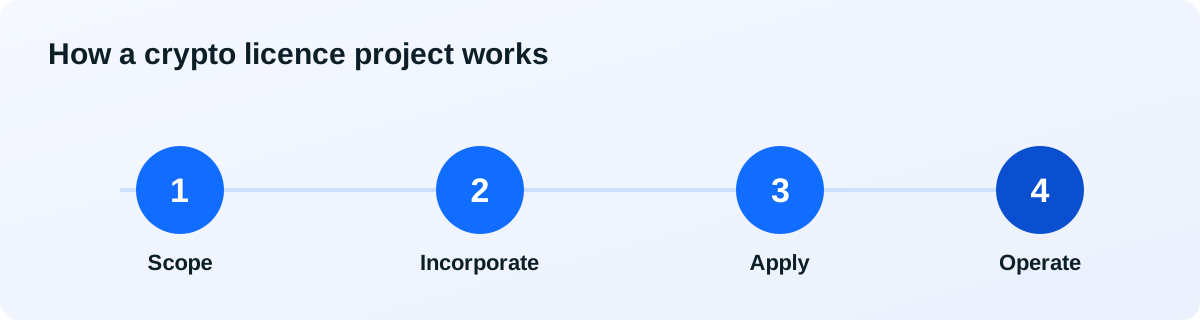
Obtaining a croatia crypto license involves several stages. Here is the typical process:
- Pre-application preparation: Define your business model, select the CASP services, and prepare a detailed business plan. Engage legal counsel and compliance experts.
- Company incorporation: Register a legal entity in Croatia (usually a limited liability company, d.o.o.). The minimum share capital is EUR 2,500, but higher capital may be needed for the license.
- Documentation: Prepare AML/KYC policies, risk management framework, IT security policy, business continuity plan, and governance documents. All must be in Croatian or certified translation.
- Submission: Submit the application to HANFA with all required documents and the application fee. HANFA will review and may request additional information.
- Assessment: HANFA evaluates the application, including fit and proper checks on management and shareholders. This stage may take 3-6 months.
- Approval: If successful, HANFA issues the CASP registration. You can then begin operations.
Consulting24 coordinates each step, liaising with HANFA and local partners to ensure a smooth process. For a faster route, some businesses consider Panama or other jurisdictions, but the croatia crypto license offers EU passporting.
Banking & Payment Services for Crypto License Holders
One of the biggest challenges for crypto businesses is obtaining a bank account. In Croatia, several banks are open to working with licensed CASPs, but due diligence is rigorous. Banks typically require proof of license, AML policies, and a track record of compliance. As of 2026, some banks offer dedicated accounts for crypto firms, but they may impose transaction limits and higher fees.
Alternative payment services include EMI (Electronic Money Institution) accounts and payment processors that specialise in crypto. Consulting24 advises on banking strategies, including which banks in Croatia are most crypto-friendly and how to present your business to meet their requirements. We also help with setting up payment gateways for fiat on-ramps.
Benefits of the Croatia Crypto License
Choosing the croatia crypto license offers several advantages:
- EU passporting: Serve clients across the entire EU single market without additional licenses.
- Competitive tax rate: Corporate tax as low as 10% for smaller companies.
- Regulatory clarity: MiCA provides a clear, harmonised framework.
- Growing ecosystem: Croatia has a developing tech and startup scene, with access to EU talent.
- Cost-effective: Compared to other EU jurisdictions like Malta or Luxembourg, Croatia offers lower setup and operational costs.
However, the license is not for everyone. If speed is critical, you might consider Panama (flat EUR 6,000, faster timeline) or Lithuania. Consulting24 provides a free initial consultation to help you weigh the options.
Compliance & Trust: Ongoing Obligations
Once licensed, CASPs must adhere to ongoing compliance requirements. These include:
- Annual AML/CFT audits
- Regular reporting to HANFA on financials, transactions, and suspicious activities
- Maintaining minimum capital at all times
- Appointing a compliance officer and AML officer
- Conducting regular risk assessments
Failure to comply can result in fines, suspension, or revocation of the license. Consulting24 offers ongoing compliance support, including outsourced AML officer services and reporting assistance. Note: This is general guidance, not legal advice. Always consult with a qualified legal professional for your specific situation.
Common Mistakes in the Application Process
Many applicants face delays or rejection due to common errors. Avoid these pitfalls:
- Incomplete documentation: Missing policies or insufficient detail in the business plan.
- Unclear source of funds: HANFA scrutinises the origin of capital and ownership structure.
- Weak AML/KYC framework: Policies must be strong and tailored to your business.
- Underestimating IT security: A security audit is often required; ensure you have appropriate measures in place.
- Choosing the wrong service class: Selecting a capital tier that does not match your intended activities can cause rework.
Consulting24 helps you avoid these mistakes by providing a checklist and reviewing your application before submission.
Alternatives to the Croatia Crypto License
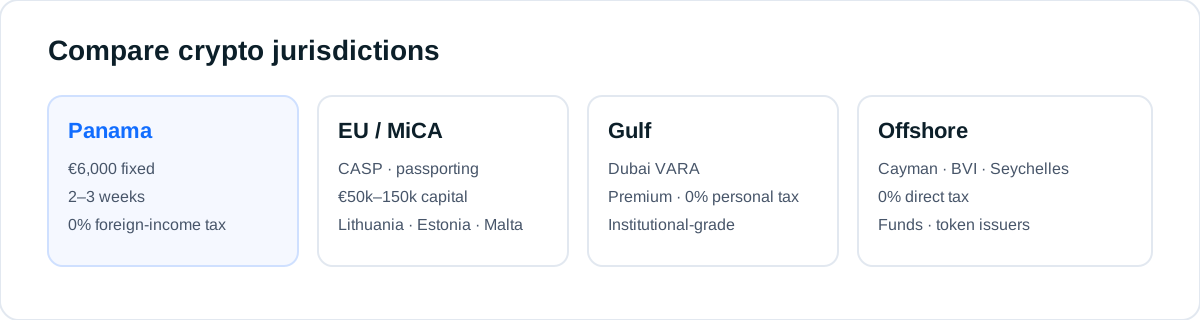
While the croatia crypto license is a solid choice, other jurisdictions may better suit your needs. Here is a comparison:
| Jurisdiction | Capital Requirement | Timeline | Tax Rate | EU Passport |
|---|---|---|---|---|
| Croatia (MiCA) | EUR 50k-150k | 3-6 months | 10-12% | Yes |
| Panama | None (EUR 6,000 flat fee) | 1-2 months | 0% offshore | No |
| Lithuania | EUR 125k (MiCA) | 3-6 months | 15% | Yes |
| Estonia | EUR 50k-150k (MiCA) | 3-6 months | 20% | Yes |
For non-EU businesses seeking speed and low cost, Panama is a popular alternative. However, it does not offer EU passporting. Consulting24 advises on the best jurisdiction based on your target market, budget, and timeline.
Why Work with Consulting24?
Consulting24 has obtained over 500 crypto licenses across multiple jurisdictions. For Croatia, we advise and coordinate the entire process. Our services include:
- Initial assessment and jurisdiction comparison
- Company incorporation in Croatia
- Preparation of all application documents
- Liaison with HANFA
- Ongoing compliance support
We do not just file paperwork; we provide strategic advice to ensure your license application is strong and your business is set up for success. Contact us for a free consultation to discuss your project.
Frequently asked questions
What is the difference between a Croatia crypto license and a simple registration?
Under MiCA, the Croatia crypto license is a full CASP authorisation, not a simple registration. It requires meeting capital, governance, and AML standards, and allows EU-wide passporting. A simple registration would not provide the same legal certainty or market access.
Can I apply for a Croatia crypto license as a non-EU company?
Yes, non-EU companies can apply by incorporating a subsidiary in Croatia. The subsidiary must have a physical office and local management. Consulting24 assists with company setup and the application process.
How long does the Croatia crypto license application take?
The typical timeline is 3 to 6 months from submission to approval. Preparation can take an additional 1-2 months. Delays can occur if documents are incomplete or if HANFA requests further information.
What are the capital requirements for a Croatia crypto license?
Minimum capital depends on services: EUR 50,000 for custody/transfer, EUR 125,000 for exchange, and EUR 150,000 for full-service platforms. These amounts must be maintained as own funds.
Is Croatia a tax-friendly jurisdiction for crypto businesses?
Yes, Croatia offers a corporate tax rate of 10% for companies with revenue up to EUR 1 million, and 12% above that. Crypto-to-crypto transactions are generally VAT-exempt. Individual investors benefit from a 12% capital gains tax on short-term holdings.
Can I passport my Croatia crypto license to other EU countries?
Yes, the Croatia crypto license allows passporting across the entire EU single market. You can serve clients in any member state without additional licensing, subject to notification to the host regulator.
What activities are NOT allowed under a Croatia crypto license?
The license does not cover security tokens, e-money tokens, or asset-referenced tokens, which fall under other EU regulations. Additionally, services like crypto lending may be restricted unless explicitly included in your license scope.
Do I need a local office in Croatia?
Yes, you need a registered office in Croatia. HANFA expects a physical presence, including a local compliance officer and management. Virtual offices are typically not accepted.
How much does the Croatia crypto license cost in total?
Total costs range from approximately EUR 14,500 to EUR 31,000, including government fees, legal advisory, AML setup, and IT audit. Ongoing annual compliance costs are EUR 5,000-10,000. Exact figures depend on your business complexity.
What happens if I operate without a Croatia crypto license?
Operating without a license is illegal and can result in fines, criminal charges, and forced cessation of activities. HANFA has enforcement powers under MiCA. Always ensure you are licensed before offering services.
Official sources
Related jurisdictions

Talk to a crypto-licensing expert
500+ licenses across Estonia, Lithuania, Panama and beyond. Tell us your model and we'll map the right route, honestly.
💬 Talk to an expertFree consultationGeneral guidance, not legal advice. Rules and fees evolve, and we confirm current requirements for your case.