Best Country for a Crypto License: Panama in 2026
Panama has emerged as the best country for obtaining a crypto license in 2026, offering a streamlined regulatory environment, zero capital requirements, and a flat fee of just EUR 6,000. For crypto founders seeking speed, cost-efficiency, and a business-friendly jurisdiction, Panama stands out among global options.
While many jurisdictions impose heavy capital thresholds and complex compliance, Panama's approach is refreshingly simple. Panama has no dedicated crypto licence or VASP register. Crypto firms operate as a Panama company and register with the UAF (Unidad de Análisis Financiero) for AML reporting under Law 23 of 2015. This means lower barriers to entry and faster time to market.
Consulting24 advises and coordinates the Panama company and AML setup, using our experience with 500+ licenses across Estonia, Lithuania, and other jurisdictions. We help you determine if Panama is the right fit and guide you through every step.
What Does Panama Offer for Crypto Firms?
Panama has no crypto licence. Crypto firms operate as a Panama company plus an AML/CFT programme, registering with the UAF for AML reporting under Law 23 of 2015, Panama's AML/CFT law. There is no separate virtual-asset licence; a company with a compliance programme can operate crypto-related services such as exchange, custody, and payment processing from Panama. A dedicated crypto framework is still in draft and is not yet law.
Panama's framework is unique because it does not impose a minimum capital requirement, making it one of the most accessible jurisdictions for startups and established firms alike. The process is straightforward: incorporate a Panama company, register with the UAF for AML, and comply with ongoing reporting obligations.
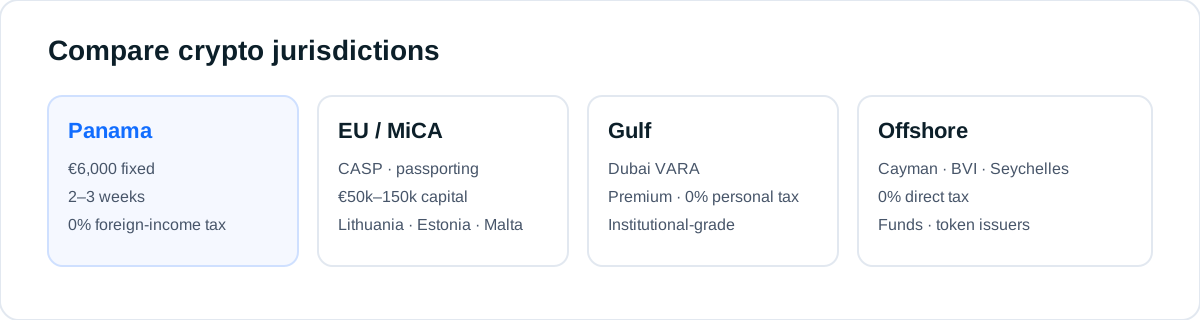
For founders comparing jurisdictions, Panama offers a compelling alternative to EU member states where MiCA is fully in force, requiring capital of EUR 50,000 to 150,000 depending on services. Panama's simplicity is a major advantage for those who want to launch quickly without a large upfront investment.
Who Needs a Panama Crypto Setup?
A Panama crypto company is ideal for:
- Crypto exchanges (centralized and decentralized) serving international clients
- Wallet providers and custodians
- Payment processors handling crypto transactions
- Token issuers and ICO/STO platforms
- DeFi protocols that require a corporate presence
It is particularly attractive for founders who want to avoid the high capital requirements of EU licenses (EUR 50,000-150,000 under MiCA) or the lengthy timelines of other jurisdictions. A Panama company and AML programme can be set up in 2-3 weeks, compared to 6-12 months in places like Lithuania or Estonia.
However, Panama is not suitable for firms that need to serve Panama's domestic market directly, as the regulator expects activities to be primarily international. If your target market is within the EU, you may need a license from an EU member state instead. Consulting24 can help you evaluate your specific needs.
Regulatory Status
Panama has no crypto licence or VASP registration. The SBP (Superintendencia de Bancos de Panamá) is Panama's bank regulator and does not license or oversee crypto activities. Crypto firms are treated as obligated entities and register with the UAF for AML reporting under Law 23 of 2015, Panama's AML/CFT law. A draft crypto framework is pending but is not yet in force.
There are no crypto licence tiers in Panama because there is no crypto licence at all. A single Panama company plus an AML/CFT programme covers your activities, unlike jurisdictions with multiple license tiers (e.g., exchange vs. custody). This simplicity reduces administrative burden and costs.
It's important to note that Panama is not a member of the EU, so MiCA does not apply. However, Panama has committed to FATF recommendations and has implemented anti-money laundering (AML) requirements. AML/CFT rules require registrants to have strong AML/KYC policies and a local compliance officer.
Cost and Timeline
The Panama crypto company setup has a flat fee of EUR 6,000 for Consulting24's service, which includes company incorporation and the AML registration process. This is significantly lower than the cost of licenses in other jurisdictions, where fees can range from EUR 10,000 to over EUR 50,000.
| Item | Cost (EUR) | Notes |
|---|---|---|
| Consulting24 service fee (all-in) | 6,000 | Includes company incorporation, registration, and initial compliance setup |
| Government fees | ~1,500-2,000 | Estimated, varies by company structure |
| Annual compliance costs | ~2,000-3,000 | AML officer, reporting, audit |
| Total first-year cost | ~8,000-11,000 | Excludes legal fees if additional support needed |
The timeline from engagement to a ready company is typically 2-3 weeks. This includes company incorporation (1-2 weeks) and preparation of AML/CFT policies with UAF registration (1-2 weeks). There is no separate crypto licence review. For comparison, EU licenses under MiCA can take 6-12 months.
Capital Requirement
Panama has no minimum capital requirement for a crypto company. This is a key differentiator from other jurisdictions. Under MiCA, EU member states require capital of EUR 50,000 for simple services (e.g., custody) up to EUR 150,000 for complex services (e.g., exchange and trading). Panama's zero capital requirement means you can allocate your funds to business growth rather than locking them up.
While there is no legal minimum, it is still sensible for a company to have sufficient capital to operate responsibly. Typically, a paid-up capital of USD 10,000-50,000 is recommended to demonstrate financial substance, but this is not a regulatory requirement. Consulting24 advises clients on appropriate capitalization based on their business model.
Tax Treatment
Panama operates a territorial tax system. Income earned outside Panama is not subject to Panamanian income tax. Since most crypto license holders serve international clients, their income is typically sourced outside Panama and therefore tax-free in Panama. This is a major advantage for founders looking to minimize tax burden.
There is no capital gains tax on crypto transactions in Panama, no VAT on crypto services (if provided to non-residents), and no withholding tax on dividends paid to foreign shareholders. However, income sourced within Panama (e.g., from Panamanian residents) is taxed at 25% corporate income tax.
Founders should still consult with a tax advisor to ensure compliance in their home country. Panama's tax regime is transparent and favorable, but it does not automatically exempt you from taxes elsewhere.
Allowed Activities
A Panama crypto company can support the following activities:
- Exchange of virtual assets for fiat currency or other virtual assets
- Custody and safekeeping of virtual assets
- Virtual asset payment services (issuance, processing, settlement)
- Token issuance and distribution (including ICOs/STOs)
- Operation of a virtual asset trading platform (centralized or decentralized)
Because there is no crypto-specific licence, take care with activities that may trigger other Panamanian financial rules, such as lending or borrowing of virtual assets, derivatives trading, and anything that violates AML laws. Services to Panamanian residents may require additional local licensing.
If you plan to offer services that require a MiCA license to EU residents, Panama may not be sufficient. However, for non-EU markets, Panama's registration is widely accepted.
Step-by-Step Process
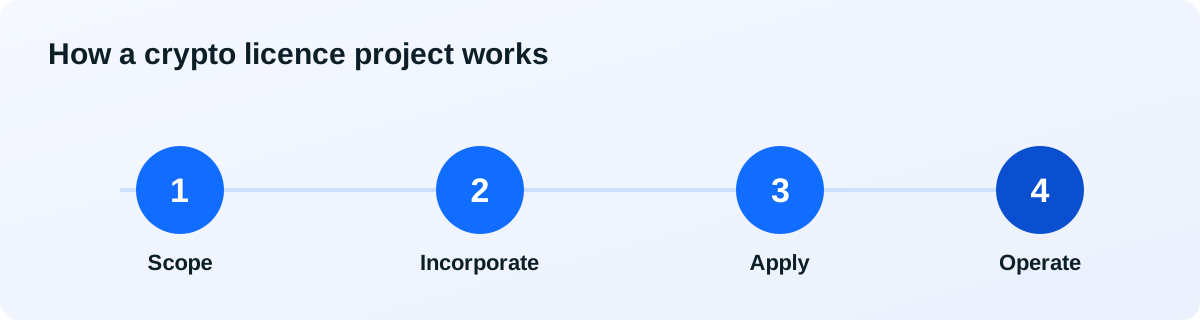
Setting up a Panama crypto company involves the following steps:
- Company Incorporation: Register a Panama corporation (Sociedad Anónima) with a local registered agent. This takes 1-2 weeks.
- Document Preparation: Prepare AML/KYC policies, business plan, organizational structure, and due diligence on directors and shareholders. Consulting24 assists with templates and review.
- UAF Registration: Register the company as an obligated entity with the UAF (Unidad de Análisis Financiero) for AML reporting under Law 23 of 2015.
- AML Programme Setup: Implement your AML/CFT programme and appoint a local compliance officer.
- Commence Operations: With the company and AML programme in place, you can begin operating crypto-related services.
- Ongoing Compliance: Submit required reports, maintain AML/KYC records, and keep a local compliance officer in place.
Consulting24 manages the entire process, from company setup to UAF registration. We also advise on banking and payment integration.
Banking and Payments
Opening a bank account for a Panama crypto company can be challenging due to global de-risking. However, Panama has a developed banking sector with several banks that accept crypto-related businesses, provided they have proper compliance. Consulting24 can introduce clients to banks in Panama and other jurisdictions that are crypto-friendly.
For payment processing, many Panama crypto companies use third-party payment gateways or partner with banks in jurisdictions like Lithuania or Estonia. Some opt for multi-jurisdictional structures, e.g., a Panama company with a Lithuania crypto license for EU payments.
It's important to have a clear banking strategy before applying. Consulting24 advises on the best approach based on your target markets and transaction volumes.
Benefits of Panama Crypto Registration
Panama offers several advantages that make it the best country for a crypto license in 2026:
- Low cost: Flat fee of EUR 6,000, no capital requirement, minimal ongoing costs.
- Fast timeline: 2-3 months from start to registration.
- Tax efficiency: Territorial taxation, no capital gains tax, no VAT on international services.
- Simplicity: A single company plus an AML programme covers your activities, no multiple license tiers.
- Privacy: Panama has strong corporate privacy laws, with bearer shares and nominee directors available (though bearer shares are being phased out).
- Stable jurisdiction: Panama has a stable political and economic environment, with the US dollar as official currency.
Compared to EU jurisdictions, Panama is more accessible for startups. However, it may not be suitable for firms targeting EU customers due to MiCA requirements.
Compliance and Trust
While Panama has no crypto licence, AML/CFT compliance is still mandatory. Under Law 23 of 2015, obligated entities must implement AML/KYC procedures, appoint a local compliance officer, and file reports with the UAF. Failure to comply can result in fines or penalties.
Consulting24 helps clients establish a compliance framework that meets Panama's AML/CFT standards under Law 23 of 2015. We also recommend engaging a local AML officer who understands Panamanian regulations. This is general guidance, not legal advice. Each company should consult with a qualified lawyer.
Trust is built through transparency. Panama's regulatory framework is recognized by FATF, and the SBP is a member of the International Association of Insurance Supervisors (IAIS) and other bodies. While not as strict as EU regulators, Panama's regime is credible for international operations.
Common Mistakes to Avoid
Founders often make these mistakes when setting up a Panama crypto company:
- Assuming no compliance needed: Even without capital requirements, AML/KYC policies are mandatory. Neglecting them can lead to rejection.
- Ignoring banking: Without a bank account, you cannot operate. Plan banking early.
- Not understanding territorial tax: If you have income from Panama sources, you must pay tax. Ensure your business model is international.
- Choosing a cheap registered agent: A poor agent can delay incorporation and cause compliance issues. Use a reputable firm.
- Overlooking EU restrictions: If you plan to serve EU clients, Panama registration alone may not be sufficient. Consider a dual-license strategy.
Consulting24 helps you avoid these pitfalls with expert guidance tailored to your business.
Panama vs Other Jurisdictions
When comparing Panama to other popular crypto licensing destinations, several differences emerge:
| Jurisdiction | Cost (EUR) | Capital Required | Timeline | Tax |
|---|---|---|---|---|
| Panama | 6,000 | None | 2-3 weeks | Territorial (0% on foreign income) |
| Estonia | ~15,000-25,000 | EUR 12,000 (minimum) | 3-6 months | 20% corporate tax on distributed profits |
| Lithuania | ~10,000-20,000 | EUR 2,500 (minimum) | 3-6 months | 15% corporate tax |
| Dubai (VARA) | ~30,000-50,000+ | Variable (often >USD 100,000) | 6-12 months | 0% corporate tax (free zone) |
Panama is the clear winner for cost and speed, but may lack the regulatory recognition of EU licenses. For founders targeting EU markets, a license from Lithuania or Estonia might be better. Consulting24 advises on the optimal jurisdiction based on your needs.
Why Choose Consulting24
Consulting24 has obtained over 500 crypto licenses across multiple jurisdictions. For Panama, we provide end-to-end service including company incorporation, UAF registration for AML, compliance setup, and banking introductions. Our flat fee of EUR 6,000 is transparent with no hidden costs.
We also advise on multi-jurisdictional strategies, such as combining a Panama company with a Poland crypto license for EU access. Our team of experts stays up to date with regulatory changes in 2026, including MiCA implementation.
Contact us for a consultation to discuss your project. We will help you determine if Panama is the best country for your crypto license and guide you through the process.
Frequently asked questions
Does Panama issue a crypto license?
No. Panama has no dedicated crypto or VASP license. Crypto firms operate as a Panama company and register with the UAF for AML reporting under Law 23 of 2015. This keeps costs and timelines low, but there is no crypto-specific authorisation. AML/KYC compliance and record-keeping are still required.
Can I serve EU customers with a Panama company?
A Panama company does not automatically comply with MiCA. If you target EU residents, you may need a license from an EU member state. However, Panama can be used for non-EU markets or as part of a multi-jurisdictional structure.
How long does the Panama setup take?
Typically 2-3 weeks from engagement, covering company incorporation and preparation of the AML/CFT programme and UAF registration. There is no separate crypto licence to apply for.
Is there a minimum capital requirement for a Panama crypto company?
No, Panama has no minimum capital requirement. However, it is advisable to have sufficient capital to demonstrate financial substance, typically USD 10,000-50,000.
What taxes will I pay in Panama?
Panama has a territorial tax system. Income from foreign sources is tax-free. Income from Panamanian sources is taxed at 25% corporate tax. There is no capital gains tax on crypto and no VAT on international services.
Can I open a bank account for my Panama crypto company?
Yes, but it can be challenging. Consulting24 can introduce you to banks in Panama and other jurisdictions that accept crypto businesses. A strong compliance framework is essential.
What activities need care under a Panama crypto company?
Because there is no crypto-specific licence, take care with activities that may trigger other Panamanian financial rules, such as lending, borrowing, and derivatives trading. Services to Panamanian residents may be restricted. AML/CFT obligations under Law 23 of 2015 always apply.
Do I need a local compliance officer in Panama?
Yes. As an obligated entity under Law 23 of 2015, a Panama crypto company needs a local compliance officer to oversee AML/KYC procedures and UAF reporting. Consulting24 can help you find a qualified professional.
How does Panama compare to Estonia for crypto licensing?
Panama is cheaper (EUR 6,000 vs. EUR 15,000-25,000) and faster (2-3 weeks vs. 3-6 months), with no capital requirement. Estonia has a more established regulatory framework and is recognized in the EU. Choose based on your target market.
Is Panama recognized by FATF?
Panama is a member of FATF and has implemented AML standards. However, Panama has been on the FATF grey list in the past. As of 2026, it is not on the grey list, but compliance is taken seriously.
Official sources
Related jurisdictions

Talk to a crypto-licensing expert
500+ licenses across Estonia, Lithuania, Panama and beyond. Tell us your model and we'll map the right route, honestly.
💬 Talk to an expertFree consultationGeneral guidance, not legal advice. Rules and fees evolve, and we confirm current requirements for your case.