Best Country for a Crypto License: Czech Republic in 2026
The Czech Republic has become a top destination for crypto licensing in 2026, thanks to its clear regulatory framework under the Czech National Bank (CNB) and full alignment with the EU's MiCA regime. For crypto founders seeking a stable, compliant, and business-friendly environment within the European Union, the Czech Republic offers a compelling balance of cost and regulatory clarity. This guide covers everything you need to know about the Czech crypto license, including who needs it, costs, timeline, tax treatment, and how it compares to other jurisdictions like Panama.
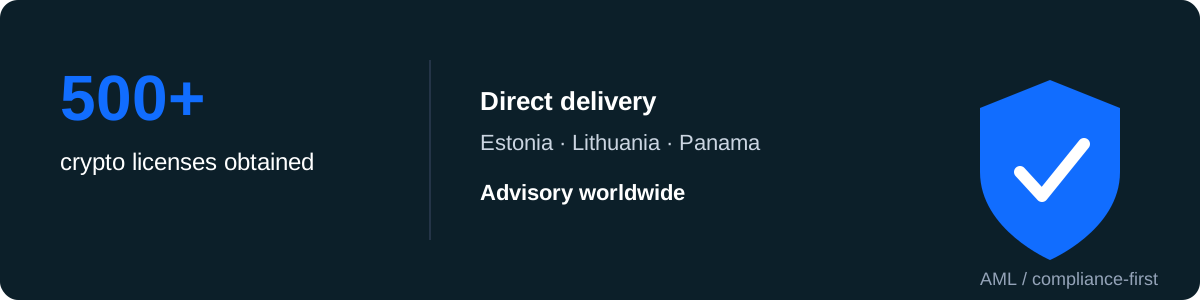
At Consulting24, we advise and coordinate crypto licensing across multiple jurisdictions. While we deliver directly in Estonia, Lithuania, and Panama, for the Czech Republic we provide expert guidance to help you handle the process smoothly. Whether you are a startup or an established exchange, understanding the Czech approach is essential for making an informed decision. Our team has helped over 500 clients obtain crypto licenses globally, and we bring that expertise to every engagement.
What Is the Czech Republic Crypto License?
The Czech Republic crypto license is not a single license but a registration requirement for virtual currency service providers. Under the Act on Selected Services of the Information Society, entities offering crypto exchange, custody, or wallet services must register with the Czech National Bank (CNB). As of 2026, this registration is fully aligned with the EU's MiCA regulation, meaning compliance with capital, AML, and governance standards is mandatory. The registration is valid for the entire EU under the MiCA passporting regime, allowing you to serve clients across all member states without additional licensing.
The CNB oversees the registration process and subsequent supervision. Unlike some EU jurisdictions that require a full license, the Czech Republic uses a registration model that is less burdensome but still rigorous. This makes it an attractive option for companies that want to operate within the EU without the high costs of a full license in Malta or Luxembourg. The registration is not a license per se, but it grants the legal right to operate and is recognized across the EU under MiCA's single passport.
Who Needs a Czech Republic Crypto License?
Any business that provides virtual currency services in the Czech Republic or to Czech residents must register with the CNB. This includes:
- Cryptocurrency exchanges (fiat-to-crypto and crypto-to-crypto)
- Custodial wallet providers
- Brokerage services
- Payment services involving virtual currencies
- Initial coin offering (ICO) platforms (if offering exchange services)
- Automated teller machines (ATMs) for crypto
If you are a founder looking to serve the European market, the Czech registration is a practical entry point. It is also suitable for startups that want to test the waters before scaling to a full license in Lithuania or Estonia. The registration is mandatory even if you are based outside the Czech Republic but offer services to Czech residents. Non-compliance can result in fines and legal action.
License Type and Regulator
The Czech Republic does not issue a traditional license but requires registration as a Virtual Currency Service Provider (VCSP). The regulator is the Czech National Bank (CNB), which also supervises compliance with AML and MiCA requirements. The registration is not a license per se, but it grants the right to operate legally. Under MiCA, the Czech registration falls under the CASP (Crypto Asset Service Provider) category. This means that from 2026, all registered entities must comply with EU-wide standards, including capital requirements, consumer protection, and transparency.
The CNB is the competent authority for supervision, and it cooperates with other EU regulators through the European Securities and Markets Authority (ESMA). The CNB has a reputation for being pragmatic and business-friendly, but it expects thorough compliance. The registration process involves a detailed review of your business plan, AML policies, and governance structure. Once registered, you are subject to ongoing supervision, including regular reporting and audits.
Cost and Timeline for Czech Crypto Registration
The cost of obtaining Czech crypto registration varies based on the complexity of your business model and the need for legal assistance. Below is an indicative table:
| Item | Estimated Cost (EUR) |
|---|---|
| Government registration fee | Approx. 1,000 - 2,000 |
| Legal and compliance setup | 5,000 - 15,000 |
| AML/KYC policy development | 2,000 - 5,000 |
| Bank account setup (if needed) | 500 - 2,000 |
| Translation and notarization | 500 - 1,500 |
| Total estimated range | 8,500 - 24,000 |
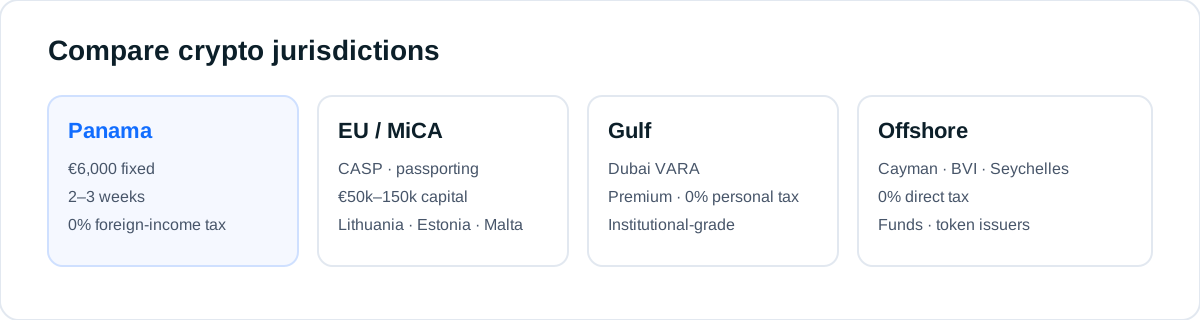
Timeline: Typically 3-6 months from application to registration. This includes document preparation, CNB review, and any follow-up questions. The timeline can be shorter if your application is complete and you have all documents ready. For comparison, Panama offers a flat EUR 6,000 fee with a faster process (1-2 months), but without EU passporting rights. The Czech registration is more expensive but provides access to the entire EU market.
Capital Requirement
Under MiCA, the Czech Republic applies capital requirements based on the services offered. For 2026, the minimum capital tiers are:
- EUR 50,000 for simple exchange services (e.g., crypto-to-fiat exchange only)
- EUR 125,000 for custody and exchange combined (e.g., exchange plus custodial wallet)
- EUR 150,000 for more complex services including trading platforms or multiple service types
These figures are subject to confirmation during your consultation, as the exact amount depends on your specific business activities. The capital must be maintained as own funds and cannot be used for operational expenses. It must be held in a bank account or liquid assets. The capital requirement is a key differentiator from non-EU jurisdictions like Panama, which has no minimum capital. However, the capital is a one-time requirement and can be used as working capital once the registration is active, subject to CNB approval.
Tax Treatment for Crypto in the Czech Republic
The Czech Republic has a favorable tax regime for crypto. As of 2026, capital gains from crypto held for more than 3 years are tax-exempt for individuals. For corporate entities, crypto gains are taxed as ordinary income at the standard corporate tax rate of 19%. VAT is not applied to crypto transactions, aligning with EU guidelines. However, mining and staking rewards are considered income and taxed accordingly at the corporate rate.
For individuals, the 3-year holding period exemption is a significant benefit, encouraging long-term investment. For companies, the 19% rate is competitive within the EU. It is advisable to consult with a local tax advisor to optimize your structure. Compared to other jurisdictions, the Czech tax treatment is competitive, especially for long-term holders. However, tax obligations vary by residency and business structure, so professional advice is essential.
Allowed Activities Under the Czech Registration
Registered VCSPs can engage in the following activities:
- Exchange of virtual currencies for fiat money
- Exchange of virtual currencies for other virtual currencies
- Custodial wallet services
- Transfer services of virtual currencies
- Participation in ICOs (as a service provider)
- Operation of crypto ATMs
Activities such as crypto derivatives trading or lending may require additional authorization under MiFID II. The CNB provides guidance on the scope of activities, and we recommend clarifying your business model during the application process. If you plan to offer services beyond the standard list, you may need a separate license under Czech financial law. The registration is limited to virtual currency services and does not cover securities or commodities.
Step-by-Step Application Process
The process for Czech crypto registration involves several steps:
- Preparation: Define your business model, prepare AML/KYC policies, and gather corporate documents (e.g., articles of association, proof of registered office, and identification of beneficial owners).
- Legal review: Engage a local lawyer to ensure compliance with Czech law and MiCA. This includes reviewing your policies and corporate structure.
- Application submission: File the registration application with the CNB, including all required documents and evidence of capital. The application must be in Czech or accompanied by a certified translation.
- CNB review: The CNB examines the application, which may take 2-4 months. They may request additional information or clarifications. Respond promptly to avoid delays.
- Approval: Once approved, you receive a registration number and can commence operations. The CNB will issue a certificate of registration.
- Ongoing compliance: Submit regular reports to the CNB, including AML reports and financial statements. Maintain your AML policies and conduct periodic audits.
For a detailed guide, see our application process page. The entire process can take 3-6 months, depending on the completeness of your application and the CNB's workload.
Banking and Payment Services for Crypto Firms
Opening a bank account for a crypto business in the Czech Republic can be challenging due to risk aversion. However, several banks and fintechs accept crypto firms with proper registration. Options include:
- Local Czech banks (e.g., CSOB, Komercni Banka) - require full registration and compliance, and may take 2-4 months to open an account.
- EMI (Electronic Money Institutions) like Revolut or Paysera - faster setup but may have transaction limits.
- Specialized crypto-friendly banks in Lithuania or Estonia - often used by Czech-registered firms for payment processing.
We advise starting the banking process early, as it may take 2-4 months. Consulting24 can recommend partners based on your needs. Some banks require a minimum deposit or turnover, so be prepared to provide financial projections. Payment services like fiat on-ramps are also available through third-party processors.
Benefits of the Czech Republic for Crypto Licensing
The Czech Republic offers several advantages:
- EU passporting: Registration allows you to serve clients across the EU under MiCA, without additional licensing in each member state.
- Cost-effective: Lower costs compared to Malta or Luxembourg, with total setup costs typically between EUR 8,500 and 24,000.
- Stable regulatory environment: Clear rules and a pragmatic regulator, the CNB, which is known for its thorough but fair approach.
- Tax benefits: 3-year holding exemption for individuals and a competitive corporate tax rate of 19%.
- Skilled workforce: Strong tech talent pool in Prague, with many blockchain developers and fintech professionals.
- Central location: Geographically central in Europe, with good connectivity to other EU markets.
For founders seeking a balance between cost and compliance, the Czech Republic is a strong contender. Compare with Lithuania for another EU option.
Compliance and Trust: Why It Matters
Compliance is not just a legal requirement but a business asset. A registered crypto firm in the Czech Republic demonstrates to partners, banks, and customers that you meet EU standards. This trust can open doors to partnerships and funding. The CNB's supervision adds credibility, as it signals that your operations are transparent and compliant with AML and consumer protection rules.
Our compliance team ensures your policies are up to date with CNB and MiCA requirements. We provide templates for AML, KYC, and risk assessments. Note that this is general guidance and not legal advice. Always consult with a qualified attorney for your specific situation. Ongoing compliance includes regular reporting, transaction monitoring, and annual audits. Failure to comply can result in fines or revocation of registration.
Common Mistakes to Avoid
Founders often make these errors:
- Underestimating capital requirements: Ensure you have the required funds in place before applying. The capital must be in a bank account and cannot be borrowed.
- Incomplete AML policies: The CNB scrutinizes AML procedures; use professional templates and tailor them to your business model.
- Ignoring ongoing reporting: Registration is not the end; you must submit periodic reports to the CNB, including AML reports and financial statements.
- Choosing the wrong jurisdiction: Compare with Panama if you don't need EU passporting. Panama is cheaper and faster but offers no EU access.
- Delaying bank account opening: Start the banking process early, as it can take months. Without a bank account, you cannot operate.
- Not using a local lawyer: Czech law requires certain documents to be in Czech or notarized. A local lawyer ensures compliance.
Avoid these pitfalls by working with experienced advisors like Consulting24, who can guide you through the process.
Alternatives and Comparison: Czech Republic vs. Panama and Others
When choosing a jurisdiction, consider your target market and budget. Here is a comparison:
| Jurisdiction | Cost (EUR) | Timeline | EU Passport | Capital Required |
|---|---|---|---|---|
| Czech Republic | 8,500 - 24,000 | 3-6 months | Yes | 50k - 150k EUR |
| Panama | 6,000 flat | 1-2 months | No | None |
| Lithuania | 10,000 - 20,000 | 3-4 months | Yes | 40k - 150k EUR |
| Estonia | 15,000 - 25,000 | 2-4 months | Yes | 50k - 150k EUR |
If you need EU access, the Czech Republic is a cost-effective choice. For non-EU operations with minimal capital, Panama is simpler. Consulting24 can help you decide based on your specific needs. We also offer direct delivery in Estonia, Lithuania, and Panama.
Why Work with Consulting24 for Czech Crypto Licensing?
Consulting24 has extensive experience in crypto licensing across Europe and beyond. For the Czech Republic, we provide advisory and coordination services, connecting you with local legal experts and handling the compliance groundwork. Our team ensures your application is complete and compliant, reducing the risk of rejection. We have helped over 500 clients obtain crypto licenses globally, and we bring that expertise to every engagement.
We also deliver directly in Estonia, Lithuania, and Panama. If the Czech route is not ideal for your business, we can recommend alternative jurisdictions that better suit your needs. Contact us today to discuss your project and get a tailored quote.
Frequently asked questions
What is the difference between Czech registration and a full license?
The Czech registration is a lighter regulatory requirement compared to a full license in Malta or Luxembourg. It is a registration with the CNB, not a license, but it grants the right to operate and is recognized across the EU under MiCA. Full licenses often involve higher capital requirements and more extensive supervision.
Can I use the Czech registration to serve clients in other EU countries?
Yes, under MiCA passporting, a Czech-registered crypto service provider can serve clients in any EU member state without additional registration. This is a major advantage over non-EU jurisdictions like Panama.
What are the ongoing compliance requirements after registration?
You must submit regular reports to the CNB, including AML reports, financial statements, and transaction monitoring records. You also need to maintain your AML/KYC policies and conduct periodic audits. The CNB may conduct on-site inspections.
How long does the Czech crypto registration take?
Typically 3-6 months from application to approval. This includes document preparation, CNB review, and any follow-up questions. The timeline can be shorter if your application is complete and you have all documents ready.
Is there a minimum capital requirement for Czech crypto registration?
Yes, under MiCA, the minimum capital is EUR 50,000 for simple exchange services, EUR 125,000 for custody and exchange, and EUR 150,000 for complex services. These figures are subject to confirmation based on your business model.
Can I operate a crypto exchange in the Czech Republic without registration?
No, registration with the CNB is mandatory for any entity offering virtual currency services to Czech residents. Operating without registration is illegal and can result in fines and legal action.
What taxes apply to crypto in the Czech Republic?
Corporate crypto gains are taxed at 19%. Individuals benefit from a tax exemption on capital gains if the crypto is held for more than 3 years. Mining and staking rewards are taxed as income. VAT is not applied to crypto transactions.
How does the Czech Republic compare to Panama for crypto licensing?
Panama offers a flat fee of EUR 6,000 with no capital requirement and a faster timeline (1-2 months), but it does not provide EU passporting. The Czech Republic is more expensive and has capital requirements but allows access to the entire EU market.
Can Consulting24 help with Czech crypto registration?
Yes, Consulting24 provides advisory and coordination services for Czech crypto registration. We connect you with local legal experts, help prepare your application, and ensure compliance with CNB and MiCA requirements. We deliver directly in Estonia, Lithuania, and Panama.
What documents are needed for Czech crypto registration?
You need corporate documents (articles of association, proof of registered office), AML/KYC policies, business plan, evidence of capital, identification of beneficial owners, and a certified translation of documents into Czech. A local lawyer can assist with the process.
Official sources
Related jurisdictions

Talk to a crypto-licensing expert
500+ licenses across Estonia, Lithuania, Panama and beyond. Tell us your model and we'll map the right route, honestly.
💬 Talk to an expertFree consultationGeneral guidance, not legal advice. Rules and fees evolve, and we confirm current requirements for your case.