Do You Need a Crypto Licence, a Registration, or Just a Company? A Decision Guide for Founders

As a crypto founder in 2026, one of the first questions you face is whether your business needs a full licence, a simpler registration, or just a company structure. The answer depends on your services, target markets, and budget. This guide helps you decide, with clear criteria and real-world examples.
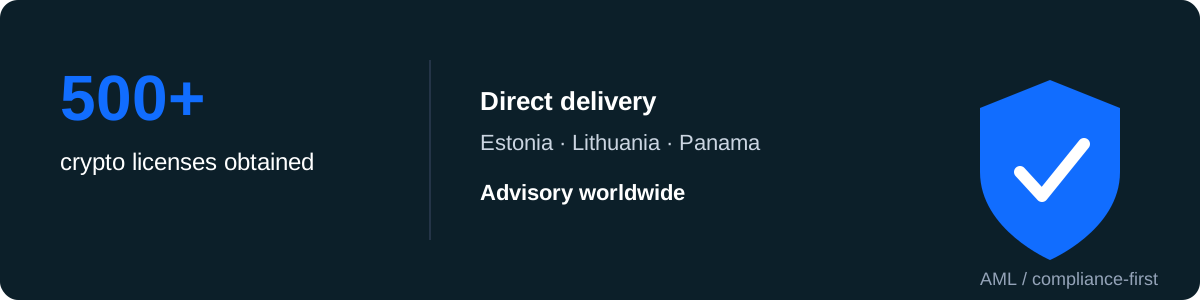
We cover the key factors: regulated activities (like custody or exchange) versus unregulated ones (like software development), the impact of MiCA in the EU, and cost-effective options like Panama. Consulting24 has helped over 500 crypto firms obtain the right authorisation, delivering directly in Estonia, Lithuania and Panama, and advising on other jurisdictions.
Overview: Licence vs Registration vs Company Only
In crypto regulation, three tiers exist. A licence is a full authorisation to provide regulated services (e.g., operating a crypto exchange, custody). A registration is a lighter touch, often for AML compliance but not full prudential supervision. A company alone is just a legal entity with no specific crypto authorisation.
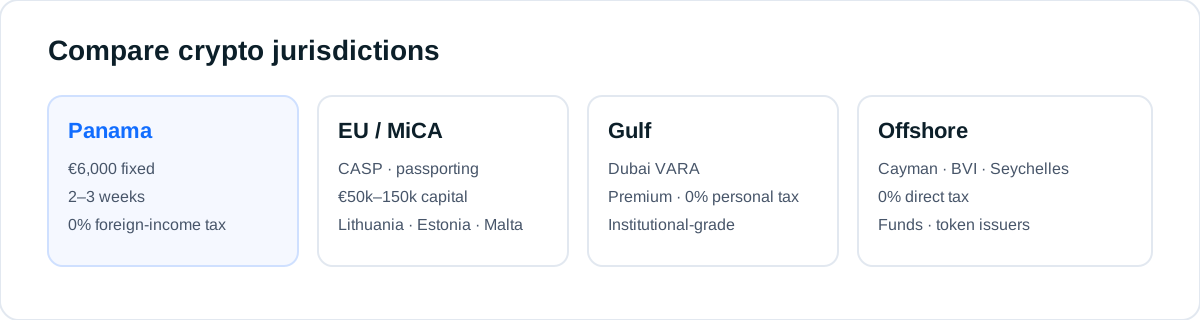
Your choice affects costs, timeline, and market access. For example, an EU CASP licence under MiCA allows passporting across the EU but requires EUR 50,000-150,000 capital. A simple company in Panama costs EUR 6,000 flat and lets you serve global clients without a licence for unregulated activities. But if you need to operate a crypto exchange in the EU, you must have a licence.
This guide walks you through the decision tree, referencing key jurisdictions like Lithuania, Estonia, and Panama.
Who Needs This Decision Guide?
This guide is for crypto founders who are unsure which regulatory path applies to their business model. You might be:
- A startup building a decentralised exchange (DEX) - do you need a licence?
- A payment processor integrating crypto - registration or licence?
- A blockchain development firm - just a company may suffice.
- A crypto fund manager - likely a licence or registration depending on jurisdiction.
If you are planning to offer services to EU residents, MiCA applies. If you target Asia or the Americas, different rules. Consulting24 helps you assess your specific situation and choose the right route, whether that is a full licence in Lithuania or a company in Panama.
License Types and Regulators
The type of authorisation depends on the regulator. In the EU under MiCA, the competent authority (e.g., Bank of Lithuania, Estonian FSA) issues a CASP licence. In Panama, the regulator is the Superintendencia de Bancos de Panamá (SBP) for crypto-related activities, but Panama does not have a dedicated crypto licence - instead, you operate under a standard company with AML compliance.
Key distinctions:
- EU CASP licence: Full prudential and AML supervision, capital requirements EUR 50k-150k, passporting rights.
- Estonia crypto licence: Pre-MiCA, now transitioning to CASP. Old licences are being replaced.
- Lithuania crypto licence: Active CASP regime with clear capital tiers.
- Panama company: No crypto-specific licence, but must register for AML if providing exchange or custody services to Panamanian residents.
For a detailed comparison, see our best country for crypto licence guide.
Cost and Timeline
| Jurisdiction | Type | Cost (EUR) | Timeline |
|---|---|---|---|
| Panama | Company (no licence) | 6,000 flat | 2-4 weeks |
| Lithuania | CASP licence | from 25,000 (incl. capital) | 3-6 months |
| Estonia | CASP licence | from 30,000 (incl. capital) | 3-6 months |
| Dubai (VARA) | Full licence | from 50,000 | 6-12 months |
Costs vary based on complexity. Consulting24 provides exact pricing in a consultation. For Panama, the EUR 6,000 includes company registration, AML compliance setup, and initial support. For EU licences, capital is held in a bank account and remains accessible.
Capital Requirement
Capital requirements are a key differentiator. Under MiCA, EU CASP licences have three tiers:
- EUR 50,000 for simple services (e.g., custody of crypto assets).
- EUR 125,000 for exchange services (fiat-crypto or crypto-crypto).
- EUR 150,000 for full services including trading on own account.
In Panama, there is no minimum capital for a company - you can start with as little as EUR 1. However, if you provide exchange services to Panamanian residents, you may need to register with the SBP and maintain a minimum capital of USD 10,000 (approx. EUR 9,200). This is not a licence but a registration.
For jurisdictions like Czech Republic or Poland, capital requirements vary. Always consult with experts to ensure compliance.
Tax Treatment
Tax is a critical factor. Panama is a territorial tax system - only income sourced in Panama is taxed. Crypto gains from abroad are tax-free. Corporate income tax is 25% on local income, but most crypto firms structure to have no local income. No capital gains tax, no VAT on crypto transactions.
In Lithuania, corporate tax is 15% (5% for small companies). Crypto gains are taxed as income. Lithuania has a favourable environment for crypto, but tax applies on worldwide income for tax residents.
Estonia has a 20% corporate income tax on distributed profits (0% on retained earnings). Crypto gains are taxed when distributed. Estonia also has no withholding tax on dividends.
Always get professional tax advice. Consulting24 can connect you with tax experts in each jurisdiction.
Allowed Activities
The activities you can perform depend on your authorisation. With a full EU CASP licence, you can:
- Operate a crypto exchange (fiat-crypto, crypto-crypto).
- Provide custody of crypto assets.
- Execute orders on behalf of clients.
- Place crypto assets (like an ICO or STO).
- Provide transfer services.
With a Panama company (no licence), you can:
- Develop blockchain software.
- Provide consultancy.
- Run a crypto mining operation.
- Operate a DEX (if no custody of user funds).
- Accept crypto payments for goods/services.
If you need to serve EU clients with exchange or custody, you need a licence. For non-regulated activities, a company suffices. See our exchange licence page for more details.
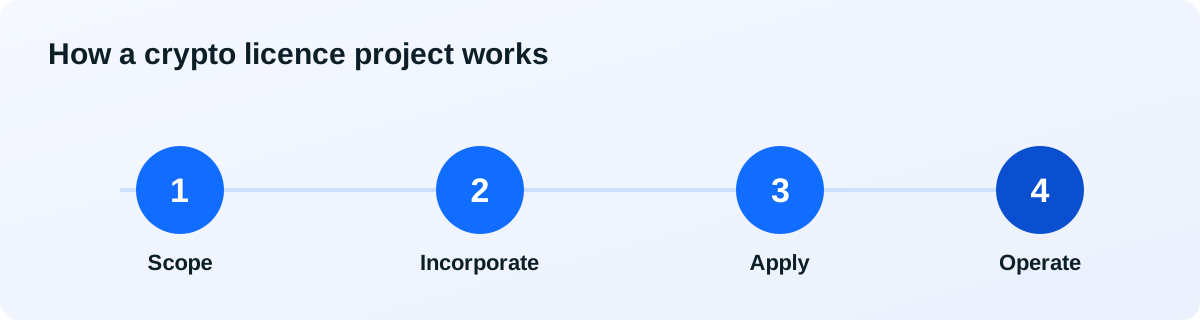
Step-by-Step Process
- Identify your services: List what you will do (exchange, custody, payments, software).
- Determine target markets: EU clients require a CASP licence; non-EU clients may not.
- Choose jurisdiction: Based on cost, timeline, and regulatory comfort. Panama for low cost and speed; Lithuania for EU passporting.
- Engage experts: Consulting24 handles the entire process for Panama, Lithuania, Estonia.
- Prepare documentation: Business plan, AML policies, financial projections, ownership structure.
- Submit application: To the regulator (e.g., Bank of Lithuania) or company registry (Panama).
- Set up banking: Open a corporate bank account. This can be challenging; we assist.
- Go live: Once approved, you can start operations.
For a detailed guide, see our application process page.
Banking and Payments
Banking is often the hardest part for crypto firms. Many traditional banks refuse to open accounts for crypto businesses. In Panama, local banks are more open, but due diligence is strict. Consulting24 has relationships with banks in Panama that accept crypto firms, provided you have proper AML compliance.
In Lithuania and Estonia, banks are cautious but there are fintech-friendly banks and EMI partners. Some require a minimum deposit and proof of licence. We recommend starting the banking process early.
For payment processing, you may need a payment institution licence or partner with a licensed provider. Our company setup service includes banking support.
Benefits of Each Option
- Panama company: Low cost (EUR 6,000), fast setup (2-4 weeks), no capital requirement, tax-free foreign income, no licence needed for many activities, stable legal system.
- EU CASP licence: Passporting across 27 EU countries, high trust with partners and banks, clear regulatory framework, access to European market.
- Registration (e.g., Estonia old licence): Lower cost than full licence, but limited to AML compliance; now being phased out under MiCA.
For a comparison, see our vs Lithuania page.
Compliance and Trust
Compliance is non-negotiable. Even if you only need a company, you must have AML/KYC procedures if you handle crypto for others. Panama requires AML registration for exchange and custody services. EU licences require ongoing reporting, audits, and compliance officers.
Trust is built through transparency. A licence signals to partners and customers that you are regulated. A Panama company with proper AML compliance can also be trusted if you are open about your structure.
This is general guidance, not legal advice. Always consult with a qualified lawyer for your specific situation.
Common Mistakes
- Choosing a licence when not needed: Paying EUR 50k+ in capital and fees when a company would suffice.
- Operating without any authorisation: Providing exchange services to EU clients without a licence can lead to fines.
- Ignoring tax implications: Not understanding tax residency and reporting obligations.
- Poor banking preparation: Not securing a bank account before applying for a licence.
- Using outdated information: Relying on pre-MiCA rules. Always check current requirements.
Consulting24 helps you avoid these pitfalls with expert advice.
Alternatives and Comparison
Besides Panama, other popular jurisdictions include:
- Lithuania: EU CASP licence, capital from EUR 50k, timeline 3-6 months, cost from EUR 25k. Good for EU market access.
- Estonia: Similar to Lithuania, but with higher costs and longer timelines. Old licences are being replaced.
- Dubai (VARA): Full licence for crypto activities, cost from EUR 50k, timeline 6-12 months. No corporate tax, but strict compliance.
- Switzerland: FINMA licence, high cost but strong reputation. Not for startups.
For most founders, Panama offers the best balance of cost, speed, and flexibility. If you need EU passporting, Lithuania is the best choice. Consulting24 delivers directly for Panama, Lithuania, and Estonia, and advises on others. See our jurisdictions page for a full list.
How Consulting24 Can Help
Consulting24 has obtained over 500 crypto licences worldwide. We deliver directly in Estonia, Lithuania, and Panama. For other jurisdictions, we advise and coordinate with local partners. Our services include:
- Company formation (Panama EUR 6,000 flat).
- Licence application management.
- AML compliance setup.
- Banking assistance.
- Ongoing compliance support.
We help you decide whether you need a licence, registration, or just a company. Contact us on WhatsApp or book a consultation to discuss your project.
Frequently asked questions
Do I need a crypto licence to accept Bitcoin payments for my online store?
If you only accept crypto as payment for goods or services and do not hold customer funds or exchange them, you likely do not need a licence. A simple company in Panama or elsewhere suffices. However, if you convert crypto to fiat for customers, you may need a payment service licence.
Can I operate a crypto exchange with just a Panama company?
If your exchange only serves non-EU clients and does not hold custody of user funds (e.g., a DEX), a Panama company may be enough. But if you hold customer assets or serve EU residents, you need a CASP licence under MiCA. Panama does not have a specific exchange licence, but AML registration may be required.
What is the difference between a licence and a registration in crypto?
A licence is a full authorisation with prudential supervision, capital requirements, and ongoing reporting. A registration is lighter, often only for AML compliance, with lower costs and fewer obligations. For example, the old Estonian licence was a registration; the new EU CASP licence is a full licence.
How much does a Panama company cost for crypto?
Consulting24 offers a Panama company for a flat fee of EUR 6,000. This includes company registration, AML compliance setup, and initial support. There is no minimum capital requirement. Additional costs may include bank account opening and annual fees.
Is a Panama company tax-free for crypto gains?
Panama has a territorial tax system. Income sourced outside Panama is not taxed. If your crypto activities are conducted abroad (e.g., trading on international exchanges), you pay no Panama tax. However, if you have local income (e.g., from Panamanian clients), it is taxed at 25%.
What is the minimum capital for an EU crypto licence in 2026?
Under MiCA, the minimum capital is EUR 50,000 for simple services (custody), EUR 125,000 for exchange services, and EUR 150,000 for full services including proprietary trading. These amounts must be held in a bank account and are not spent.
Can I passport my EU crypto licence to other EU countries?
Yes, a CASP licence from one EU member state allows you to provide services across the entire EU without additional licences. This is a major benefit of MiCA. You must notify your home regulator of your intention to passport.
How long does it take to get a crypto licence in Lithuania?
The typical timeline is 3 to 6 months from application submission to approval. This includes document preparation, background checks, and regulatory review. Consulting24 can expedite the process with proper preparation.
What happens if I operate without a required licence?
Operating without a required licence can result in fines, forced shutdown, and even criminal charges. Regulators like the Bank of Lithuania actively monitor the market. It is safer to obtain proper authorisation or choose a jurisdiction where no licence is needed, like Panama.
Do I need a licence for a crypto mining operation?
Crypto mining is generally not a regulated activity. You can operate a mining farm with just a company. However, if you also offer hosting or pool services, you may need a licence depending on the jurisdiction. In Panama, no licence is needed for mining.
Can Consulting24 help with banking for my crypto company?
Yes, Consulting24 assists with bank account opening in Panama, Lithuania, and Estonia. We have relationships with banks that accept crypto firms. Banking is included in our company setup and licence packages.
What is the cheapest way to start a crypto business in 2026?
The cheapest option is a Panama company at EUR 6,000 flat. This allows you to operate legally for many activities without a licence. If you need an EU licence, Lithuania offers the most cost-effective CASP licence with capital from EUR 50,000.
Official sources
Related jurisdictions

Talk to a crypto-licensing expert
500+ licenses across Estonia, Lithuania, Panama and beyond. Tell us your model and we'll map the right route, honestly.
💬 Talk to an expertFree consultationGeneral guidance, not legal advice. Rules and fees evolve, and we confirm current requirements for your case.