Panama AML/KYC Program: What You Actually Need in 2026

Panama has become a leading jurisdiction for crypto businesses seeking a straightforward, cost-effective licensing path. As of 2026, the Panama AML/KYC program is a key requirement for any crypto firm operating from or through Panama. This page explains exactly what the program entails, who needs it, and how to fulfil it efficiently.
Whether you are a crypto exchange, wallet provider, or DeFi project, understanding Panama's anti-money laundering and know-your-customer obligations is critical. The program is designed to align with international standards while keeping costs low. Consulting24 has helped over 500 firms obtain their Panama crypto license, and we break down the essentials here.
Panama's approach is unique because it does not have a dedicated crypto license. Instead, it uses a general business license combined with a mandatory AML/KYC program registration. This makes it one of the most flexible and affordable options globally. For founders who want to avoid the heavy capital requirements of EU MiCA jurisdictions, Panama offers a pragmatic alternative. Consulting24 delivers the Panama license directly, ensuring a smooth process from start to finish.
What is the Panama AML/KYC Program?
The Panama AML/KYC program is a regulatory framework that requires crypto service providers to implement strong anti-money laundering (AML) and know-your-customer (KYC) procedures. It is enforced by the Financial Analysis Unit (UAF) of Panama, which oversees compliance with Law 23 of 2015 and subsequent amendments. The program mandates that companies verify customer identities, monitor transactions, report suspicious activities, and maintain records for at least five years.
For crypto firms, the program is part of the licensing process. Without a compliant AML/KYC program, you cannot obtain or maintain a Panama crypto license. The requirements are similar to those in other jurisdictions but are tailored to Panama's legal environment. Consulting24 advises clients on building a program that meets both local and international expectations. The program covers risk assessment, customer due diligence (CDD), enhanced due diligence (EDD) for high-risk clients, and ongoing transaction monitoring. It also requires the appointment of a compliance officer and regular training for staff. Panama's framework follows FATF recommendations, so it is recognized globally. Consulting24 provides templates and guidance to help you draft a program that passes UAF scrutiny.
Who Needs a Panama AML/KYC Program?
Any crypto business that applies for a Panama crypto license must implement an AML/KYC program. This includes:
- Cryptocurrency exchanges (centralized and decentralized)
- Wallet providers
- Payment processors dealing in crypto
- Token issuers and ICO/STO platforms
- Crypto ATMs
- Any entity that transfers, stores, or exchanges virtual assets for customers
If your business involves holding customer funds or facilitating crypto transactions, you are subject to Panama's AML/KYC rules. Even if you operate remotely, the license requires a local presence and compliance infrastructure. Consulting24 helps firms determine whether they fall under the scope and how to proceed. For example, a DeFi protocol that only provides software and does not hold customer funds may not need the license, but if it offers custodial services, it does. Consulting24 offers a free scoping call to clarify your obligations. The program also applies to non-profit organizations that accept crypto donations if they operate as a money service business. Consulting24's experience with over 500 licenses means we can quickly assess your situation.
License Type and Regulator
Panama does not have a specific 'crypto license' per se. Instead, crypto businesses operate under a general business license combined with a mandatory AML/KYC program registration. The regulator is the Financial Analysis Unit (UAF) of Panama, which supervises AML compliance. The Superintendency of Banks and other financial regulators may also have oversight depending on the activities.
As of 2026, Panama is not an EU member, so MiCA does not apply. However, the country has its own AML laws that align with FATF recommendations. The license is obtained through a local legal representative and a registered agent. Consulting24 manages the entire process, from company setup to UAF registration. The UAF is the central authority for all AML matters, and it requires annual renewal of the program. Unlike EU jurisdictions where Lithuania and Estonia have specific crypto licenses under MiCA, Panama's approach is simpler. Consulting24 delivers directly in Panama, Estonia, and Lithuania, and advises on other jurisdictions.
Cost and Timeline
The Panama crypto license has a flat fee of EUR 6,000 for the license itself, covering the company setup and initial compliance. Additional costs include legal fees, registered agent services, and ongoing compliance costs. The timeline is typically 4-6 weeks for company incorporation and license approval, assuming all documents are in order.
| Item | Cost (EUR) | Timeline |
|---|---|---|
| License fee (flat) | 6,000 | N/A |
| Company incorporation | Included | 1-2 weeks |
| UAF registration | Included | 2-4 weeks |
| Annual compliance (estimated) | 2,000-4,000 | Ongoing |
| Registered agent (annual) | 500-1,000 | Ongoing |
| Legal fees (one-time) | 1,000-2,000 | First month |
These figures are based on current practices. Exact pricing is confirmed in a consultation with Consulting24. Compared to other jurisdictions, Panama is extremely cost-effective. For example, a Lithuania crypto license can cost EUR 15,000-25,000 and take 3-6 months. Panama's flat fee and fast timeline make it ideal for startups.
Capital Requirement
Panama has no statutory minimum capital requirement for crypto license applicants. However, firms must demonstrate sufficient financial resources to operate and maintain compliance. Typically, a paid-up capital of around USD 10,000 (approximately EUR 9,200) is recommended to show substance. This is significantly lower than EU jurisdictions where MiCA imposes capital tiers of EUR 50,000 / 125,000 / 150,000 depending on service class. Consulting24 advises clients on appropriate capital levels based on their business model.
For example, a small exchange with low transaction volume may only need USD 5,000, while a larger platform might require USD 20,000. The capital can be held in a Panama bank account or a recognized international bank. Consulting24 helps you determine the right amount and structure. The low capital requirement is a major advantage over EU jurisdictions like Estonia, which now requires EUR 100,000 under MiCA. Panama's flexibility allows you to allocate more funds to business development.
Tax Treatment
Panama operates a territorial tax system. Income earned outside Panama is not taxed. Crypto businesses that generate revenue from international clients typically pay no corporate income tax on that income. However, income sourced within Panama (e.g., from Panamanian residents) may be subject to local taxes. There is no VAT on crypto transactions, but a 7% ITBMS (transfer tax) may apply to certain services. Consulting24 recommends a tax review to ensure compliance. Panama also has no capital gains tax on crypto profits if the gains are from offshore sources.
For example, if your exchange serves customers worldwide but none in Panama, your revenue is tax-free. If you have a Panamanian client, only that portion is taxed. This is a powerful incentive for international crypto firms. Consulting24 works with local tax advisors to structure your operations optimally. Compare this to Lithuania where corporate tax is 15% on worldwide income, or Estonia where distributed profits are taxed at 20%. Panama's territorial system can save you significant amounts.
Allowed Activities Under the Panama License
The Panama crypto license permits a wide range of activities, including:
- Cryptocurrency exchange (fiat-to-crypto and crypto-to-crypto)
- Wallet services (custodial and non-custodial)
- Payment processing using virtual assets
- Token issuance and management
- Staking and lending platforms
- OTC trading desks
- Crypto ATM operation
- Initial exchange offerings (IEOs)
Activities that involve securities or derivatives may require additional regulation under Panama's securities laws. The license does not cover banking or deposit-taking. Consulting24 helps clients scope their activities to ensure they fall within the permitted range. For example, if you plan to offer margin trading, you may need to register with the Superintendency of Securities. Consulting24 provides a detailed activity checklist during the onboarding process. The wide scope means most crypto business models can operate under one license, unlike some jurisdictions that require separate licenses for each activity.
Step-by-Step Process to Obtain the License
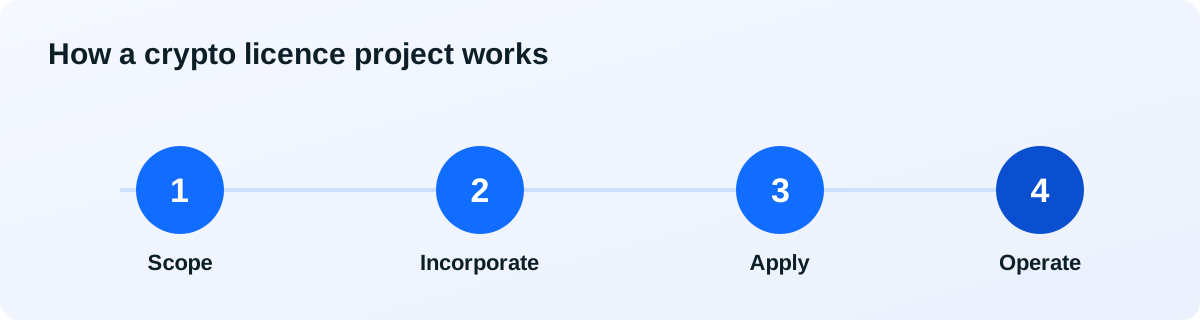
Obtaining a Panama crypto license involves the following steps:
- Company incorporation: Register a Panama corporation (Sociedad Anónima) with a local registered agent. This takes 1-2 weeks.
- AML/KYC program development: Draft policies covering customer due diligence, transaction monitoring, record keeping, and suspicious activity reporting. Consulting24 provides templates.
- Appoint a compliance officer: Designate a local or remote compliance officer responsible for AML oversight. The officer must have relevant experience.
- Submit to UAF: Register the AML program with the Financial Analysis Unit. This includes filing the program documents and paying a registration fee (included in the flat fee).
- Obtain business license: Secure the municipal business license (Aviso de Operación) from the municipality where your registered office is located.
- Open a bank account: Establish a corporate bank account in Panama or abroad. Consulting24 assists with introductions to crypto-friendly banks.
- Ongoing compliance: File annual reports, renew the AML program, and submit suspicious activity reports as needed.
Consulting24 handles each step, from document preparation to submission. The entire process typically takes 4-6 weeks. We have a dedicated project manager for each client to ensure milestones are met. For example, we recently helped a client incorporate in 5 days and obtain UAF approval in 3 weeks. Our streamlined process reduces delays.
Banking and Payment Integration
One of the challenges for crypto firms is banking. Panama has a well-developed banking sector, but many banks are cautious about crypto-related businesses. Consulting24 assists clients in opening accounts with crypto-friendly banks in Panama or internationally. We have relationships with banks that accept crypto license holders, such as Banco General and Towerbank, as well as international options like Bank Frick (Liechtenstein) and Clear Junction (UK). Payment integration for fiat on-ramps and off-ramps can be arranged through local payment processors like Transfast or through partnerships with payment gateways like Simplex or MoonPay.
It is advisable to have multiple banking relationships to mitigate risk. The Panama license itself does not guarantee banking, but our network helps streamline the process. Consulting24 also advises on payment integration for your platform, including compliance with card network rules if you accept credit cards. For example, we recently helped a client integrate with a Panamanian payment processor that supports SEPA and SWIFT transfers. We also provide guidance on setting up a corporate account with a digital bank like Mercury or Brex if you prefer a US-based solution.
Benefits of the Panama Crypto License
Key benefits include:
- Low cost: Flat fee of EUR 6,000, no hidden costs. This is the most affordable option among major crypto jurisdictions.
- Fast timeline: 4-6 weeks to license. You can be operational quickly.
- No minimum capital: Low barrier to entry. Recommended capital is only USD 10,000.
- Territorial tax: Offshore income is tax-free. No capital gains tax on crypto profits from foreign clients.
- Wide activity scope: Covers most crypto services under one license.
- Privacy: Panama has strong corporate privacy laws. Shareholder information is not publicly disclosed.
- No MiCA: Not subject to EU regulations, offering flexibility. You avoid the capital tiers and complex reporting of MiCA.
- Stable legal environment: Panama uses the US dollar as its currency, eliminating currency risk.
For startups and established firms alike, Panama offers a pragmatic alternative to more expensive jurisdictions like Lithuania or Estonia. Consulting24 has extensive experience in helping clients use these benefits. For example, a DeFi project we worked with saved over EUR 100,000 in capital requirements by choosing Panama over Lithuania.
Compliance and Trust: Maintaining Your License
Once licensed, ongoing compliance is essential. The UAF requires annual renewal of the AML program registration and submission of suspicious activity reports. Firms must conduct regular audits of their AML/KYC procedures. Failure to comply can result in fines or license revocation. Consulting24 provides ongoing compliance support, including policy updates, training, and audit preparation. Note: This is general guidance, not legal advice. Always consult a qualified attorney for your specific situation.
Key ongoing obligations include:
- Annual AML program review and update
- Quarterly transaction monitoring reports
- Immediate reporting of suspicious transactions
- Staff training at least once a year
- Record keeping for at least five years
- Notification of any changes in ownership or management
Consulting24 offers a compliance maintenance package that covers these requirements. We also help you prepare for UAF inspections, which can occur randomly. Our clients appreciate the peace of mind that comes with expert support. For example, we recently helped a client respond to a UAF data request within 24 hours, avoiding a potential fine.
Common Mistakes to Avoid
Many applicants make errors that delay or derail the process. Common mistakes include:
- Submitting incomplete or poorly drafted AML policies. Use templates from Consulting24 to avoid this.
- Failing to appoint a qualified compliance officer. The officer must have relevant experience and be able to demonstrate knowledge of AML regulations.
- Underestimating the importance of a local registered agent. The agent is your legal representative and must be licensed.
- Ignoring ongoing reporting obligations. Missing a deadline can result in fines.
- Choosing a non-compliant banking partner. Some banks may freeze accounts if they are not comfortable with crypto.
- Assuming the license covers all activities without checking. For example, if you plan to offer derivatives, you may need additional registration.
- Not conducting a proper risk assessment before drafting the AML program. The UAF expects a risk-based approach.
Consulting24 helps clients avoid these pitfalls by providing templates, checklists, and expert review. We have seen it all and can guide you around common traps. For instance, we recently corrected a client's AML policy that had omitted enhanced due diligence for politically exposed persons (PEPs), which would have been a red flag for the UAF.
Alternatives and Comparisons: Panama vs. Other Jurisdictions
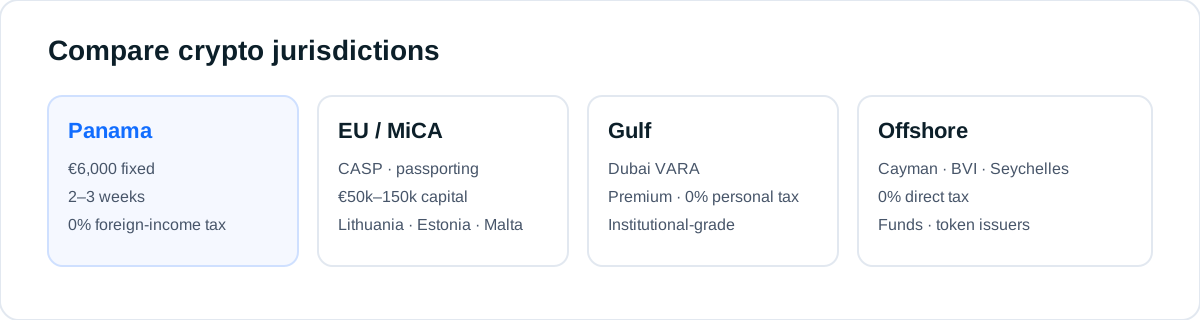
Panama is often compared to other crypto-friendly jurisdictions. Here is a quick comparison:
| Jurisdiction | Cost (EUR) | Timeline | Capital Requirement | Tax |
|---|---|---|---|---|
| Panama | 6,000 flat | 4-6 weeks | None (recommended USD 10k) | Territorial (offshore tax-free) |
| Lithuania | ~15,000-25,000 | 3-6 months | EUR 125,000 (MiCA) | 15% corporate tax |
| Estonia | ~10,000-20,000 | 2-4 months | EUR 100,000 (MiCA) | 20% corporate tax (distributed profits) |
| Dubai (VARA) | ~30,000-50,000 | 4-8 months | Variable (often >USD 100k) | 0% corporate tax (free zone) |
For those seeking a low-cost, fast option with minimal capital, Panama is hard to beat. However, if you need access to EU markets, a Lithuanian or Estonian license may be necessary. Consulting24 advises and coordinates for all jurisdictions, but delivers directly only for Panama, Estonia, and Lithuania. For other jurisdictions like Dubai, we help you choose the right route and set up where we operate. Panama remains our most popular choice for cost-conscious founders. If you need a license in Switzerland or Malta, we can coordinate with local partners.
Why Choose Consulting24?
Consulting24 (X24Consulting OU) has obtained over 500 crypto licenses worldwide. We deliver directly in Estonia, Lithuania, and Panama, and advise on all other jurisdictions. Our team of experts ensures your AML/KYC program meets regulatory standards. We handle everything from company setup to ongoing compliance. With a flat fee of EUR 6,000 for Panama, we offer transparency and value. Contact us today to start your application.
Our process is designed for founders who want to focus on their business, not paperwork. We provide a dedicated project manager, regular updates, and a clear timeline. Our clients range from solo entrepreneurs to established exchanges. We also offer post-license support, including banking introductions and compliance maintenance. To get started, book a consultation with our team. We will assess your business model, answer your questions, and provide a tailored proposal. No hidden fees, no surprises.
Frequently asked questions
What is the Panama AML/KYC program?
It is a regulatory framework requiring crypto firms to implement AML and KYC procedures. It is overseen by the Financial Analysis Unit (UAF) and includes customer verification, transaction monitoring, and suspicious activity reporting. The program must be registered with the UAF as part of the licensing process.
Who needs to comply with the Panama AML/KYC program?
Any crypto business holding a Panama license must comply. This includes exchanges, wallet providers, payment processors, token issuers, and crypto ATM operators. Even if you operate remotely, the license requires a local presence and a compliant AML program.
How much does the Panama crypto license cost?
The flat fee is EUR 6,000, which includes company incorporation and UAF registration. Additional annual costs include registered agent fees (EUR 500-1,000) and compliance maintenance (EUR 2,000-4,000). Exact pricing is confirmed in a consultation.
How long does it take to get a Panama crypto license?
Typically 4-6 weeks from start to finish. Company incorporation takes 1-2 weeks, and UAF registration takes 2-4 weeks. The timeline can be faster if all documents are in order.
Is there a minimum capital requirement for Panama?
No statutory minimum, but a recommended paid-up capital of USD 10,000 (approx. EUR 9,200) is advised to demonstrate financial substance. This is much lower than EU MiCA requirements.
What taxes will my crypto business pay in Panama?
Panama has a territorial tax system. Income from outside Panama is tax-free. Only income sourced within Panama may be taxed. There is no capital gains tax on offshore crypto profits. No VAT on crypto transactions, but a 7% ITBMS may apply to certain services.
What activities are allowed under the Panama license?
The license covers cryptocurrency exchange, wallet services, payment processing, token issuance, staking, lending, OTC trading, and crypto ATM operation. Activities involving securities or derivatives may require additional regulation.
Can I open a bank account with a Panama crypto license?
Yes, but it can be challenging. Consulting24 assists with introductions to crypto-friendly banks in Panama and internationally. Having multiple banking relationships is recommended.
What are the ongoing compliance requirements?
Annual renewal of the AML program with the UAF, quarterly transaction monitoring reports, immediate reporting of suspicious transactions, staff training, and record keeping for at least five years. Consulting24 offers a compliance maintenance package.
How does Panama compare to EU crypto licenses under MiCA?
Panama is cheaper (EUR 6,000 vs. EUR 10,000-25,000), faster (4-6 weeks vs. 2-6 months), and has no minimum capital (vs. EUR 50,000-150,000 under MiCA). However, Panama does not provide EU market access. For EU access, a Lithuanian or Estonian license is needed.
Does Consulting24 handle the entire process?
Yes. Consulting24 manages company incorporation, AML program drafting, UAF registration, and ongoing compliance. We also assist with banking introductions. We deliver directly in Panama, Estonia, and Lithuania, and advise on other jurisdictions.
Official sources
Related jurisdictions

Talk to a crypto-licensing expert
500+ licenses across Estonia, Lithuania, Panama and beyond. Tell us your model and we'll map the right route, honestly.
💬 Talk to an expertFree consultationGeneral guidance, not legal advice. Rules and fees evolve, and we confirm current requirements for your case.