How to Legally Launch a DeFi Project: Compare Key Risks and Choices

The biggest DeFi launch risk may sit outside the smart contract. To understand how to legally launch a DeFi project in 2026, assess the protocol’s functions, who controls it, its token and rewards, and the jurisdictions it will reach. Rules differ across countries, with securities, anti-money-laundering, and sanctions issues among the areas projects must account for.
A clean audit matters, but it doesn’t settle who can change the protocol or how regulators may view its operations. The practical task is to connect technical choices with legal exposure before launch, not treat compliance as a separate final step.
This guide compares blockchain and Layer 2 choices, audits and administrator keys, jurisdictional risk, token classification, and reward taxation. You’ll see what each decision changes, where the risks overlap, and how to use those criteria to shape a launch plan.
Key Takeaways
- Compare chains by fees, security assumptions, liquidity, and bridge exposure, not speed alone.
- Assess audit scope, bug-bounty coverage, administrator-key controls, and active governance as separate risk factors.
- Map the countries your project reaches against its functions, token design, and compliance responsibilities.
- Evaluate whether a token has practical use or depends mainly on buyers expecting others to drive its value.
- Build sanctions controls around the protocol’s actual points of control and access, then document how those controls work.

Audits and protocol administrator keys
Treat a smart contract audit as one control, not proof that a protocol is safe. Before launch, identify the contracts that hold funds, execute swaps, set fees, or manage upgrades. An audit examines specified code and reports findings. It does not establish who controls the protocol after deployment or how that operator may act.
Compare the audit’s scope with the system you plan to deploy. Match the contract names and versions in the report to the launch code, and check whether the review includes dependencies, upgrade mechanisms, and integrations such as decentralized exchanges or bridges. If the deployed code changes after the review, document the change and arrange an assessment of the affected logic.
Use this sequence to make the review actionable:
- List every contract that can move, freeze, or redirect user funds.
- Match each listed contract to an audit report and its reviewed code version.
- Sort findings by severity, then document fixes and retesting.
- Publish the report and explain unresolved findings in plain language.
Next, map administrator keys to their actual permissions. A key might pause deposits, change fees, upgrade a contract, or update an oracle address. For each control, record the permission, key holder, approval process, and emergency procedure. An upgradeable lending contract, for example, creates a different operator risk from deployed logic that cannot be changed. Neither design eliminates risk; each changes who can respond and what users must trust.
| Control option | Who can act | Key risk | Evidence to review |
|---|---|---|---|
| Single administrator key | One key holder | Compromise or unilateral change | Permission list and key custody process |
| Multisignature control | Several authorized signers | Signer coordination or collusion | Approval rules and signer roles |
| Governance-controlled changes | Token holders or delegates | Low participation or concentrated control | Proposal history and voting rules |
| Immutable deployment | No administrator for deployed logic | Limited ability to fix defects | Verified code and stated limits |
Choose a model by matching necessary emergency powers with transparent, reviewable controls, rather than relying on a claim that the protocol is decentralized.
A bug bounty provides another review channel, but does not replace a formal audit. Publish the eligible contracts, scope, and reporting process so researchers can identify valid issues. Check that the program remains active and that reported fixes appear in the deployed code. Governance also needs evidence: proposals, participation, and clear decision rules show whether oversight works in practice.
Distinguish code risk from operator risk in user disclosures. An audit may reduce uncertainty about the code it reviewed, but it does not address a compromised operator. Explain which administrator powers remain, how they are controlled, and what users could experience if those controls are misused. This gives users a concrete basis for assessing the protocol before depositing funds.
Choosing a blockchain for DeFi
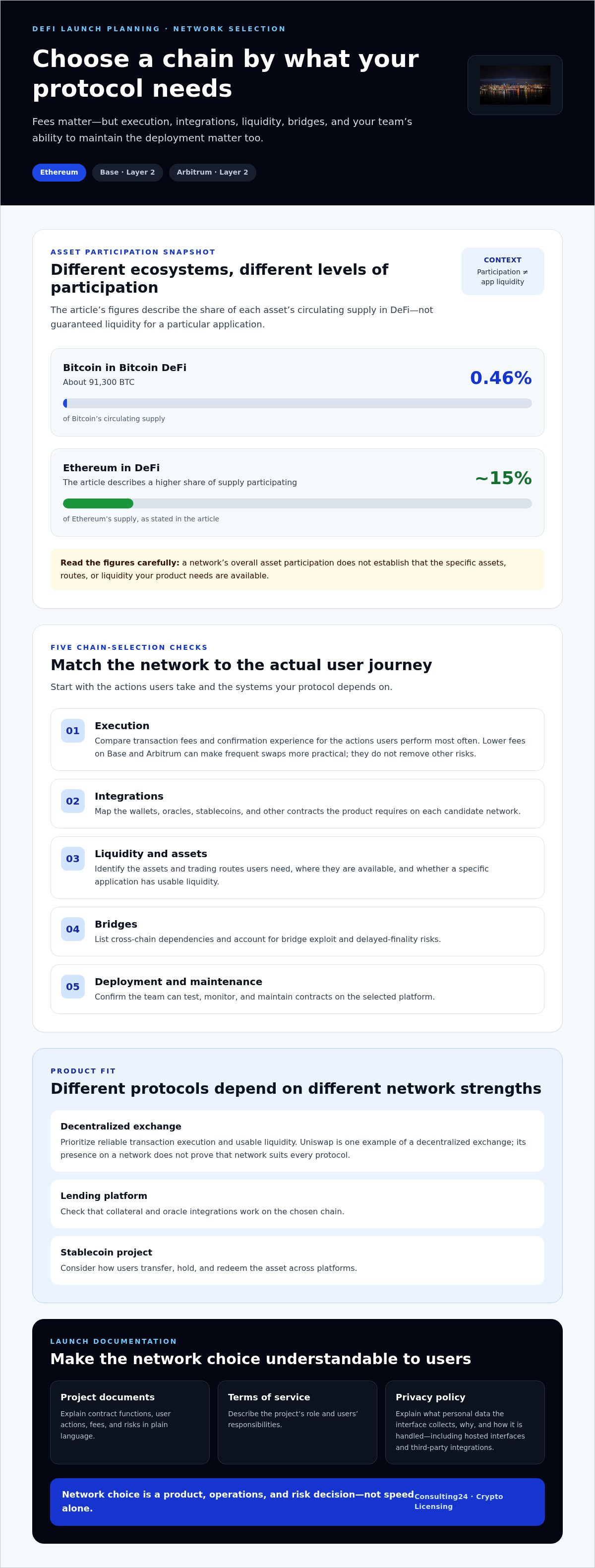
Choosing a blockchain is one step in how to legally launch a DeFi project in 2026. DeFi financial transactions run through blockchain-based smart contracts, so the network shapes execution, integrations, and user experience. Ethereum offers an established DeFi environment. Base and Arbitrum are Layer 2 options beginners are advised to consider for lower fees. Lower fees can make frequent swaps more practical, but they don’t remove contract, bridge, or liquidity risks.
Compare each network with the product’s requirements. A decentralized exchange needs reliable transaction execution and usable liquidity. A lending platform depends on collateral and oracle integrations that work on its chosen chain. A stablecoin project must consider how users transfer, hold, and redeem the asset across platforms. Uniswap is one example of a decentralized exchange. Its presence on a network can inform integration planning, but does not prove that the chain suits every protocol.
Asset availability can differ between ecosystems. About 91,300 BTC, or 0.46% of Bitcoin’s circulating supply, was in Bitcoin DeFi, compared with roughly 15% of Ethereum in DeFi. These figures show differing levels of asset participation, not guaranteed liquidity for a specific application. List the assets your product needs, where they are available, and whether users must rely on a bridge to access them.
Compare candidate chains using these criteria:
- Execution: Compare transaction fees and confirmation experience for the actions users take most often.
- Integrations: Map required wallets, oracles, stablecoins, and other contracts on each network.
- Liquidity: Assess whether the assets and trading routes users need are available.
- Bridges: Identify cross-chain dependencies and account for exploit and delayed-finality risks.
- Deployment: Confirm your team can test, monitor, and maintain contracts on the selected platform.
Project documentation should explain contract functions, user actions, fees, and risks in plain language. Terms of service should describe the project’s role and users’ responsibilities. A privacy policy should explain what personal data the interface collects, why it collects it, and how it is handled. Make sure these materials reflect the actual user journey, including any hosted interface or third-party integration.
The cost of legal and compliance support for a U.S. DeFi launch depends on the protocol’s functions, token model, operating structure, and scope of work. Pricing is provided after a quote request.
A useful chain-selection record links technical design to the product’s user and asset requirements. Teams planning how to legally launch a DeFi project in 2026 can treat chain, contract, and token choices as one operating model. Technical design decisions can be assessed together before deployment.

Regulatory uncertainty across jurisdictions
A DeFi protocol can reach users across borders without a centralized exchange or local office. Assess its functions, token, and control points in each target jurisdiction. Deployment on Ethereum or Solana alone does not settle the legal analysis.
Token Security Classification
For a U.S. launch, assess whether the token has practical use or is mainly speculative. Its label and blockchain do not determine its classification; its design and role in the project matter. This differs from sanctions analysis, which focuses on restricted parties and access, and operational rules, which depend on what the protocol does.
Map the token’s functions before distribution. Record whether it enables governance, access, or protocol use, and explain how it may gain value. Then compare those features with the project’s promotion and the expectations it creates for users. Calling a project decentralized does not remove securities-law questions if its token is mainly speculative.
Sanctions and OFAC Rules
Sanctions analysis concerns who can access or use a protocol, not whether its token is a security. DeFi projects face sanctions-related regulatory challenges, and a decentralized interface can still involve identifiable developers, operators, or maintainers. Map the project’s actual control points, including any hosted interface, upgrade authority, or service that can restrict access.
Document how the protocol addresses sanctions exposure in its operating model. Distinguish immutable smart-contract functions from centrally managed services, for example, and identify who can change or pause each service. Cross-border use makes this mapping important: effective enforcement and regulatory efforts require coordination across jurisdictions because DeFi operates across borders.
Legal Launch Steps in the United States
To launch in the United States, first classify the token and protocol functions, then assess securities, anti-money-laundering, and sanctions exposure. The outcome depends on what the project actually does and who controls key operations, not simply on whether its network is decentralized. Unlike token analysis, this operational review examines the full service model.
U.S. policy remains unsettled. The House passed the CLARITY Act, H.R. 3633, in July 2025; it states certain DeFi activities are outside its provisions and calls for federal studies. A January 2026 Senate Banking Committee draft addressed non-controlling developers and money-transmission treatment. These developments don’t replace project-specific analysis.
- Document protocol functions, token use, users, and operator roles.
- Assess securities, anti-money-laundering, and sanctions issues against those functions.
- Review whether activity resembles used or margined digital-asset transactions. In 2023, the CFTC brought actions against Opyn, Deridex, and ZeroEx over such transactions without required registration.
- Record the analysis, assigned responsibilities, and controls before public launch.
FinCEN published guidance in May 2019 on whether cryptocurrency services fall under the Bank Secrecy Act and related regulations. Use the project’s actual services and control structure to assess that question; a leading blockchain or decentralized architecture doesn’t determine the outcome by itself.
When can a DeFi token be considered a security under U.S. law?
For a U.S. DeFi project, examine what the token does and how the project presents it. A practical role in a protocol differs from promotion mainly as a speculative asset. That distinction helps identify securities-law risk, but the token’s name or blockchain alone does not resolve its classification.
Build the analysis around the token’s functions at launch. If it enables a specific protocol action, document that action and how holders use it. If its main appeal is potential price appreciation, record how the project describes that prospect and what buyers are told. The central question is whether the token has practical use or is mainly speculative.
Review the complete token model, not just the smart contract. A governance token, for example, may let holders vote, but the project should also explain what those votes control and how governance works. A token described as useful still needs a clear, usable function. Compare its stated purpose with the actual product experience before distribution.
Use this review sequence before offering or distributing a token:
- List each function: Describe what a holder can do with the token inside the protocol.
- Test practical use: Identify whether that function works at launch or depends on future development.
- Review promotion: Compare website claims, token materials, and public statements for speculative emphasis.
- Record the design: Keep the token model, user disclosures, and launch materials aligned.
These steps reveal gaps between a token’s stated utility and how it is presented commercially. If project materials emphasize expected appreciation while describing protocol use only in general terms, for instance, examine the token’s speculative character more closely. If a token supports a defined activity, show that activity clearly and avoid implying functions the protocol does not provide.
Classification also affects launch decisions beyond token wording. The distribution method, governance structure, and project’s ongoing role can shape how the arrangement is understood. Document them as part of one assessment rather than relying on a “utility token” label. A decentralized design does not, by itself, answer whether a token is mainly speculative.
Revisit the analysis whenever the product or token model changes. Adding a function, changing governance, or revising promotional claims can alter the practical picture. Before launch, compare the token’s actual use with its stated purpose and the expectations created by project communications. This gives the team a clear basis for identifying and addressing securities-law concerns.

How do sanctions and OFAC rules apply to DeFi protocols and users?
For a DeFi project with U.S. connections, include sanctions exposure in the operating-risk review. OFAC-related analysis is not limited to smart-contract code. It also considers the people and services around a protocol, such as developers, interface operators, treasury, and governance participants. Map those roles before launch, then identify where they interact with users or transaction flows.
Separate on-chain functions from managed services. An immutable contract may operate differently from a hosted interface that a team can change or restrict. A user might interact directly with a contract or through a project-controlled website, for example. Document each path, who maintains it, and what access or transaction controls that person can exercise. This map shows where sanctions screening or escalation processes can be designed.
Build a practical review around the project’s actual exposure, not a generic claim that the protocol is decentralized. Identify the countries and user groups the project targets, the services it provides, and the points where the team can act. A protocol limited to autonomous contract execution presents a different operational picture from one with a managed interface, customer support, or treasury activity.
- Map control: Record who controls the interface, contract upgrades, treasury, and any pause or access function.
- Map transaction paths: Show how a user reaches the protocol, including project-operated websites and third-party integrations.
- Set review roles: Assign responsibility for assessing sanctions alerts and escalating potential matches.
- Document decisions: Keep a record of review steps, rationale, and actions taken for identified concerns.
- Reassess changes: Repeat the review when the project adds a service, changes access controls, or expands its target markets.
For users, the practical question is whether the protocol or related services impose access controls, and how those controls work. Read the project’s terms and disclosures for information about restricted access, supported services, and transaction limits. Distinguish direct interaction with a smart contract from use of a team-operated interface, since these paths can involve different operators and controls.
For project teams, do not treat public contracts or decentralized governance as proof that sanctions obligations are fully addressed. A public contract does not explain who operates the interface, manages project assets, or responds to a flagged interaction. Record who is responsible, what process they follow, and how decisions are communicated. These details make the project’s compliance approach more concrete.
Use this control map alongside the token and jurisdiction analysis, so legal structure matches actual operations. Assess your DeFi project’s legal structure before launch, especially when the team, interface, and protocol controls sit in different jurisdictions.
Consulting24: Panama crypto company registration
Consulting24 arranges Panama crypto company registration for DeFi founders who have selected a jurisdiction and need an entity structure. Registration and permission to conduct a regulated activity are separate decisions. Depending on the project’s functions, the next step may involve assessing a crypto exchange license, wallet and custody license, or staking license.
Use the project’s token, custody, and transaction model to define the structure before formation. Consulting24 states a 2-3-week timeline for Panama crypto company registration. This route may suit teams seeking a corporate base; it does not replace analysis of rules in the countries where the protocol operates or reaches users.
Contact Consulting24 to discuss Panama crypto company registration for your project.
Turn Your Launch Plan Into an Operating Structure
A workable launch plan assigns a clear owner to each decision, from entity formation to the services users can access. In your next planning session, assign responsibilities, sequence legal and technical work, and record which decisions must be settled before launch. That turns a broad roadmap into an actionable plan.
A practical approach to how to legally launch a DeFi project in 2026 is to align the project’s corporate structure with its actual activities. Consulting24 offers Panama crypto company registration, a crypto exchange license, and a wallet and custody license for projects whose business models require those steps. The relevant path depends on the services the project plans to provide.
Bring your intended operating model and launch priorities into the next discussion. Contact Consulting24 about your DeFi launch to discuss the appropriate setup. A defined next step can move your project from planning toward a structured launch.
Frequently asked questions
What Are the Main Risks?
Key risks include contract failures, compromised access controls, thin liquidity, and unclear reward mechanics. When assessing a lending pool, identify how borrower interest generates yield and how liquidations or high utilization could affect withdrawals. A staking product also carries slashing and peg risks. Review withdrawal limits and the source of rewards before using a protocol; advertised yield alone does not explain the exposure.
What Counts as a DeFi Project?
A DeFi project uses blockchain-based applications and smart contracts to provide financial functions without relying solely on a centralized intermediary. Examples include decentralized exchanges, lending protocols, and staking applications. These categories serve different purposes, so a lending platform and a DEX aren’t necessarily direct competitors. For founders, the useful starting point is the function users access, the assets involved, and whether project operators retain control over key services.
What U.S. laws and regulations apply to launching a DeFi project in 2026?
U.S. analysis can involve securities laws, anti-money-laundering rules, sanctions, and commodity regulation, depending on the project’s activities. The Bank Secrecy Act is cited as 31 U.S.C. §§ 5311-5332. FinCEN published guidance in May 2019 on whether cryptocurrency services are subject to the Act and related regulations. U.S. law also addresses smart-contract enforceability, so contract terms and the project’s actual operating model both matter.
Does a DeFi project need SEC, CFTC, or state registration or licensing?
There’s no single answer based only on calling a product “DeFi”; assess its functions, token, and operator role. In 2023, the CFTC brought actions against Opyn, Deridex, and ZeroEx over used or margined digital-asset transactions offered without registration required under the Commodity Exchange Act. That example makes product mechanics central to the review. Map each service separately, including trading, custody, and token distribution.
What recent 2025-2026 U.S. regulatory changes affect DeFi projects?
Key developments include the House passage of the CLARITY Act, H.R. 3633, in July 2025. The bill states certain DeFi activities are outside its provisions and calls for federal studies. In June 2025, the SEC chair said an innovation exemption for on-chain developers was under consideration. A January 2026 Senate Banking Committee draft addressed non-controlling developers and money-transmission treatment. These are distinct policy actions, not one unified DeFi rule.
Related jurisdictions

Talk to a crypto-licensing expert
500+ licenses across Estonia, Lithuania, Panama and beyond. Tell us your model and we'll map the right route, honestly.
💬 Talk to an expertFree consultationGeneral guidance, not legal advice. Rules and fees evolve, and we confirm current requirements for your case.