Panama Crypto Company Registration: A 2026 Founder’s Guide

What if forming a company in Panama gives your crypto project a legal entity, but not permission to serve every customer or market? That distinction sits at the center of Panama crypto company registration. Incorporation can establish a corporate base; it doesn’t automatically authorize an exchange, custody, or other regulated activity.
It’s reasonable to see Panama as a potential fit for an international crypto business. But the structure only works if it matches what the company actually does, where its customers are, and how it operates. As of 2026, Panama has no dedicated crypto-specific VASP licensing regime, while existing compliance rules and proposed legislation make activity-based analysis essential.
This guide explains what incorporation establishes, where additional regulatory analysis may be needed, and how to assess the structure against your operating markets. It also covers practical questions around tax treatment, AML/CFT compliance, banking readiness, and ongoing administration. You’ll finish with a checklist of project details to prepare before discussing registration and licensing options with a consultant.
Key Takeaways
- Panama crypto company registration creates a corporate entity; it doesn’t automatically authorize every service or target market.
- Assess your exact activities, asset flows, customer types, and operating jurisdictions before choosing a structure.
- Compare Panama against your project’s needs for asset control, banking access, and ongoing compliance rather than treating it as a universal fit.
- Prepare a concise description of your business model and target markets to make a registration and licensing assessment more focused.
- Consulting24 arranges Panama company registration and advises on crypto licensing and legal structure, with the scope shaped around your project.

Panama crypto company registration: what incorporation establishes
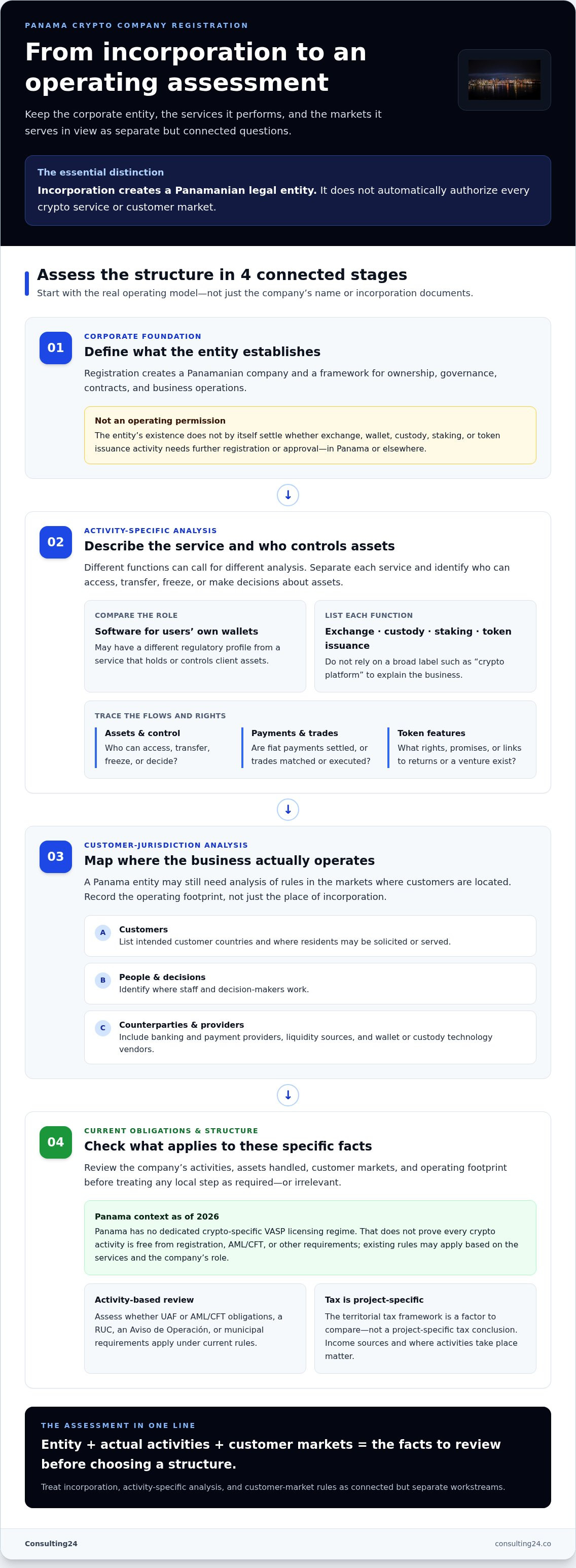
Panama crypto company registration creates a Panamanian legal entity that can serve as the corporate vehicle for a project. That is a structural step, not a universal operating permission. The entity’s existence does not by itself settle whether an exchange, wallet, custody, staking, or token issuance activity needs further registration or approval, either in Panama or elsewhere.
A crypto business can involve several distinct functions. A company that develops software may have a different regulatory profile from one that controls customer assets or executes transactions. Even the term Cryptocurrency covers a broad range of assets and uses. Start the legal analysis with what the business does in practice, not just the label on its incorporation documents.
Three separate questions
- Incorporation: What legal entity is being created, and what corporate purpose will it serve?
- Activity-specific analysis: Do the actual services, asset flows, or control over funds trigger additional obligations?
- Customer-jurisdiction obligations: What rules may apply where customers are located, even if the company is incorporated in Panama?
What does registering a crypto company in Panama mean?
Registration establishes the company as a Panamanian entity and provides a corporate framework for ownership, governance, contracts, and business operations. Founders can then assess how that entity fits their operating model and whether the proposed activities call for additional local steps.
It doesn’t answer every compliance question. Panama does not have a dedicated crypto-specific VASP licensing regime as of 2026, but that does not prove every crypto activity is free from registration, AML/CFT, or other requirements. Existing rules may apply based on the services provided, assets handled, and role the company plays. Avoid relying on blanket claims that crypto companies need no licence or registration; the treatment depends on the specific facts.
Why do international founders consider Panama?
Founders may consider Panama as a base for an international corporate structure, including when they want a distinct entity for a crypto project’s contracts, governance, or group operations. The jurisdiction’s territorial tax framework is another factor to compare. A general description of that framework is not a project-specific tax conclusion. Income sources, where activities take place, and the company’s wider operating facts can affect the analysis.
Test Panama’s corporate appeal against the project’s real footprint. Identify where the team works, who controls customer assets, which counterparties are involved, and where customers are served. Then assess the relevant tax and regulatory treatment using current legal advice. Rules and interpretations can change, and a structure that fits one activity or market may not fit another.
Incorporation creates the company; it does not authorize the company to operate across borders. Treat registration, activity-specific analysis, and customer-market rules as connected but separate workstreams.
How Panama company formation, compliance, and market rules fit together
Once the company structure is defined, map the business itself. A name such as “crypto platform” is too broad to guide a regulatory assessment. Describe each service, who performs it, how assets move, and which entity controls each step. One company may combine functions that call for different analysis.
Which crypto activities change the regulatory analysis?
Start with the service model. Software that lets users interact directly with their own wallets differs from a service that holds or controls client assets. Describe exchange functions, custody, staking, token issuance, and other services separately. The practical distinction is who can access, transfer, freeze, or make decisions about the assets.
Trace money and value flows too. Record whether customers pay in fiat currency, whether the company settles payments, and whether it matches or executes trades. For tokens, document holders’ rights, the issuer’s promises, and any link to returns or participation in a venture. These features can affect legal classification. Don’t assume that calling a token a utility token, or a service non-custodial, settles the analysis.
Panama-specific steps also need activity-based review. UAF or AML/CFT obligations, a RUC, an Aviso de Operación, and municipal requirements shouldn’t be treated as automatic or irrelevant across every structure. Determine which, if any, apply to the company’s activities under current rules before including them in a formation plan.
Why do customer and counterparty locations matter?
Incorporation is only one point on the operating map. List intended customer countries, where staff and decision-makers work, and where the company’s key counterparties are established. Include banking and payment providers, liquidity sources, wallet or custody technology vendors, and other firms that support the service. Their roles can reveal operational dependencies and jurisdiction-specific questions.
Cross-border obligations can depend on what the company does and whom it serves. A Panama entity may still need analysis of rules in customer markets. The relevant questions can change if the business solicits residents in a country, holds their assets, processes fiat payments, or distributes tokens with investment-like features. Don’t infer the answer from the entity’s registered address alone.
Keep the review streams separate. Confirm the company’s formation and local administrative requirements, assess the service and asset flows, then review intended markets and counterparties. For banking context, the Superintendency of Banks of Panama is the country’s banking-sector supervisor; its role is distinct from determining every crypto service’s permissions. A bank’s onboarding decision is also separate from licensing analysis, so prepare a clear description of activities, asset origins, and compliance controls.
Align the structure with operations before paperwork creates a false sense of readiness. Consulting24 can map proposed activities and markets as part of its Panama crypto company registration support and licensing advice.

Is Panama the right crypto company jurisdiction for your project?
Choose a jurisdiction against the operating model, not its reputation. Panama may merit consideration if your project needs an international corporate vehicle and its activities, target markets, and operational footprint fit the structure. It isn’t automatically the right choice for a business that needs a particular licence, serves customers in tightly regulated markets, or depends on specific banking arrangements.
Use the same questions for Panama and every alternative. This makes the comparison practical rather than promotional:
- Activity: Are you developing software, exchanging assets, providing custody, staking, or issuing tokens? More regulated or complex services may need closer jurisdictional analysis.
- Target markets: Where will customers live, and where will the company actively offer services? Incorporation doesn’t remove obligations that may apply in customer markets.
- Asset control: Will the company hold, control, transfer, or make decisions about client assets? Describe who controls each step.
- Banking needs: Does the model depend on fiat settlement, payment processing, or access to particular banking counterparties? Company formation doesn’t guarantee account opening or provider onboarding.
- Ongoing compliance: What monitoring, reporting, governance, and administrative work will the business need to sustain? Compare the actual workload, not just setup requirements.
When might a Panama structure fit?
Panama may be worth assessing when founders need a corporate base for a documented international business model and can explain its services, asset flows, customer profile, and counterparties. The country’s territorial tax framework may also be relevant, but it doesn’t establish that a particular company will receive tax savings. Assess tax treatment against the project’s income and operating facts with qualified professional advice.
For Panama crypto company registration, let the business design guide the jurisdiction choice. A potentially suitable corporate structure still needs to work alongside the company’s activities and markets.
When should founders compare other jurisdictions?
Compare alternatives if you’ll provide regulated services, build a substantial customer base in specific countries, or rely on demanding banking and payment arrangements. Estonia and Lithuania can be included in the comparison, but neither should be treated as a shortcut. Apply the same activity, customer, asset-control, banking, and compliance assumptions to each jurisdiction before judging the fit.
Keep corporate formation and financial onboarding separate in your decision. A registered company doesn’t guarantee that a bank or payment provider will accept the business. Their assessment may depend on the model, documentation, counterparties, and controls. Likewise, a provider’s willingness to onboard a company doesn’t establish that its activities are authorized in every target market.
Build a short comparison before committing: record the services, customer countries, asset flows, banking dependencies, and expected compliance workload for each option. Then assess regulatory and tax treatment using current, project-specific advice. This gives founders a usable basis for comparing Panama with Estonia, Lithuania, or another candidate without assuming one jurisdiction is best for every crypto project.
What to prepare before registering a Panama crypto company
Prepare the operating picture before focusing on forms. A clear project brief helps clarify whether the proposed company structure fits the business and which activity-specific or market-specific questions need review. This is a planning sequence, not a definitive filing checklist. Administrative documents and requirements can vary by structure and should be assessed against current procedures.
How to document the business model
Write a plain-language description of every service. Explain what users can do, what the company does, and whether it can hold, transfer, safeguard, or otherwise control customer assets. Be specific about product features: a wallet interface, for example, may be materially different from a service that controls users’ private keys or moves assets on their behalf.
Then map the customer journey and flow of value. A simple diagram can show where funds or crypto enter, who handles each transaction, how fees are charged, and which counterparties support the service. Include customer types and target jurisdictions. These details give legal and structuring analysis a factual basis instead of relying on broad labels such as “Web3 platform.”
- Services: Describe each feature, including exchange, custody, wallet, staking, or token functions.
- Asset flows: Show customer deposits, transfers, withdrawals, fees, and any fiat settlement.
- Roles: Identify which entity or provider performs each operational task.
- Markets: Record intended customer countries and customer categories.
Which workstreams need separate planning?
Keep incorporation, compliance design, banking preparation, and market-specific legal review as distinct workstreams. They inform one another, but completing one doesn’t automatically complete the others. Incorporation documents establish the company’s structure, while compliance planning addresses how the business will manage its actual services and risks.
Prepare a working ownership and governance outline. Identify proposed owners, founders, directors, decision-makers, and each person’s intended role. Record how key decisions will be made and who is responsible for operations and compliance. Treat this as planning information, not a definitive list of required filings. Final corporate information and supporting documents depend on the structure and current requirements.
- Corporate formation: Organize proposed ownership, founder details, governance, and the business rationale for the entity.
- Compliance design: Outline how the project expects to address controls and responsibilities relevant to its activities.
- Banking preparation: Assemble a consistent explanation of the business model, counterparties, asset flows, and source of funds for onboarding discussions. Company formation doesn’t guarantee a bank or payment provider will accept the business.
- Legal review: Flag questions about Panama procedures, possible registrations, and obligations in customer markets for current, project-specific analysis.
Use the brief to align the structure with the project before moving into registration. Consulting24’s Panama registration and licensing support can help map your proposed activities and markets.

How Consulting24 supports Panama crypto company registration
Registration is most useful when it matches the business the founders intend to operate. Consulting24 arranges Panama company registration and advises crypto projects on licensing and legal structure. The work starts with the project’s activities and markets, not just the requested entity. That helps founders define the registration scope and identify where separate licensing or regulatory analysis may be needed.
What does Consulting24 bring to the registration process?
Consulting24 reports more than 500 crypto licences obtained for projects worldwide and over eight years of crypto licensing experience. These figures reflect the company’s reported experience, not a promise of approval or a particular regulatory outcome. Its Panama crypto company registration package is advertised at a fixed fee of €6,000, with higher fees for structures involving additional people. The stated process is online, with a two-to-three-week timeline.
Founders can organize the discussion around the services they plan to provide, how assets move, who controls them, and where customers are located. That context helps align corporate formation with the project’s wider licensing questions. A software provider, a custodial wallet, and an exchange may have different operating profiles, so describing the actual service matters more than relying on a broad crypto label.
What happens after the initial structure decision?
Once the proposed structure and activities are mapped, founders can assess registration and licensing needs together. Consulting24 helps define the scope, align registration work with the project’s legal-structure questions, and coordinate the registration process. If a proposed service raises separate regulatory issues, those should be considered on their own merits and against the relevant markets.
Consulting24 supports structuring and registration, while the company remains responsible for running its products, maintaining its controls, and meeting obligations that apply to its activities and customer jurisdictions. Registration also doesn’t guarantee bank or payment-provider onboarding, and it doesn’t replace project-specific tax or accounting advice.
To make an initial assessment more focused, prepare a short project brief covering:
- Services: What the platform will let customers do.
- Asset flows: Whether the company or another party will hold, transfer, or control customer assets.
- Markets: The customer types and countries the project intends to serve.
- Structure: Proposed owners, decision-makers, and the business purpose for the entity.
These inputs connect the proposed corporate structure to real operating plans and help separate incorporation work from market-specific legal questions and ongoing responsibilities.
If you’re ready to scope your project, discuss your Panama crypto registration plan with Consulting24. A focused assessment can map the proposed activities and markets before registration support is coordinated.
Turn your structure decision into an operating plan
Convert your jurisdiction choice into a clear sequence of decisions. Document what the company will do, who it will serve, how assets will move, and which markets matter first. That working plan gives the registration discussion a practical starting point and helps surface questions that need separate legal analysis before launch.
Panama crypto company registration is most useful when the entity’s purpose is clear and its structure is considered alongside the project’s real activities. Avoid treating incorporation as the finish line. Use it as one part of building a workable operating model, with responsibilities and outstanding compliance questions clearly assigned.
Consulting24 can assess your proposed activities and markets, advise on legal structure and licensing scope, and coordinate Panama registration support. Discuss your Panama crypto company registration with Consulting24 to move forward with a defined project brief and a practical plan.
Frequently asked questions
What does registering a crypto company in Panama mean?
Registration establishes the company as a Panamanian entity and provides a corporate framework for ownership, governance, contracts, and business operations. Founders can then assess how that entity fits their operating model and whether the proposed activities call for additional local steps. It doesn’t answer every compliance question. Panama does not have a dedicated crypto-specific VASP licensing regime as of 2026, but that does not prove every crypto activity is free from registration, AML/CFT, or other requirements. Existing rules may apply based on the services provided, assets handled, and role the company plays. Avoid relying on blanket claims that crypto companies need no licence or registration; the treatment depends on the specific facts.
Why do international founders consider Panama?
Founders may consider Panama as a base for an international corporate structure, including when they want a distinct entity for a crypto project’s contracts, governance, or group operations. The jurisdiction’s territorial tax framework is another factor to compare. A general description of that framework is not a project-specific tax conclusion. Income sources, where activities take place, and the company’s wider operating facts can affect the analysis. Test Panama’s corporate appeal against the project’s real footprint. Identify where the team works, who controls customer assets, which counterparties are involved, and where customers are served. Then assess the relevant tax and regulatory treatment using current legal advice. Rules and interpretations can change, and a structure that fits one activity or market may not fit another. Incorporation creates the company; it does not authorize the company to operate across borders. Treat registration, activity-specific analysis, and customer-market rules as connected but separate workstreams. Once the company structure is defined, map the business itself. A name such as “crypto platform” is too broad to guide a regulatory assessment. Describe each service, who performs it, how assets move, and which entity controls each step. One company may combine functions that call for different analysis.
Which crypto activities change the regulatory analysis?
Start with the service model. Software that lets users interact directly with their own wallets differs from a service that holds or controls client assets. Describe exchange functions, custody, staking, token issuance, and other services separately. The practical distinction is who can access, transfer, freeze, or make decisions about the assets. Trace money and value flows too. Record whether customers pay in fiat currency, whether the company settles payments, and whether it matches or executes trades. For tokens, document holders’ rights, the issuer’s promises, and any link to returns or participation in a venture. These features can affect legal classification. Don’t assume that calling a token a utility token, or a service non-custodial, settles the analysis. Panama-specific steps also need activity-based review. UAF or AML/CFT obligations, a RUC, an Aviso de Operación, and municipal requirements shouldn’t be treated as automatic or irrelevant across every structure. Determine which, if any, apply to the company’s activities under current rules before including them in a formation plan.
Why do customer and counterparty locations matter?
Incorporation is only one point on the operating map. List intended customer countries, where staff and decision-makers work, and where the company’s key counterparties are established. Include banking and payment providers, liquidity sources, wallet or custody technology vendors, and other firms that support the service. Their roles can reveal operational dependencies and jurisdiction-specific questions. Cross-border obligations can depend on what the company does and whom it serves. A Panama entity may still need analysis of rules in customer markets. The relevant questions can change if the business solicits residents in a country, holds their assets, processes fiat payments, or distributes tokens with investment-like features. Don’t infer the answer from the entity’s registered address alone. Keep the review streams separate. Confirm the company’s formation and local administrative requirements, assess the service and asset flows, then review intended markets and counterparties. For banking context, the Superintendency of Banks of Panama is the country’s banking-sector supervisor; its role is distinct from determining every crypto service’s permissions. A bank’s onboarding decision is also separate from licensing analysis, so prepare a clear description of activities, asset origins, and compliance controls. Align the structure with operations before paperwork creates a false sense of readiness. Consulting24 can map proposed activities and markets as part of its Panama crypto company registration support and licensing advice. Choose a jurisdiction against the operating model, not its reputation. Panama may merit consideration if your project needs an international corporate vehicle and its activities, target markets, and operational footprint fit the structure. It isn’t automatically the right choice for a business that needs a particular licence, serves customers in tightly regulated markets, or depends on specific banking arrangements. Use the same questions for Panama and every alternative. This makes the comparison practical rather than promotional:
When might a Panama structure fit?
Panama may be worth assessing when founders need a corporate base for a documented international business model and can explain its services, asset flows, customer profile, and counterparties. The country’s territorial tax framework may also be relevant, but it doesn’t establish that a particular company will receive tax savings. Assess tax treatment against the project’s income and operating facts with qualified professional advice. For Panama crypto company registration, let the business design guide the jurisdiction choice. A potentially suitable corporate structure still needs to work alongside the company’s activities and markets.
When should founders compare other jurisdictions?
Compare alternatives if you’ll provide regulated services, build a substantial customer base in specific countries, or rely on demanding banking and payment arrangements. Estonia and Lithuania can be included in the comparison, but neither should be treated as a shortcut. Apply the same activity, customer, asset-control, banking, and compliance assumptions to each jurisdiction before judging the fit. Keep corporate formation and financial onboarding separate in your decision. A registered company doesn’t guarantee that a bank or payment provider will accept the business. Their assessment may depend on the model, documentation, counterparties, and controls. Likewise, a provider’s willingness to onboard a company doesn’t establish that its activities are authorized in every target market. Build a short comparison before committing: record the services, customer countries, asset flows, banking dependencies, and expected compliance workload for each option. Then assess regulatory and tax treatment using current, project-specific advice. This gives founders a usable basis for comparing Panama with Estonia, Lithuania, or another candidate without assuming one jurisdiction is best for every crypto project. Prepare the operating picture before focusing on forms. A clear project brief helps clarify whether the proposed company structure fits the business and which activity-specific or market-specific questions need review. This is a planning sequence, not a definitive filing checklist. Administrative documents and requirements can vary by structure and should be assessed against current procedures.
Which workstreams need separate planning?
Keep incorporation, compliance design, banking preparation, and market-specific legal review as distinct workstreams. They inform one another, but completing one doesn’t automatically complete the others. Incorporation documents establish the company’s structure, while compliance planning addresses how the business will manage its actual services and risks. Prepare a working ownership and governance outline. Identify proposed owners, founders, directors, decision-makers, and each person’s intended role. Record how key decisions will be made and who is responsible for operations and compliance. Treat this as planning information, not a definitive list of required filings. Final corporate information and supporting documents depend on the structure and current requirements. Use the brief to align the structure with the project before moving into registration. Consulting24’s Panama registration and licensing support can help map your proposed activities and markets. Registration is most useful when it matches the business the founders intend to operate. Consulting24 arranges Panama company registration and advises crypto projects on licensing and legal structure. The work starts with the project’s activities and markets, not just the requested entity. That helps founders define the registration scope and identify where separate licensing or regulatory analysis may be needed.
What does Consulting24 bring to the registration process?
Consulting24 reports more than 500 crypto licences obtained for projects worldwide and over eight years of crypto licensing experience. These figures reflect the company’s reported experience, not a promise of approval or a particular regulatory outcome. Its Panama crypto company registration package is advertised at a fixed fee of €6,000, with higher fees for structures involving additional people. The stated process is online, with a two-to-three-week timeline. Founders can organize the discussion around the services they plan to provide, how assets move, who controls them, and where customers are located. That context helps align corporate formation with the project’s wider licensing questions. A software provider, a custodial wallet, and an exchange may have different operating profiles, so describing the actual service matters more than relying on a broad crypto label.
What happens after the initial structure decision?
Once the proposed structure and activities are mapped, founders can assess registration and licensing needs together. Consulting24 helps define the scope, align registration work with the project’s legal-structure questions, and coordinate the registration process. If a proposed service raises separate regulatory issues, those should be considered on their own merits and against the relevant markets. Consulting24 supports structuring and registration, while the company remains responsible for running its products, maintaining its controls, and meeting obligations that apply to its activities and customer jurisdictions. Registration also doesn’t guarantee bank or payment-provider onboarding, and it doesn’t replace project-specific tax or accounting advice. To make an initial assessment more focused, prepare a short project brief covering: These inputs connect the proposed corporate structure to real operating plans and help separate incorporation work from market-specific legal questions and ongoing responsibilities. If you’re ready to scope your project, discuss your Panama crypto registration plan with Consulting24. A focused assessment can map the proposed activities and markets before registration support is coordinated. Convert your jurisdiction choice into a clear sequence of decisions. Document what the company will do, who it will serve, how assets will move, and which markets matter first. That working plan gives the registration discussion a practical starting point and helps surface questions that need separate legal analysis before launch. Panama crypto company registration is most useful when the entity’s purpose is clear and its structure is considered alongside the project’s real activities. Avoid treating incorporation as the finish line. Use it as one part of building a workable operating model, with responsibilities and outstanding compliance questions clearly assigned. Consulting24 can assess your proposed activities and markets, advise on legal structure and licensing scope, and coordinate Panama registration support. Discuss your Panama crypto company registration with Consulting24 to move forward with a defined project brief and a practical plan.
Does registering a crypto company in Panama mean it has a crypto licence?
No. Company registration establishes the legal entity, but it isn’t itself a crypto licence. Panama has no dedicated crypto-specific VASP licensing regime as of 2026, but that doesn’t mean every activity is exempt from other rules or obligations. For example, a company offering custody may face different compliance questions from one that only develops software. Classify the actual service before treating incorporation as operating approval.
Can a Panama crypto company serve customers in other countries?
Potentially, but incorporation in Panama doesn’t automatically permit service in every country. Check the rules that may apply in each intended customer market, especially if the company markets services there, handles customer assets, or processes payments. A practical starting point is a country-by-country list of planned customers, services, and marketing channels. This helps identify where separate legal analysis may be needed before launch.
How long does Panama crypto company registration take?
Consulting24 states that its Panama registration process takes two to three weeks. Treat that as the stated process timeline, not a guarantee that every project will be completed within that period. Preparation and the project’s details can affect the work involved. Organize ownership information and a concise business description early so the registration scope can be assessed without avoidable gaps.
Is Panama suitable for a crypto exchange or custody business?
It may be considered, but suitability depends on the specific service, asset controls, customer markets, and compliance requirements. An exchange that executes trades or a custodian that controls customer assets needs a closer activity-based review than a software-only project. Map who holds keys, authorizes transfers, and settles transactions. Then assess Panama requirements alongside obligations in the countries where customers will be served.
Does a Panama crypto company automatically pay no tax?
No. Incorporation doesn’t establish that a company owes no tax. Panama’s territorial tax framework may be relevant, but the outcome depends on income sources and the company’s operating facts. For example, where activities are carried out and how revenue is earned can matter to the analysis. Have the project’s specific tax position assessed using current professional advice instead of relying on a general jurisdiction description.
Can company registration guarantee a bank account for a crypto business?
No. Registering a company doesn’t guarantee that a bank or payment provider will onboard it. Financial institutions make separate decisions based on their requirements and their assessment of the business. Prepare a consistent explanation of the services, expected transaction flows, counterparties, and source of funds. That information can support an onboarding application, but it can’t ensure acceptance or substitute for any required regulatory analysis.
What information should founders prepare before registering?
Prepare a concise business brief covering the product, customer types, target countries, and each party’s role in moving or controlling assets. Add a simple funds-flow diagram showing deposits, transfers, withdrawals, and fees. Also organize proposed ownership, founder details, decision-makers, and the company’s business rationale. These materials help distinguish the corporate setup questions from licensing, compliance, and market-specific issues that need separate review.
Does Consulting24 provide crypto exchange operations, banking, or accounting?
Consulting24 arranges Panama company registration and advises on crypto licensing and legal structure. Founders remain responsible for running the business and meeting applicable obligations. Its Panama registration process is online. Bring your activity and market details to scope the registration and licensing work.
Primary sources
This guide reflects 2026 rules. Verify current requirements with the official regulator:
Related jurisdictions

Talk to a crypto-licensing expert
500+ licenses across Estonia, Lithuania, Panama and beyond. Tell us your model and we'll map the right route, honestly.
💬 Talk to an expertFree consultationGeneral guidance, not legal advice. Rules and fees evolve, and we confirm current requirements for your case.