Panama Crypto License: 2026 Legal Status & Requirements

A “crypto license in Panama” is not a standalone government-issued authorization as of October 2026. The phrase can obscure the real question: what does your business do, and where are its customers? Incorporating a Panamanian company alone does not authorize every crypto activity or provide unrestricted access to international markets.
That distinction matters most for founders planning exchange, custody, wallet, staking, or token services. Panama has no dedicated crypto licensing regime in force, but general corporate and anti-money-laundering rules still matter. Law 23 of 2015, potential UAF registration, and the details of the operating model warrant assessment. Draft fintech and virtual-asset legislation is also under review, but it has not been enacted.
This guide explains what the current legal position means in practice and how to assess the rules relevant to your proposed services. It covers the regulatory questions raised by different business models, the limits of company incorporation, and the documents and structural decisions to prepare before choosing Panama. The practical priority is to align the activity, customer markets, legal structure, and compliance preparation before launch.
Key Takeaways
- Assess the crypto license in panama question by looking at the service being delivered, not just the label used to describe the business.
- Compare exchange, custody, token, payment, and software-only models by who controls the assets, handles customer funds, and contracts with users.
- Build an activity map covering owners, managers, customer markets, funds, product features, and counterparties before selecting a company structure.
- Use the regulatory overview to identify which authorities and legal questions may be relevant to your operating model.
- Follow a practical sequence: define activities, map markets and asset flows, assess legal scope, then structure the company.

Crypto license in Panama: what the term means, and what it does not
“Crypto license” can refer to several separate legal and corporate questions. It may mean forming a Panamanian company, completing relevant commercial formalities, determining whether a particular activity needs sectoral authorization, or assessing whether the business can serve customers in other countries. These are distinct steps. A company registration document does not answer all of them.
As of October 2026, Panama has no dedicated licensing regime for cryptocurrency businesses or virtual asset service providers (VASPs). That does not mean every crypto business is unregulated or every activity is automatically permitted. Law 23 of 2015 addresses anti-money laundering and counter-terrorist financing obligations, while other rules may matter depending on the service and how it is delivered. Start the regulatory analysis with the business model, not the phrase “crypto license in Panama.”
Is there a single Panama crypto license?
No single crypto-specific permit currently applies across all business models. Keep enacted law separate from proposals and commentary: draft fintech and virtual-asset legislation, including Anteproyecto de Ley No. 314 and Bill 247, is not the same as an enacted licensing requirement. Bill 697, passed by the National Assembly in 2022, was vetoed and declared unconstitutional by the Supreme Court in 2023. It is not in force.
This status can change, so legal conclusions should be tied to a date and checked against current legislation and official regulatory information. The wider Financial Regulation Overview explains why financial rules often depend on the activity performed, rather than the name a company gives its product. In Panama, the relevant question is which rules apply to the specific service, entity, and customer markets.
Company formation is not the same as operating authorization
Incorporation creates a legal entity and establishes the company’s formal existence. It does not, by itself, grant blanket permission to provide financial services. Commercial registrations and other corporate formalities are separate from any activity-specific authorization that may apply to a particular business model.
For example, a company that handles customer assets or facilitates fiat payments raises different regulatory questions from a software business that provides tools without controlling funds. A token offering may also need assessment under rules relevant to securities or other regulated activities. Classification depends on the actual rights, functions, and contractual arrangements, not just labels such as “utility token” or “technology platform.”
Corporate registration creates the entity; regulatory permission depends on the activities it performs. That distinction is essential when evaluating a Panama structure. Incorporation alone does not authorize every crypto activity, satisfy every compliance obligation, or grant permission to serve overseas customers. Other jurisdictions may apply their own rules based on customer location, solicitation, or the services offered.
Before choosing a structure, document what the company will do, who controls the assets, how funds move, and where customers are located. These facts provide the basis for assessing applicable obligations without assuming either a universal license requirement or a blanket exemption.
Panama crypto regulation in 2026: identify the rules that actually apply
Panama’s regulatory picture is not one crypto statute and one crypto regulator. The relevant questions depend on the activity: securities issuance, payment processing, banking, and anti-money-laundering controls can each raise different issues. The table separates rules already in force from proposals and authority statements. Use it as a starting map, then classify the actual service.
| Instrument or authority | Responsible authority | Relevant activity | Status as of October 2026 |
|---|---|---|---|
| Law 23 of 2015 | UAF, Panama’s financial intelligence unit | AML/CFT controls; UAF registration may be relevant if a crypto business is considered a financial intermediary | Enacted law. Application depends on the business and its classification. |
| Anteproyecto de Ley No. 314, introduced January 13, 2026 | Panamanian National Assembly | Proposed framework for virtual-asset services, payment providers, and e-money issuers | Draft bill, not enacted law. National Assembly legislative records, checked October 2026. |
| Bill 247, introduced in 2025 | Panamanian National Assembly | Proposed crypto-related regulation | Under review; not a current licensing requirement. |
| SMV public position | Superintendencia del Mercado de Valores | Capital-markets and securities oversight | The SMV has stated cryptocurrencies are not securities and do not fall under its jurisdiction. A token’s features still need separate assessment. |
| Banking supervision | Superintendencia de Bancos de Panamá (SBP) | Banking-sector supervision, relevant where a model involves banking activity | Not a dedicated crypto licensing authority. Consult the Panama Superintendency of Banks for its official remit. |
| Commercial activity | Ministry of Commerce and Industries (MICI) | Commercial and business matters within its remit | Not a crypto-wide licensing authority; assess the relevant commercial formalities for the entity and activity. |
Enacted law, proposals, and guidance: keep the categories separate
Law 23 is enacted legislation. Bills 314 and 247 are proposals, not present-day permits or duties. The National Assembly passed Bill 697 in 2022, but the President vetoed it and the Supreme Court declared it unconstitutional in 2023; it is not in force. The SMV’s statement is an authority position, not a universal exemption from other laws. Check official legislative and regulatory materials for amendments and current status before relying on any summary.
Which Panamanian authorities may be relevant?
There is no single Panamanian authority that licenses and supervises all virtual-asset services. The SMV’s relevance turns on securities questions, SBP’s on banking activity, MICI’s on applicable commercial matters, and UAF’s on financial-intelligence and AML/CFT issues. A classification question may remain where a service combines crypto, fiat, custody, or payment functions. Treat that as an issue for activity-specific review, not as proof that a license is or is not required.
In October 2026, Panama has no dedicated crypto-licensing regime in force, but existing rules may still apply according to the service and its legal classification. For a structured review of activities, entity formation, and compliance preparation, Panama crypto company registration and structuring can be considered as connected steps.

Exchange, custody, tokens, or payments: compare the activity before the license label
The same platform can combine several services, and each can raise different regulatory questions. For a useful assessment, map four facts for every service: who controls the assets, whether customer funds are handled, whether fiat is involved, and what role the company takes in its contracts with users. The label on a product page is not enough to classify the activity or determine whether a crypto license in Panama is relevant.
- Exchange: Does the company only match buyers and sellers, or does it also execute trades, take the other side, or control assets during settlement? Identify who holds customer funds and whether fiat payments are part of the service.
- OTC brokerage: Does the business introduce counterparties, negotiate trades, or execute orders as an agent or principal? Record who contracts with the customer and who receives or transfers the assets.
- Custody: Who holds private keys or can move customer assets? A company with signing authority or operational control raises different safeguarding and compliance questions from one that never controls assets.
- Transfers: Does the company initiate, route, or execute crypto transfers for customers? Trace whether it ever possesses assets, controls a wallet, or handles fiat at any point.
- Merchant settlement: Does the business simply provide software, or does it receive crypto, convert it, or pay merchants in fiat or another asset? Document who accepts payment and who bears settlement responsibility.
- Token issuance: What rights does the token give its holder? Examine economic features, redemption terms, profit or investment-related promises, and the issuer’s contractual commitments rather than relying on names such as “utility token.”
- Staking: Does the company provide tools, delegate assets, pool customer holdings, or control validators or withdrawal arrangements? The service structure and control over assets can change the analysis.
- Software-only services: Does the provider supply code or interface tools without accessing keys, initiating transactions, or arranging trades? Compare the product’s actual functions with its customer-facing promises.
Control, settlement, and contractual role
These distinctions matter because matching a trade is not identical to executing it; executing a transaction is not the same as transferring an asset; and transferring an asset is not necessarily the same role as safeguarding it. Record the flow from customer instruction through settlement, including every entity that receives funds or can authorize movement. A service described as “non-custodial” still needs review if the company can trigger transactions or directs how customer assets are handled.
Fiat flows need their own analysis. A crypto business that converts assets, processes merchant payments, or holds customer money may raise questions distinct from those for a software provider that never touches funds. Banking services are also a separate layer: the Role of Panama’s Banking Superintendent provides background on the banking supervisor, but a banking relationship does not itself classify a crypto service.
Match the product to the legal questions
Prepare a short activity map for each product: functions, asset-control points, customer funds, fiat steps, contractual parties, and customer locations. Then assess whether securities, investment products, payments, e-money, banking, or AML/CFT rules may be relevant. No single product label resolves those questions, and no activity should be assumed exempt or regulated without current, fact-specific legal analysis.
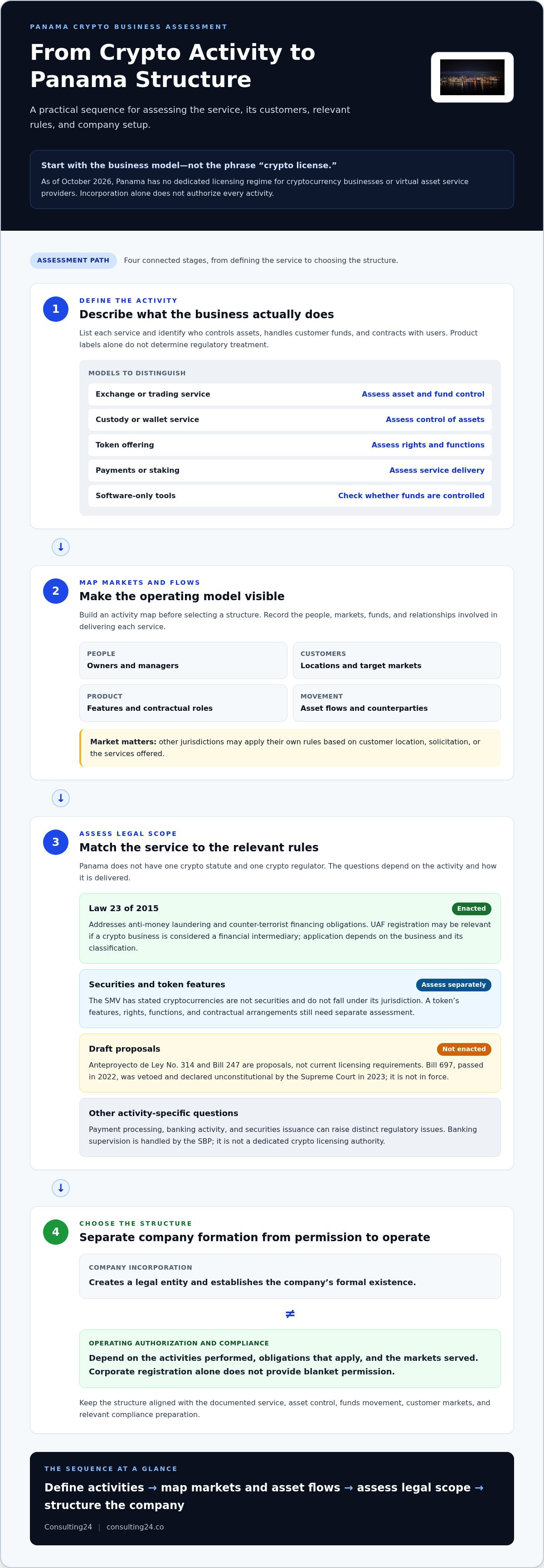
Panama crypto business requirements: map ownership, customers, funds, and controls
A useful Panama crypto assessment starts with operational facts, not an incorporation checklist. The same company structure can support very different services, and the relevant legal questions depend on ownership, customers, product functions, and transaction flows. Build one evidence file that shows how the business will work in practice. Use it to assess the scope of applicable rules, including any AML/CFT obligations under Law 23 of 2015.
Build an operating-model and customer-market map
Work through the sequence below for each proposed service. Keep separate models separate, even if they sit inside one platform. For example, a trading interface and a custody feature may involve different customer instructions, asset controls, and counterparties.
- Identify ownership and management. Record beneficial owners, ownership percentages, decision-makers, directors, and each person’s operational role. Note who approves products, controls access, and oversees risk decisions.
- Define services and users. Describe each product in plain language, the customer groups it serves, and the role the company plays. Include customer-facing promises, such as whether the business executes trades, safeguards assets, or arranges transactions.
- List customer markets. Identify the countries where customers are located, where the business markets its services, and where users can access the product. Customer geography can raise questions beyond Panama’s rules.
- Trace transactions end to end. Show where fiat and digital assets enter, move through, and leave the platform. Name each entity that receives, converts, holds, transfers, or settles them.
- Record control points. Identify who controls private keys, wallets, transaction approvals, settlement, and customer instructions. Include third-party platforms and counterparties in the flow map.
The core inputs for an activity-based legal assessment are ownership, management, services, customer locations, asset flows, control points, and counterparties. Keep the map consistent with product documentation and actual platform design. If a feature changes, update the assessment.
Prepare compliance and governance materials
Organize supporting documents around the operating model: ownership records, management responsibilities, product descriptions, transaction diagrams, customer terms, and a risk overview. These materials help identify which obligations may apply and where controls need to be developed.
Assess AML/KYC procedures, sanctions screening, recordkeeping, and governance against the rules that apply to the specific model. Law 23 of 2015 is relevant to AML/CFT analysis; whether UAF registration or particular controls apply depends on the business’s classification and activities. Do not present a generic checklist as proof of compliance. Document the basis for each control, who owns it, and how it will operate.
Banking access is a separate provider decision. Company formation does not ensure that a bank will accept the business or its counterparties. Prepare a consistent explanation of the business, asset flows, ownership, and compliance framework for institutional review. Plan Panama crypto company registration and structuring around those operating facts, rather than treating incorporation as the whole assessment.

Plan a Panama crypto license assessment with Consulting24
A sound structure follows the operating model. Define the services first, map customer markets and asset flows, assess the legal scope, then select the company structure. This sequence keeps registration decisions tied to the business the company will actually conduct. It also helps separate Panama’s corporate requirements from rules that may apply in customer jurisdictions.
What to define before selecting a structure
Prepare a concise operating brief before comparing jurisdictions. Describe each product’s functions, whether the company controls or safeguards assets, how fiat and crypto move, which countries customers will come from, and the planned launch sequence. Specify which features will be live at launch and which are planned for later. A staged rollout can change the regulatory questions if it adds custody, payments, token issuance, or new markets.
Keep related but distinct workstreams visible. Corporate setup concerns the legal entity and its governance. Regulatory analysis concerns the activities and markets. Tax treatment, banking relationships, and operational controls require separate assessment based on current rules and the project’s facts. Do not assume company formation resolves those questions.
Use the same documented model to compare Panama with other relevant jurisdictions. Assess whether each option fits the service scope, customer locations, control of funds, and planned operating structure. A jurisdiction comparison is useful only when it compares the same business model, not a broad description of each country.
From legal assessment to a workable launch plan
Consulting24 supports Panama crypto company registration and structuring as parts of a broader project assessment. Its advisory work can connect project strategy and legal structure with blockchain architecture, tokenomics, and token launches. The practical output is clearer alignment between the proposed product, company design, and compliance preparation, not an assumption that registration itself authorizes every activity.
Consulting24 states that it has more than eight years of crypto licensing experience and has obtained over 500 crypto licences worldwide. These are company-reported track-record figures, not a promise that a particular activity will qualify for authorization or that Panama is suitable for every project. Consulting24 arranges registrations and prepares licensing applications. Its advertised Panama crypto company registration package has a fixed fee of €6,000, with higher fees for structures involving additional people, and a stated timeline of 2-3 weeks. Company registration is distinct from a crypto license and does not itself authorize every activity.
For an assessment of the crypto license in panama question, bring the activity map, ownership and management details, customer markets, transaction flows, product documentation, and launch plan into one working file. That gives the structuring discussion a concrete basis and makes open regulatory questions easier to identify.
Learn more about Panama crypto company structuring assessment and how it fits into your project plan.
Move from assessment to a structure you can execute
Turn the regulatory assessment into a launch plan with clear owners, dependencies, and decision points. Set out what must be resolved before launch, what can follow later, and which product changes would trigger a fresh review. That makes your Panama structure easier to evaluate against the business you intend to build, not just the company you intend to register.
Consulting24 supports crypto company registration and structuring, alongside project strategy, legal structure, blockchain architecture, tokenomics, and token launches. Its stated experience includes more than eight years in crypto licensing and over 500 crypto licences obtained worldwide. These figures describe the company’s track record, not a guarantee of a particular regulatory outcome. The next step is to assess how your proposed services and operating model fit your business plans.
Before making a structure decision, bring together the service descriptions, customer locations, asset flows, and launch sequence. Use these materials to identify decisions that depend on the product design, rather than treating company registration as the end of the regulatory assessment.
Frequently asked questions
Is there a single Panama crypto license?
No single crypto-specific permit currently applies across all business models. Keep enacted law separate from proposals and commentary: draft fintech and virtual-asset legislation, including Anteproyecto de Ley No. 314 and Bill 247, is not the same as an enacted licensing requirement. Bill 697, passed by the National Assembly in 2022, was vetoed and declared unconstitutional by the Supreme Court in 2023. It is not in force. This status can change, so legal conclusions should be tied to a date and checked against current legislation and official regulatory information. The wider Financial Regulation Overview explains why financial rules often depend on the activity performed, rather than the name a company gives its product. In Panama, the relevant question is which rules apply to the specific service, entity, and customer markets.
Which Panamanian authorities may be relevant?
There is no single Panamanian authority that licenses and supervises all virtual-asset services. The SMV’s relevance turns on securities questions, SBP’s on banking activity, MICI’s on applicable commercial matters, and UAF’s on financial-intelligence and AML/CFT issues. A classification question may remain where a service combines crypto, fiat, custody, or payment functions. Treat that as an issue for activity-specific review, not as proof that a license is or is not required. In October 2026, Panama has no dedicated crypto-licensing regime in force, but existing rules may still apply according to the service and its legal classification. For a structured review of activities, entity formation, and compliance preparation, Panama crypto company registration and structuring can be considered as connected steps. The same platform can combine several services, and each can raise different regulatory questions. For a useful assessment, map four facts for every service: who controls the assets, whether customer funds are handled, whether fiat is involved, and what role the company takes in its contracts with users. The label on a product page is not enough to classify the activity or determine whether a crypto license in Panama is relevant.
Is there a crypto license in Panama in 2026?
No standalone crypto-specific license regime is in force in Panama as of October 2026. That does not establish that every service is free of regulatory requirements. The legal analysis can still involve existing AML/CFT rules and activity-specific questions. Treat claims about a “crypto license in Panama” as shorthand until you know whether they refer to company formation, a particular authorization, or another country’s requirements.
Can a crypto exchange operate in Panama without a license?
There is no dedicated Panamanian crypto-exchange license in force, but that alone does not confirm an exchange can operate without other obligations. The answer depends on what the platform does, how it handles customer assets and fiat, and where customers are located. For example, an exchange that also holds funds or processes payments raises different questions from a platform that only provides trading software.
Does a Panama company registration authorize crypto custody?
No. Registration establishes the company as a legal entity; it does not grant blanket permission to safeguard customer assets. Before offering custody, identify who controls private keys, can authorize withdrawals, and bears contractual responsibility for assets. Also map where customers are located, since their jurisdictions may impose separate requirements. Keep company records and the custody operating model distinct in your launch documentation.
What activities can trigger additional crypto regulatory requirements in Panama?
Activities that warrant closer review include issuing tokens with investment-like rights, handling customer assets, executing or arranging trades, converting crypto to fiat, processing payments, and safeguarding funds. A software product may also need analysis if it initiates transactions or directs asset movement. These are assessment triggers, not automatic legal classifications. The contractual role, product design, counterparties, and customer locations all affect the analysis.
Does Panama tax crypto profits at 0%?
Not automatically. Panama’s territorial tax approach generally distinguishes income by source, so the treatment of foreign-source income may differ from income generated in Panama. A crypto company’s result depends on how and where income is earned and on its specific operations. Do not treat a broad “0% tax” claim as a tax conclusion for your business. Assess the treatment against current rules and the company’s specific facts.
What information is needed to assess a crypto business in Panama?
Prepare an ownership chart, management roles, product descriptions, customer countries, and a transaction-flow diagram. Show where fiat and digital assets enter and leave, who controls wallets or keys, and which partners process or settle transactions. Include customer terms and planned launch features. This evidence helps distinguish separate services within one platform and identify legal questions for further review before selecting a structure. Ready to assess your Panama structure? Start a crypto company registration and structuring discussion with Consulting24.
Primary sources
This guide reflects 2026 rules. Verify current requirements with the official regulator:
Related jurisdictions

Talk to a crypto-licensing expert
500+ licenses across Estonia, Lithuania, Panama and beyond. Tell us your model and we'll map the right route, honestly.
💬 Talk to an expertFree consultationGeneral guidance, not legal advice. Rules and fees evolve, and we confirm current requirements for your case.