Panama Crypto Exchange: Legal Scope & Allowed Activities

Panama is a neutral, tax-advantaged jurisdiction that allows you to structure a crypto exchange through a Panama S.A. (Sociedad Anónima). While Panama does not yet have a dedicated crypto licensing law, its corporate and tax framework enables a wide range of digital asset activities. This page explains the legal scope of a Panama crypto exchange, what activities are permitted, and the structural limits you must respect, especially regarding crypto-to-fiat conversion.
At Consulting24, we have obtained over 500 crypto licenses worldwide. We deliver Panama company setup directly (flat EUR 6,000) and advise on structuring your exchange to comply with international standards. Whether you are launching a spot exchange, an OTC desk, or a stablecoin platform, understanding the legal boundaries is critical.
For a broader view of options, explore our jurisdictions overview.
What is a Panama Crypto Exchange?
A Panama crypto exchange is a digital asset trading platform operated by a Panama S.A. company. Panama does not have a specific crypto license, but its corporate law allows a S.A. to engage in any lawful business, including crypto trading, custody, and payment processing. The exchange must comply with anti-money laundering (AML) regulations if it handles fiat currency, and must follow general corporate and tax obligations.
Panama's legal framework is based on the Commercial Code and the Law 23 of 2015 on AML. For crypto activities, the exchange must register with the Financial Analysis Unit (UAF) for AML supervision if it deals with fiat. Crypto-to-crypto trading is generally unregulated, but any conversion to fiat requires a licensed intermediary (e.g., a bank or payment processor) or the use of a stablecoin as an intermediate step.
In practice, a Panama exchange often operates as a global platform serving clients from multiple countries. The S.A. structure provides flexibility to adapt to changing regulations. For example, if you later decide to obtain a regulated license in Lithuania, the Panama entity can serve as a holding company. Read more about company setup options.
Who Needs a Panama Crypto Exchange?
A Panama crypto exchange is ideal for founders who want a cost-effective, tax-efficient jurisdiction to launch a global exchange. Typical clients include:
- Startups seeking a flat EUR 6,000 company setup with no ongoing licensing fees.
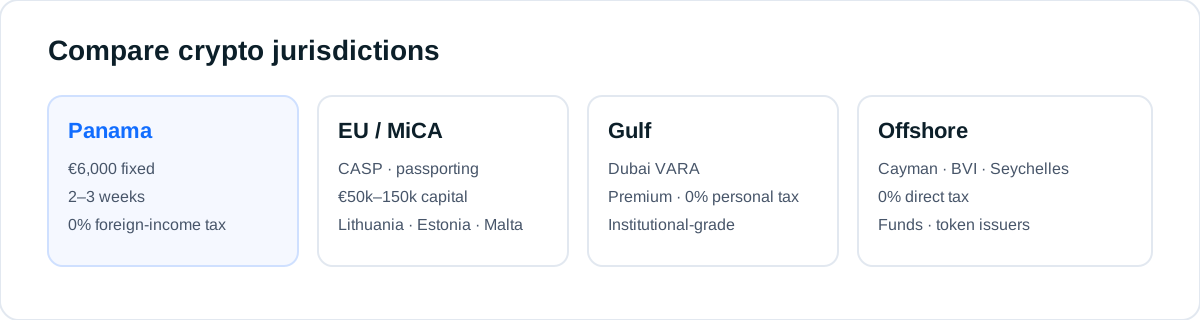
- Entrepreneurs who want to avoid the high capital requirements of EU MiCA licenses (EUR 50,000-150,000).
- Operators focusing on crypto-to-crypto trading, DeFi integration, or stablecoin issuance.
- Businesses that plan to use a Panama S.A. as a holding company for multiple regulated entities elsewhere.
If your primary activity involves direct crypto-to-fiat conversion for retail customers, you may need a regulated bank or a payment processor in a jurisdiction like Lithuania or Estonia. Panama works best as a corporate wrapper for non-fiat activities. For a comparison, see our Panama vs Lithuania guide.
License Type & Regulator
Panama does not issue a specific crypto license. Instead, the Panama S.A. operates under general corporate law. The main regulatory bodies are:
- Public Registry of Panama - registers the company and its shareholders.
- Financial Analysis Unit (UAF) - oversees AML compliance if the exchange handles fiat currency.
- Superintendency of Banks of Panama (SBP) - regulates banking activities; a crypto exchange cannot accept deposits without a banking license.
For crypto-to-crypto activities, no license is required. For fiat-related services, the exchange must either partner with a licensed bank or use a stablecoin bridge (e.g., USDC) to avoid direct fiat handling. The legal scope is therefore limited by the absence of a dedicated crypto framework, but this also means lower compliance costs. This contrasts with EU jurisdictions where a crypto exchange license is mandatory.
Cost & Timeline
| Item | Cost (EUR) | Timeline |
|---|---|---|
| Panama S.A. company setup (including registered agent, corporate documents, and initial fees) | 6,000 (flat) | 2-4 weeks |
| Annual registered agent fee | ~1,000-1,500 | Annual |
| UAF registration (if handling fiat) | ~500-1,000 (legal fees) | 1-2 months |
| Bank account opening (corporate) | Variable (deposit required) | 2-6 weeks |
| Legal opinion on crypto activities | ~2,000-5,000 | 1-2 weeks |
Total initial cost is typically EUR 8,000-12,000 including legal advice. The timeline is 4-8 weeks for a fully operational structure. Ongoing costs are low compared to regulated jurisdictions. For a detailed breakdown, visit our cost page.
Capital Requirement
Panama has no minimum capital requirement for a S.A. The standard authorized capital is USD 10,000 (or equivalent), but no paid-in capital is required. This makes Panama extremely attractive for startups. However, if you plan to apply for a payment processor license or a bank partnership, those institutions may impose their own capital requirements (e.g., EUR 50,000 for a Lithuanian EMI). For pure crypto-to-crypto exchange, you can start with minimal capital.
Compare this to EU MiCA licenses which require EUR 50,000 for basic services, EUR 125,000 for exchange and custody, and EUR 150,000 for full services. Panama's zero capital requirement is a major advantage for bootstrapped projects. Check our requirements page for more details.
Tax Treatment
Panama operates a territorial tax system: income earned outside Panama is not taxed. Crypto exchange revenues from non-Panamanian clients are generally tax-free. There is no capital gains tax, no VAT on crypto transactions, and no withholding tax on dividends paid to non-resident shareholders. The only taxes are:
- Annual corporation tax (flat USD 300 for companies with no local income).
- Registered agent fee (~USD 1,200 per year).
- Dividends paid from Panama-source income are subject to 10% withholding (rare for crypto exchanges).
This tax regime is one of the most favorable for crypto businesses. However, you must ensure your exchange does not have a permanent establishment in a high-tax country. Consulting24 advises on structuring to maintain tax neutrality. For more on tax implications, see our blog.
Allowed Activities
With a Panama S.A., you can legally conduct the following crypto activities:
- Crypto-to-crypto exchange (spot, limit orders, DEX aggregation).
- OTC trading for institutional clients.
- Custody of digital assets (non-fiat).
- Stablecoin issuance (e.g., USDP, USDC-like tokens) - subject to legal review.
- DeFi protocol integration (lending, staking, yield farming).
- Payment processing using stablecoins as an intermediary (crypto -> stablecoin -> fiat via third-party).
Limits: Direct crypto-to-fiat conversion is restricted because Panama law requires a banking license to handle fiat currency. The workaround is to use a stablecoin as a bridge: the exchange converts crypto to USDC, then a licensed payment processor converts USDC to fiat. This structure is legally sound and commonly used. For a full list of permitted activities, refer to our application process guide.
Step-by-Step Process
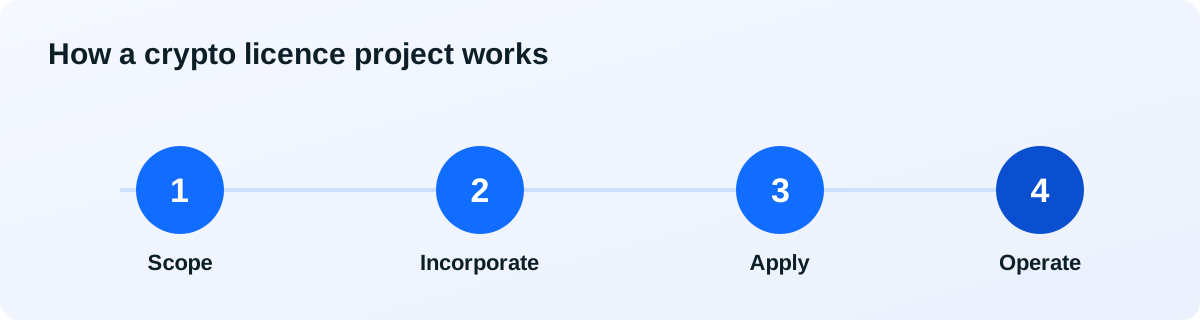
- Company formation: Register a Panama S.A. with a registered agent. Consulting24 handles this for a flat EUR 6,000.
- Corporate documents: Obtain articles of incorporation, corporate seal, and shareholder registry.
- Bank account: Open a corporate bank account in Panama or internationally (e.g., in Switzerland, Lithuania, or Singapore).
- Legal opinion: Engage a Panama law firm to draft an opinion confirming the legality of your planned crypto activities.
- AML program: Implement an AML/KYC policy and register with the UAF if handling fiat.
- Exchange platform: Develop or integrate your trading engine, wallet infrastructure, and user interface.
- Compliance: Set up transaction monitoring, reporting, and periodic audits.
- Launch: Go live with crypto-to-crypto trading; add fiat on-ramp via stablecoin bridge.
Total time: 6-12 weeks. Consulting24 coordinates the entire process. For a detailed timeline, see our application process page.
Banking & Payments
Opening a corporate bank account for a Panama crypto exchange can be challenging due to perceived risk. Recommended banks include:
- Panama banks: Banco General, Banistmo, Credicorp Bank - require physical presence and may restrict crypto-related transactions.
- International banks: Swiss banks (e.g., Frick, SEBA), Lithuanian banks (e.g., Revolut Business, PayrNet), or digital banks (e.g., Mercury, Brex).
For fiat on/off-ramps, partner with a licensed payment processor like Simplex, MoonPay, or a Lithuanian EMI. The stablecoin bridge structure (crypto -> USDC -> fiat) is the most common approach. Consulting24 can introduce you to banking partners that accept crypto businesses. For more on banking, read our Lithuania crypto license page which covers EMI options.
Benefits of a Panama Crypto Exchange
- Low cost: Flat EUR 6,000 setup, no minimum capital, low annual fees.
- Tax efficiency: Territorial tax system - no tax on foreign income.
- Speed: Company formation in 2-4 weeks.
- Privacy: Shareholder information is not public (bearer shares possible, but not recommended for compliance).
- Flexibility: No specific crypto license means you can pivot activities quickly.
- Global reach: Panama S.A. can operate worldwide, subject to local laws.
These benefits make Panama a top choice for crypto exchanges that want to minimize regulatory burden and maximize profit. For a comparison with other jurisdictions, see our jurisdictions page.
Compliance & Trust
While Panama offers flexibility, you must maintain trust with users and partners. Essential compliance steps include:
- AML/KYC program: Implement identity verification, transaction monitoring, and suspicious activity reporting.
- Data protection: Comply with Panama's data protection law (Law 81 of 2019) and GDPR if serving EU clients.
- Transparency: Publish clear terms of service, fee schedules, and a privacy policy.
- Audits: Conduct regular security audits and proof-of-reserves.
This is general guidance, not legal advice. Consulting24 recommends engaging a Panama law firm for a compliance review. A well-structured Panama exchange can be as trustworthy as any regulated entity. For more on compliance, visit our requirements page.
Common Mistakes
- Handling fiat directly without a license - This can lead to fines or account closure. Always use a stablecoin bridge or partner with a licensed payment processor.
- Ignoring AML obligations - Even crypto-to-crypto exchanges should have AML policies to avoid being used for money laundering.
- Choosing the wrong bank - Some banks close accounts of crypto businesses. Work with crypto-friendly banks.
- Not obtaining a legal opinion - A legal opinion protects you if regulators question your activities.
- Assuming Panama is a regulatory-free zone - Panama has AML laws and international cooperation. Act professionally.
Avoiding these mistakes will save you time and legal trouble. For more tips, read our blog.
Alternatives: Panama vs Lithuania vs Estonia
| Jurisdiction | License Type | Capital Required | Cost (Setup) | Tax |
|---|---|---|---|---|
| Panama | None (corporate) | None | EUR 6,000 | Territorial (0% foreign income) |
| Lithuania | CASP (MiCA) | EUR 50,000-150,000 | ~EUR 15,000-25,000 | 15% corporate tax |
| Estonia | CASP (MiCA) | EUR 50,000-150,000 | ~EUR 10,000-20,000 | 20% corporate tax (0% on reinvested) |
Panama is the cheapest and most tax-efficient, but lacks a formal license. Lithuania and Estonia offer regulated status under MiCA, which may be necessary for fiat handling and institutional trust. For a detailed comparison, see our Panama vs Lithuania page and Estonia crypto license page.
Frequently asked questions
Is a Panama crypto exchange legal?
Yes, a Panama S.A. can legally operate a crypto exchange for crypto-to-crypto activities. Direct fiat handling requires a banking license, but using a stablecoin bridge is a common legal workaround. You should obtain a legal opinion to confirm compliance with Panama law.
What is the cost to set up a Panama crypto exchange?
Consulting24 offers a flat EUR 6,000 for company setup. Additional costs include annual registered agent fees (~EUR 1,000-1,500), UAF registration if handling fiat (~EUR 500-1,000), bank account opening (variable), and a legal opinion (~EUR 2,000-5,000). Total initial cost is typically EUR 8,000-12,000.
Does Panama have a crypto license?
No, Panama does not have a specific crypto license. Crypto businesses operate under general corporate law. The main regulatory bodies are the Public Registry, UAF (for AML), and SBP (for banking). This lack of a dedicated license reduces compliance costs but also limits fiat handling.
What are the capital requirements for a Panama crypto exchange?
There is no minimum capital requirement for a Panama S.A. Standard authorized capital is USD 10,000, but no paid-in capital is needed. This is a major advantage compared to EU MiCA licenses which require EUR 50,000-150,000.
How are crypto exchanges taxed in Panama?
Panama has a territorial tax system: income earned outside Panama is tax-free. There is no capital gains tax, no VAT on crypto, and no withholding tax on dividends to non-residents. The only taxes are a flat annual corporation tax (USD 300) and registered agent fees.
Can I handle fiat currency with a Panama crypto exchange?
Direct fiat handling requires a banking license. The common workaround is to use a stablecoin bridge: convert crypto to USDC, then use a licensed payment processor to convert USDC to fiat. This structure is legally sound and widely used.
How long does it take to set up a Panama crypto exchange?
Company formation takes 2-4 weeks. Total setup including bank account, legal opinion, and AML program takes 6-12 weeks. Consulting24 coordinates the entire process.
What activities are allowed with a Panama S.A. for crypto?
Allowed activities include crypto-to-crypto exchange, OTC trading, custody, stablecoin issuance, DeFi integration, and payment processing via stablecoin bridge. Direct crypto-to-fiat conversion is restricted.
Is Panama better than Lithuania for a crypto exchange?
Panama is cheaper and more tax-efficient (no capital, territorial tax). Lithuania offers a regulated MiCA license which may be necessary for fiat handling and institutional trust. The choice depends on your business model and target market.
Do I need a legal opinion for a Panama crypto exchange?
Yes, a legal opinion from a Panama law firm is highly recommended. It confirms the legality of your activities and protects you if regulators question your operations. Cost is typically EUR 2,000-5,000.
Can Consulting24 help with banking for a Panama crypto exchange?
Yes, Consulting24 can introduce you to crypto-friendly banks and payment processors. We advise on the stablecoin bridge structure and help you open corporate accounts in Panama or internationally.
What are the ongoing compliance obligations for a Panama crypto exchange?
Ongoing obligations include annual registered agent fees, corporation tax (USD 300), AML/KYC program maintenance, and transaction monitoring. If handling fiat, UAF registration and reporting are required. This is general guidance, not legal advice.
Official sources

Talk to a crypto-licensing expert
500+ licenses across Estonia, Lithuania, Panama and beyond. Tell us your model and we'll map the right route - honestly.
💬 Talk to an expertFree consultationGeneral guidance, not legal advice. Rules and fees evolve - we confirm current requirements for your case.