UAE Crypto License: A 2026 Comparison Guide for Crypto Founders
The United Arab Emirates has emerged as a global hub for cryptocurrency and blockchain innovation, particularly in Dubai and Abu Dhabi. With clear regulations and a forward-looking approach, many crypto founders consider obtaining a UAE crypto license. However, the process, cost, and ongoing compliance requirements differ significantly from jurisdictions like Panama, Estonia, and Lithuania.
This guide provides an up-to-date comparison of the UAE crypto license framework in 2026, including the relevant regulator, capital requirements, tax treatment, and allowed activities. We also compare it directly with Panama (where Consulting24 delivers a flat-fee license for €6,000) and other EU jurisdictions we serve. Our goal is to help you make an informed decision without overspending or overcommitting.
What Is a UAE Crypto License?
A UAE crypto license is a regulatory authorization that allows companies to operate virtual asset services within the UAE's financial free zones or mainland. The two primary regulators are the Dubai Virtual Assets Regulatory Authority (VARA) and the Abu Dhabi Global Market (ADGM) Financial Services Regulatory Authority.
Under VARA, firms must obtain a Virtual Asset Service Provider (VASP) license. ADGM offers a similar regime under its Financial Services and Markets Regulations. Both require compliance with anti-money laundering (AML) and counter-terrorism financing (CTF) rules, plus capital adequacy and custody standards.
As of 2026, the UAE does not have a single federal crypto license; instead, each emirate and free zone sets its own rules. This fragmentation can increase complexity and cost compared to unified regimes like Panama's or Lithuania's.
Who Needs a UAE Crypto License?
Any business that provides virtual asset services in or from the UAE requires a license. This includes:
- Cryptocurrency exchanges (centralized and decentralized)
- Digital wallet providers
- Token issuers (including ICOs/STOs)
- Custodians of virtual assets
- Brokerage and dealing services
- Payment services using virtual assets
- Fund management involving digital assets
If your target market includes UAE residents or you plan to have a physical presence in Dubai or Abu Dhabi, you need a local license. However, many founders choose to serve global markets from jurisdictions like Panama, which offers a simpler and more cost-effective path.
License Type & Regulator
The UAE crypto license is primarily issued by two regulators:
| Regulator | License Type | Scope |
|---|---|---|
| Dubai VARA | VASP License | Virtual asset exchange, custody, transfer, and advisory services within Dubai (excluding DIFC) |
| ADGM FSRA | Financial Services Permission (Crypto) | Operating a multilateral trading facility, custody, arranging deals, and advising on virtual assets in Abu Dhabi |
Both regulators require a physical office, a local management team, and rigorous AML/CFT policies. The application process involves multiple stages, including a preliminary assessment, in-principle approval, and final licensing. This can take 6 to 12 months or longer.
Cost & Timeline
The cost of a UAE crypto license varies significantly depending on the regulator, free zone, and complexity of services. Below is an indicative comparison:
| Jurisdiction | Initial Setup (approx.) | Annual Renewal | Timeline |
|---|---|---|---|
| Dubai VARA | €100,000 - €200,000 | €50,000 - €100,000 | 6-12 months |
| ADGM | €80,000 - €150,000 | €40,000 - €80,000 | 6-9 months |
| Panama (Consulting24) | €6,000 flat | €1,500 - €3,000 | 4-8 weeks |
| Estonia | €3,000 - €5,000 | €1,000 - €2,000 | 1-3 months |
| Lithuania | €2,500 - €4,000 | €1,000 - €2,000 | 2-4 months |
Exact pricing for UAE licenses depends on your specific business model and should be confirmed in a consultation. The UAE is significantly more expensive than Panama, Estonia, or Lithuania, making it suitable only for firms with substantial funding or a strong local market focus.
Capital Requirement
Both VARA and ADGM impose minimum capital requirements based on the type of services offered. As of 2026:
- Dubai VARA: Minimum capital ranges from AED 500,000 (approx. €125,000) for simple custody services to AED 2,000,000 (approx. €500,000) for exchange and brokerage services.
- ADGM: Capital requirements are similar, typically starting at AED 500,000 and scaling with risk. Additional capital may be required for operational risk and custody of client assets.
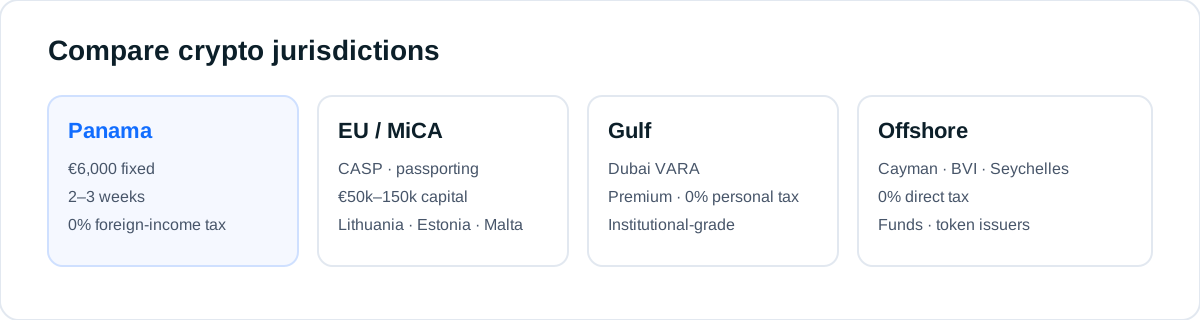
These amounts are high compared to Panama, which has no explicit minimum capital for crypto license holders (though a reasonable working capital is expected), and EU jurisdictions like Lithuania (€125,000 for exchange) under MiCA.
Tax Treatment
The UAE offers a very attractive tax environment for crypto businesses:
- Corporate tax: 0% on qualifying income from virtual asset activities in most free zones (including DMCC, ADGM). A 9% federal corporate tax applies to mainland companies exceeding AED 375,000 profit, but free zone entities can maintain 0% if they meet substance requirements.
- VAT: 5% on most goods and services, but virtual asset transactions may be exempt or zero-rated depending on the specific activity. Professional advice is recommended.
- Personal income tax: 0% for individuals.
Panama also offers territorial taxation (only income sourced in Panama is taxed), and no capital gains tax. Estonia and Lithuania have corporate income tax rates of 20% and 15% respectively, but with incentives for reinvested profits.
Allowed Activities
A UAE crypto license permits a wide range of virtual asset services, subject to the specific scope granted by the regulator. Typical allowed activities include:
- Operating a virtual asset exchange (order book, OTC, P2P)
- Providing custody and safekeeping of virtual assets
- Transferring virtual assets on behalf of clients
- Advising on virtual asset investments
- Issuing and managing virtual assets (including stablecoins, subject to additional approval)
- Underwriting and placement of virtual assets
However, certain activities like decentralized finance (DeFi) protocols and algorithmic stablecoins face additional scrutiny. The Panama crypto license allows similar activities but with a broader, more permissive framework that does not restrict DeFi or token issuance as heavily.
Step-by-Step Process
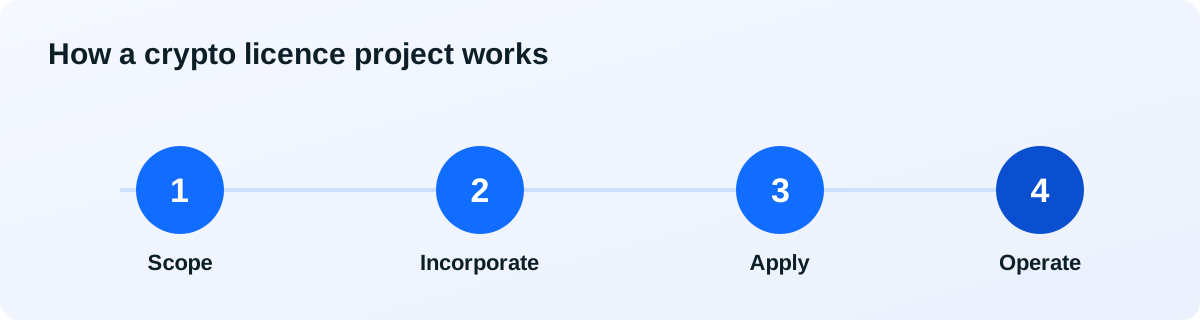
The process to obtain a UAE crypto license involves several stages:
- Pre-application: Engage a local agent or consultancy. Prepare a detailed business plan, AML/CFT policies, and corporate structure.
- Initial submission: Submit the application to VARA or ADGM with required documentation, including proof of capital, background checks on directors, and a risk assessment.
- In-Principle Approval (IPA): The regulator reviews the application and may request additional information. IPA is typically granted within 2-4 months.
- Setup and compliance: Once IPA is obtained, incorporate the legal entity, lease a physical office, hire a local compliance officer, and implement the AML/CFT program.
- Final approval: After meeting all conditions, the regulator issues the full license. This can take another 2-4 months.
- Ongoing supervision: Submit periodic reports, undergo audits, and maintain compliance with regulatory requirements.
In contrast, Panama's process through Consulting24 is streamlined: we handle company incorporation, license application, and compliance setup in 4-8 weeks with a fixed fee.
Banking & Payments
Opening a bank account for a UAE crypto license can be challenging due to compliance concerns. Many traditional banks are reluctant to serve crypto firms. Options include:
- Local UAE banks with dedicated digital asset units (e.g., Mashreq, RAKBANK)
- Free zone banks like those in ADGM or DIFC
- International crypto-friendly banks (e.g., Standard Chartered, but with strict onboarding)
Panama offers more straightforward banking for crypto businesses, with several local banks accepting crypto clients. Estonia and Lithuania also have a growing number of fintech-friendly banks and EMI partners.
Benefits of a UAE Crypto License
Despite the high cost, the UAE license offers several advantages:
- Regulatory clarity: VARA and ADGM have published comprehensive rulebooks, providing legal certainty.
- Tax efficiency: 0% corporate tax in free zones and no personal income tax.
- Global reputation: The UAE is seen as a progressive, well-regulated jurisdiction, which can enhance trust with partners and customers.
- Access to the Middle East market: A physical presence in Dubai or Abu Dhabi facilitates business with regional investors and institutions.
However, for many startups, the cost and complexity outweigh the benefits. Panama offers similar tax advantages (territorial tax, no capital gains) at a fraction of the cost, making it a more practical choice for early-stage ventures.
Compliance & Trust
UAE regulators enforce strict compliance requirements. Licensees must:
- Appoint a local compliance officer with relevant experience
- Conduct ongoing AML/CFT screening of clients
- Maintain records of all transactions for at least 5 years
- Submit periodic financial and operational reports
- Undergo annual audits by a licensed auditor
Failure to comply can result in fines, suspension, or revocation of the license. This is general guidance, not legal advice. We recommend engaging local legal counsel for UAE compliance. In Panama, compliance is less burdensome, with no mandatory local office or compliance officer, though AML procedures are still required.
Common Mistakes When Applying for a UAE Crypto License
Founders often make these errors:
- Underestimating costs: The total cost including professional fees, office rent, and capital can exceed €300,000 in the first year.
- Inadequate AML/CFT policies: Regulators reject applications that lack detailed, risk-based policies.
- Choosing the wrong free zone: Each free zone has different rules; some are more crypto-friendly than others.
- Ignoring substance requirements: The UAE requires a physical office and local staff, which adds ongoing expenses.
- Overlooking ongoing compliance: Many firms focus on getting the license but fail to budget for annual compliance costs.
To avoid these pitfalls, consider starting with a simpler jurisdiction like Panama, where Consulting24 provides end-to-end support, and then expand to the UAE later if needed.
Alternatives & Comparison: UAE vs Panama, Estonia, and Lithuania
Choosing the right jurisdiction depends on your budget, target market, and business model. Here is a quick comparison:
| Factor | UAE | Panama | Estonia | Lithuania |
|---|---|---|---|---|
| Initial cost | €80,000 - €200,000 | €6,000 flat | €3,000 - €5,000 | €2,500 - €4,000 |
| Timeline | 6-12 months | 4-8 weeks | 1-3 months | 2-4 months |
| Capital requirement | €125,000 - €500,000 | None (reasonable working capital) | €12,000 (share capital) | €125,000 (MiCA) |
| Corporate tax | 0% (free zone) | Territorial (0% on foreign income) | 20% (0% on reinvested profit) | 15% |
| Physical office required | Yes | No | Yes (virtual allowed) | Yes (virtual allowed) |
| Regulator | VARA / ADGM | Superintendencia de Bancos | FIU / FSA | Bank of Lithuania |
For most startups, Panama offers the best balance of cost, speed, and flexibility. Estonia and Lithuania are strong EU options under MiCA, while the UAE is best for well-funded firms targeting the Middle East.
Why Choose Consulting24 for Your Crypto License?
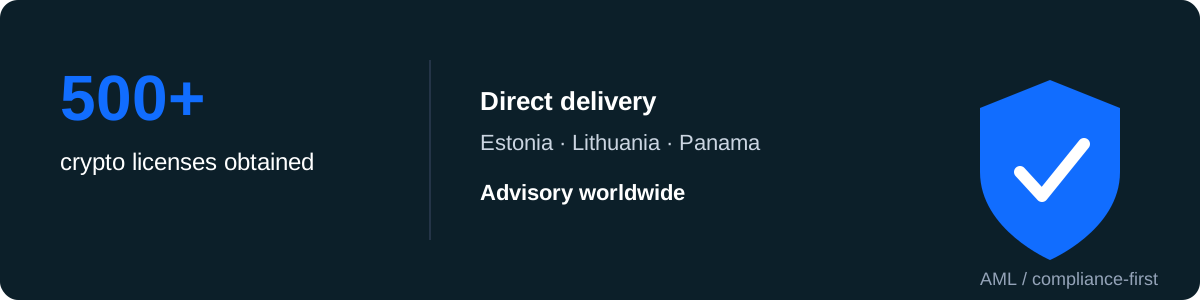
Consulting24 (X24Consulting OU) has obtained over 500 crypto licenses across multiple jurisdictions. We deliver directly in Estonia, Lithuania, and Panama. For the UAE, we provide expert advice and coordination to help you understand the options, but we do not file UAE licenses ourselves.
Our Panama service is particularly attractive: a flat fee of €6,000 includes company incorporation, license application, and compliance setup. We handle the entire process so you can focus on building your business.
Whether you choose Panama, Estonia, Lithuania, or need help comparing with the UAE, our team can guide you. Contact us on WhatsApp or book a consultation to discuss your specific needs.
Frequently asked questions
What is the cost of a UAE crypto license in 2026?
The cost varies by regulator and services. For Dubai VARA, expect €100,000-€200,000 initial setup plus €50,000-€100,000 annual renewal. ADGM is slightly lower at €80,000-€150,000 initial. These figures include professional fees but exclude capital requirements.
How long does it take to get a UAE crypto license?
The process typically takes 6 to 12 months from application to final approval. This includes obtaining in-principle approval, incorporating the company, setting up a physical office, and meeting all compliance conditions.
What is the minimum capital for a UAE crypto license?
Minimum capital ranges from AED 500,000 (€125,000) for custody services to AED 2,000,000 (€500,000) for exchange and brokerage. Capital must be deposited in a UAE bank account and maintained throughout the license period.
Can I get a UAE crypto license without a physical office?
No. Both VARA and ADGM require licensees to have a physical office in the respective free zone. This adds significant cost for rent, utilities, and local staff. Virtual offices are not accepted.
Is a UAE crypto license tax-free?
Companies operating in UAE free zones can benefit from 0% corporate tax on qualifying income. There is also no personal income tax. However, VAT at 5% may apply to certain services. Panama offers similar tax benefits with no corporate tax on foreign income.
What activities are allowed under a UAE crypto license?
Allowed activities include operating a crypto exchange, custody services, transfer services, advisory, and token issuance. DeFi and stablecoin projects face additional scrutiny. The Panama license is more permissive for innovative models.
How does Panama compare to the UAE for a crypto license?
Panama is significantly cheaper (€6,000 flat vs €80,000+), faster (4-8 weeks vs 6-12 months), and has no minimum capital or physical office requirement. Panama also offers territorial taxation. The UAE provides better regional access and regulatory prestige.
Can Consulting24 help me get a UAE crypto license?
Consulting24 advises and coordinates for UAE licenses but does not directly file them. We recommend Panama, Estonia, or Lithuania, which we deliver directly. We can help you compare options and choose the best jurisdiction for your business.
What are the ongoing compliance requirements for a UAE crypto license?
Licensees must appoint a local compliance officer, conduct AML/CFT screening, maintain transaction records for 5 years, submit periodic reports, and undergo annual audits. Non-compliance can lead to fines or license revocation.
Is the UAE crypto license recognized globally?
The UAE license is respected but not automatically recognized in other jurisdictions. If you plan to serve global markets, a Panama or EU license may offer broader acceptance due to FATF and MiCA alignment.
Official sources
Related jurisdictions

Talk to a crypto-licensing expert
500+ licenses across Estonia, Lithuania, Panama and beyond. Tell us your model and we'll map the right route — honestly.
💬 Talk to an expertFree consultationGeneral guidance, not legal advice. Rules and fees evolve — we confirm current requirements for your case.