El Salvador vs Singapore Crypto License: Which Jurisdiction Fits Your Business?
Choosing the right jurisdiction for your crypto license is a strategic decision that affects your operational costs, regulatory burden, and market access. In 2026, El Salvador and Singapore present two distinct paths: one offers a low-cost, tax-friendly environment with a Bitcoin-friendly government, while the other provides a prestigious, well-regulated framework with access to Asian markets. This page compares both options in detail, focusing on the crypto license requirements, costs, timelines, and compliance obligations. Whether you are a startup or an established exchange, understanding the trade-offs is essential.
Consulting24 advises and coordinates crypto licensing across multiple jurisdictions, including El Salvador and Singapore. We help you evaluate the best fit for your business model and guide you through the application process. Our team has deep knowledge of the regulatory markets in both countries, ensuring you make an informed decision without unnecessary delays or hidden costs. For a low-cost alternative, consider Panama with a flat EUR 6,000 fee.
Overview: What Is the El Salvador and Singapore Crypto License?
El Salvador does not have a dedicated crypto license per se, but it offers a Bitcoin Services Provider (BSP) registration under the Bitcoin Law of 2021. The regulator is the Central Reserve Bank of El Salvador (BCR). This registration allows businesses to operate Bitcoin-related services, including exchanges, wallets, and payment processing. The process is relatively straightforward and low-cost, reflecting the country's pro-Bitcoin stance. However, it is limited to Bitcoin only, not other cryptocurrencies.
Singapore, on the other hand, requires a Major Payment Institution (MPI) license under the Payment Services Act (PSA), regulated by the Monetary Authority of Singapore (MAS). This license covers digital payment token (DPT) services, including crypto exchanges, custodial wallets, and peer-to-peer transfers. Singapore is known for its rigorous compliance standards, high capital requirements, and strong investor protections. The MPI license is a full-fledged license that allows a broad range of payment services, including e-money issuance and cross-border transfers, in addition to crypto services.
Both jurisdictions have their own appeal, but the choice depends on your target market, asset focus, and budget. For a broader comparison of jurisdictions, visit our jurisdictions page.
Who Needs These Licenses?
El Salvador BSP registration is suitable for:
- Bitcoin exchanges and trading platforms targeting Latin American markets
- Payment processors that want to use Bitcoin's legal tender status
- Startups seeking a low-cost entry point with minimal capital requirements
- Businesses that prioritize tax efficiency (no capital gains tax on Bitcoin)
- Companies that plan to operate Bitcoin ATMs or provide Bitcoin wallet services
Singapore MPI license is ideal for:
- Established exchanges and fintech firms seeking credibility in Asia
- Businesses that require a strong regulatory framework to attract institutional investors
- Companies planning to offer multiple payment services (e-money, cross-border transfers, DPT)
- Firms that can commit to high compliance costs and capital outlay
- Enterprises that want to deal with multiple cryptocurrencies, not just Bitcoin
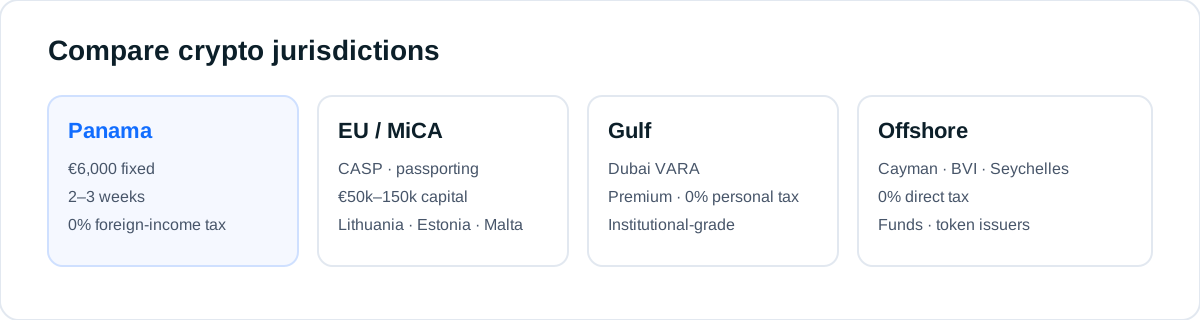
If your business is Bitcoin-only and cost-sensitive, El Salvador may be the better choice. For a multi-asset platform with institutional ambitions, Singapore is more appropriate. For a balanced option, consider Panama with a flat fee and no capital gains tax.
License Type and Regulator
| Jurisdiction | License Type | Regulator |
|---|---|---|
| El Salvador | Bitcoin Services Provider (BSP) registration | Central Reserve Bank of El Salvador (BCR) |
| Singapore | Major Payment Institution (MPI) license under Payment Services Act | Monetary Authority of Singapore (MAS) |
The BCR in El Salvador is a central bank with limited crypto-specific resources, while MAS is a world-class financial regulator with a dedicated fintech team. This difference affects the application timeline and scrutiny level.
Cost and Timeline
The cost and timeline for obtaining a crypto license in El Salvador vs Singapore differ significantly. Below is a comparison based on 2026 figures. Exact costs may vary; we recommend a consultation for precise quotes.
| Jurisdiction | Application Fee | Total Estimated Cost (including legal & advisory) | Timeline |
|---|---|---|---|
| El Salvador | No official fee (registration is free) | Typically EUR 8,000 - 15,000 (advisory + setup) | 2-4 months |
| Singapore | Application fee: SGD 10,000 (approx EUR 6,500) | Typically EUR 50,000 - 100,000 (legal, compliance, setup) | 6-12 months |
El Salvador offers a faster and cheaper route, while Singapore requires a larger upfront investment and a longer timeline due to rigorous due diligence. For a cost-effective alternative, Panama offers a flat EUR 6,000 fee with a 3-4 month timeline.
Capital Requirement
Capital requirements are a key differentiator. For El Salvador, there is no statutory minimum capital for BSP registration. However, the BCR may require proof of sufficient operational funds, typically around USD 10,000 - 50,000 depending on the service scope. This is a low barrier for startups.
Singapore imposes a clear minimum capital requirement: for MPI license holders, the base capital is SGD 250,000 (approx EUR 160,000). If the business handles e-money or cross-border payments, higher tiers apply. This is a significant barrier for smaller firms but provides credibility. The capital must be maintained as liquid funds.
In comparison, many EU jurisdictions under MiCA require EUR 50,000 to 150,000 depending on service type. Lithuania offers a capital requirement as low as EUR 50,000 for certain services.
Tax Treatment
Tax treatment is a major consideration. El Salvador offers a highly favorable tax regime: no capital gains tax on Bitcoin, no income tax on Bitcoin transactions (if held as a capital asset), and a general corporate income tax rate of 30% (but with exemptions for tech companies). Many crypto businesses effectively pay 0% tax on Bitcoin gains. However, income from other services may be taxed.
Singapore has a territorial tax system: corporate income tax is 17% on profits derived from or remitted to Singapore. Capital gains are not taxed, but crypto trading profits are considered income and subject to tax. Goods and Services Tax (GST) at 9% applies to certain crypto transactions. Overall, Singapore is competitive but not as tax-free as El Salvador. For a tax-neutral option, Panama has no capital gains tax and no corporate income tax on offshore income.
Allowed Activities
El Salvador BSP registration allows:
- Bitcoin exchange (buy/sell)
- Bitcoin wallet services
- Bitcoin payment processing
- Bitcoin ATM operation
- Conversion between Bitcoin and USD
Singapore MPI license covers:
- Digital payment token (DPT) exchange (including altcoins)
- DPT custodial services
- Cross-border money transfer (including crypto)
- E-money issuance
- Merchant acquisition for crypto payments
Singapore allows a broader range of crypto assets, while El Salvador is Bitcoin-centric. If you plan to offer services for Ethereum, USDT, or other tokens, Singapore is necessary. For Bitcoin-only operations, El Salvador suffices. For a multi-asset license with lower costs, explore Estonia.
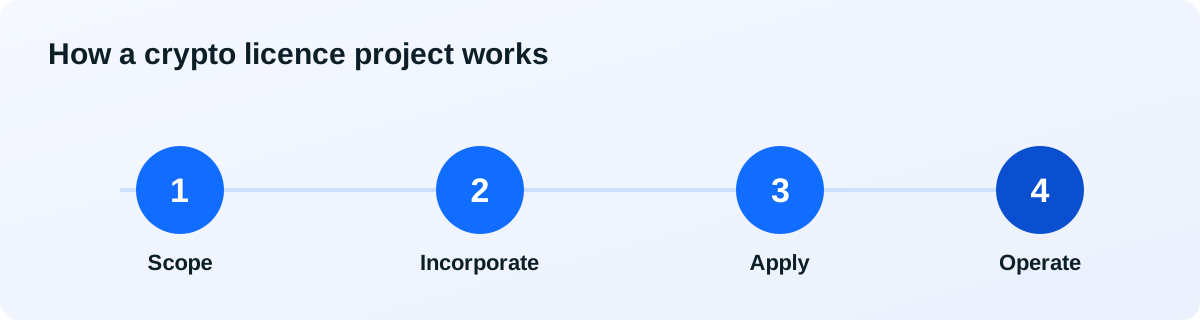
Step-by-Step Application Process
El Salvador BSP Registration
- Incorporate a local company (Sociedad Anónima de Capital Variable).
- Prepare a business plan, AML/CFT policies, and compliance manual.
- Submit application to the Central Reserve Bank (BCR) with required documents.
- Undergo background checks on beneficial owners and directors.
- Receive approval and register as a Bitcoin Services Provider.
- Ongoing reporting to BCR (quarterly transaction reports and annual audits).
Singapore MPI License
- Incorporate a Singapore company (Private Limited).
- Appoint at least one local director, a company secretary, and a compliance officer.
- Prepare a detailed business plan, risk assessment, AML/CFT policies, and audit framework.
- Submit application via MAS's e-licensing portal with SGD 10,000 fee.
- MAS conducts a thorough review (6-12 months), including interviews and site visits.
- Upon approval, pay the annual license fee and comply with ongoing reporting (monthly/quarterly).
For a smoother process, Consulting24 can assist with document preparation and liaising with regulators. For a simpler alternative, consider Panama with a straightforward registration.
Banking and Payment Integration
Banking is a challenge in both jurisdictions. In El Salvador, local banks are often hesitant to serve crypto businesses due to perceived risk, but the government encourages Bitcoin adoption. Many firms use international payment processors or crypto-friendly banks in Panama or the US. The Central Bank does not mandate banks to serve crypto firms, so building relationships is key.
Singapore has a more developed banking sector, but major banks like DBS, OCBC, and UOB are cautious. Some digital banks and fintech-friendly institutions like DBS (via its digital exchange) may offer services. However, compliance requirements are strict, and many firms rely on payment service providers (PSPs) for fiat on/off ramps. Opening a corporate account can take 2-4 months.
For banking ease, Panama offers a more accessible banking environment with international banks that accept crypto businesses. Consulting24 can recommend banking partners.
Benefits of Each Jurisdiction
El Salvador:
- Low cost and fast setup (2-4 months)
- No capital gains tax on Bitcoin
- Bitcoin is legal tender, reducing friction
- Government actively supports crypto innovation
- Minimal ongoing compliance burden
Singapore:
- High regulatory credibility and investor trust
- Access to Asian markets and financial hub
- Clear legal framework for multiple crypto assets
- Strong intellectual property protection and talent pool
- strong banking infrastructure once approved
Both have unique advantages. For a middle ground, Lithuania offers EU credibility with lower costs than Singapore.
Compliance and Trust Considerations
Compliance is a critical factor. El Salvador's regulatory framework is less mature, with limited enforcement. This can be an advantage for speed but may raise concerns for institutional partners. Firms must still implement strong AML/CFT measures to satisfy international standards and avoid being blacklisted. The BCR requires quarterly reports but does not conduct frequent inspections.
Singapore's MAS is one of the most respected regulators globally. The MPI license requires rigorous compliance: regular audits, transaction monitoring, and reporting. This builds trust with banks, investors, and partners. However, the compliance burden is high, requiring dedicated staff and systems. Non-compliance can result in fines or license revocation. General guidance, not legal advice.
For a balanced compliance environment, Estonia offers a strong but manageable framework under MiCA.
Common Mistakes to Avoid
- Underestimating compliance costs: In Singapore, legal and compliance fees can exceed EUR 100,000. Budget accordingly. In El Salvador, while cheaper, don't skip AML policies.
- Ignoring local banking challenges: Even with a license, opening a bank account may be difficult. Plan alternative payment rails or use crypto-friendly banks in other jurisdictions.
- Choosing El Salvador without a Bitcoin focus: The BSP registration is Bitcoin-specific. If you deal with altcoins, Singapore or other jurisdictions may be better.
- Overlooking tax obligations: In Singapore, crypto trading profits are taxable. Get professional tax advice. In El Salvador, understand the difference between capital gains and business income.
- Rushing the application: Incomplete applications lead to delays. Use experienced advisors like Consulting24 to avoid rejections.
- Assuming a license guarantees banking: Banks may still refuse service. Prepare a strong compliance track record.
Alternatives and Comparison with Other Jurisdictions
If neither El Salvador nor Singapore fits your needs, consider other options. For a low-cost, tax-friendly alternative, Panama offers a flat EUR 6,000 fee for a crypto license with no capital gains tax and no corporate income tax on offshore income. Panama is ideal for Latin American market access and has a straightforward registration process with a 3-4 month timeline.
For a European base, Lithuania and Estonia provide MiCA-compliant licenses with capital requirements from EUR 50,000. Lithuania offers a faster timeline (3-4 months) and lower costs than Singapore, while Estonia has a strong e-residency program. Both are well-regarded for fintech.
For a Middle Eastern hub, Dubai's VARA license is prestigious but costly (EUR 100,000+). Other options include Czech Republic, Poland, Malta, Switzerland, Cyprus, and Cayman Islands. Each has unique advantages in terms of cost, tax, and regulatory rigor.
Conclusion: Which One Should You Choose?
The choice between El Salvador and Singapore depends on your business model, target market, and budget. If you are a Bitcoin-focused startup with limited capital, El Salvador offers a fast, low-cost entry with tax benefits. If you are an established exchange seeking credibility in Asia with a multi-asset platform, Singapore is the better choice despite higher costs.
For many businesses, a middle-ground jurisdiction like Panama or Lithuania may be more suitable. Consulting24 can help you evaluate your options and guide you through the application process. Contact us for a consultation to discuss your specific needs.
Frequently asked questions
What is the difference between El Salvador BSP registration and Singapore MPI license?
El Salvador BSP is a Bitcoin-specific registration with low costs and no minimum capital, ideal for Bitcoin-only businesses. Singapore MPI is a comprehensive license covering multiple crypto assets with high capital requirements (SGD 250,000) and rigorous compliance, suitable for multi-asset exchanges targeting institutional clients.
Which jurisdiction is cheaper for a crypto license?
El Salvador is significantly cheaper, with total costs around EUR 8,000-15,000 and no application fee. Singapore costs EUR 50,000-100,000 including legal fees. For a budget-friendly alternative, Panama offers a flat EUR 6,000 fee.
How long does it take to get a crypto license in El Salvador vs Singapore?
El Salvador takes 2-4 months, while Singapore takes 6-12 months due to thorough due diligence by MAS. Panama offers a 3-4 month timeline.
What are the capital requirements for each jurisdiction?
El Salvador has no statutory minimum capital, but proof of operational funds (USD 10,000-50,000) may be required. Singapore requires SGD 250,000 (approx EUR 160,000) base capital for MPI license.
What is the tax treatment for crypto businesses in El Salvador and Singapore?
El Salvador has no capital gains tax on Bitcoin and a 30% corporate tax with exemptions. Singapore taxes crypto trading profits as income at 17%, with no capital gains tax. Panama has no capital gains tax and no corporate tax on offshore income.
Can I operate an altcoin exchange with an El Salvador BSP registration?
No, El Salvador BSP registration is limited to Bitcoin services only. For altcoins, you need a license in Singapore or other jurisdictions like Lithuania or Estonia.
Which jurisdiction is better for attracting institutional investors?
Singapore is better due to its strong regulatory framework and MAS reputation. El Salvador's framework is less mature, which may deter institutional investors.
Is it easy to open a bank account for a crypto business in El Salvador or Singapore?
In both jurisdictions, banking is challenging. El Salvador's local banks are hesitant, while Singapore's major banks are cautious. Many firms use international payment processors or crypto-friendly banks. Consulting24 can assist with banking introductions.
What are the ongoing compliance requirements for each license?
El Salvador requires quarterly transaction reports and annual audits. Singapore requires monthly/quarterly reporting, regular audits, transaction monitoring, and AML/CFT compliance. Singapore's burden is higher.
Can Consulting24 help me apply for a crypto license in El Salvador or Singapore?
Yes, Consulting24 advises and coordinates licensing in both jurisdictions. We provide end-to-end support from company setup to application submission. Contact us for a consultation.
What is the best alternative if I find El Salvador too limited and Singapore too expensive?
Consider Panama with a flat EUR 6,000 fee, no capital gains tax, and a 3-4 month timeline. Lithuania and Estonia also offer MiCA-compliant licenses with capital from EUR 50,000.
Official sources
Related jurisdictions

Talk to a crypto-licensing expert
500+ licenses across Estonia, Lithuania, Panama and beyond. Tell us your model and we'll map the right route, honestly.
💬 Talk to an expertFree consultationGeneral guidance, not legal advice. Rules and fees evolve, and we confirm current requirements for your case.