Crypto Exchange License Singapore Crypto License: Crypto Exchange License Singapore: Your 2026 Guide to MAS Regulation
The Monetary Authority of Singapore (MAS) has established one of the world's most respected regulatory frameworks for digital assets. Under the Payment Services Act, any business operating a crypto exchange in Singapore must hold a Major Payment Institution (MPI) license for Digital Payment Token (DPT) services. This license is essential for compliance, trust, and access to Singapore's advanced financial ecosystem.
Singapore's approach balances innovation with strict anti-money laundering (AML) and counter-terrorism financing (CFT) requirements. The MPI license allows firms to provide cross-border money transfer, e-money issuance, and DPT services. As of 2026, the regulatory environment is mature, with clear capital requirements and ongoing compliance obligations. The MAS regularly updates its guidelines, and recent enforcement actions show a commitment to high standards.
Consulting24 advises and coordinates the Singapore crypto exchange license application. Our team works with local legal partners to guide you through the process, from company incorporation to MAS approval. While we do not file directly in Singapore, we provide end-to-end advisory and connect you with vetted experts. For a cost-effective alternative, consider our direct service for Panama at a flat EUR 6,000.
What is the Singapore Crypto Exchange License?
The Singapore crypto exchange license, formally known as the Major Payment Institution (MPI) license under the Payment Services Act (PSA), is a regulatory approval required to operate a digital payment token (DPT) exchange in Singapore. The Monetary Authority of Singapore (MAS) oversees all licensing and compliance. The license covers services such as:
- Digital payment token exchange (buying, selling, swapping)
- Cross-border money transfer
- Domestic money transfer
- E-money issuance
- Merchant acquisition
To qualify, companies must meet strict criteria including a minimum capital requirement of S$500,000 (or S$100,000 for smaller operations under the Standard Payment Institution license, but the MPI is the typical choice for exchanges). The license is valid indefinitely but subject to annual compliance assessments. MAS also requires a physical office in Singapore and at least one local director who is a Singapore resident. The application process is rigorous, with detailed scrutiny of the business model, AML/CFT controls, and the background of key personnel.
As of 2026, Singapore remains a top-tier jurisdiction for crypto businesses, but the cost and complexity are high. For startups with limited budgets, Panama offers a faster and cheaper path at a flat EUR 6,000, though with a different regulatory environment. Consulting24 can help you compare both options.
Who Needs a Singapore Crypto Exchange License?
Any entity that provides DPT exchange services in or from Singapore must hold an MPI license. This includes:
- Crypto exchanges (centralized and decentralized platforms that match buyers and sellers)
- OTC trading desks facilitating large trades
- Brokerages that offer crypto trading to clients
- Any business that holds customer assets for trading
Exemptions exist for very small operations (e.g., monthly transaction volume below S$3 million or limited to specific payment services), but most professional exchanges will require the MPI license. If you plan to serve Singapore residents or operate a trading platform from Singapore, you need this license. Even if your company is headquartered elsewhere, if you have a branch or significant business activity in Singapore, MAS may require licensing.
For businesses that are not ready for Singapore's high capital and compliance demands, consider Estonia or Lithuania under MiCA, or Panama for a lower-cost entry. Consulting24 advises on jurisdiction selection based on your target market and budget.
License Type and Regulator
The regulator is the Monetary Authority of Singapore (MAS). The relevant license is the Major Payment Institution (MPI) license under the Payment Services Act (PSA). There is also a Standard Payment Institution (SPI) license for smaller operators, but it has lower transaction limits (monthly average below S$3 million for any payment service) and is less common for exchanges. The MPI license allows:
- Unlimited transaction volume
- Multiple payment services under one license
- Holding of customer funds with safeguards (e.g., trust accounts)
MAS is known for its thorough oversight. It conducts regular inspections and requires annual audits. The regulator also publishes enforcement actions, including fines and license revocations, for non-compliance. As of 2026, MAS has granted over 20 MPI licenses to crypto firms, with many more applications pending. The process is competitive, and only well-prepared applicants succeed.
Cost and Timeline
| Item | Cost (SGD) | Notes |
|---|---|---|
| Application fee | ~S$10,000 | Non-refundable, paid to MAS |
| Annual license fee | ~S$10,000 | Paid yearly, subject to change |
| Legal & compliance setup | S$50,000 - S$150,000 | Varies by complexity, includes AML/CFT policy drafting, local counsel, and compliance officer services |
| Company incorporation | S$1,000 - S$3,000 | ACRA registration, registered address, nominee director if needed |
| Bank account opening | S$500 - S$2,000 | Some banks charge setup fees |
| Total estimated cost (excl. capital) | S$70,000 - S$200,000 | Depending on scope and legal fees |
The timeline from incorporation to license approval typically takes 6 to 12 months. MAS has a rigorous review process, including background checks, business plan evaluation, and AML/CFT framework assessment. Delays often occur due to incomplete documentation or failure to meet capital maintenance requirements. Consulting24 advises on preparing a strong application to avoid common pitfalls. For a faster and cheaper option, Panama offers a flat EUR 6,000 license with a timeline of 2-4 months.
Capital Requirement
The minimum capital requirement for an MPI license is S$500,000 (approximately EUR 310,000 as of 2026). This must be maintained as paid-up capital and can be in cash or liquid assets. For the SPI license, the requirement is S$100,000, but the MPI is the standard for exchanges. The capital must be held in a Singapore bank account and cannot be used for operational expenses without MAS approval. Additionally, MAS may require higher capital based on the volume of transactions or risk profile.
Capital must be fully paid up before the license is granted. Some applicants use a combination of cash and liquid assets like government bonds, but cash is preferred. The capital serves as a buffer against operational risks and demonstrates financial stability. Compared to other jurisdictions, Singapore's capital requirement is high. For example, Panama has no minimum capital requirement (only the flat fee), and Lithuania under MiCA requires EUR 125,000 for CASP services. Consulting24 can help you assess which jurisdiction fits your financial capacity.
Tax Treatment
Singapore has a territorial tax system. Corporate income tax is 17% on chargeable income. However, there are incentives for financial institutions:
- Tax exemption for new start-ups: up to S$100,000 of chargeable income exempt for the first three years.
- Goods and Services Tax (GST) is 9% (2026) and applies to commission fees, but not to digital payment token transactions themselves.
- No capital gains tax.
- Withholding tax on certain payments (e.g., royalties, interest) may apply at rates up to 15%, but can be reduced under tax treaties.
Singapore also has a network of double taxation agreements (DTAs) with over 80 countries, which can reduce withholding taxes on cross-border payments. Crypto exchanges must register for GST if their annual turnover exceeds S$1 million. Consulting24 recommends engaging a local tax advisor to optimize your structure and ensure compliance with MAS and IRAS requirements.
Allowed Activities
With an MPI license, you can:
- Operate a digital payment token exchange (buy/sell crypto)
- Provide cross-border money transfer services
- Issue e-money
- Provide domestic money transfer services
- Facilitate merchant acquisition
Activities not covered: derivatives trading (requires Capital Markets Services license under the Securities and Futures Act), lending/borrowing of crypto (may require additional approval from MAS), and any activity involving securities tokens (regulated under SFA). Staking and yield farming may also be restricted depending on the structure. It is important to clearly define your business model and confirm with MAS that all activities are within scope. Consulting24 can help map your services to the appropriate regulatory categories.
Step-by-Step Application Process
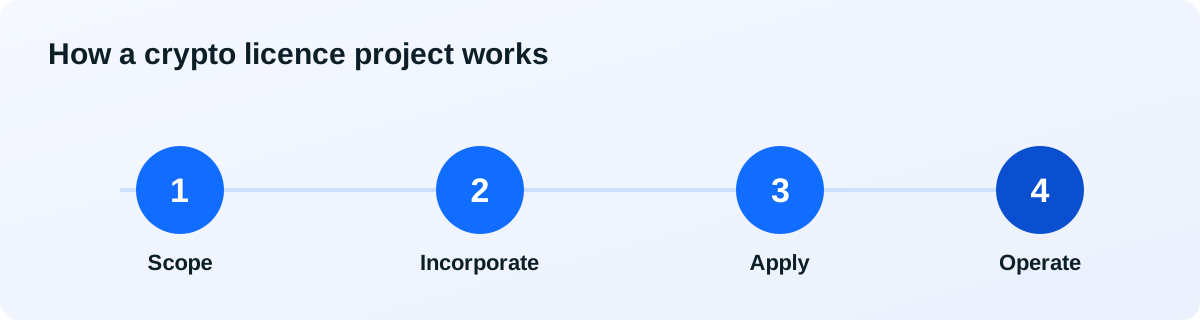
- Company incorporation: Register a Singapore company with ACRA, with at least one local director (Singapore resident) and a registered address. You may also need a company secretary.
- Prepare documentation: Business plan, AML/CFT policies, risk assessment, organizational structure, financial projections, and background checks on directors and shareholders.
- Submit application: File with MAS via the e-licensing portal, including all supporting documents and the application fee (S$10,000).
- MAS review: MAS evaluates the application, may request clarifications, and conducts background checks on key personnel. This stage can take 4-8 months.
- In-principle approval: If satisfied, MAS issues an in-principle approval (IPA), allowing you to start operations under certain conditions (e.g., sandbox restrictions).
- Final approval: After meeting all conditions (e.g., operational readiness, audit, capital maintenance), MAS grants the full MPI license. This may take another 2-4 months.
Consulting24 advises on each step, from entity setup to compliance framework. We coordinate with local law firms and compliance specialists to streamline the process. For a simpler alternative, Panama offers a streamlined process with no capital requirement.
Banking and Payments
Singapore has a well-developed banking sector, but crypto firms face challenges due to AML concerns. Common banking options include:
- DBS, OCBC, UOB (local banks) - require strong compliance history and may take months to open accounts.
- Specialized fintech-friendly banks like Standard Chartered or HSBC (may have higher fees and minimum balances).
- Digital banks (e.g., Trust Bank) - limited for crypto firms, often require a local track record.
You will need a corporate bank account for capital and operational funds. MAS requires segregation of customer assets and may mandate a trust account for client funds. Some banks also require a minimum deposit of S$50,000 to S$100,000. Consulting24 can introduce you to banking partners familiar with crypto. For payment processing, you may need a merchant account with a payment gateway that supports crypto transactions. Alternatives like Panama have more accessible banking for crypto firms.
Benefits of a Singapore Crypto License
- Global reputation: MAS regulation is recognized worldwide, enhancing trust with partners and customers.
- Tax-friendly: No capital gains tax, low corporate tax (17%), and incentives for start-ups.
- Access to Asia: Singapore is a gateway to Southeast Asian markets, with strong trade links and a skilled workforce.
- Stable regulatory environment: Clear rules and consistent enforcement, reducing regulatory uncertainty.
- Strong talent pool: Access to skilled professionals in finance, tech, and compliance.
- High-quality infrastructure: Excellent banking, legal, and technological infrastructure.
However, these benefits come at a cost. For businesses that prioritize speed and lower expense, Panama or Estonia may be more suitable. Consulting24 helps you weigh the trade-offs.
Compliance and Ongoing Obligations
After obtaining the license, you must:
- Submit annual audited financial statements and compliance reports to MAS.
- Maintain AML/CFT programs, including transaction monitoring and suspicious activity reporting.
- Appoint a compliance officer and a money laundering reporting officer (MLRO) who are based in Singapore.
- Conduct regular audits of internal controls and risk management systems.
- Notify MAS of any material changes (e.g., new products, change in directors, significant shareholding changes).
- Maintain the minimum capital requirement at all times.
Non-compliance can result in fines (up to S$1 million), suspension, or revocation of the license. MAS also conducts thematic reviews and may impose additional conditions. Consulting24 provides ongoing advisory to help you stay compliant. This is general guidance, not legal advice. Always consult with a qualified lawyer for your specific situation.
Common Mistakes in the Application
- Incomplete documentation: Missing business plans or vague AML policies lead to delays or rejection.
- Underestimating capital: Not maintaining the S$500,000 requirement throughout the process, or using capital for operational expenses before approval.
- Poor background checks: Directors with adverse records (e.g., bankruptcies, regulatory actions) may be rejected.
- Ignoring local presence: MAS expects a substantive office and local staff (at least one director and a compliance officer in Singapore).
- Rushing the timeline: Expect 6-12 months; trying to fast-track often backfires and leads to more scrutiny.
- Inadequate risk assessment: Failing to address specific risks of your business model (e.g., privacy coins, high-risk jurisdictions).
Consulting24 helps you avoid these pitfalls by preparing a comprehensive application package. For a less demanding process, consider Panama or Lithuania.
Alternatives and Comparisons
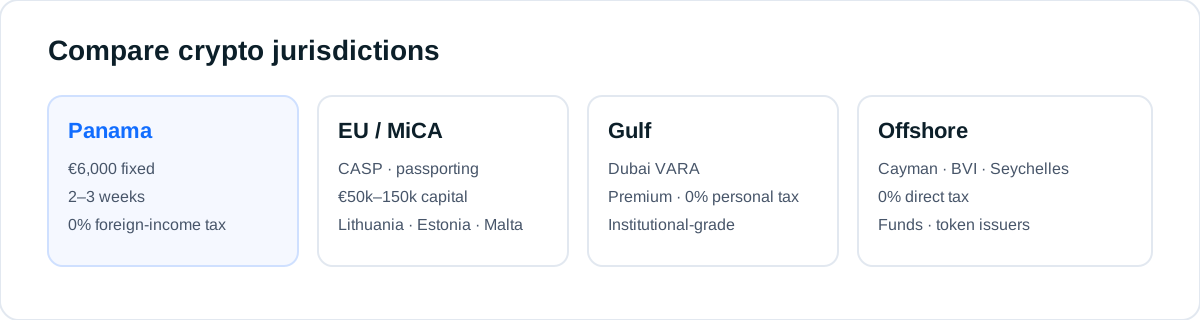
While Singapore is a top-tier jurisdiction, other options exist. For a cost-effective alternative, consider Panama which offers a crypto license at a flat EUR 6,000 with faster setup (2-4 months) and no minimum capital. Panama is ideal for startups with limited budgets. Another alternative is Estonia, which has a straightforward licensing process under the Financial Intelligence Unit (FIU) with capital from EUR 12,000. However, Estonia is now part of the EU's MiCA framework, which imposes higher capital requirements (EUR 50,000 to 150,000) and stricter rules. For those targeting the EU market, Lithuania offers a CASP license under MiCA with capital from EUR 125,000 and a timeline of 3-6 months. Each jurisdiction has trade-offs in cost, timeline, and regulatory burden. Consulting24 can help you compare and choose the best fit. Explore our jurisdictions page for more options.
Why Choose Consulting24?
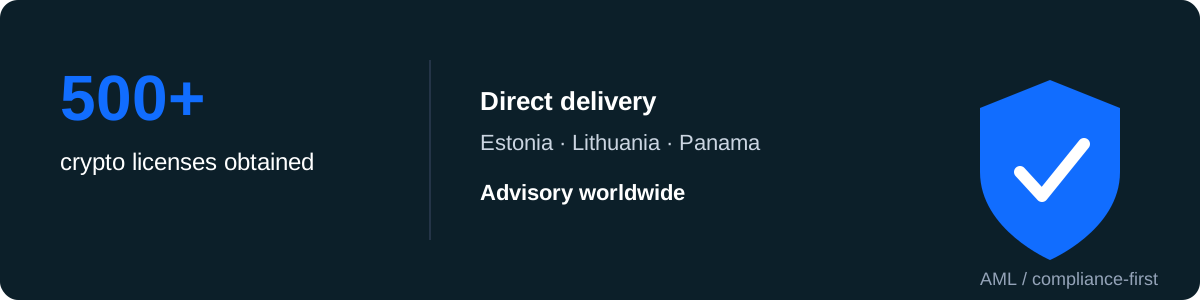
Consulting24 has obtained over 500 crypto licenses globally. For Singapore, we advise and coordinate with local experts to ensure a smooth application. Our services include:
- Initial jurisdiction assessment and strategy
- Company incorporation and bank account setup
- AML/CFT policy drafting
- Application preparation and submission support
- Ongoing compliance monitoring
We do not guarantee approval, but our track record shows that well-prepared applications have a high success rate. Contact us for a consultation to discuss your project. For direct licensing services, we deliver in Estonia, Lithuania, and Panama. For all other jurisdictions, including Singapore, we advise and coordinate with local partners.
Frequently asked questions
What is the minimum capital for a Singapore crypto exchange license?
The minimum capital is S$500,000 (approximately EUR 310,000) for the Major Payment Institution license. This must be maintained as paid-up capital in a Singapore bank account and cannot be used for operational expenses without MAS approval.
How long does it take to get a Singapore crypto license?
The process typically takes 6 to 12 months from company incorporation to final approval. MAS conducts thorough due diligence, including background checks and business plan evaluation. Delays are common if documentation is incomplete.
Can a foreign company apply for a Singapore crypto license?
Yes, but you must incorporate a Singapore company with at least one local director (Singapore resident) and a registered address. The company must have a physical office in Singapore. Consulting24 can assist with the incorporation.
What are the ongoing compliance requirements?
You must submit annual audited financial statements and compliance reports, maintain AML/CFT programs, appoint a local compliance officer and MLRO, and notify MAS of any material changes. Non-compliance can lead to fines or license revocation.
Is the Singapore crypto license recognized in other countries?
Yes, MAS regulation is highly respected globally, which can facilitate partnerships with banks and other regulated entities. However, it does not automatically grant passporting rights in other jurisdictions.
What activities are not allowed under the MPI license?
Derivatives trading, lending/borrowing of crypto, and activities involving securities tokens require separate licenses under the Securities and Futures Act. Staking and yield farming may also be restricted.
How much does the application cost?
The MAS application fee is approximately S$10,000 (non-refundable). Total costs including legal and compliance setup range from S$70,000 to S$200,000, excluding the capital requirement of S$500,000.
Can I operate a crypto exchange in Singapore without a license?
No, operating without an MPI license is illegal and can result in criminal penalties, including fines and imprisonment. All DPT exchange services must be licensed by MAS.
What is the difference between MPI and SPI licenses?
The MPI license has no transaction volume limits and requires S$500,000 capital. The SPI license has a monthly transaction limit of S$3 million and requires S$100,000 capital. Most exchanges opt for the MPI.
Does Singapore tax crypto transactions?
Corporate income tax of 17% applies to profits from crypto trading. GST of 9% applies to commission fees but not to DPT transactions themselves. No capital gains tax. Start-ups may enjoy tax exemptions.
Official sources
Related jurisdictions

Talk to a crypto-licensing expert
500+ licenses across Estonia, Lithuania, Panama and beyond. Tell us your model and we'll map the right route, honestly.
💬 Talk to an expertFree consultationGeneral guidance, not legal advice. Rules and fees evolve, and we confirm current requirements for your case.