Crypto Exchange License Saint Lucia: A Complete Guide for 2026
Saint Lucia has emerged as a pragmatic jurisdiction for crypto exchange licensing, offering a balanced regulatory framework that appeals to founders seeking a credible yet cost-effective base. The island nation's financial services authority has developed a specific licensing regime for virtual asset service providers, including exchanges, that aligns with international anti-money laundering standards while maintaining flexibility for business operations.
For crypto entrepreneurs evaluating a crypto exchange license Saint Lucia, this guide provides the essential facts for 2026: the regulator, licence type, capital requirements, tax treatment, timeline, and step-by-step process. Consulting24 advises and coordinates for Saint Lucia licensing, helping you handle the application with precision. Whether you are launching a new exchange or relocating an existing one, understanding the local requirements is the first step toward a compliant and successful operation.
What Is the Saint Lucia Crypto Exchange License?
The Saint Lucia crypto exchange license is a regulatory authorisation issued by the Financial Services Regulatory Authority (FSRA) of Saint Lucia. It permits a company to operate a virtual asset exchange, including trading platforms that facilitate the buying, selling, and swapping of cryptocurrencies. The regime was introduced under the Virtual Asset Business Act and is designed to provide a clear legal framework for digital asset activities while ensuring compliance with FATF recommendations.
This licence is not a simple registration; it involves a fit-and-proper assessment of directors, a minimum capital requirement, and ongoing reporting obligations. The FSRA supervises licensed entities to prevent money laundering and terrorist financing. As of 2026, Saint Lucia's regime is fully operational and actively issuing licences to qualifying applicants. Consulting24 advises and coordinates the entire process, from company formation to licence submission.
Who Needs a Saint Lucia Crypto Exchange License?
Any business that provides exchange services between cryptocurrencies and fiat currencies, or between one cryptocurrency and another, and is based in or targeting customers from Saint Lucia, must obtain this licence. This includes:
- Centralised cryptocurrency exchanges
- Decentralised exchange operators with a legal entity in Saint Lucia
- Over-the-counter (OTC) trading desks
- Automated market makers (AMMs) with a local presence
- Brokerage services that facilitate crypto trades
If your platform allows users to place buy/sell orders and matches them, the FSRA considers that exchange activity. Even if you operate remotely, having a Saint Lucia company and licence can provide regulatory credibility. Consulting24 helps you assess whether your business model falls under the licensing requirement and advises on structuring accordingly.
Licence Type and Regulator
The Saint Lucia crypto exchange licence falls under the Virtual Asset Business Act, administered by the Financial Services Regulatory Authority (FSRA). The FSRA is the sole regulator for virtual asset service providers in Saint Lucia. The licence is a Class 1 Virtual Asset Service Provider licence, which covers exchange services, transfer services, and custodian wallet services. There is no separate licence for exchange-only; it is bundled under the VASP licence.
The FSRA requires applicants to be a company incorporated in Saint Lucia, with a registered office and at least one director resident in Saint Lucia (or a local agent). The regulator conducts a thorough due diligence process, including background checks on shareholders and directors. Consulting24 coordinates the preparation of the application pack and liaises with the FSRA on your behalf.
Cost and Timeline for a Saint Lucia Crypto Exchange License
The cost of obtaining a Saint Lucia crypto exchange licence varies based on the complexity of the application and the services of professional advisors. Below is a typical cost breakdown for 2026. Exact figures are confirmed in a consultation.
| Item | Estimated Cost (EUR) |
|---|---|
| Government application fee | 2,000 - 5,000 |
| Company incorporation (including registered office) | 1,500 - 3,000 |
| Due diligence and compliance setup | 3,000 - 7,000 |
| Legal and advisory fees (Consulting24) | From 8,000 |
| Total estimated range | 14,500 - 23,000 |
The timeline from application to licence issuance is typically 3 to 6 months, depending on the completeness of the application and the FSRA's workload. A pre-application review can shorten the process. Consulting24 advises on the optimal timeline and helps avoid common delays.
Capital Requirement for Saint Lucia Crypto Exchange License
The minimum capital requirement for a Saint Lucia crypto exchange licence is set by the FSRA and is generally in the range of EUR 50,000 to EUR 100,000, depending on the scope of activities and risk profile. This capital must be maintained as liquid assets (cash or equivalents) and cannot be used for operational expenses. The exact amount is determined during the application process based on your business plan.
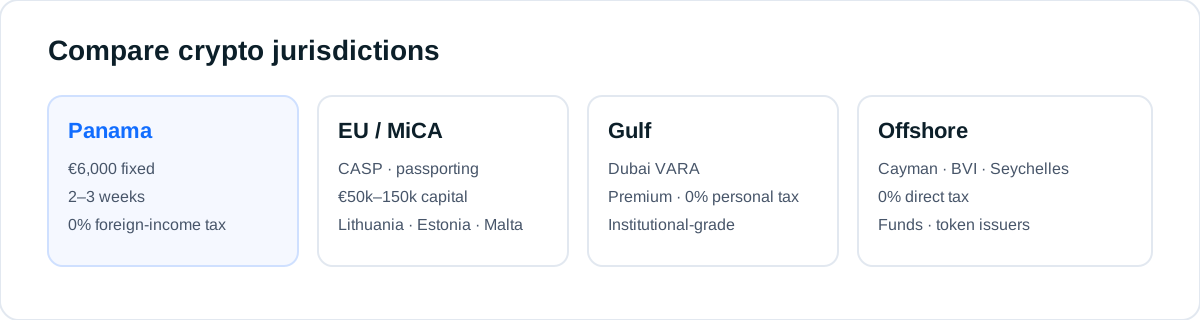
For comparison, the Panama crypto licence has a flat fee of EUR 6,000 with no separate capital requirement, making it a lower-cost alternative. However, Saint Lucia's capital requirement is lower than many EU jurisdictions, where MiCA imposes tiers of EUR 50,000, 125,000, and 150,000. Consulting24 can help you structure your capital to meet the FSRA's expectations efficiently.
Tax Treatment for Crypto Exchange License Holders in Saint Lucia
Saint Lucia offers a favourable tax regime for international business companies (IBCs) that hold a crypto exchange licence. The standard corporate income tax rate is 30%, but IBCs can apply for a reduced rate of 1% to 2% on income from foreign sources, subject to approval. There is no capital gains tax, no withholding tax on dividends, and no VAT on digital services. This makes Saint Lucia attractive for crypto exchanges that generate revenue from trading fees and spreads.
It is important to structure the company correctly to qualify for the reduced tax rate. Consulting24 advises on tax planning and coordinates with local tax advisors to ensure compliance with Saint Lucia's tax laws. As always, this is general guidance and not legal advice; you should seek tailored tax advice for your specific situation.
Allowed Activities Under the Saint Lucia Crypto Exchange License
The Saint Lucia VASP licence permits a broad range of activities, including:
- Operating a cryptocurrency exchange (centralised or decentralised)
- Providing crypto-to-fiat and crypto-to-crypto trading pairs
- Offering custodial wallet services for clients
- Facilitating OTC trades and block trades
- Running an automated market maker (AMM) protocol
- Providing liquidity aggregation services
The licence does not cover activities such as issuing security tokens (which fall under securities law) or operating a crypto ATM without additional approval. The FSRA may impose conditions on the licence, such as transaction limits or reporting requirements. Consulting24 reviews your business model to ensure all intended activities are covered and advises on any necessary amendments.
Step-by-Step Process to Obtain a Saint Lucia Crypto Exchange License
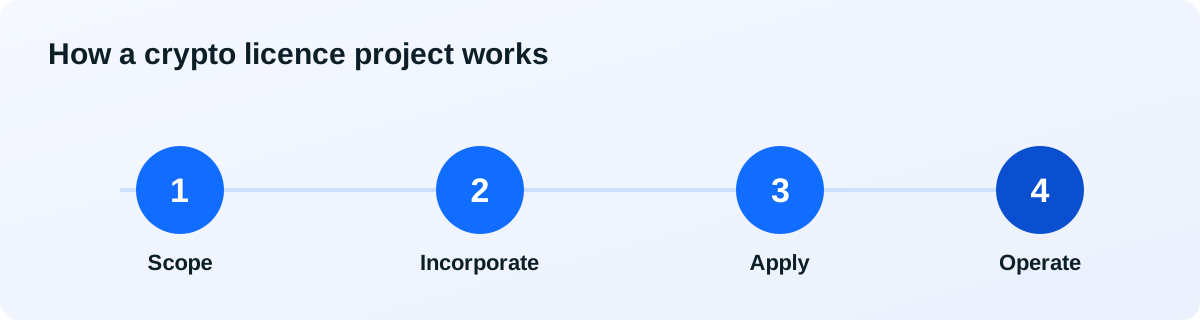
The application process involves several stages. Consulting24 coordinates each step:
- Initial consultation: We assess your business model and confirm eligibility.
- Company incorporation: We set up a Saint Lucia IBC with a registered office and local agent.
- Document preparation: We compile the application pack, including business plan, AML/CFT policies, financial projections, and due diligence documents for all directors and shareholders.
- Submission to FSRA: We submit the application along with the government fee.
- Review and queries: The FSRA may request additional information; we handle all correspondence.
- Approval and licence issuance: Once approved, you receive the licence certificate.
- Post-licence compliance: We assist with ongoing reporting and AML obligations.
The entire process typically takes 3-6 months. Consulting24 provides a dedicated project manager to keep everything on track.
Banking and Payment Solutions for Saint Lucia Crypto Exchanges
Access to banking is a critical consideration for any crypto exchange. Saint Lucia has a developing fintech ecosystem, and several local and international banks accept VASP-licensed companies, though due diligence is rigorous. Options include:
- Local commercial banks in Saint Lucia (e.g., Bank of Saint Lucia, 1st National Bank)
- International payment processors (e.g., PSPs that support crypto-friendly merchant accounts)
- EMI accounts in Europe or other jurisdictions for multi-currency operations
It is advisable to open a corporate bank account in Saint Lucia to receive the licence, but many exchanges also maintain secondary accounts in jurisdictions like Lithuania or the UK for operational flexibility. Consulting24 has relationships with banking partners and can facilitate introductions. Note that banking is not guaranteed, and each bank conducts its own compliance review.
Benefits of a Saint Lucia Crypto Exchange License
Saint Lucia offers several advantages for crypto exchange founders:
- Cost-effective: Lower government fees and capital requirements compared to EU MiCA regimes.
- Tax efficiency: Potential 1-2% tax rate on foreign income for IBCs.
- Regulatory clarity: The FSRA has a clear framework and is responsive to applications.
- Fast processing: Typical 3-6 month timeline, faster than many European jurisdictions.
- No residency requirement: Directors can be non-residents, though a local agent is needed.
- International credibility: A regulated licence enhances trust with customers and partners.
Compared to Lithuania, which now requires MiCA-compliant capital of EUR 125,000 for exchanges, Saint Lucia is more accessible for startups. Consulting24 helps you weigh these benefits against your specific needs.
Compliance and Trust: Ongoing Obligations
Holding a Saint Lucia crypto exchange licence comes with ongoing compliance duties. These include:
- Annual AML/CFT training for staff
- Submission of audited financial statements to the FSRA
- Regular transaction monitoring and suspicious activity reporting
- Annual licence renewal fee (typically EUR 1,000-3,000)
- Maintenance of minimum capital at all times
The FSRA may conduct on-site inspections or request information at any time. Non-compliance can result in fines or licence revocation. Consulting24 provides ongoing compliance support, including AML policy updates and reporting templates. This is general guidance, not legal advice; you should engage a local compliance officer for day-to-day oversight.
Common Mistakes When Applying for a Saint Lucia Crypto License
Founders often make errors that delay or derail their application. Avoid these pitfalls:
- Incomplete due diligence: Failing to provide clear source of funds or background checks for all shareholders.
- Weak AML policies: Submitting generic or outdated AML/CFT manuals that do not reflect the specific business model.
- Underestimating capital: Not having the required capital fully paid up and evidenced before application.
- Ignoring local agent requirements: The FSRA requires a local registered agent; using a virtual office without a physical presence can cause rejection.
- Rushing the business plan: A vague or unrealistic business plan raises red flags; it must show sustainable operations and compliance capacity.
Consulting24's pre-application review catches these issues early, saving time and money. We also advise on structuring the company to meet FSRA expectations.
Alternatives and Comparisons: Saint Lucia vs Other Jurisdictions
Saint Lucia is one of several options for crypto exchange licensing. Here is how it compares to other popular jurisdictions:
| Jurisdiction | Capital Requirement | Tax Rate | Timeline | Cost (approx.) |
|---|---|---|---|---|
| Saint Lucia | EUR 50,000-100,000 | 1-2% (IBC) | 3-6 months | EUR 14,500-23,000 |
| Panama | None | 0% offshore | 1-2 months | EUR 6,000 flat |
| Estonia (MiCA) | EUR 125,000 | 20% corporate | 3-6 months | EUR 20,000+ |
| Lithuania (MiCA) | EUR 125,000 | 15% corporate | 3-6 months | EUR 25,000+ |
Panama remains the most cost-effective option with no capital requirement and zero tax on offshore income. However, Saint Lucia offers a regulated licence that may be preferred for partnerships with banks or institutional clients. Consulting24 helps you choose the right jurisdiction based on your budget, target market, and growth plans.
Why Choose Consulting24 for Your Saint Lucia Crypto License?
Consulting24 (X24Consulting OU) has extensive experience in crypto licensing across multiple jurisdictions. For Saint Lucia, we advise and coordinate the entire process, from company formation to licence approval. Our team understands the FSRA's expectations and can prepare a strong application that minimises delays.
We do not just file paperwork; we provide strategic advice on structuring your business to optimise tax and compliance. Our network includes local agents, lawyers, and bankers in Saint Lucia. Whether you are a startup or an established exchange, we tailor our support to your needs. Contact us via WhatsApp or book a consultation to discuss your project.
Frequently asked questions
What is the minimum capital for a Saint Lucia crypto exchange license?
The FSRA requires minimum capital typically between EUR 50,000 and EUR 100,000, depending on the business scope. This must be maintained as liquid assets. The exact amount is confirmed during the application process.
How long does it take to get a Saint Lucia crypto exchange license?
The process usually takes 3 to 6 months from application to issuance. Delays can occur if documents are incomplete. Consulting24's pre-application review helps keep the timeline on track.
What taxes apply to a Saint Lucia crypto exchange?
International business companies can qualify for a reduced tax rate of 1-2% on foreign income. There is no capital gains tax or VAT on digital services. Standard corporate tax is 30% for domestic income.
Can I operate a crypto exchange from Saint Lucia without a license?
No. Any entity providing exchange services in or from Saint Lucia must hold a VASP licence from the FSRA. Operating without a licence is illegal and can result in penalties.
Do I need to be a resident of Saint Lucia to get a license?
No, you do not need to be a resident. However, you must appoint a local registered agent and have a registered office in Saint Lucia. The FSRA may require at least one director to be a resident, but this can be fulfilled by a local nominee.
What activities are covered under the Saint Lucia crypto exchange license?
The licence covers operating a crypto exchange (centralised or decentralised), OTC trading, custodial wallet services, and automated market making. It does not cover security token issuance or crypto ATM operation without separate approval.
How does Saint Lucia compare to Panama for crypto licensing?
Panama offers a flat EUR 6,000 cost with no capital requirement and zero tax on offshore income, making it cheaper and faster. Saint Lucia provides a regulated licence with a capital requirement and tax benefits, which may be preferred for institutional partnerships.
What are the ongoing compliance requirements?
Licensees must submit annual audited financial statements, conduct AML training, monitor transactions, and pay an annual renewal fee (typically EUR 1,000-3,000). The FSRA may conduct inspections.
Can Consulting24 help with banking for a Saint Lucia crypto exchange?
Yes, Consulting24 can introduce you to local banks and payment processors that accept VASP-licensed companies. However, banking is subject to each institution's own due diligence and is not guaranteed.
Is the Saint Lucia crypto exchange license recognised internationally?
While not automatically passported like EU MiCA licences, a Saint Lucia licence demonstrates compliance with FATF standards and can facilitate partnerships with banks and other regulated entities. It is recognised by many counterparties as a credible regulatory status.
Related jurisdictions

Talk to a crypto-licensing expert
500+ licenses across Estonia, Lithuania, Panama and beyond. Tell us your model and we'll map the right route, honestly.
💬 Talk to an expertFree consultationGeneral guidance, not legal advice. Rules and fees evolve, and we confirm current requirements for your case.