Crypto OTC Desk License Saint Lucia: Complete Guide for 2026
Saint Lucia has become a notable jurisdiction for crypto OTC desk operations, offering a straightforward licensing process under the Financial Services Regulatory Authority (FSRA). A crypto OTC desk license in Saint Lucia allows firms to facilitate large-volume cryptocurrency trades between institutional clients, often with favourable tax treatment and minimal capital requirements. This guide covers everything you need to know about obtaining a Saint Lucia crypto license for your OTC desk, including costs, timeline, and compliance obligations.
As a firm that advises and coordinates crypto licensing across multiple jurisdictions, Consulting24 helps you work through the Saint Lucia process efficiently. While we deliver directly in Estonia, Lithuania, and Panama, we coordinate with local partners in Saint Lucia to ensure your application meets regulatory standards. Whether you are setting up a new OTC desk or expanding an existing operation, understanding the local regulatory framework is critical. This page provides accurate, up-to-date information for 2026.
Saint Lucia's regime is designed to attract fintech businesses by offering a clear legal framework, low setup costs, and a tax-neutral environment. However, it is important to weigh the benefits against the limitations, such as potential challenges in banking and counterparty recognition. Consulting24 can help you compare Saint Lucia with other jurisdictions to find the best fit for your business.
What Is a Crypto OTC Desk License in Saint Lucia?
A crypto OTC desk license in Saint Lucia is a regulatory authorisation issued by the FSRA that permits a company to operate an over-the-counter trading platform for digital assets. Unlike a standard exchange, an OTC desk facilitates direct trades between counterparties, often for large volumes, without order books. The license covers activities such as executing trades, providing liquidity, and settling transactions. Saint Lucia's regime is based on the Digital Asset Business Act (DABA), which categorises OTC desks as a class of digital asset service providers. The license is valid for one year and renewable annually, with a streamlined application process designed to process applications within 3-6 months.
For example, a hedge fund wanting to buy $5 million worth of Bitcoin without moving the market price would use an OTC desk. The OTC desk finds a seller, negotiates a price, and settles the trade privately. Saint Lucia's license allows this activity legally, with oversight from the FSRA. The jurisdiction is particularly attractive for firms that want a regulated status without the high costs of EU licensing under MiCA.
Who Needs a Saint Lucia Crypto OTC Desk License?
This license is ideal for businesses that:
- Operate an OTC trading desk for cryptocurrencies and digital assets.
- Facilitate large-volume trades between institutional investors, hedge funds, or high-net-worth individuals.
- Provide liquidity services or block trading for crypto assets.
- Want to establish a regulated presence in a Caribbean jurisdiction with low operational costs.
- Seek a license that does not require a physical office in Saint Lucia (remote operations allowed).
It is not suitable for retail-facing exchanges or custodial services that hold client funds for extended periods, as those may require additional licensing. For example, if your business plans to offer a public order book or allow retail clients to trade, an exchange license would be more appropriate. Consulting24 can help you assess whether Saint Lucia is the right fit or if a jurisdiction like Panama might be better for your specific activities.
License Type and Regulator
The regulatory body for crypto OTC desk licenses in Saint Lucia is the Financial Services Regulatory Authority (FSRA). The license falls under the Digital Asset Business Act (DABA), which was enacted to provide a legal framework for digital asset service providers. The FSRA issues a specific license for OTC trading activities, distinct from exchange or wallet licenses. As of 2026, the regime is fully operational, with a streamlined application process. The FSRA conducts due diligence on directors, shareholders, and beneficial owners, and requires a local registered agent and address.
The license is categorised as a "Digital Asset OTC Trading License" under the DABA. This means the activities are clearly defined, and the regulator expects compliance with AML/CFT obligations. Unlike some jurisdictions that lump all crypto activities under one license, Saint Lucia's specificity allows for a tailored compliance framework. Consulting24 coordinates with local legal partners who have direct experience with FSRA applications.
Cost and Timeline for a Saint Lucia Crypto OTC Desk License
| Item | Estimated Cost (USD) | Notes |
|---|---|---|
| Government application fee | $5,000 - $10,000 | Non-refundable, paid upon submission |
| License issuance fee | $15,000 - $25,000 | Annual renewal fee similar |
| Legal and compliance setup | $10,000 - $20,000 | Includes drafting policies and procedures |
| Company incorporation (if needed) | $2,000 - $5,000 | Saint Lucia IBC or LLC |
| Total estimated first-year cost | $32,000 - $60,000 | Excluding capital requirement |
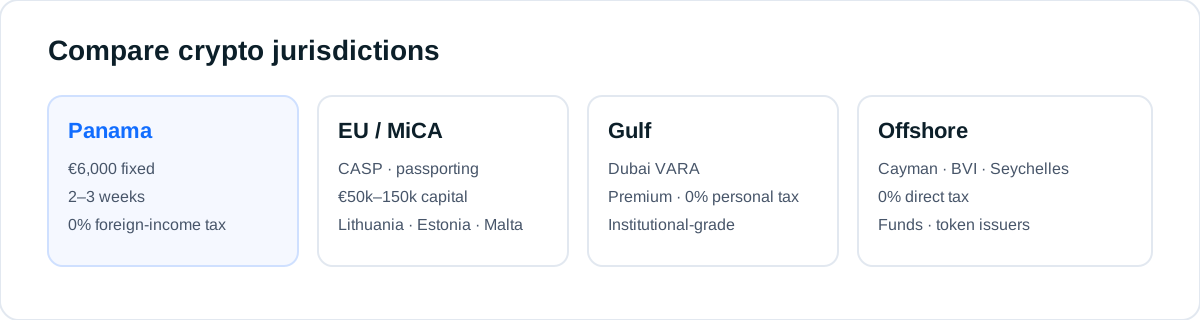
Timeline: The FSRA typically processes applications within 3-6 months, provided all documents are complete. Consulting24 coordinates with local legal partners to expedite the process. Exact pricing is confirmed during a consultation. For comparison, Panama offers a flat fee of EUR 6,000 with a 2-4 month timeline, which may be more cost-effective for some businesses. However, Saint Lucia's license may offer better recognition in certain markets.
Capital Requirement
The minimum capital requirement for a crypto OTC desk license in Saint Lucia is not explicitly mandated by law, but regulatory guidelines suggest a minimum of $50,000 in paid-up capital. This amount may vary based on the scale of operations and risk assessment. For larger OTC desks handling significant volumes, the FSRA may require up to $200,000. The capital must be maintained in a bank account in Saint Lucia or a recognised jurisdiction. Consulting24 advises clients on structuring capital to meet FSRA expectations.
For example, if your OTC desk plans to handle trades exceeding $10 million per month, the FSRA might expect a higher capital buffer to cover operational risks. The capital can be in the form of cash or liquid assets, and proof of funding must be provided with the application. In contrast, Panama has no capital requirement, making it a simpler option for startups.
Tax Treatment for Saint Lucia Crypto OTC Desks
Saint Lucia offers a favourable tax regime for international business companies (IBCs) holding a crypto license. Key benefits include:
- 0% corporate income tax on foreign-source income.
- No capital gains tax.
- No withholding tax on dividends or interest paid to non-residents.
- No VAT on digital asset services.
- Annual government fee of approximately $1,500 for IBCs.
However, if the OTC desk serves local clients (Saint Lucia residents), local taxes may apply. Most OTC desks operate on a cross-border basis to maximise tax efficiency. Consulting24 recommends a tax structure review with a local advisor. For example, an OTC desk that only services non-resident institutional clients would pay 0% corporate tax, whereas one that also serves Saint Lucian individuals would be subject to the standard 30% corporate tax on that income. This is a critical distinction that many applicants overlook.
Allowed Activities Under the License
Holders of a Saint Lucia crypto OTC desk license may engage in the following activities:
- Execution of OTC trades in cryptocurrencies and digital tokens.
- Provision of liquidity for large-block trades.
- Price negotiation and settlement between counterparties.
- Custody of digital assets for the duration of a trade settlement (short-term).
- Conversion between fiat and crypto for institutional clients.
Activities not permitted include operating a public exchange with order books, retail margin trading, and holding client assets as a custodian beyond settlement. For those activities, a separate exchange license or custodian license is required. For example, if your OTC desk wants to also offer a matching engine for retail clients, you would need a separate exchange license under the DABA. Consulting24 can help you structure your business to fit within the license scope or advise on additional licensing needs.
Step-by-Step Application Process
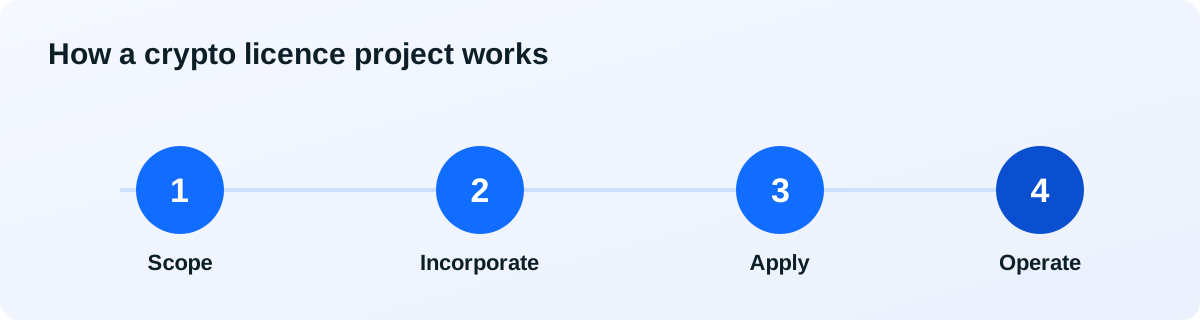
- Company Incorporation: Register a Saint Lucia IBC or LLC with a registered address and local agent.
- Document Preparation: Gather corporate documents, business plan, AML/KYC policies, risk management framework, and financial statements.
- Submit Application: File the license application with the FSRA, including all supporting documents and the application fee.
- Regulatory Review: The FSRA conducts due diligence on directors, shareholders, and beneficial owners. This may take 2-4 months.
- License Issuance: Upon approval, pay the issuance fee and receive the license. Annual renewal is required.
- Ongoing Compliance: Submit periodic reports, maintain AML procedures, and undergo annual audits.
Consulting24 coordinates each step with local legal partners, ensuring a smooth process. For a detailed timeline, see our application process page. We also help clients prepare for the due diligence interview, which is a common source of delays. For example, the FSRA may ask for additional documentation on the source of funds for beneficial owners, and having this ready can save weeks.
Banking and Payment Solutions for Saint Lucia OTC Desks
Finding a bank that works with crypto OTC desks in Saint Lucia can be challenging. Options include:
- Local Saint Lucia banks (e.g., Bank of Saint Lucia) may open accounts for licensed entities, but due diligence is strict.
- International banks in jurisdictions like Panama, Lithuania, or Estonia often accept Saint Lucia-licensed companies. See our comparison with Lithuania for banking insights.
- EMI (Electronic Money Institution) accounts in the EU or UK can provide fiat on/off ramps.
Consulting24 advises clients on banking strategy, including opening accounts in Panama (where we deliver directly) or Lithuania. Many OTC desks use a multi-jurisdictional approach, where the Saint Lucia entity holds the license but banking is done through a Lithuanian EMI. For example, a client might use a Lithuania-based EMI for euro transactions and a Panama bank for USD. It is important to start the banking process early, as account opening can take 1-3 months.
Benefits of a Saint Lucia Crypto OTC Desk License
- Low Cost: Compared to EU licenses, Saint Lucia is significantly cheaper. Total first-year costs are around $32,000-$60,000.
- Fast Processing: 3-6 months, faster than many European jurisdictions.
- Tax Neutrality: 0% corporate tax on foreign income.
- Remote Operation: No requirement for a physical office in Saint Lucia.
- Privacy: Beneficial ownership information is not publicly accessible.
- Flexibility: The license covers a range of OTC activities.
However, the license may not be recognised by some EU or US counterparties, who may prefer a license from a more regulated jurisdiction like Estonia or Lithuania. For example, a European bank might refuse to transact with a Saint Lucia-licensed entity due to perceived higher risk. Consulting24 can help you weigh these trade-offs.
Compliance and Trust Considerations
To maintain the license, OTC desks must comply with Saint Lucia's AML/CFT regulations. This includes:
- Appointing a Money Laundering Reporting Officer (MLRO).
- Implementing customer due diligence (CDD) for all counterparties.
- Reporting suspicious transactions to the Financial Intelligence Authority.
- Conducting annual audits by a licensed auditor.
- Maintaining records for at least 5 years.
Failure to comply can result in fines or license revocation. Consulting24 provides compliance support, including policy templates and training. This is general guidance, not legal advice. Always consult a local lawyer for specific obligations. For example, the FSRA may require that the MLRO be a resident of Saint Lucia, which can be arranged through a local service provider. Regular compliance reporting is due quarterly, and missing deadlines can lead to penalties.
Common Mistakes When Applying
- Incomplete Documentation: Missing business plans or AML policies cause delays.
- Ignoring Beneficial Ownership Rules: All ultimate owners must be disclosed and pass background checks.
- Underestimating Capital: The FSRA may require more than the minimum if volumes are high.
- Choosing the Wrong License Type: Some applicants apply for an exchange license when they only need an OTC desk license.
- Neglecting Banking: Securing a bank account should start early, as it can take months.
Consulting24 helps avoid these pitfalls by reviewing applications before submission. For example, we recently assisted a client who initially applied for an exchange license but only needed an OTC desk license, saving them $15,000 in fees. We also ensure that the business plan is detailed enough to satisfy the FSRA's scrutiny.
Alternatives and Comparisons: Saint Lucia vs Other Jurisdictions
When comparing Saint Lucia to other popular jurisdictions for OTC desk licensing, consider the following:
| Jurisdiction | Cost (First Year) | Timeline | Capital | Tax |
|---|---|---|---|---|
| Saint Lucia | $32,000 - $60,000 | 3-6 months | $50,000+ | 0% foreign income |
| Panama | EUR 6,000 (flat) | 2-4 months | None | 0% territorial tax |
| Lithuania (CASP) | EUR 25,000 - 50,000 | 4-8 months | EUR 125,000 | 15% corporate tax |
| Estonia (CASP) | EUR 30,000 - 60,000 | 6-12 months | EUR 50,000 | 20% corporate tax |
Panama is a strong alternative for those seeking a low-cost, fast setup with no capital requirement. Consulting24 delivers Panama licenses directly. For EU recognition, Lithuania or Estonia are better choices but come with higher costs and capital requirements. Saint Lucia sits in the middle, offering a balance of cost and speed. Consulting24 can help you choose the best jurisdiction based on your specific needs.
Frequently asked questions
What is the minimum capital for a Saint Lucia crypto OTC desk license?
The FSRA guidelines suggest a minimum of $50,000 in paid-up capital, but this can vary based on the scale of operations. For larger volumes, the regulator may require up to $200,000. The capital must be held in a bank account in Saint Lucia or a recognised jurisdiction.
How long does it take to get a Saint Lucia crypto OTC desk license?
The FSRA typically processes applications within 3-6 months, assuming all documents are complete and due diligence is straightforward. Delays often occur if the business plan or AML policies are insufficient. Consulting24 coordinates with local partners to expedite the process.
Can I operate a crypto OTC desk from outside Saint Lucia?
Yes, the license does not require a physical office in Saint Lucia. You can operate remotely, but you must have a registered agent and address in Saint Lucia. Many firms manage operations from other jurisdictions while holding the Saint Lucia license.
What taxes apply to a Saint Lucia crypto OTC desk?
International business companies (IBCs) pay 0% corporate tax on foreign-source income, no capital gains tax, and no withholding tax on dividends to non-residents. However, income from local clients is taxed at 30%. Most OTC desks serve only non-residents to maintain tax neutrality.
Is a Saint Lucia crypto license recognised in the EU?
No, Saint Lucia is not an EU member state, so its license does not automatically allow you to passport services into the EU under MiCA. EU counterparties may still accept the license, but some may prefer a CASP license from Lithuania or Estonia for regulatory comfort.
What activities are prohibited under the OTC desk license?
You cannot operate a public exchange with order books, offer retail margin trading, or act as a long-term custodian. Short-term custody during trade settlement is allowed. For other activities, you would need a separate exchange or custodian license.
How do I find a bank for my Saint Lucia OTC desk?
Local banks like Bank of Saint Lucia may open accounts, but due diligence is strict. Many firms use international banks in Panama or Lithuania, or EMIs in the EU. Consulting24 can advise on banking strategy, including opening accounts in Panama where we deliver directly.
What are the ongoing compliance requirements?
You must appoint an MLRO, conduct CDD on all counterparties, report suspicious transactions, undergo annual audits, and maintain records for 5 years. Quarterly reports to the FSRA are also required. Consulting24 provides compliance support and policy templates.
Can I convert my Saint Lucia OTC desk license to an exchange license?
Yes, you can apply to the FSRA for a variation of license to add exchange activities. This would require additional documentation and fees. It is often simpler to apply for the correct license from the start. Consulting24 can help you determine the right license type.
What happens if my application is rejected?
The FSRA will provide reasons for rejection. You can address the issues and reapply, but the application fee is non-refundable. Common reasons include incomplete documentation or adverse background checks. Consulting24 reviews applications before submission to minimise rejection risk.
Related jurisdictions

Talk to a crypto-licensing expert
500+ licenses across Estonia, Lithuania, Panama and beyond. Tell us your model and we'll map the right route, honestly.
💬 Talk to an expertFree consultationGeneral guidance, not legal advice. Rules and fees evolve, and we confirm current requirements for your case.