Bermuda Crypto OTC Desk License: Complete 2026 Guide
Bermuda has established itself as a leading jurisdiction for digital asset businesses, particularly for over-the-counter (OTC) trading desks. The Bermuda Monetary Authority (BMA) regulates crypto OTC desk activities under the Digital Asset Business Act 2018 (DABA). This page provides a detailed overview of the Bermuda crypto OTC desk license, including costs, timeline, capital requirements, and the application process. Whether you are a startup or an established firm, understanding the regulatory framework is essential for a successful application.
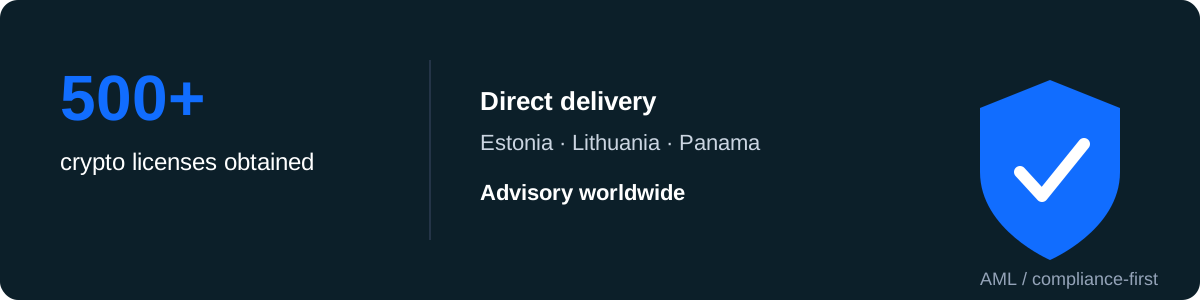
Consulting24 advises and coordinates crypto license applications globally, including in Bermuda. While we deliver directly in Estonia, Lithuania, and Panama, for Bermuda we offer expert advisory and coordination services to help you handle the BMA's requirements efficiently. Our team has assisted numerous clients in securing licenses across multiple jurisdictions, ensuring compliance and operational readiness.
What is a Bermuda Crypto OTC Desk License?
A Bermuda crypto OTC desk license allows a company to operate an over-the-counter trading platform for digital assets. OTC desks facilitate large-volume trades between institutional clients without the liquidity and slippage issues of public exchanges. The license is issued under the Digital Asset Business Act 2018 (DABA) by the Bermuda Monetary Authority (BMA). It covers activities such as trading, brokering, and custody of digital assets on behalf of clients.
Bermuda's regulatory regime is known for its strong standards, including anti-money laundering (AML) and counter-terrorism financing (CTF) requirements. The jurisdiction is particularly attractive for firms seeking a reputable, well-regulated environment with a clear legal framework for digital assets. As of 2026, Bermuda remains a top choice for OTC desks targeting institutional clients in North America and Europe.
The license is not a simple registration; it involves a rigorous application process that examines your business plan, governance, and financial health. The BMA expects applicants to demonstrate a deep understanding of digital asset risks, including market volatility, cybersecurity, and operational resilience. For example, an OTC desk handling Bitcoin swaps for a pension fund would need to show how it manages counterparty risk and settlement finality.
Who Needs a Bermuda Crypto OTC Desk License?
Any company that provides OTC trading services for digital assets to clients in or from Bermuda must hold a license. This includes:
- OTC brokers executing large trades on behalf of institutional investors.
- Market makers providing liquidity in digital assets.
- Platforms offering matched principal trading or agency execution.
- Firms that combine OTC trading with custody or advisory services.
If your business model involves facilitating trades between two parties for a fee or spread, you likely fall under the BMA's definition of a digital asset business. Exemptions exist for limited activities, but most commercial OTC desks require a full license. Consulting24 can help determine the correct license class for your operations.
For instance, a startup that only provides a bulletin board for matching buyers and sellers without handling funds may not need a license, but once you take custody or execute trades, the license becomes mandatory. The BMA also considers whether your clients are in Bermuda, even if your company is incorporated elsewhere. If you have a physical presence in Bermuda, you must apply.
License Type and Regulator
The Bermuda Monetary Authority (BMA) is the sole regulator for digital asset businesses in Bermuda. The relevant license is the Class F (Full) Digital Asset Business License, which permits all activities including OTC trading, custody, and exchange operations. There is also a Class M (Modified) license for smaller firms with limited activities, but most OTC desks will require Class F.
The BMA's regulatory framework is principles-based, focusing on risk management, capital adequacy, and client protection. The application process involves a detailed review of the business plan, governance structure, AML/CTF policies, and financial projections. The BMA also conducts fit and proper checks on directors and senior management.
Class F is the most comprehensive license, allowing you to operate an OTC desk, custody client assets, and even issue tokens. If you only want to broker trades without custody, a Class M might suffice, but the BMA encourages full licensing for credibility. Consulting24 advises most OTC desks to pursue Class F to avoid future limitations.
Cost and Timeline
The cost of obtaining a Bermuda crypto OTC desk license includes application fees, legal and advisory fees, and ongoing compliance costs. Below is a typical breakdown. Exact figures may vary based on complexity and the service provider.
| Item | Estimated Cost (USD) |
|---|---|
| Application fee (BMA) | 2,500 - 5,000 |
| Legal and advisory fees (Consulting24) | 15,000 - 25,000 |
| Compliance setup (AML/CFT policies, audit) | 5,000 - 10,000 |
| Annual BMA fee | 1,000 - 3,000 |
| Ongoing compliance (annual) | 10,000 - 20,000 |
The timeline from application to approval is typically 4 to 8 months, depending on the completeness of the application and the BMA's workload. Consulting24 can expedite the process by ensuring all documents are prepared correctly from the start. For example, a client with a well-drafted business plan and AML policies may get approval in 5 months, while incomplete submissions can take over a year.
Capital Requirement
The BMA requires a minimum capital of at least 100,000 USD for a Class F license. This capital must be maintained at all times and can be in the form of cash or liquid assets. Higher capital may be required based on the volume of transactions or risk profile. The capital requirement is designed to ensure the firm has sufficient financial resources to cover operational risks and client obligations.
In addition to capital, the BMA may require a surety bond or professional indemnity insurance, depending on the activities. Consulting24 advises clients on structuring their capital to meet BMA expectations while optimising for operational efficiency. For instance, if you plan to trade large volumes, the BMA might ask for 200,000 USD or more. The capital must be held in a bank account in Bermuda or a jurisdiction approved by the BMA.
Tax Treatment
Bermuda has no corporate income tax, capital gains tax, or withholding tax. The tax regime is based on a payroll tax and social insurance contributions. For digital asset businesses, this means that profits from OTC trading are not subject to corporate tax. However, companies must register for payroll tax if they have employees. There is also a stamp duty on certain documents but generally not applicable to trading activities.
Bermuda's tax-neutral environment is a major advantage for crypto OTC desks, as it allows firms to retain more of their trading profits. Consulting24 recommends consulting with a tax advisor to understand the specific implications for your business structure. For example, if you have employees in Bermuda, you will need to pay payroll tax of about 4.75% on salaries above a threshold. No VAT or sales tax applies to digital asset services.
Allowed Activities
A Class F license permits the following activities:
- Operating an OTC trading desk for digital assets.
- Brokering trades between buyers and sellers.
- Providing custody services for digital assets.
- Issuing and redeeming stablecoins or other digital tokens.
- Acting as a market maker.
- Offering advisory services related to digital assets.
The BMA does not permit unlicensed retail exchange services without additional licensing. OTC desks can also engage in proprietary trading, subject to capital adequacy rules. All activities must be conducted in compliance with AML/CTF regulations and the BMA's conduct of business rules. For example, if you want to offer margin trading to institutional clients, you must disclose the risks and maintain additional capital.
Step-by-Step Application Process
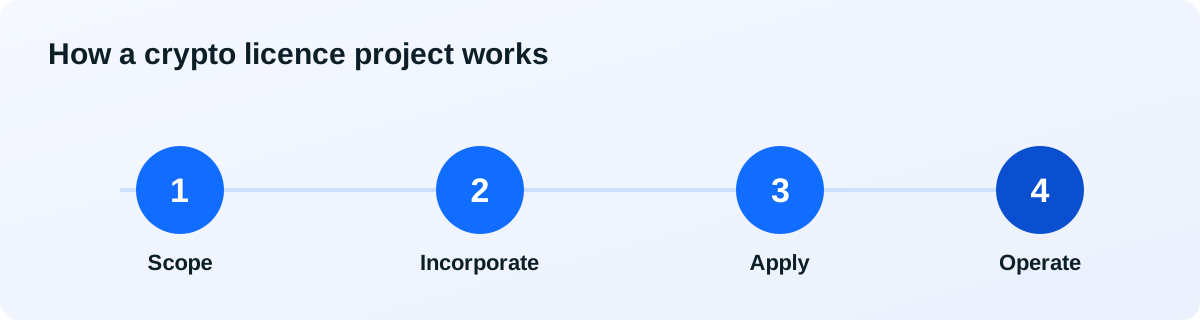
The application process for a Bermuda crypto OTC desk license involves several stages:
- Pre-application consultation: Discuss your business model with Consulting24 to determine the appropriate license class and structure.
- Document preparation: Prepare a detailed business plan, financial projections, AML/CTF policies, governance framework, and personal questionnaires for directors.
- Submission: Submit the application to the BMA along with the application fee.
- BMA review: The BMA conducts a thorough review, which may include requests for additional information or clarifications.
- Interview: Key personnel may be interviewed by the BMA to assess fitness and propriety.
- Approval: Once satisfied, the BMA issues the license, subject to any conditions.
- Post-licensing: Implement ongoing compliance reporting and maintain the required capital.
Consulting24 coordinates each step, liaising with the BMA and local legal partners to ensure a smooth process. Typical timeline is 4-8 months. For example, after submission, the BMA usually takes 2-3 months for initial review, then may ask for clarifications which take another month. The interview is scheduled within 1-2 months after that.
Banking and Payments
Opening a bank account in Bermuda for a crypto OTC desk can be challenging due to the perceived risk. However, Bermuda has a number of banks that are open to digital asset businesses, provided the firm has a BMA license. Banks typically require a minimum deposit, proof of license, and a detailed business plan.
Consulting24 can introduce clients to banking partners in Bermuda and other jurisdictions. For payment processing, firms may need to use third-party payment providers that support crypto-to-fiat conversions. The BMA expects firms to have strong payment controls to prevent money laundering. For example, you might use a bank like Butterfield or HSBC Bermuda, which have dedicated teams for licensed digital asset firms. They often require a minimum deposit of 50,000 USD and a personal guarantee from directors.
Benefits of a Bermuda Crypto OTC Desk License
Bermuda offers several advantages for OTC desks:
- Strong regulatory reputation: The BMA is respected globally, enhancing trust with institutional clients.
- Tax neutrality: No corporate tax, capital gains tax, or VAT.
- Clear legal framework: The DABA provides legal certainty for digital asset activities.
- Time zone: Bermuda operates in Atlantic Time, overlapping with US and European markets.
- Access to international markets: Bermuda is a gateway to North American and European investors.
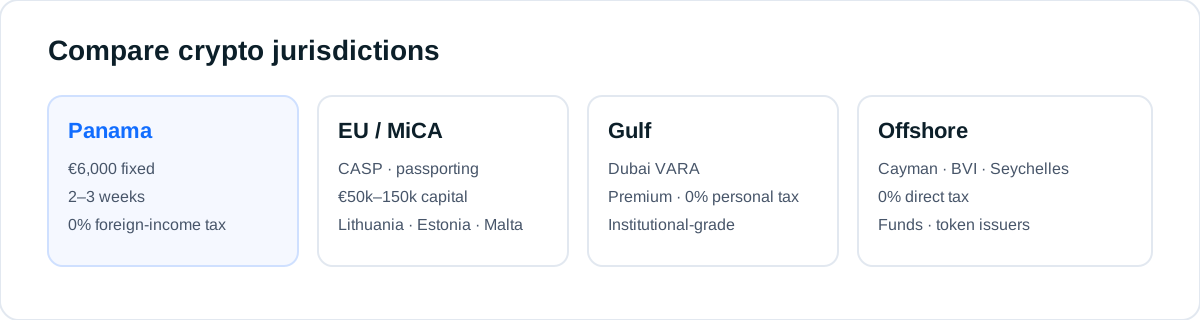
These benefits make Bermuda a competitive jurisdiction for crypto OTC desks, especially when compared to other options like Panama or other jurisdictions. For instance, Panama offers a simpler process at EUR 6,000 flat, but lacks the same regulatory depth and tax neutrality. Estonia under MiCA requires EUR 50,000 capital and EU compliance, which may be more burdensome for a pure OTC desk.
Compliance and Trust
Compliance is at the core of the Bermuda regulatory framework. Licensees must implement strong AML/CTF programs, conduct regular audits, and report suspicious transactions to the Financial Intelligence Agency. The BMA also requires annual financial statements and compliance reports.
To maintain trust, firms should engage a qualified compliance officer and consider external audits. Consulting24 provides ongoing compliance support, including policy updates and training. This is general guidance, not legal advice; always consult with a legal professional for your specific situation. For example, you must file a compliance report every six months, detailing transaction volumes, client due diligence, and any suspicious activity. The BMA may conduct on-site inspections every two years.
Common Mistakes in the Application Process
Applicants often make the following errors:
- Incomplete business plans: The BMA requires a detailed plan covering all aspects of the business.
- Inadequate AML policies: Policies must be specific to digital assets and meet international standards.
- Poor governance: Directors must have relevant experience and pass fit and proper tests.
- Underestimating capital: Ensure you have sufficient liquid capital to meet the 100,000 USD minimum and operational needs.
- Ignoring ongoing costs: Budget for annual fees and compliance expenses.
Consulting24 helps clients avoid these pitfalls by providing a comprehensive checklist and review process. For example, one client submitted a business plan without detailing their custody solution, which delayed approval by 3 months. Another failed to include a clear AML risk assessment, leading to a rejection. We ensure all documents are complete and aligned with BMA expectations.
Alternatives and Comparison
While Bermuda is a strong choice, other jurisdictions may suit different needs. For example, Panama offers a simpler licensing process with a flat fee of EUR 6,000, but lacks the same regulatory depth. Estonia provides a digital residency and EU passporting, but with higher capital requirements under MiCA (EUR 50,000 to 150,000). Lithuania is another EU option with a fast track for existing companies.
For OTC desks targeting institutional clients, Bermuda's reputation and tax benefits are hard to beat. Consulting24 can help you compare these options and choose the best jurisdiction for your business model. We advise and coordinate in all jurisdictions, delivering directly in Estonia, Lithuania, and Panama. Contact us to discuss your specific needs and get a tailored recommendation.
Why Choose Consulting24 for Your Bermuda License?
Consulting24 has extensive experience in crypto licensing across multiple jurisdictions. For Bermuda, we provide advisory and coordination services, using our network of local legal and compliance experts. Our team understands the BMA's expectations and can guide you through each step of the application process.
We offer a free initial consultation to assess your business model and determine the best approach. Our services include document preparation, liaison with the BMA, and ongoing compliance support. Unlike some providers, we do not guarantee approval, but we maximise your chances by ensuring a thorough and accurate application. Contact us today to book a consultation and start your Bermuda crypto OTC desk license journey.
Frequently asked questions
What is the minimum capital for a Bermuda crypto OTC desk license?
The BMA requires a minimum capital of 100,000 USD for a Class F license. This must be maintained in liquid assets. Higher amounts may be required based on trading volume or risk profile.
How long does it take to get a Bermuda crypto OTC desk license?
The typical timeline is 4 to 8 months from application to approval. This depends on the completeness of your application and the BMA's workload. Consulting24 can help expedite the process.
What are the tax benefits of a Bermuda OTC desk license?
Bermuda has no corporate income tax, capital gains tax, or VAT. The only taxes are payroll tax and social insurance. This tax-neutral environment allows OTC desks to retain more profits.
Can I operate an OTC desk in Bermuda without a license?
No, any company providing OTC trading services for digital assets in or from Bermuda must hold a license from the BMA. Unlicensed operations are illegal and subject to penalties.
What activities are allowed under a Class F license?
A Class F license permits OTC trading, brokering, custody, token issuance, market making, and advisory services. It is the most comprehensive license for digital asset businesses.
How do I open a bank account for my Bermuda OTC desk?
Bermuda banks like Butterfield and HSBC require a BMA license, a minimum deposit, and a detailed business plan. Consulting24 can introduce you to banking partners.
What are the ongoing compliance costs for a Bermuda license?
Annual BMA fees are 1,000-3,000 USD, and ongoing compliance (audits, reporting) costs 10,000-20,000 USD per year. These are estimates and may vary.
Can Consulting24 guarantee approval of my Bermuda license?
No, we cannot guarantee approval. The BMA makes the final decision. However, we maximise your chances by ensuring a complete and accurate application.
Is Bermuda a good jurisdiction for retail crypto exchanges?
Bermuda is better suited for institutional OTC desks and custody. Retail exchanges may find other jurisdictions like Panama or Lithuania more cost-effective. Consult Consulting24 for advice.
What happens if my application is rejected?
You can reapply after addressing the BMA's concerns. Consulting24 can help identify the issues and strengthen your application for resubmission.
Official sources
Primary sources
This guide reflects 2026 rules. Verify current requirements with the official regulator:
Related jurisdictions

Talk to a crypto-licensing expert
500+ licenses across Estonia, Lithuania, Panama and beyond. Tell us your model and we'll map the right route, honestly.
💬 Talk to an expertFree consultationGeneral guidance, not legal advice. Rules and fees evolve, and we confirm current requirements for your case.