Crypto Wallet Custody License Bermuda: 2026 Guide
Bermuda has established itself as a leading jurisdiction for digital asset businesses, particularly for those seeking a crypto wallet custody license Bermuda. The Bermuda Monetary Authority (BMA) oversees a comprehensive regulatory framework under the Digital Asset Business Act 2018 (DABA), which provides clarity and legitimacy for custodians of digital assets. As of 2026, Bermuda remains a top-tier choice for firms that prioritise regulatory compliance and international credibility.
This guide covers everything you need to know about obtaining a crypto wallet custody license in Bermuda: the regulator, licence types, capital requirements, tax treatment, timeline, costs, and a step-by-step application process. Consulting24 advises and coordinates applications for this licence, using our experience with over 500 crypto licences across multiple jurisdictions. We help you manage the process efficiently.
Whether you are a startup or an established financial institution, understanding Bermuda's requirements is essential. The jurisdiction offers a clear path for custodians, with a strong reputation among institutional investors. Read on to learn how to secure your crypto wallet custody license Bermuda and position your business for success.
What Is a Crypto Wallet Custody License in Bermuda?
A crypto wallet custody license in Bermuda is a regulatory authorisation issued by the BMA under the Digital Asset Business Act 2018. It allows a company to hold, store, and safeguard digital assets on behalf of clients. This licence is essential for any business offering custodial wallet services, including hot and cold storage, multi-signature wallets, and private key management.
The licence is part of Bermuda's broader digital asset regime, which also covers exchange, issuance, and payment services. Custody is treated as a distinct activity requiring specific operational and capital standards. The BMA expects licensees to have strong security protocols, insurance coverage, and clear client asset segregation.
For founders, this licence provides a regulated environment that instils trust among institutional clients. Bermuda's framework is recognised globally, making it a preferred hub for custody providers targeting professional investors. The BMA conducts regular inspections and requires annual audits to ensure compliance.
Who Needs This Licence?
Any company that intends to provide custodial services for digital assets in or from Bermuda must hold this licence. This includes:
- Custodial wallet providers (both retail and institutional)
- Digital asset custodians serving funds, exchanges, or individual clients
- Firms offering private key management or multi-signature services
- Broker-dealers that hold client crypto assets
If your business involves holding private keys or controlling digital assets on behalf of others, you likely need this licence. Even if you outsource custody, the entity with contractual control may be subject to regulation. Consulting24 advises clients on whether the licence applies to their specific business model. For example, a fintech startup offering a non-custodial wallet app would not require this licence, but a service that stores user keys would.
Licence Type and Regulator
The regulator is the Bermuda Monetary Authority (BMA). Under the Digital Asset Business Act 2018, there are three classes of licence for digital asset businesses: Class F (full), Class M (moderate), and Class T (testing). For custody services, the typical licence is Class F or Class M, depending on the scale and risk profile.
Class F is for full-scale operations with higher transaction volumes and client assets. Class M is for businesses with moderate activity, often startups or smaller firms. Class T is for testing new business models with limited clients and volumes. The BMA assesses each application on its merits, considering the business plan, risk controls, and capital adequacy.
As of 2026, the BMA has not adopted MiCA-style capital tiers, but it imposes its own capital requirements based on the licence class. The minimum capital for a Class F licence is typically in the range of USD 500,000 to USD 1,000,000, while Class M may require USD 100,000 to USD 500,000. Exact figures are confirmed during the application process. The BMA also requires that key personnel be fit and proper, with background checks conducted on directors and shareholders.
Cost and Timeline
The cost of obtaining a crypto wallet custody license in Bermuda includes application fees, legal fees, and advisory costs. The BMA charges a non-refundable application fee, which varies by licence class. As of 2026, estimated costs are:
| Item | Estimated Cost (USD) |
|---|---|
| BMA application fee (Class F) | 10,000 - 20,000 |
| BMA application fee (Class M) | 5,000 - 10,000 |
| Legal and compliance advisory | 30,000 - 80,000 |
| Company setup and registered office | 5,000 - 15,000 |
| Insurance (first year premium) | 10,000 - 50,000 |
| Total estimated cost (all-in) | 60,000 - 175,000 |
The timeline from application to decision is typically 6 to 12 months, depending on the completeness of the application and the BMA's workload. A pre-application meeting is recommended to clarify requirements. Consulting24 coordinates the entire process, liaising with local legal partners. We help prepare the application package, including the business plan, AML policies, and security documentation.
Capital Requirement
The BMA imposes a minimum capital requirement based on the licence class and the nature of the business. For a Class F custody licence, the minimum capital is typically USD 500,000. For Class M, it is around USD 100,000. These amounts must be maintained at all times and may be higher if the business holds large client assets.
Capital can be held in cash or liquid assets approved by the BMA. The requirement is designed to ensure the licensee has sufficient financial resources to cover operational risks and potential losses. Consulting24 advises clients on structuring their capital to meet BMA expectations. In practice, the BMA may require additional capital if the custodian plans to hold assets exceeding a certain threshold, such as USD 10 million in client funds.
Tax Treatment
Bermuda has no corporate income tax, capital gains tax, or withholding tax. This makes it a highly attractive jurisdiction for crypto custody businesses. Instead, companies pay an annual fee to the BMA and a payroll tax on employee salaries. The payroll tax rate is progressive, typically around 10-15% of total payroll.
There is no VAT or sales tax. Bermuda's tax-neutral environment allows custody providers to retain more of their revenue. However, clients should consider their own tax obligations in their home jurisdictions. Consulting24 recommends consulting a tax advisor for cross-border implications. For example, a US-based company might still owe US tax on global income, but the Bermuda entity itself pays no local corporate tax.
Allowed Activities
A crypto wallet custody license in Bermuda permits the following activities:
- Safeguarding and administering digital assets on behalf of clients
- Storing private keys and facilitating transactions
- Providing multi-signature and threshold signature services
- Offering insured custody solutions
- Sub-custody arrangements with other regulated entities
The licence does not automatically permit exchange trading, lending, or staking. Those activities require separate authorisation or a broader licence. The BMA expects custodians to have clear policies on asset segregation, audit trails, and client disclosure. For instance, a custodian must maintain separate wallets for each client or use a ledger system that clearly attributes assets to individual clients.
Step-by-Step Application Process
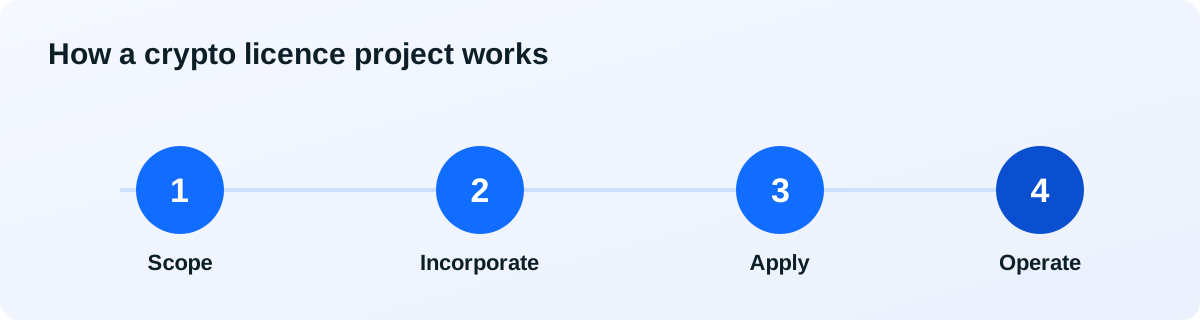
The application process for a crypto wallet custody license in Bermuda involves several stages:
- Pre-application consultation: Engage with the BMA to discuss your business model and licence class. This is a free initial meeting to clarify requirements.
- Prepare documentation: Business plan, financial projections, compliance policies, AML/CFT framework, security audits, and insurance details. The business plan should cover target market, revenue model, and risk management.
- Submit application: File the application with the BMA, including all supporting documents and the application fee. The BMA will acknowledge receipt within 10 business days.
- Review and due diligence: The BMA conducts background checks on directors, shareholders, and key personnel. This includes criminal record checks and financial history.
- Interview or additional information: The BMA may request clarifications or a meeting. This is common if the application is complex or if there are gaps in the documentation.
- Decision: The BMA issues the licence or provides reasons for refusal. If approved, the licence is subject to conditions that must be met within a specified timeframe.
Consulting24 advises clients at each stage, ensuring the application is complete and responsive to BMA requirements. We also help with company setup in Bermuda if needed.
Banking and Payment Services
Opening a bank account in Bermuda for a crypto custody business can be challenging due to correspondent banking restrictions. However, several local and international banks accept digital asset firms with a BMA licence. Options include:
- Bermuda-based banks (e.g., HSBC Bermuda, Butterfield Bank) - require a licence and a strong compliance history. They typically ask for a detailed business plan and proof of capital.
- International banks with Bermuda presence - may offer accounts for licensed entities, but often require a minimum deposit of USD 100,000 or more.
- Payment service providers and crypto-friendly banks in other jurisdictions, such as those in the UK or Switzerland, may also be viable alternatives.
Consulting24 assists clients in identifying suitable banking partners. It is advisable to start the banking process early, as due diligence can take several months. Some banks may require a personal guarantee from directors or a minimum account balance.
Benefits of a Bermuda Custody Licence
Bermuda offers several advantages for custody providers:
- Regulatory clarity under DABA, with a dedicated digital asset framework that is well understood by institutional investors.
- No corporate income tax, making it cost-efficient compared to jurisdictions like the UK or US.
- Strong reputation among institutional investors and regulators globally, facilitating partnerships with banks and funds.
- Access to a skilled workforce and professional services, including law firms and auditors experienced in digital assets.
- Political and economic stability, with a common law legal system based on English law.
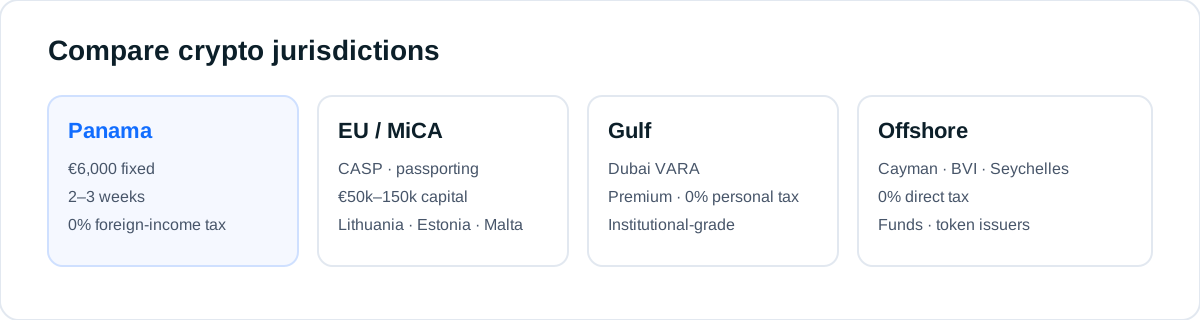
Compared to other jurisdictions like Panama (which offers a flat-fee company setup but no specific crypto custody licence), Bermuda provides a regulated environment that meets institutional standards. For firms targeting professional clients, Bermuda is often the preferred choice. However, for startups with limited budgets, Panama's company setup at EUR 6,000 may be more accessible, though it lacks a dedicated regulatory framework for custody.
Compliance and Ongoing Obligations
Once licensed, custody providers must comply with ongoing requirements:
- Annual audit and submission of audited financial statements to the BMA within 6 months of year-end.
- AML/CFT programme updates and suspicious transaction reporting. The BMA expects regular training for staff.
- Maintenance of minimum capital and insurance coverage. The insurance policy must cover theft, cyber attacks, and employee dishonesty.
- Regular reporting to the BMA on client assets, transaction volumes, and security incidents. Reports are typically due quarterly.
- Annual licence renewal fee (typically USD 5,000-10,000).
Non-compliance can result in fines, suspension, or revocation of the licence. Consulting24 provides compliance support to ensure ongoing adherence. General guidance, not legal advice. We recommend engaging a local compliance officer to manage day-to-day regulatory matters.
Common Mistakes and How to Avoid Them
Founders often make these errors when applying for a Bermuda custody licence:
- Inadequate business plan: The BMA expects a detailed, realistic plan with financial projections. Avoid generic templates. Include a clear value proposition and competitive analysis.
- Poor AML/CFT framework: Bermuda has strict AML standards. Ensure your policies are tailored to digital assets, including transaction monitoring and customer due diligence.
- Underestimating timeline: The process can take 6-12 months. Plan accordingly and do not commit to clients prematurely. Start the application well before your planned launch date.
- Insufficient capital: Ensure you have committed capital before applying, as the BMA may request proof of funds. Capital must be held in a bank account and be readily available.
- Ignoring insurance: The BMA expects custodians to have professional indemnity or crime insurance. Obtain quotes early and ensure the policy covers the required risks.
Consulting24 helps clients avoid these pitfalls by providing pre-application guidance and document review. We also offer a readiness assessment to identify gaps before formal submission.
Alternatives and Comparisons
For founders considering other jurisdictions, here is how Bermuda compares with other popular options:
- Panama: Panama offers a flat EUR 6,000 company setup but no specific crypto custody licence. It is suitable for non-custodial services or as a holding company, but does not provide the regulatory credibility needed for institutional custody.
- Estonia: Estonia's crypto licence (now under MiCA) requires minimum capital of EUR 50,000-150,000 depending on services. It is cheaper than Bermuda but less recognised for institutional custody. Estonia crypto license is a good option for EU-focused businesses.
- Lithuania: Similar to Estonia, Lithuania offers a MiCA-compliant licence with capital requirements of EUR 50,000-150,000. It has a faster timeline (3-6 months) and lower costs. Lithuania crypto license is popular among fintech startups.
For custody specifically, Bermuda's strong regulatory framework and tax benefits make it ideal for institutional-grade services. However, if your target market is the EU, a MiCA licence in Lithuania or Estonia may be more practical. Consulting24 can help you evaluate which jurisdiction aligns with your business goals.
Frequently asked questions
What is the minimum capital for a Bermuda crypto custody licence?
For a Class F licence, the minimum capital is typically USD 500,000. For Class M, it is around USD 100,000. The exact amount depends on the scale of operations and is confirmed during the application process. Capital must be maintained at all times.
How long does it take to get a Bermuda custody licence?
The timeline is usually 6 to 12 months from application to decision. This includes the BMA's review, due diligence, and any requests for additional information. A pre-application meeting can help streamline the process.
What are the ongoing costs after obtaining the licence?
Ongoing costs include annual licence renewal fees (USD 5,000-10,000), audit fees, compliance staff salaries, and insurance premiums. Total annual costs can range from USD 20,000 to USD 100,000 depending on the size of the business.
Does Bermuda have corporate income tax?
No, Bermuda has no corporate income tax, capital gains tax, or withholding tax. Companies pay a payroll tax on employee salaries and an annual fee to the BMA. This makes Bermuda a tax-neutral jurisdiction.
Can I use the Bermuda licence to serve clients in the EU?
The Bermuda licence is not automatically recognised in the EU. To serve EU clients, you may need a separate MiCA licence or rely on reverse solicitation. Consult a legal advisor for cross-border compliance.
What insurance is required for a custody licence?
The BMA expects custodians to have professional indemnity insurance or crime insurance covering theft, cyber attacks, and employee dishonesty. The coverage amount should be proportional to the assets under custody.
Is a physical office required in Bermuda?
Yes, you must have a registered office and a physical presence in Bermuda. This can be a shared office space or a dedicated office. The BMA expects key personnel to be based in Bermuda or accessible.
Can I apply for a Bermuda custody licence if I am a non-resident?
Yes, non-residents can apply. However, the company must be incorporated in Bermuda, and directors and shareholders must pass background checks. Consulting24 can assist with company formation.
What happens if I do not maintain the minimum capital?
Failure to maintain minimum capital can result in fines, suspension, or revocation of the licence. The BMA may also impose additional conditions. It is critical to monitor capital levels regularly.
How does Bermuda compare to Panama for custody?
Bermuda offers a regulated custody licence with institutional credibility, while Panama provides a flat EUR 6,000 company setup but no specific custody regime. For institutional clients, Bermuda is preferable; for cost-sensitive startups, Panama may be an alternative.
Official sources
Primary sources
This guide reflects 2026 rules. Verify current requirements with the official regulator:
Related jurisdictions

Talk to a crypto-licensing expert
500+ licenses across Estonia, Lithuania, Panama and beyond. Tell us your model and we'll map the right route, honestly.
💬 Talk to an expertFree consultationGeneral guidance, not legal advice. Rules and fees evolve, and we confirm current requirements for your case.