Cayman Islands vs Singapore Crypto License: Which Jurisdiction Suits Your Business?
Choosing the right jurisdiction for your crypto license is one of the most critical decisions for a crypto business. Two popular options are the Cayman Islands and Singapore, each offering distinct advantages. The Cayman Islands provides a flexible, tax-neutral environment with a light-touch regulatory approach, while Singapore offers a strong, well-regarded framework under the Payment Services Act. This guide compares both jurisdictions across key factors: regulator, license type, capital requirements, tax treatment, timeline, and allowed activities. Whether you are a startup or an established exchange, understanding these differences will help you make an informed choice. Consulting24 advises and coordinates crypto licensing across multiple jurisdictions, including the Cayman Islands and Singapore, and can help you get through the application process.
What Is the Cayman Islands vs Singapore Crypto License Comparison?
This comparison evaluates two leading jurisdictions for crypto licensing: the Cayman Islands and Singapore. The Cayman Islands is a British Overseas Territory known for its zero-tax regime and flexible regulatory environment under the Cayman Islands Monetary Authority (CIMA). It offers a Virtual Asset Service Provider (VASP) registration under the Virtual Asset (Service Providers) Act, 2020 (as amended). Singapore, on the other hand, is a global financial hub regulated by the Monetary Authority of Singapore (MAS). Crypto businesses in Singapore must obtain a Major Payment Institution (MPI) license under the Payment Services Act (PSA). Both jurisdictions are popular but cater to different business needs. The Cayman Islands is often chosen for its tax neutrality and lower upfront costs, while Singapore is preferred for its regulatory clarity and reputation. A key difference lies in the regulatory philosophy: the Cayman Islands adopts a principles-based approach, while Singapore enforces a detailed, prescriptive framework. This affects everything from application documentation to ongoing compliance. For example, the Cayman Islands requires a business plan and AML policies, whereas Singapore demands a full compliance manual, risk assessment, and financial projections. The choice depends on your business model, target market, and risk appetite. Consulting24 advises clients on which jurisdiction aligns with their strategic goals, drawing on experience from 500+ license applications across the globe.
Who Needs a Crypto License in These Jurisdictions?
Any business providing virtual asset services needs to consider licensing. In the Cayman Islands, a VASP registration is required for entities that, as a business, provide virtual asset services such as exchange, transfer, custody, or issuance. In Singapore, the PSA covers digital payment token (DPT) services, including dealing, exchange, and transfer. Typical applicants include:
- Crypto exchanges (centralized and decentralized)
- OTC trading desks
- Wallet providers
- Custodians
- Payment service providers using digital tokens
Both jurisdictions require a physical presence and compliance with AML/CFT regulations. If your target market is Asia, Singapore may be more suitable; for a global, tax-efficient structure, the Cayman Islands might be better. Additionally, the Cayman Islands is often used by investment funds and holding companies that engage in crypto activities, while Singapore attracts fintech startups and payment firms. Consulting24 helps assess whether your business activities fall under the licensing scope and advises on structuring to meet local requirements.
License Type and Regulator
Cayman Islands
Regulator: Cayman Islands Monetary Authority (CIMA). License type: Virtual Asset Service Provider (VASP) registration under the Virtual Asset (Service Providers) Act, 2020. There are two categories: Category A (for businesses that issue virtual assets or provide custody) and Category B (for other services like exchange). Category A has stricter requirements, including a detailed business plan and proof of adequate systems. Category B is simpler but still requires AML/CFT compliance.
Singapore
Regulator: Monetary Authority of Singapore (MAS). License type: Major Payment Institution (MPI) license under the Payment Services Act (PSA). The MPI license covers digital payment token (DPT) services, including dealing, exchange, and transfer. A Standard Payment Institution (SPI) license is for smaller volumes but does not cover DPT services. For crypto businesses, the MPI license is the relevant one. MAS also requires an applicant to be a Singapore-incorporated company and to have a permanent place of business.
Cost and Timeline
| Factor | Cayman Islands | Singapore |
|---|---|---|
| Application Fee | USD 5,000 (approx.) | SGD 10,000 (approx. USD 7,500) |
| Annual Fee | USD 5,000 (approx.) | SGD 10,000 (approx. USD 7,500) |
| Minimum Capital | No statutory minimum (typically USD 50,000-100,000 expected) | SGD 250,000 (approx. USD 185,000) for MPI license |
| Timeline | 3-6 months | 6-12 months |
| Ongoing Compliance Costs | USD 10,000-30,000/year | SGD 30,000-80,000/year |
Exact pricing is confirmed in a consultation. The Cayman Islands is generally faster and cheaper, while Singapore is more expensive but offers a stronger regulatory reputation. The timeline in Singapore can extend if MAS requests additional information or if the applicant's compliance framework is not fully developed. In the Cayman Islands, the process is more straightforward, but CIMA may still require clarifications. Consulting24 provides a detailed cost breakdown during the initial consultation and helps manage the timeline through proactive communication with regulators.
Capital Requirement
The Cayman Islands does not impose a statutory minimum capital requirement for VASP registration, but CIMA expects applicants to maintain adequate financial resources. Typically, USD 50,000 to 100,000 is considered acceptable, though higher amounts may be required for larger operations. This flexibility makes the Cayman Islands attractive for startups. Singapore requires a minimum base capital of SGD 250,000 (approx. USD 185,000) for an MPI license. Additionally, MAS may impose higher capital requirements based on the volume of business or risk profile. For example, if you handle large transaction volumes, MAS may require up to SGD 1 million. For smaller operations, the Cayman Islands is more capital-friendly. Consulting24 helps clients determine the appropriate capital level based on their business plan and regulatory expectations.
Tax Treatment
The Cayman Islands has no direct taxes: no corporate income tax, capital gains tax, withholding tax, or VAT. This makes it a zero-tax jurisdiction. However, there is an annual registration fee and stamp duties on certain documents. Singapore has a corporate tax rate of 17%, but there are incentives: the start-up tax exemption scheme (75% exemption on first SGD 100,000 of chargeable income) and the Financial Sector Incentive (FSI) for fund management and treasury activities. For crypto businesses, Singapore's tax treatment is standard corporate tax, with GST (VAT) exemption for digital payment token transactions. The Cayman Islands offers a clear tax advantage for businesses seeking to minimize tax burden. However, the substance requirements in the Cayman Islands mean that management and control must be exercised locally, which may impact tax residency. Consulting24 advises on tax structuring to ensure compliance with both local and international tax rules.
Allowed Activities
Cayman Islands: VASP registration allows exchange between virtual assets and fiat, exchange between virtual assets, transfer of virtual assets, custody, and issuance of virtual assets (Category A). Category B covers other services like advisory. Activities must be conducted from or in the Cayman Islands. The Cayman Islands also permits the operation of virtual asset trading platforms, but they must comply with additional rules.
Singapore: MPI license covers dealing in digital payment tokens (including exchange), facilitating the exchange of DPTs, and providing custodial services for DPTs. It also covers cross-border money transfer and merchant acquisition. The scope is broader for payment services but limited to DPTs under the PSA. For example, if you want to offer both crypto and fiat payment services, the MPI license covers both. In contrast, the Cayman Islands VASP is specific to virtual assets. Consulting24 helps define the scope of activities to ensure the correct license type is applied for.
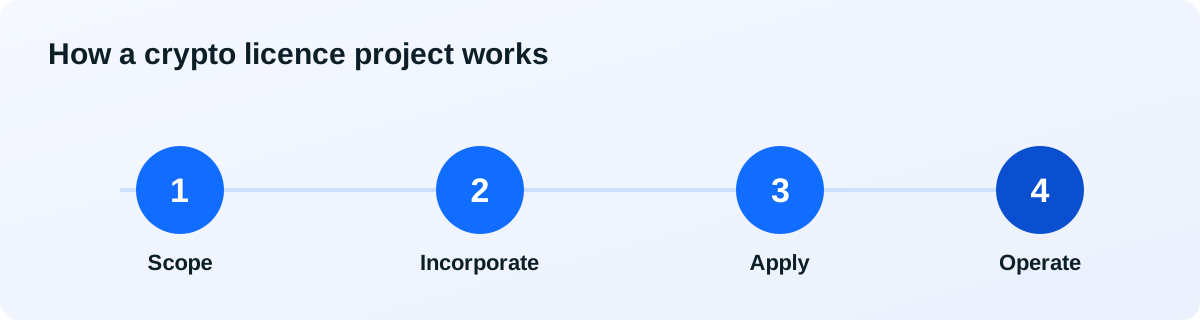
Step-by-Step Application Process
Cayman Islands
- Incorporate a Cayman Islands company (exempted company or LLC).
- Prepare VASP application with business plan, AML/CFT policies, governance structure, and financial statements.
- Submit to CIMA with application fee of USD 5,000.
- CIMA reviews and may request additional information. This typically takes 2-3 months.
- Approval and issuance of VASP registration. Total timeline: 3-6 months.
Singapore
- Incorporate a Singapore company (private limited) with at least one local director.
- Prepare MPI application with detailed compliance framework, risk assessment, financial projections, and organizational structure.
- Submit to MAS with application fee of SGD 10,000.
- MAS conducts rigorous review, including interviews and site visits. This can take 6-9 months.
- Approval and issuance of MPI license. Total timeline: 6-12 months.
Consulting24 advises and coordinates the entire process for both jurisdictions, from company incorporation to final approval. We also assist with drafting the required documentation and liaising with regulators.
Banking and Payment Services
Banking is a challenge for crypto businesses in both jurisdictions. In the Cayman Islands, banks are cautious but a few local banks (e.g., Butterfield, Cayman National) may open accounts for VASPs with proper compliance. International banks like HSBC and Barclays also operate but have strict due diligence. In Singapore, major banks (DBS, OCBC, UOB) are more open but require thorough due diligence, including source of funds and business model. Singapore also has a strong fintech ecosystem with payment service providers like Stripe and PayPal. The Cayman Islands has limited local payment options, but international payment gateways can be used. Consulting24 has established relationships with banking partners and can facilitate introductions. We advise clients to start the banking process early, as it can take 2-4 months to open an account. For Singapore, consider using a payment services provider like Xfers or Liquid Group for local payment needs.
Benefits of Each Jurisdiction
Cayman Islands: Zero tax, lower capital requirement, faster timeline, flexible regulatory regime, no exchange controls. Ideal for holding companies and investment funds. The Cayman Islands also has a well-established legal system based on English common law, which provides certainty for contracts and dispute resolution.
Singapore: Strong regulatory reputation, access to Asian markets, stable political environment, advanced fintech ecosystem, clear legal framework. Ideal for businesses targeting Asia or seeking credibility. Singapore also has double tax treaties with many countries, which can be beneficial for international operations. The MPI license is recognized by other regulators, making it easier to expand to other jurisdictions.
Compliance and Trust
Both jurisdictions have strong AML/CFT regimes. The Cayman Islands is a FATF member and has a good track record, but its reputation has been affected by past concerns about tax evasion. Singapore is a global leader in financial regulation and is on the FATF white list. Compliance costs are higher in Singapore due to more stringent requirements, such as regular audits, transaction monitoring, and reporting. For businesses prioritizing regulatory trust, Singapore is superior. For cost efficiency, the Cayman Islands is attractive. This is general guidance, not legal advice. Consulting24 helps clients implement compliance frameworks that meet local and international standards, including FATF recommendations.
Common Mistakes When Choosing a Jurisdiction
- Ignoring substance requirements: Both require local directors and office space. In the Cayman Islands, you need at least one local director or manager; in Singapore, at least one local director who is a resident.
- Underestimating compliance costs: Singapore's ongoing costs are high, including audit fees, compliance officer salary, and regulatory filing fees.
- Choosing based on tax alone: Consider market access and reputation. A zero-tax jurisdiction may not be accepted by counterparties in regulated markets.
- Not planning for banking: Secure banking relationships early, as banks may take months to onboard crypto clients.
- Applying without professional advice: Both processes are complex and errors can delay approval. Consulting24 has a track record of successful applications.
Alternatives: Panama and Other Jurisdictions
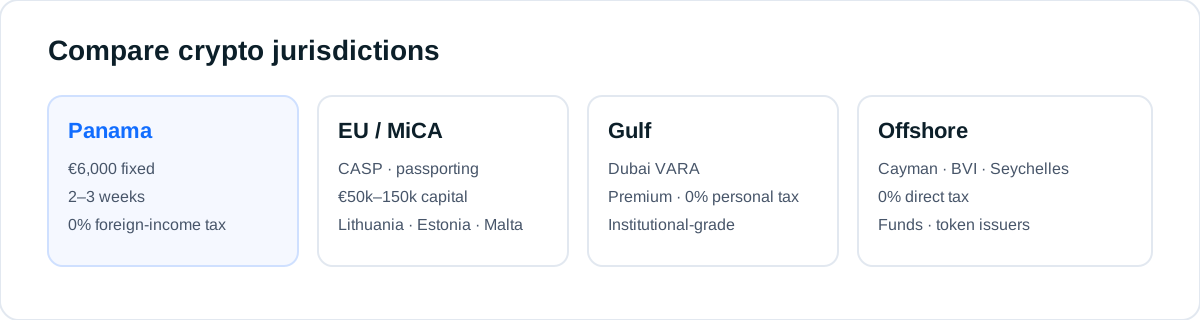
If neither jurisdiction fits, consider Panama (flat fee EUR 6,000, no capital requirement, quick setup) or Lithuania (EU MiCA-compliant, capital EUR 125,000 for exchanges). Other options include Estonia and Dubai. Consulting24 advises across multiple jurisdictions. For a comparison with Lithuania, see vs Lithuania. Panama is particularly attractive for its low cost and speed, while Lithuania offers access to the EU market under MiCA. Consulting24 helps clients evaluate all options and choose the best fit.
Why Choose Consulting24 for Your Crypto License?
Consulting24 has obtained 500+ crypto licenses globally. We advise and coordinate applications in the Cayman Islands, Singapore, and many other jurisdictions. Our team provides end-to-end support: company setup, application drafting, compliance framework, and banking introductions. We do not guarantee approval but maximize your chances. Contact us via WhatsApp or book a consultation to discuss your project. Our expertise includes navigating complex regulatory environments and tailoring solutions to your business model. Whether you choose the Cayman Islands, Singapore, or another jurisdiction, we are your partner in licensing.
Frequently asked questions
What is the difference between Cayman Islands and Singapore crypto licenses?
The Cayman Islands offers a VASP registration under CIMA with no statutory minimum capital and zero tax. Singapore requires an MPI license under MAS with SGD 250,000 capital and 17% corporate tax. Singapore has a stronger regulatory reputation but higher costs.
Which jurisdiction is cheaper for a crypto license?
The Cayman Islands is cheaper: application fee around USD 5,000, no minimum capital, and lower ongoing costs. Singapore costs more: application fee SGD 10,000, capital SGD 250,000, and higher compliance expenses.
How long does it take to get a crypto license in the Cayman Islands vs Singapore?
Cayman Islands: 3-6 months. Singapore: 6-12 months. The Cayman Islands process is faster due to less stringent requirements.
Do I need to have a physical office in the Cayman Islands or Singapore?
Yes, both require a physical presence. In the Cayman Islands, you need a registered office and local directors or a local manager. Singapore requires a local office and at least one local director.
Can I use a Cayman Islands license to serve clients in Asia?
Yes, but it may not be as recognized as a Singapore license. Singapore's license is more trusted in Asia and may be required for local operations.
What are the tax benefits of the Cayman Islands?
The Cayman Islands has no corporate income tax, capital gains tax, withholding tax, or VAT. This makes it a zero-tax jurisdiction, ideal for minimizing tax burden.
What are the ongoing compliance requirements in Singapore?
Singapore requires annual audits, AML/CFT reporting, transaction monitoring, and regular filings with MAS. Compliance costs can range from SGD 30,000 to 80,000 per year.
Can I switch from a Cayman Islands license to a Singapore license later?
Yes, but you would need to apply for a new license in Singapore and meet its requirements. There is no direct conversion. Consulting24 can assist with the transition.
Is a Cayman Islands VASP registration recognized by other regulators?
Recognition varies. The Cayman Islands is a FATF member, so its registration is generally accepted, but some jurisdictions may require additional local licensing.
What is the minimum capital for a Cayman Islands VASP?
There is no statutory minimum, but CIMA expects adequate financial resources. Typically, USD 50,000 to 100,000 is considered acceptable.
Official sources
Primary sources
This guide reflects 2026 rules. Verify current requirements with the official regulator:
Related jurisdictions

Talk to a crypto-licensing expert
500+ licenses across Estonia, Lithuania, Panama and beyond. Tell us your model and we'll map the right route, honestly.
💬 Talk to an expertFree consultationGeneral guidance, not legal advice. Rules and fees evolve, and we confirm current requirements for your case.