Crypto Staking License in El Salvador (2026): Cost & Setup Staking License El Salvador: What You Need to Know in 2026
El Salvador has positioned itself as a pioneering jurisdiction for cryptocurrency, being the first country to adopt Bitcoin as legal tender. For crypto founders looking to offer staking services, understanding the regulatory environment is crucial. As of 2026, El Salvador does not have a specific "crypto staking license" but requires registration with the Central Reserve Bank (BCR) for certain virtual asset service provider (VASP) activities, including staking. This page provides a detailed overview of the requirements, costs, and alternatives, including the straightforward Panama crypto license.
Consulting24 advises and coordinates licensing in El Salvador and other jurisdictions. We have helped over 500 clients obtain crypto licenses globally, with direct delivery in Estonia, Lithuania, and Panama. Our team ensures you choose the right regulatory path for your staking business. For a cost-effective alternative, consider the Panama crypto license with a flat EUR 6,000 fee.
What Is a Crypto Staking License in El Salvador?
In El Salvador, there is no standalone "staking license." Instead, staking services fall under the broader category of virtual asset service providers (VASPs). The regulatory framework is governed by the Bitcoin Law and the Digital Assets Securities Law (Ley de Activos Digitales, or LAD). The main regulator is the Central Reserve Bank (BCR) for payment-related services, while the National Digital Assets Commission (CNAD) oversees digital asset securities and investment services. Staking, being a yield-generating activity, typically requires registration with the BCR if it involves custody or transfer of virtual assets.
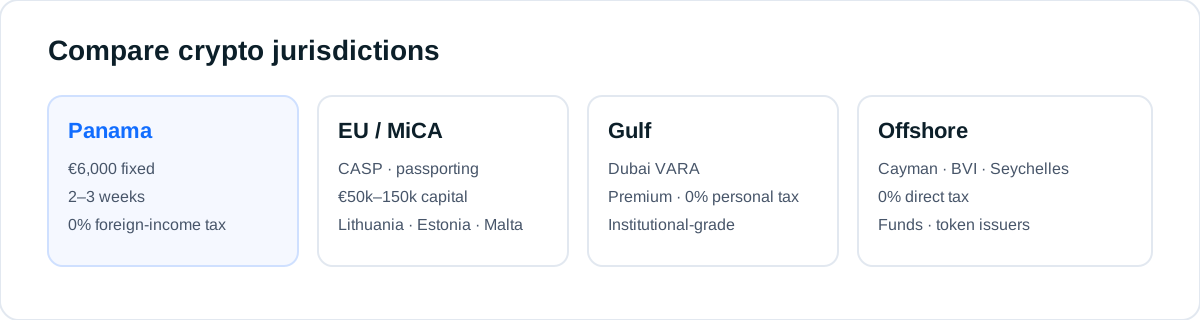
As of 2026, the licensing process is still evolving, and specific capital requirements for staking are not yet codified. However, general VASP registration requires a minimum capital of around USD 50,000, proof of a local physical presence, and compliance with anti-money laundering (AML) regulations. The timeline for approval varies from 3 to 6 months. For a more predictable and cost-effective alternative, many founders consider the Panama crypto license, which offers a flat EUR 6,000 fee and a faster 2-3 month process. Consulting24 can help you compare both options. For a detailed comparison of jurisdictions, visit our jurisdictions page.
Who Needs a Crypto Staking License in El Salvador?
Any entity that offers staking services to clients in or from El Salvador needs to register. This includes:
- Crypto exchanges that offer staking rewards to users, such as Binance-style platforms.
- Platforms that pool tokens for staking on behalf of clients, like Lido or Rocket Pool equivalents.
- Companies that provide staking-as-a-service (StaaS) to institutional investors.
- Foundations or DAOs that operate staking pools and distribute rewards to token holders.
- Individual node operators who charge fees for delegation services.
If you are a foreign company targeting Salvadoran clients, you may also need to establish a local subsidiary. The BCR requires a local registered address and a legal representative. Consulting24 can help you determine your exact obligations and whether a simpler jurisdiction like Panama might be more suitable. For example, a European staking platform expanding to Latin America might find Panama's territorial tax system more advantageous.
License Type & Regulator
The primary regulator for staking services is the Banco Central de Reserva (BCR) for VASP registration under the Bitcoin Law. For activities involving digital asset securities (e.g., staking tokens that qualify as securities), the Comisión Nacional de Activos Digitales (CNAD) may have oversight. The registration is not a full license but a mandatory registration to operate legally. The BCR registration covers custody, transfer, and exchange of virtual assets, which includes staking operations.
Key points:
- Registration with BCR is mandatory before offering services.
- CNAD approval may be needed if staking involves securities.
- No specific staking license exists; it falls under VASP activities.
- The regulatory framework is still developing, so expect updates.
- Both regulators require ongoing compliance reporting.
For a more established regulatory framework, consider the Lithuania crypto license under MiCA, which provides clear capital tiers and activity definitions.
Cost & Timeline
| Item | Cost (USD) | Timeline |
|---|---|---|
| BCR registration fee | 1,000 - 5,000 (estimated, confirm with regulator) | 1-2 months for submission |
| Legal and compliance setup | 5,000 - 15,000 | 1-2 months |
| Minimum capital requirement | 50,000 (estimated, varies) | Must be deposited before registration |
| Local office and representative | 2,000 - 5,000 per year | Ongoing |
| Total estimated cost | 10,000 - 25,000 (excluding capital) | 3-6 months total |
Exact costs depend on the complexity of your business model. Consulting24 provides a free consultation to give you a precise quote. In contrast, the Panama crypto license is a flat EUR 6,000 with a faster timeline of 2-3 months. For more details on Panama, see our cost page. Note that El Salvador's costs can increase if additional CNAD approval is needed.
Capital Requirement
The minimum capital for VASP registration in El Salvador is not explicitly defined in law. However, based on regulatory practice, a minimum of USD 50,000 is typically required. This capital must be maintained in a Salvadoran bank account and can be used for operational expenses. For staking services that involve holding client assets, higher capital may be required, potentially up to USD 250,000. Consulting24 recommends budgeting at least USD 50,000 to start. Compare this to Panama, where no minimum capital is required, only the flat EUR 6,000 fee. For more on capital requirements across jurisdictions, see our requirements page. In EU jurisdictions under MiCA, capital tiers are EUR 50,000 / 125,000 / 150,000 depending on service class.
Tax Treatment
El Salvador offers a favorable tax regime for crypto businesses. There is no capital gains tax on Bitcoin or other cryptocurrencies. However, income from staking rewards is considered taxable income and is subject to the standard corporate income tax rate of 30%. VAT (13%) applies to services provided to Salvadoran clients. The government has proposed a 0% tax rate for digital asset issuers, but as of 2026, this has not been enacted for staking services. Consulting24 recommends consulting with a local tax advisor. For a tax-neutral alternative, Panama offers territorial taxation, meaning income earned outside Panama is tax-free, and the corporate tax rate is 25% on local income. This makes Panama attractive for international staking operations. Learn more on our blog about tax optimization.
Allowed Activities
Under the BCR registration, you can perform the following staking-related activities:
- Staking of PoS tokens (e.g., ETH, SOL, ADA) on behalf of clients.
- Pooling client funds for staking and distributing rewards proportionally.
- Providing staking infrastructure and node operation services.
- Custody of staked assets (requires additional compliance and possibly CNAD approval).
- Delegation services for proof-of-stake networks.
Activities that are not allowed include unregistered securities offerings, lending of staked assets without disclosure, and services that violate AML laws. The scope is broad but subject to regulatory interpretation. For a more defined scope, consider the exchange license in Lithuania under MiCA, which clearly outlines permitted activities for CASPs.
Step-by-Step Process
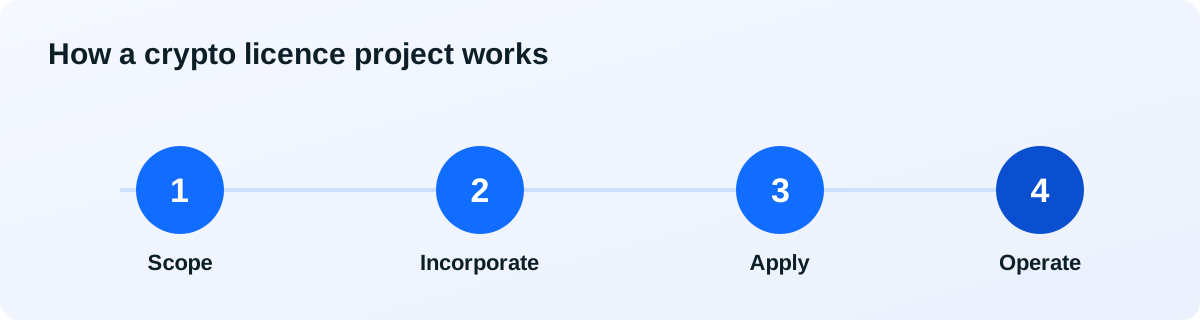
- Incorporate a Salvadoran company (Sociedad Anónima) with a local registered address and legal representative.
- Open a corporate bank account in El Salvador and deposit the minimum capital (at least USD 50,000).
- Prepare documentation: AML/KYC policies, business plan, source of funds, and ownership structure.
- Submit BCR registration application with required fees and supporting documents.
- Undergo regulatory review (3-6 months). Respond to any queries promptly.
- Receive registration certificate and begin operations.
- Ongoing compliance: Submit periodic reports and maintain AML procedures.
Consulting24 advises and coordinates each step, ensuring compliance with local laws. For a simpler alternative, consider the company setup in Panama, which includes the license application and can be completed in 2-3 months.
Banking & Payments
Opening a bank account in El Salvador for a crypto business can be challenging. Traditional banks are wary of crypto due to regulatory uncertainty. However, the government has encouraged banks to serve crypto companies. Options include:
- Banco Agrícola, Banco Cuscatlán, and Banco Davivienda (some accept crypto firms, but require extensive due diligence).
- Local fintech payment processors like Chivo (government-owned wallet) for Bitcoin transactions.
- International payment gateways like Stripe or Coinbase Commerce for fiat on/off ramps.
Consulting24 can introduce you to banking partners. For payment processing, you may also use stablecoin-based solutions. In Panama, banking is more straightforward, with several banks open to crypto businesses. See our blog for banking tips. We recommend starting the banking process early, as it can take 2-4 months.
Benefits of a Crypto Staking License in El Salvador
- First-mover advantage in a pro-Bitcoin jurisdiction with government support.
- No capital gains tax on crypto transactions, encouraging trading and investment.
- Growing ecosystem with Bitcoin adoption and digital nomad visas.
- Low setup costs compared to EU jurisdictions (though Panama is cheaper).
- Potential for regulatory clarity as the framework matures.
However, the regulatory framework is still maturing, which brings uncertainty. Many founders prefer established regimes like Estonia or Lithuania for clarity. Consulting24 can help you weigh the pros and cons based on your specific business model.
Compliance & Trust
Compliance is critical for maintaining your registration. You must implement strong AML/KYC procedures, report suspicious transactions, and undergo regular audits. The BCR and CNAD have the power to revoke registration for non-compliance. Key requirements include:
- Appointing a compliance officer with local presence.
- Conducting regular AML training for staff.
- Submitting periodic reports to the regulator.
- Maintaining records of all transactions for at least 5 years.
Consulting24 helps you design compliance frameworks that meet local requirements. This is general guidance, not legal advice. For a more established compliance environment, consider the Czech Republic or Poland, where AML standards are well-defined.
Common Mistakes to Avoid
- Operating without registration - can result in fines or closure of your business.
- Underestimating capital requirements - ensure you have sufficient funds, as the BCR may request proof.
- Ignoring AML obligations - must have written policies and procedures in place before applying.
- Choosing the wrong entity type - a local SA (Sociedad Anónima) is mandatory, not a foreign branch.
- Not securing banking early - bank account opening can take months; start early.
- Assuming staking is exempt - even if your platform is based abroad, targeting Salvadoran clients triggers registration.
Consulting24 can help you avoid these pitfalls. For a more straightforward process, many clients choose the Panama license, which has fewer regulatory hurdles.
Alternatives: Panama vs El Salvador vs Other Jurisdictions
For crypto staking businesses, Panama offers a simpler and cheaper alternative. The Panama crypto license costs a flat EUR 6,000 with no minimum capital requirement, and the process takes 2-3 months. In contrast, El Salvador requires a minimum capital of USD 50,000 and a timeline of 3-6 months, with ongoing uncertainty. Other alternatives include:
- Lithuania (under MiCA): Capital tiers of EUR 50,000 / 125,000 / 150,000, clear regulatory framework, and EU passporting.
- Estonia: Established VASP license with a capital requirement of EUR 12,000 (for staking) and a 1-3 month timeline.
- Dubai (VARA): Requires a local presence and higher capital, but offers access to the Middle East market. Consulting24 does not provide this license but can help you compare.
Consulting24 advises and coordinates licensing in El Salvador, Estonia, Lithuania, and Panama. For other jurisdictions like Dubai, we provide neutral comparison advice. Our jurisdictions page offers a comprehensive overview.
Why Choose Consulting24?
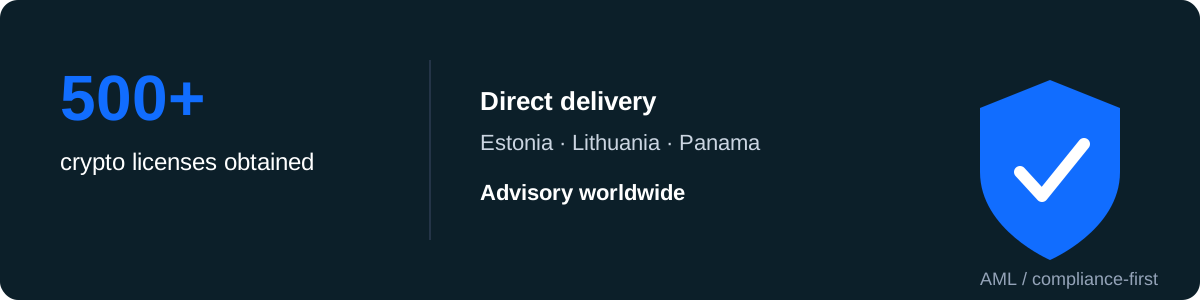
Consulting24 has obtained over 500 crypto licenses worldwide. We deliver directly in Estonia, Lithuania, and Panama, and advise and coordinate in all other jurisdictions including El Salvador. Our team of experts provides end-to-end support, from company incorporation to regulatory compliance. We understand the nuances of each jurisdiction and can help you select the best fit for your staking business. Whether you choose El Salvador for its Bitcoin-friendly environment or Panama for its simplicity, we guide you through every step. Contact us for a free consultation to discuss your project.
Frequently Asked Questions
Below are answers to common questions about crypto staking licenses in El Salvador and alternatives.
Frequently asked questions
Is there a specific staking license in El Salvador?
No, El Salvador does not have a specific staking license. Staking services fall under the broader VASP registration with the BCR. If staking involves digital asset securities, CNAD approval may also be required.
What is the minimum capital for a staking license in El Salvador?
The minimum capital is not explicitly defined but is typically around USD 50,000. For staking services holding client assets, higher capital may be required, potentially up to USD 250,000.
How long does it take to get a staking license in El Salvador?
The registration process takes 3 to 6 months, depending on the completeness of your application and regulatory workload. Consulting24 can help expedite the process.
Can I offer staking services to Salvadoran clients from abroad?
If you target Salvadoran clients, you likely need to register with the BCR and establish a local presence. Operating without registration can lead to penalties.
What are the tax implications of staking in El Salvador?
Staking rewards are taxable as income at the corporate rate of 30%. There is no capital gains tax on crypto. VAT of 13% applies to services provided locally.
How does Panama compare to El Salvador for staking?
Panama offers a flat EUR 6,000 license fee, no minimum capital, and a 2-3 month timeline. El Salvador requires USD 50,000 capital and 3-6 months. Panama is simpler and cheaper.
What activities are allowed under the BCR registration?
Allowed activities include staking PoS tokens, pooling client funds, providing staking infrastructure, and custody of staked assets (with additional compliance).
Do I need a local office in El Salvador?
Yes, you need a local registered address and a legal representative. A physical office is not strictly required but a registered address is mandatory.
Can Consulting24 help with the El Salvador license?
Yes, Consulting24 advises and coordinates the licensing process in El Salvador. We also provide direct delivery in Estonia, Lithuania, and Panama.
What are the AML requirements for staking in El Salvador?
You must implement AML/KYC policies, appoint a compliance officer, report suspicious transactions, and maintain records for 5 years. Regular audits may be required.
Is El Salvador's regulatory framework stable?
The framework is still evolving. While the government is pro-crypto, regulations are subject to change. Consulting24 monitors updates to keep you compliant.
What is the cost of the Panama crypto license?
The Panama crypto license is a flat EUR 6,000, with no additional capital requirements. This includes company incorporation and the license application.
Official sources
Related jurisdictions

Talk to a crypto-licensing expert
500+ licenses across Estonia, Lithuania, Panama and beyond. Tell us your model and we'll map the right route, honestly.
💬 Talk to an expertFree consultationGeneral guidance, not legal advice. Rules and fees evolve, and we confirm current requirements for your case.