Crypto Staking License in Liechtenstein (2026): Cost & Setup Staking License Liechtenstein: Your 2026 Guide
Liechtenstein has established itself as a leading jurisdiction for blockchain and crypto asset businesses, particularly for staking services. Under the Token and Trusted Technology Service Provider Act (TVTG), staking activities fall under a specific license category that provides legal clarity and investor confidence. This page explains everything you need to know about obtaining a crypto staking license in Liechtenstein in 2026, including costs, capital requirements, tax treatment, and the step-by-step application process.
Consulting24 advises and coordinates crypto staking license applications in Liechtenstein, helping you handle the regulatory process efficiently. Whether you are a startup or an established firm, we provide tailored support to ensure compliance with Liechtenstein's rigorous standards. Our team has deep expertise in this niche, having assisted numerous clients in securing their licenses. For a broader view, explore our jurisdictions page.
What Is a Crypto Staking License in Liechtenstein?
A crypto staking license in Liechtenstein is a regulatory authorization issued under the TVTG (Token and Trusted Technology Service Provider Act) that allows companies to offer staking services to clients. Staking involves locking up crypto assets to support blockchain network operations, earning rewards in return. In Liechtenstein, this activity is classified as a “token transaction” or “custody of tokens” service, depending on the business model.
The license ensures that your staking operation meets strict standards for security, transparency, and customer protection. It covers both proof-of-stake (PoS) and delegated proof-of-stake (DPoS) protocols. The regulator is the Financial Market Authority (FMA) Liechtenstein, which oversees compliance with anti-money laundering (AML) and know-your-customer (KYC) obligations.
For founders, this license provides a clear legal framework to operate across the European Economic Area (EEA) under passporting rights, though MiCA (Markets in Crypto Assets Regulation) now applies in the EU. Liechtenstein, as part of the EEA, aligns with MiCA but maintains its own TVTG regime for certain services. The TVTG is one of the first comprehensive blockchain laws globally, offering legal certainty that many other jurisdictions lack.
Who Needs a Crypto Staking License in Liechtenstein?
Any company that offers staking services to third parties, whether retail or institutional, requires a license under the TVTG. This includes:
- Staking-as-a-service providers
- Exchanges that offer staking to their users
- Custodians that manage staked assets on behalf of clients
- DeFi platforms that facilitate staking pools
- Validators who operate nodes for clients
If you only stake your own corporate treasury assets, you may not need a license, but professional staking services for others always require authorization. The FMA takes a broad view of what constitutes staking, so it is safer to assume you need a license if you handle client funds. Even if your business model involves non-custodial staking (where clients retain control of private keys), you may still need a license if you facilitate the staking process or earn commissions.
License Type & Regulator
The relevant license under the TVTG is the “Token Service Provider” (TSP) license, which covers various activities including staking. The regulator is the Financial Market Authority (FMA) Liechtenstein (www.fma-li.li). The FMA is responsible for supervising all financial services, including crypto asset services under the TVTG.
There is no separate “staking license” per se; staking is considered a token custody or token transaction service. The license type depends on whether you take custody of the staked assets (custody) or merely facilitate staking without custody (transaction). Most staking providers require a custody license because they hold private keys.
Under MiCA, which is fully in force in 2026, EU member states apply capital tiers of EUR 50,000 / 125,000 / 150,000 by service class. Liechtenstein, as an EEA member, aligns with MiCA but its TVTG regime may have different capital requirements for staking. As of 2026, the minimum capital for a staking license in Liechtenstein is typically EUR 50,000 for simple staking services, but higher if you also offer custody or trading. Exact figures should be confirmed with a consultation.
Cost & Timeline
The cost of obtaining a crypto staking license in Liechtenstein varies based on complexity. Below is an indicative breakdown. Exact pricing is confirmed in a consultation.
| Item | Estimated Cost (EUR) |
|---|---|
| Government application fee | 5,000 - 15,000 |
| Legal and advisory fees (Consulting24) | From 15,000 |
| AML/KYC compliance setup | 5,000 - 10,000 |
| Audit and technical review | 5,000 - 20,000 |
| Annual supervision fee | 2,000 - 8,000 |
| Total estimated (one-time) | 30,000 - 60,000 |
Timeline: The application process typically takes 3 to 6 months from submission to approval, assuming all documents are complete. Pre-submission preparation can take an additional 1 to 2 months. Consulting24 advises and coordinates the entire process to minimize delays. For a faster route, consider Panama company setup at a flat EUR 6,000, though it lacks a dedicated staking license.
Capital Requirement
Liechtenstein's TVTG requires a minimum capital for token service providers. For staking services, the capital requirement is generally EUR 50,000 if you only provide staking without custody of client assets. If you also offer custody, the requirement may be EUR 125,000 or higher, depending on the volume of assets under custody. Under MiCA, which applies from 2026, the tiers are EUR 50,000 / 125,000 / 150,000. Since Liechtenstein is in the EEA, it follows these tiers, but the TVTG may have specific adjustments. Consulting24 can provide exact figures based on your business model.
Capital must be held in a regulated bank account and cannot be used for operational expenses. It serves as a buffer against losses and demonstrates financial stability to the regulator. If your staking operation involves high volumes or complex DeFi protocols, the FMA may require additional capital.
Tax Treatment of Staking in Liechtenstein
Liechtenstein offers a favorable tax environment for crypto businesses. Corporate income tax is a flat 12.5%, one of the lowest in Europe. Staking rewards are generally treated as income at the time they are received, and capital gains on the sale of staked assets may be tax-exempt for corporate entities under certain conditions. VAT is not applicable on staking services, as they are considered financial services. However, specific tax treatment depends on your structure and the nature of the staking. Consulting24 recommends consulting a tax advisor familiar with Liechtenstein law.
For example, if you stake ETH on behalf of clients and earn a 5% commission, that commission is taxable income. The underlying rewards passed to clients may be treated as client assets and not subject to corporate tax. Liechtenstein also has double taxation treaties with many countries, which can reduce withholding taxes on cross-border payments.
Allowed Activities Under the Staking License
With a crypto staking license in Liechtenstein, you can:
- Offer staking services for PoS and DPoS blockchains
- Take custody of staked assets (if licensed for custody)
- Operate validator nodes for clients
- Distribute staking rewards to clients
- Provide staking pool management
- Offer delegated staking
Activities that are NOT allowed without additional licenses include: trading on own account, operating a crypto exchange, or offering lending products. If your staking service involves any of these, you may need a separate license or a broader license category. For example, if you also want to offer a swap feature within your staking platform, you would need an exchange license in addition.
Step-by-Step Application Process
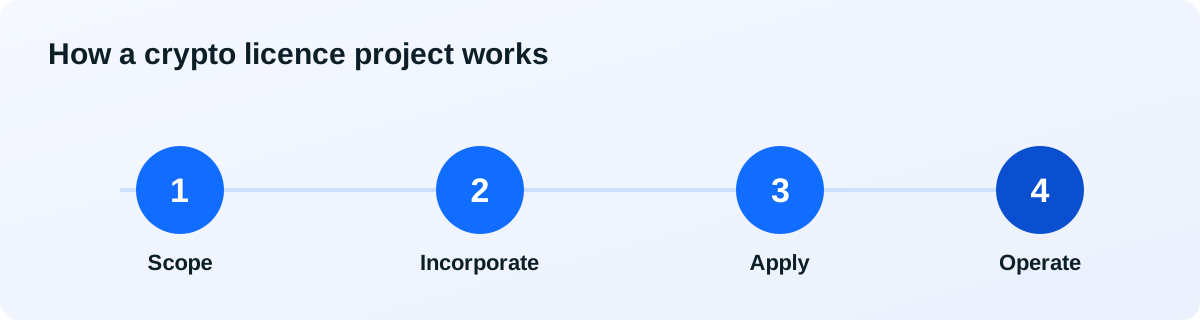
- Pre-assessment: Consulting24 reviews your business model to determine the exact license type and capital needed.
- Company incorporation: You need a Liechtenstein entity (e.g., AG or GmbH). We can assist with company setup.
- Document preparation: Draft AML/KYC policies, business plan, risk assessment, and technical documentation.
- Submit application: File with the FMA along with the application fee.
- FMA review: The regulator assesses your application, may request additional information, and conducts background checks on directors.
- Approval: Once approved, you receive the license and can start operations. Ongoing compliance includes annual reporting and audits.
Throughout the process, Consulting24 provides hands-on support, from drafting documents to liaising with the FMA. We also help prepare for the mandatory external audit that is part of the application.
Banking & Payment Services
Opening a bank account for a crypto staking business in Liechtenstein can be challenging due to perceived risk. However, Liechtenstein has several banks that accept crypto-related businesses, such as Bank Frick and VP Bank. Consulting24 can help you connect with these banks. Additionally, you may consider payment processors that specialize in crypto. For many clients, we recommend combining a Liechtenstein license with a Panama company setup for banking flexibility, as Panama offers easier access to international banking.
Typical banking requirements include proof of license, AML policies, and a detailed business plan. Some banks may require a minimum deposit or a relationship manager interview. Consulting24 can prepare the necessary documentation to streamline the account opening process.
Benefits of a Liechtenstein Crypto Staking License
- Legal certainty under the TVTG, a comprehensive blockchain law
- Low corporate tax rate of 12.5%
- Passporting rights within the EEA
- Strong reputation and trust among institutional investors
- Proactive regulator with clear guidelines
- Access to a skilled workforce and professional services
Additionally, Liechtenstein's proximity to Switzerland and its stable political environment make it an attractive base for long-term operations. The TVTG has been in force since 2020, giving it a track record that newer regimes lack.
Compliance & Trust Considerations
Compliance is critical to maintain your license. You must implement strong AML/KYC procedures, conduct ongoing monitoring, and report suspicious transactions to the FMA. Annual audits by an external auditor are mandatory. Failure to comply can result in fines or revocation of the license. Consulting24 provides ongoing compliance support to ensure you meet all obligations. This is general guidance, not legal advice.
Trust is also built through transparency. Publish your license number, disclose your AML policy on your website, and consider obtaining a voluntary audit from a reputable firm. Many institutional clients require proof of regulatory compliance before engaging a staking provider.
Common Mistakes to Avoid
- Underestimating the capital requirement - ensure you have sufficient funds before applying.
- Poor documentation - incomplete or vague business plans lead to delays.
- Ignoring AML/KYC - the FMA scrutinizes these policies heavily.
- Choosing the wrong license type - staking may require a custody license if you hold keys.
- Not engaging local experts - the process is complex; Consulting24 can help.
- Assuming passporting rights automatically apply to all EEA countries - some states have additional requirements.
Another common error is failing to plan for ongoing costs like annual supervision fees and audit expenses. Budget for at least EUR 10,000 per year in compliance costs.
Alternatives: Liechtenstein vs Panama and Other Jurisdictions
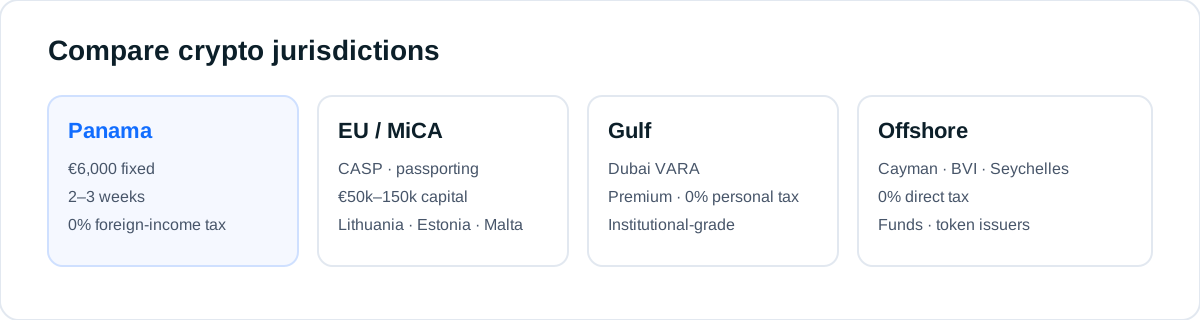
When comparing Liechtenstein to other popular jurisdictions, consider your specific needs. Panama offers a flat EUR 6,000 company setup with no specific crypto license for staking, but it lacks the regulatory clarity of Liechtenstein. For EU-focused businesses, Liechtenstein is ideal. Other alternatives include Lithuania (MiCA-compliant, lower costs) and Estonia (established but now under MiCA). Consulting24 advises on all these jurisdictions to help you choose the best fit.
For a quick comparison:
- Liechtenstein: High regulatory clarity, moderate cost (EUR 30-60k), 3-6 months.
- Panama: Low cost (EUR 6k), no specific staking license, less regulatory clarity.
- Lithuania: Lower cost (EUR 10-20k), MiCA-compliant, 2-4 months.
Why Choose Consulting24 for Your Liechtenstein Staking License?
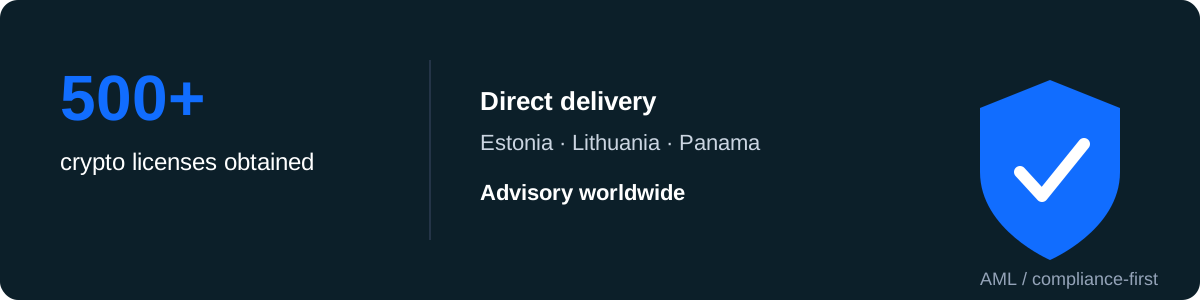
Consulting24 is a senior crypto-licensing firm with over 500 licenses obtained globally. We deliver directly in Estonia, Lithuania, and Panama, and we advise and coordinate for Liechtenstein. Our team includes legal experts, compliance officers, and former regulators. We provide end-to-end support from company setup to license approval and ongoing compliance. Contact us via WhatsApp for a free consultation.
Our track record includes helping clients navigate complex FMA requirements and securing licenses for staking, custody, and exchange services. We also offer post-license support, including annual compliance reporting and regulatory updates.
Frequently asked questions
What is the minimum capital for a crypto staking license in Liechtenstein?
The minimum capital is typically EUR 50,000 for staking-only services, but may be higher if you also offer custody or trading. Under MiCA, tiers are EUR 50,000 / 125,000 / 150,000. Exact figures depend on your business model and should be confirmed with a consultation.
How long does it take to get a staking license in Liechtenstein?
The application process takes 3 to 6 months from submission to approval, plus 1-2 months for preparation. Consulting24 can help streamline the process by ensuring all documents are complete and accurate.
Can I passport my Liechtenstein staking license to other EU countries?
Yes, Liechtenstein is part of the EEA, so your license can be passported to other EEA member states under the TVTG and MiCA frameworks. However, some countries may have additional notification requirements.
What is the tax rate for staking rewards in Liechtenstein?
Corporate income tax is a flat 12.5%. Staking rewards are generally taxed as income when received. Capital gains on staked assets may be tax-exempt for corporates under certain conditions. VAT does not apply.
Do I need a separate license for custody if I offer staking?
If you hold private keys to client assets, you need a custody license. Most staking providers require custody. If you use a non-custodial model, a transaction license may suffice. Consulting24 can help determine the right category.
What are the ongoing compliance requirements?
You must conduct annual audits, submit reports to the FMA, maintain AML/KYC procedures, and report suspicious transactions. Annual supervision fees range from EUR 2,000 to 8,000. Consulting24 offers ongoing compliance support.
Can I use a Panama company for staking instead of a Liechtenstein license?
Panama does not have a specific staking license, so you would operate without regulatory clarity. For EU clients, a Liechtenstein license is recommended. Panama is better for non-regulated activities or as a holding company.
What happens if I fail to comply with FMA requirements?
Non-compliance can result in fines, suspension, or revocation of your license. The FMA takes AML/KYC violations seriously. Consulting24 provides compliance monitoring to help you avoid pitfalls.
Is Liechtenstein part of the EU?
Liechtenstein is not an EU member but is part of the EEA and Schengen Area. It aligns with EU regulations like MiCA through its EEA membership, but maintains its own TVTG law.
How much does Consulting24 charge for Liechtenstein staking license support?
Our advisory fees start from EUR 15,000, depending on complexity. This includes pre-assessment, document preparation, and coordination with the FMA. Contact us for a custom quote.
Official sources
Related jurisdictions

Talk to a crypto-licensing expert
500+ licenses across Estonia, Lithuania, Panama and beyond. Tell us your model and we'll map the right route, honestly.
💬 Talk to an expertFree consultationGeneral guidance, not legal advice. Rules and fees evolve, and we confirm current requirements for your case.