Crypto Staking License in Germany (2026): Cost & Setup License Germany: Complete Guide for 2026
Germany is one of the most respected jurisdictions in Europe for crypto asset regulation, and obtaining a crypto staking license Germany is a strategic move for any serious crypto business. Under the German Banking Act (KWG), staking services are considered proprietary trading or custody business, requiring a license from the Federal Financial Supervisory Authority (BaFin).
This guide covers everything you need to know about the crypto staking license Germany in 2026: who needs it, the regulator, costs, timeline, capital requirements, tax treatment, and the step-by-step process. Consulting24 advises and coordinates your application, using our experience with over 500 licenses across Europe and Panama.
Whether you are launching a staking platform or integrating staking into an existing exchange, understanding the German regime is critical. Let us walk you through the requirements and help you decide if Germany is the right home for your staking business.
What Is a Crypto Staking License in Germany?
A crypto staking license Germany is an authorisation from BaFin that permits a company to offer staking services for proof-of-stake (PoS) cryptocurrencies. Staking involves locking tokens to support network operations (validation, security) and earning rewards. In Germany, this activity falls under financial services regulation, typically classified as proprietary trading (Eigenhandel) or custody business (Kryptoverwahrgeschäft).
The license is not a separate "staking license" but an extension of the existing crypto custody or trading license. However, because staking involves holding client assets and generating returns, it triggers additional compliance obligations under the German Banking Act (KWG) and the EU's Markets in Crypto-Assets Regulation (MiCA).
Key points:
- BaFin is the sole regulator for crypto staking in Germany.
- Staking is treated as a financial service, not a utility.
- MiCA applies fully from 2025, but Germany already has national rules that remain in force.
For example, if you operate a staking pool for Ethereum or Solana, you need to classify whether you hold client private keys (custody) or merely facilitate delegation (proprietary trading). This classification affects the license type and capital requirement. Consulting24 advises and coordinates to ensure correct classification.
Who Needs a Crypto Staking License in Germany?
Any company that offers staking services to German clients or operates from Germany must hold a BaFin license. This includes:
- Crypto exchanges that allow users to stake their tokens.
- Staking-as-a-service platforms.
- Wallet providers that offer staking rewards.
- DeFi protocols that market staking to German residents.
If you only stake your own corporate treasury and do not hold third-party assets, you may not need a license. But as soon as you manage staking for clients, the license requirement applies. Consulting24 advises and coordinates your application, helping you determine if your business model falls under the licensing requirement.
A common scenario: a crypto exchange in Lithuania wants to offer staking to German users. Under MiCA, they can passport their Lithuanian license to Germany, but if they operate a German branch, a separate German license may be required. Consulting24 advises and coordinates on passporting vs. direct licensing.
License Type and Regulator
The crypto staking license Germany is granted by the Federal Financial Supervisory Authority (BaFin). The specific license type depends on your activities:
- Proprietary trading license (Eigenhandel): For staking where the provider acts as a principal (trades on own account).
- Crypto custody license (Kryptoverwahrgeschäft): For staking where the provider holds private keys on behalf of clients.
- Investment brokerage (Anlagevermittlung): If you only introduce clients to staking pools.
Most staking platforms require a combination of custody and proprietary trading licenses. BaFin assesses fitness and properness of management, adequate capital, and strong AML controls. The regulator is known for thorough scrutiny, so preparation is key.
For instance, if you run a staking platform where clients deposit tokens and you delegate them to validators while holding the keys, you need both a custody license and a proprietary trading license. Consulting24 advises and coordinates to define the exact scope.
Cost and Timeline
The cost of a crypto staking license Germany varies based on complexity and legal support. Below is an indicative table:
| Item | Cost (EUR) |
|---|---|
| BaFin application fee | 5,000 - 20,000 (depending on scope) |
| Legal and compliance setup | 30,000 - 80,000 |
| AML/KYC system implementation | 10,000 - 30,000 |
| Total estimated | 45,000 - 130,000 |
Timeline: 6 to 12 months from application to approval. BaFin has a statutory deadline of 3 months, but in practice the process takes longer due to back-and-forth. Consulting24 advises and coordinates to streamline the process.
For comparison, a Lithuania crypto license can be obtained in 2-4 months at a lower cost, but without the same regulatory prestige. The German timeline includes company incorporation (2-4 weeks), document preparation (4-8 weeks), and BaFin review (3-6 months). Delays often occur due to incomplete AML documentation or insufficient capital proof.
Capital Requirement
Under MiCA, capital requirements for crypto asset service providers (CASPs) are tiered by service class. For staking, which typically involves custody and trading, the minimum capital is EUR 125,000. If your staking service also includes execution of orders on behalf of clients, the requirement may rise to EUR 150,000.
Germany's national rules (KWG) previously required a minimum of EUR 50,000 for proprietary trading, but MiCA now overrides with higher tiers. As of 2026, the applicable capital is:
- EUR 125,000 for custody + staking.
- EUR 150,000 if you also execute client orders.
Exact figures depend on your business model. Consulting24 advises and coordinates to determine the precise capital needed.
For example, a staking platform that only delegates tokens to a validator pool (no order execution) would need EUR 125,000. A platform that also allows clients to set staking parameters or trade rewards might need EUR 150,000. The capital must be held in a German bank account and cannot be used for operational expenses.
Tax Treatment of Staking in Germany
Germany treats staking rewards as income from capital assets under the Investmentsteuergesetz (InvStG). Key points:
- Staking rewards are taxable as income at the time of receipt.
- If you hold staked tokens for more than one year, gains from sale are tax-free (private sale).
- Corporate staking: rewards are subject to corporate income tax (15%) plus trade tax (7-17%).
- VAT: staking services are generally VAT-exempt as financial services.
Tax treatment can be complex, especially for pooled staking. Consulting24 advises and coordinates with German tax advisors to ensure compliance.
For instance, if your company receives 100 ETH in staking rewards annually, you must pay corporate tax on the market value at receipt. If you later sell the ETH after a year, the gain is tax-free. However, if you distribute rewards to clients, you may need to withhold tax. Consulting24 advises and coordinates with local tax experts.
Allowed Activities Under the License
A crypto staking license Germany permits the following activities:
- Accepting tokens from clients for staking.
- Delegating tokens to validators or staking pools.
- Distributing staking rewards to clients (minus fees).
- Providing wallet infrastructure for staked assets.
What is not allowed without additional licensing:
- Operating a crypto exchange (requires separate exchange license).
- Lending or borrowing staked assets (requires MiFID or banking license).
- Offering derivative products based on staking yields.
If your business model includes multiple services, you may need a combined license. Consulting24 advises and coordinates the scope of your application.
For example, if you want to offer staking and also allow users to trade their staked tokens on an order book, you would need a separate exchange license. Consulting24 advises and coordinates to structure your business appropriately.
Step-by-Step Application Process
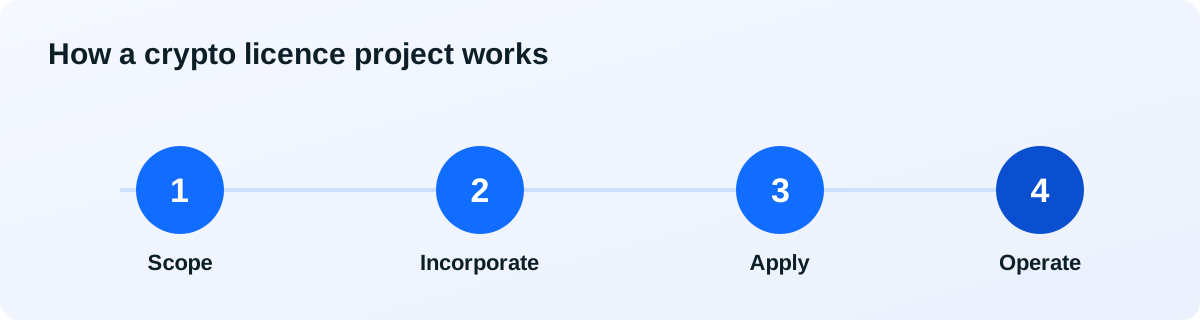
Obtaining a crypto staking license Germany involves several stages:
- Pre-assessment: Consulting24 reviews your business model and determines the exact license type needed.
- Company setup: Incorporate a German GmbH or AG with a registered office in Germany.
- Documentation: Prepare a detailed business plan, AML policies, risk management framework, and organisational chart.
- Capital deposit: Show proof of minimum capital (e.g., EUR 125,000) in a German bank account.
- Fit and proper checks: Provide CVs and police clearance for all managers and beneficial owners.
- Application submission: File with BaFin via the electronic portal (MVP).
- Review and queries: BaFin may ask for clarifications; respond promptly.
- Approval: Once granted, you can commence staking operations.
The entire process typically takes 6-12 months. Consulting24 advises and coordinates each step.
For a detailed breakdown, see our application process guide. We help you prepare a strong business plan that covers staking mechanics, reward distribution, risk management, and exit strategy. Our experience with 500+ licenses ensures your application meets BaFin's expectations.
Banking and Payment Providers for Staking Platforms
German staking license holders need a bank account for operational expenses and client fund segregation. However, many traditional banks are reluctant to serve crypto firms. Options include:
- German banks with crypto-friendly policies (e.g., Solarisbank, Fidor Bank).
- Lithuanian payment institutions (e.g., PayrNet, UAB Finansines Paslaugos).
- EMI licences from Lithuania or Estonia.
Consulting24 advises and coordinates banking introductions as part of our service. We also help with setting up a company setup in Germany or alternative jurisdictions like Panama if banking is a concern.
For example, a German staking firm might open a business account with Solarisbank, which offers dedicated crypto banking services. However, due diligence can take 4-8 weeks. Consulting24 advises and coordinates to expedite the process.
Benefits of a German Crypto Staking License
Germany offers several advantages for staking businesses:
- Regulatory clarity: BaFin provides detailed guidance on staking classification.
- EU passport: Under MiCA, a German license allows you to serve clients across the EU.
- Reputation: A BaFin license signals trustworthiness to partners and clients.
- Access to banking: German-licensed firms find it easier to open bank accounts.
However, the high cost and long timeline may not suit every startup. Consulting24 advises and coordinates to help you weigh these benefits against alternatives like Lithuania or Estonia.
For instance, a staking platform targeting institutional investors may prefer Germany for its reputation, while a startup with limited budget might opt for Lithuania or Panama (flat EUR 6,000). Consulting24 advises and coordinates to find the best fit.
Compliance and Ongoing Obligations
After obtaining the license, you must maintain compliance:
- Annual audit by a German auditor.
- Ongoing AML/KYC monitoring.
- Regular reporting to BaFin (financial statements, transaction reports).
- Capital adequacy: maintain minimum capital at all times.
- Fit and proper: any change in management must be notified.
Non-compliance can result in fines or license revocation. Consulting24 advises and coordinates with local compliance partners to ensure you meet all obligations. This is general guidance, not legal advice.
For example, you must file quarterly transaction reports detailing staking rewards distributed, fees charged, and any suspicious activity. Consulting24 advises and coordinates with compliance software providers to automate these reports.
Common Mistakes When Applying for a German Staking License
Many applicants stumble on these points:
- Underestimating capital: Trying to use the old EUR 50,000 minimum when EUR 125,000 is required.
- Poor business plan: Not detailing staking mechanics, reward distribution, and risk management.
- Inadequate AML: Failing to implement transaction monitoring for staking rewards.
- Ignoring tax: Not planning for corporate and personal tax on staking income.
Consulting24 advises and coordinates to avoid these pitfalls. We have seen hundreds of applications and know what BaFin expects.
Another common mistake is assuming that a German license automatically allows staking of any token. BaFin may restrict activities to specific blockchains or require additional approvals for certain protocols. Consulting24 advises and coordinates to ensure your license covers your intended operations.
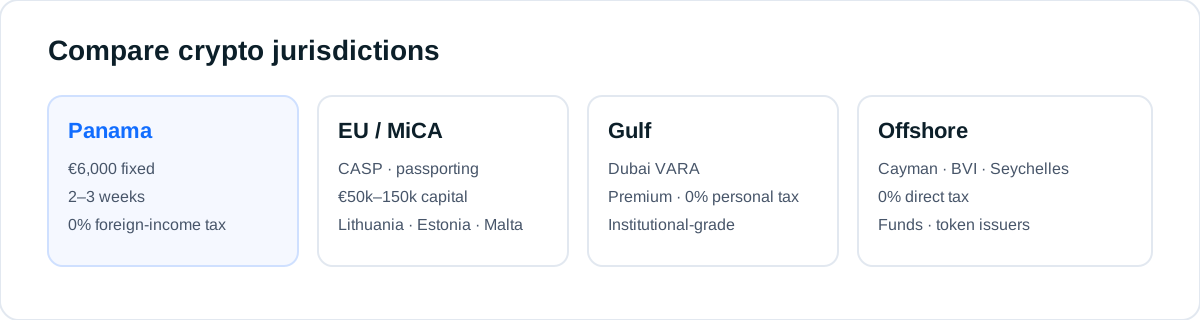
Alternatives: Germany vs. Panama vs. Lithuania vs. Estonia
Germany is not the only option for a staking license. Here is a comparison:
| Jurisdiction | Cost (EUR) | Timeline | Capital | EU Passport |
|---|---|---|---|---|
| Germany | 45,000 - 130,000 | 6-12 months | 125,000+ | Yes |
| Panama | 6,000 flat | 2-3 months | None | No |
| Lithuania | 10,000 - 25,000 | 2-4 months | 125,000 (MiCA) | Yes |
| Estonia | 5,000 - 15,000 | 1-3 months | 12,000 (pre-MiCA), 125,000 (MiCA) | Yes |
Panama offers the lowest cost and fastest setup, but no EU passport. Lithuania and Estonia are cheaper and faster than Germany, but with less regulatory prestige. Consulting24 advises and coordinates to help you choose the best jurisdiction for your staking business. For a full overview, see our jurisdictions page.
Frequently asked questions
What is a crypto staking license in Germany?
A crypto staking license in Germany is an authorisation from BaFin to offer staking services for proof-of-stake cryptocurrencies. It is not a separate license but an extension of the crypto custody or proprietary trading license under the German Banking Act (KWG) and MiCA.
Who needs a German staking license?
Any company offering staking services to German clients or operating from Germany needs a BaFin license. This includes exchanges, staking-as-a-service platforms, wallet providers, and DeFi protocols targeting German residents.
How much does a German crypto staking license cost?
Total costs range from EUR 45,000 to EUR 130,000, including BaFin fees (EUR 5,000-20,000), legal setup (EUR 30,000-80,000), and AML implementation (EUR 10,000-30,000). Exact pricing depends on business complexity.
How long does it take to get a staking license in Germany?
The timeline is 6 to 12 months from application to approval. BaFin has a statutory deadline of 3 months, but practical delays due to documentation queries and back-and-forth extend the process.
What is the minimum capital for a German staking license?
Under MiCA, the minimum capital is EUR 125,000 for custody and staking. If you also execute client orders, it rises to EUR 150,000. The capital must be held in a German bank account.
How are staking rewards taxed in Germany?
Staking rewards are taxed as income at receipt. For corporations, corporate income tax (15%) and trade tax (7-17%) apply. If tokens are held over one year, sale gains are tax-free. VAT is generally exempt.
Can I use a German staking license to serve clients across the EU?
Yes, under MiCA, a German license allows passporting to other EU member states. You can serve clients across the EU without additional licenses, though local registration may be required.
What are the common mistakes when applying for a German staking license?
Common mistakes include underestimating capital requirements (using old EUR 50,000 instead of EUR 125,000), submitting a weak business plan, inadequate AML procedures, and ignoring tax planning.
How does Germany compare to Panama for staking licenses?
Panama offers a flat EUR 6,000 cost and 2-3 month timeline with no capital requirement, but no EU passport. Germany costs more (EUR 45,000-130,000) and takes longer (6-12 months), but provides EU passport and high regulatory reputation.
Does Consulting24 provide the German staking license directly?
Consulting24 advises and coordinates the German staking license application. We do not file directly in Germany but work with local legal partners to manage the process. We deliver directly in Estonia, Lithuania, and Panama.
Official sources
Related jurisdictions

Talk to a crypto-licensing expert
500+ licenses across Estonia, Lithuania, Panama and beyond. Tell us your model and we'll map the right route, honestly.
💬 Talk to an expertFree consultationGeneral guidance, not legal advice. Rules and fees evolve, and we confirm current requirements for your case.