Crypto NFT Marketplace License in South Africa (2026): Cost: Crypto NFT Marketplace License South Africa: Your 2026 Guide
South Africa is emerging as a key jurisdiction for crypto and NFT businesses in Africa. With a clear regulatory framework under the Financial Sector Conduct Authority (FSCA), obtaining a crypto NFT marketplace license South Africa is now a structured process. This page explains who needs it, the license type, costs, capital requirements, tax treatment, and the step-by-step application process.
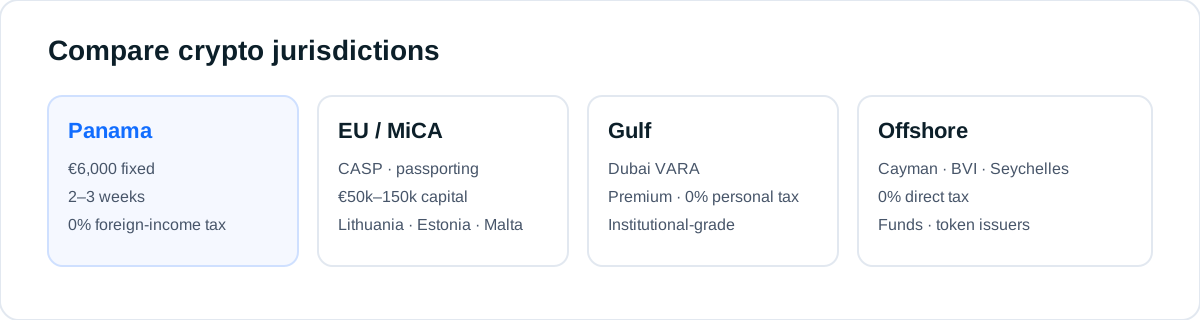
Whether you are launching an NFT trading platform or a broader crypto exchange, understanding South Africa's licensing regime is essential. Consulting24 advises and coordinates applications for crypto licenses globally, including South Africa, helping you manage the requirements efficiently. For a fixed-price alternative, consider Panama at EUR 6,000 flat, or explore other jurisdictions we serve.
What is the Crypto NFT Marketplace License in South Africa?
The crypto NFT marketplace license in South Africa refers to the registration as a Crypto Asset Service Provider (CASP) with the Financial Sector Conduct Authority (FSCA). Under the Financial Advisory and Intermediary Services Act (FAIS), all businesses offering crypto asset services-including NFT marketplaces-must be licensed. This requirement became effective in 2024, and by 2026, the regime is fully operational. The FSCA is the primary regulator, and the license is a Category I or II financial services provider (FSP) license, depending on the activities.
Key points:
- Regulator: Financial Sector Conduct Authority (FSCA)
- License type: CASP registration under FAIS
- Applicable to: Any business facilitating crypto asset transactions, including NFT marketplaces
- Status: Fully enforced as of 2026
Unlike EU jurisdictions under MiCA, South Africa does not impose a statutory minimum capital, but expects adequate financial resources. This makes it attractive for startups, though the timeline can be longer than in Panama.
Who Needs a Crypto NFT Marketplace License in South Africa?
Any entity operating an NFT marketplace or crypto exchange in South Africa must hold a CASP license. This includes platforms that allow users to buy, sell, or trade NFTs, as well as those offering custody, staking, or other crypto asset services. Even if your platform is based offshore but serves South African residents, you may be required to register. Exemptions are limited to very narrow cases, such as purely peer-to-peer platforms without any intermediary role.
Typical businesses that need this license:
- NFT marketplaces (digital art, collectibles, gaming assets)
- Crypto exchanges (spot, derivatives)
- Wallet providers
- Payment processors using crypto
- Brokers and dealers in crypto assets
If you are unsure whether your business model requires a license, Consulting24 can help assess your specific case. We coordinate with local legal experts to determine the exact scope of licensing needed.
License Type and Regulator
The South African crypto license is formally a Financial Services Provider (FSP) license under the FAIS Act, with a specific endorsement for crypto asset services. The regulator is the Financial Sector Conduct Authority (FSCA). The license is divided into categories:
- Category I FSP: For advisory and intermediary services, including crypto asset advice and transactions.
- Category II FSP: For discretionary investment management, which may be relevant for platforms offering managed portfolios.
Most NFT marketplaces will require a Category I FSP license with the crypto asset endorsement. The FSCA also requires compliance with the Financial Intelligence Centre Act (FICA) for anti-money laundering (AML) and know-your-customer (KYC) procedures. Compared to EU regimes under MiCA, South Africa's categories are simpler, but the application process involves rigorous fit-and-proper checks on directors and beneficial owners.
Cost and Timeline
The cost of obtaining a crypto NFT marketplace license in South Africa varies depending on the complexity of your business and the service provider you engage. Below is an indicative table based on current 2026 information. Exact costs should be confirmed in a consultation.
| Item | Estimated Cost (ZAR) | Notes |
|---|---|---|
| FSCA application fee | ~5,000 - 10,000 | Non-refundable |
| Compliance setup (AML/KYC policies, risk framework) | ~30,000 - 80,000 | Depends on complexity |
| Legal and advisory fees | ~50,000 - 150,000 | Includes Consulting24 coordination |
| Company registration (CIPC) | ~500 - 2,000 | One-time |
| Total estimated cost | ~85,000 - 242,000 ZAR (approx. EUR 4,500 - 12,500) | Excluding capital requirement |
| Timeline | 3 - 6 months | From application to approval |
Compared to other jurisdictions, South Africa's costs are moderate. For a fixed-price alternative, consider Panama at EUR 6,000 flat, with a faster 1-2 month timeline. For EU options, see our Lithuania and Estonia pages.
Capital Requirement
South Africa does not impose a statutory minimum capital requirement for CASP licenses under FAIS. However, the FSCA expects applicants to demonstrate adequate financial resources to operate sustainably. This typically means having sufficient working capital to cover operational expenses for at least 6-12 months. For most NFT marketplaces, a capital buffer of ZAR 1-5 million (approx. EUR 50,000 - 250,000) is advisable, though not legally mandated. Exact requirements depend on the business model and risk profile.
In contrast, EU jurisdictions under MiCA require minimum capital of EUR 50,000 to 150,000 depending on services. South Africa's flexibility can be an advantage for early-stage projects. Consulting24 can advise on appropriate capital levels for your application, ensuring your financial projections are realistic and well-documented.
Tax Treatment for Crypto NFT Marketplaces in South Africa
South Africa treats crypto assets as intangible assets for tax purposes. Income from NFT sales, trading fees, and other crypto activities is subject to income tax at the standard corporate rate of 27% (as of 2026). Capital gains tax (CGT) applies to disposals of crypto assets held as investments, with an effective rate of up to 21.6% for companies. VAT (15%) may apply to platform fees, but the sale of NFTs themselves is generally exempt from VAT as they are considered financial services.
Key tax considerations:
- Corporate income tax: 27% on net profits
- Capital gains tax: Effective rate up to 21.6% for companies
- VAT: 15% on fees, but NFT sales exempt
- Withholding tax: 15% on dividends, 20% on interest to non-residents
It is essential to maintain detailed records of all transactions. We recommend consulting a South African tax specialist for your specific situation. For offshore income, Panama offers 0% tax on foreign-source income, which may be more favorable for international operations.
Allowed Activities Under the License
A South African CASP license permits a range of activities, including:
- Operating an NFT marketplace (buying, selling, auctioning)
- Facilitating crypto-to-fiat and crypto-to-crypto exchanges
- Providing custody or wallet services
- Staking and lending (with additional approvals)
- Issuing stablecoins or tokens (subject to additional regulations)
Activities that are explicitly prohibited include unregistered securities offerings, gambling, and any services that violate AML/CFT laws. The FSCA may impose conditions on the license, such as limits on use or product types. For example, if your platform offers derivatives, you may need a Category II FSP license or additional approval from the Financial Services Board. Always check the exact scope with a regulatory advisor.
Step-by-Step Application Process
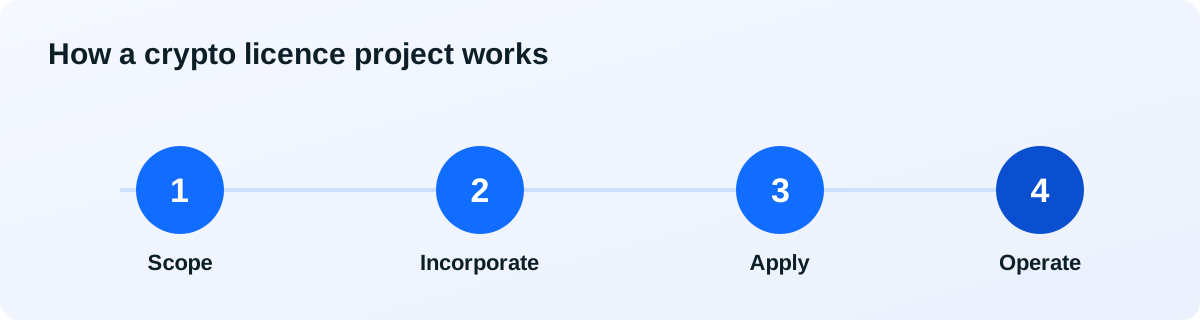
The process to obtain a crypto NFT marketplace license in South Africa involves several stages:
- Pre-application assessment: Determine the appropriate license category and prepare your business plan, including financial projections and risk management framework.
- Company registration: Register a legal entity in South Africa (e.g., private company) with the Companies and Intellectual Property Commission (CIPC). You will need a registered address and local directors.
- Compliance documentation: Draft AML/KYC policies, risk management framework, and governance structures. This must align with FICA requirements.
- Appoint key personnel: Ensure directors and compliance officers meet fit-and-proper requirements, including clean criminal records and relevant experience.
- Submit application: File the FSP application with the FSCA, including all supporting documents and fees. The FSCA may request additional information.
- Regulatory review: The FSCA assesses the application, which may take 3-6 months. They may conduct interviews or site visits.
- License issuance: Once approved, you receive the FSP license with crypto asset endorsement. You must then register with the Financial Intelligence Centre (FIC) as an accountable institution.
Consulting24 advises and coordinates each step, liaising with local partners to ensure a smooth process. We also offer support for ongoing compliance obligations.
Banking and Payment Services for Licensed Platforms
Opening a bank account for a crypto business in South Africa can be challenging due to perceived risks. However, licensed CASPs have better chances. Major banks like Standard Bank, First National Bank, and Nedbank may offer accounts to licensed entities, though they often require extensive due diligence, including proof of licensing, AML policies, and source of funds.
Alternative options include:
- Fintech payment providers: PayFast, Yoco, and Ozow offer fiat on/off ramps for local transactions.
- Digital banks: Bank Zero, TymeBank, and Discovery Bank may be more open to crypto businesses.
- International providers: Wise (formerly TransferWise) and Mercury (US-based) for multi-currency accounts.
For NFT marketplaces, integrating a payment gateway that supports both fiat and crypto is essential. Consulting24 can recommend banking partners based on your needs. In contrast, Panama offers a more straightforward banking environment for crypto businesses, with no capital controls and access to international banking.
Benefits of a South Africa Crypto License
Obtaining a South African crypto license offers several advantages:
- Regulatory clarity: The FSCA framework provides legal certainty for your operations, reducing the risk of regulatory action.
- Access to a growing market: South Africa has a large unbanked population and high crypto adoption, with over 10 million crypto users as of 2026.
- Gateway to Africa: A South African license can facilitate expansion into other African markets, such as Nigeria, Kenya, and Ghana, where regulatory frameworks are still developing.
- Cost-effective: Compared to Europe or Dubai, South Africa's licensing costs are lower, with no minimum capital requirement.
- No minimum capital: Reduces entry barriers for startups, though working capital is still needed.
However, the timeline can be longer than in some jurisdictions like Panama, where a license can be obtained faster and at a fixed cost. For a comparison with EU options, see our Lithuania and Estonia pages.
Compliance and Trust Considerations
Maintaining compliance is an ongoing obligation. License holders must:
- Submit annual financial statements and compliance reports to the FSCA.
- Conduct regular AML/CFT training for staff.
- Appoint a compliance officer and auditor.
- Report suspicious transactions to the Financial Intelligence Centre (FIC).
- Undergo periodic audits and inspections by the FSCA.
Failure to comply can result in fines, suspension, or revocation of the license. For example, in 2025, the FSCA fined several CASPs for inadequate AML controls. This is general guidance, not legal advice. Always consult with a qualified legal professional for your specific circumstances. Consulting24 can help you set up a compliance framework and provide ongoing support.
Common Mistakes to Avoid When Applying
Many applicants face delays or rejections due to common errors:
- Incomplete or inconsistent documentation: Missing signatures, outdated policies, or contradictory information.
- Underestimating the fit-and-proper requirements for directors: The FSCA checks criminal records, credit history, and relevant experience.
- Lack of a strong AML/CFT framework: Policies must be detailed and tailored to your business model.
- Not engaging a local compliance expert early: Local knowledge is critical for navigating FICA and FSCA requirements.
- Assuming the process is quick: 3 months is optimistic; many applications take 6 months or longer.
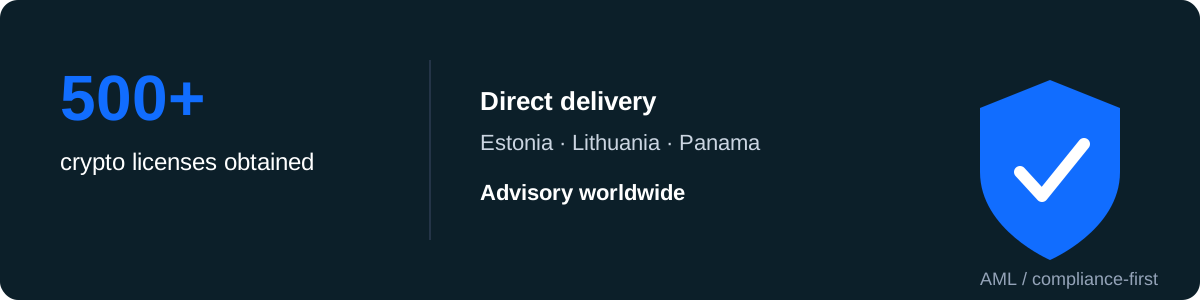
To avoid these pitfalls, work with an experienced advisor like Consulting24, who coordinates with local legal and compliance partners. We have helped over 500 clients obtain licenses globally, including in South Africa.
Alternatives: South Africa vs Panama, Lithuania, and Estonia
When choosing a jurisdiction for your crypto NFT marketplace, consider these alternatives:
| Jurisdiction | Cost (EUR) | Timeline | Capital Requirement | Tax |
|---|---|---|---|---|
| Panama | 6,000 fixed | 1-2 months | None | 0% on offshore income |
| Lithuania | ~15,000 - 25,000 | 3-6 months | EUR 125,000 (MiCA) | 15% corporate tax |
| Estonia | ~10,000 - 20,000 | 2-4 months | EUR 100,000 (MiCA) | 20% corporate tax (distributed profits) |
| South Africa | ~4,500 - 12,500 | 3-6 months | None (but working capital needed) | 27% corporate tax |
Panama offers the fastest and most cost-effective route, while South Africa provides local market access. For a broader comparison, see our jurisdictions page. Consulting24 delivers directly in Panama, Estonia, and Lithuania, and advises/coordinates for South Africa and other jurisdictions.
Frequently asked questions
What is the cost of a crypto NFT marketplace license in South Africa?
The total cost ranges from approximately ZAR 85,000 to 242,000 (EUR 4,500 - 12,500), including application fees, compliance setup, and legal fees. Exact costs depend on business complexity. Consulting24 can provide a tailored quote.
How long does it take to get a South African crypto license?
The timeline is typically 3 to 6 months from submission to approval. Delays can occur if documentation is incomplete or if the FSCA requests additional information. Engaging an experienced advisor can help expedite the process.
Is there a minimum capital requirement for a South Africa crypto license?
No statutory minimum capital is required, but the FSCA expects adequate working capital to cover 6-12 months of operations. A buffer of ZAR 1-5 million (EUR 50,000-250,000) is advisable.
Can a foreign company apply for a South Africa crypto license?
Yes, but you must register a local entity (e.g., private company) with the CIPC and appoint local directors. The FSCA will assess the fit-and-proper status of all directors and beneficial owners.
What activities are allowed under a South Africa crypto license?
The license permits operating an NFT marketplace, crypto exchange, wallet services, staking, lending (with approvals), and token issuance. Prohibited activities include unregistered securities offerings and gambling.
Does South Africa tax crypto NFT marketplace income?
Yes, corporate income tax is 27% on net profits. Capital gains tax applies at up to 21.6% for companies. VAT of 15% applies to platform fees but not to NFT sales. Consult a tax specialist for your specific case.
How does South Africa compare to Panama for crypto licensing?
Panama offers a fixed cost of EUR 6,000, a 1-2 month timeline, no capital requirement, and 0% tax on offshore income. South Africa is more expensive and slower but provides local market access. See our jurisdictions page for more.
What are the ongoing compliance obligations for a South Africa crypto license?
License holders must submit annual financial and compliance reports, conduct AML training, appoint a compliance officer, and report suspicious transactions to the FIC. Non-compliance can lead to fines or license revocation.
Can I use a South Africa license to serve clients in other African countries?
Yes, a South African license can be a stepping stone for expansion into other African markets, but you must comply with local regulations in each country. Consulting24 can advise on multi-jurisdictional strategies.
What banking options are available for licensed crypto platforms in South Africa?
Major banks like Standard Bank and Nedbank may offer accounts to licensed entities, but due diligence is extensive. Fintech providers like PayFast and Yoco are alternatives. International options include Wise and Mercury.
Official sources
Related jurisdictions

Talk to a crypto-licensing expert
500+ licenses across Estonia, Lithuania, Panama and beyond. Tell us your model and we'll map the right route, honestly.
💬 Talk to an expertFree consultationGeneral guidance, not legal advice. Rules and fees evolve, and we confirm current requirements for your case.