Panama vs Cayman Islands Crypto License: Which Is Right for Your Business?
Choosing the right jurisdiction for a crypto license is one of the most critical decisions for any crypto founder. Two popular offshore destinations are Panama and the Cayman Islands. Both offer favourable tax regimes and business environments, but they differ significantly in regulatory approach, cost, and timeline. This page provides a detailed, factual comparison of Panama vs Cayman Islands crypto licensing in 2026, helping you make an informed choice.
Panama offers a straightforward, cost-effective company setup with no specific crypto license requirement for many activities, while the Cayman Islands has a formal licensing regime under the Virtual Asset Service Provider (VASP) Act. Consulting24 advises and coordinates in both jurisdictions, with direct delivery in Panama (flat fee EUR 6,000) and advisory services for the Cayman Islands. We help you get through the nuances and select the best path for your business model.
Overview: Panama vs Cayman Islands Crypto License
In 2026, the global crypto licensing environment is more regulated than ever. Panama and the Cayman Islands represent two distinct approaches: Panama operates without a dedicated crypto license, relying on its general corporate and financial services framework, while the Cayman Islands has implemented a comprehensive VASP licensing regime since 2020, fully enforced by 2026.
For founders, the choice often comes down to cost, speed, regulatory clarity, and market access. Panama is ideal for startups and trading firms that want minimal upfront cost and fast setup. The Cayman Islands, with its higher compliance standards, suits institutional players and those seeking a regulated stamp for banking and partnerships. Consulting24 helps you evaluate both options based on your specific business model and target market.
Panama's approach is essentially a company setup with no crypto-specific license, making it one of the fastest and cheapest routes to market. The Cayman Islands, by contrast, requires a formal application process with the Cayman Islands Monetary Authority (CIMA), which can take months and costs significantly more. However, the regulatory clarity and international recognition of a Cayman license can be a major asset for raising capital and building trust.
Who Needs a Crypto License in Each Jurisdiction?
Panama: Any business offering crypto exchange, custody, or payment services can operate under a standard Panamanian corporation. There is no mandatory license, but firms must comply with anti-money laundering (AML) regulations if they handle fiat currency. This makes Panama attractive for early-stage projects, peer-to-peer platforms, and trading firms that want to avoid the regulatory overhead of a formal license.
Cayman Islands: The VASP Act requires any entity providing virtual asset services to or from the Cayman Islands to obtain a license. This includes exchanges, custodians, wallet providers, and token issuers. The regime applies to both domestic and foreign firms targeting Cayman residents. If your business model involves serving institutional clients or requires a regulated status for banking and partnerships, the Cayman Islands may be the right choice. Consulting24 can advise on whether your business model triggers licensing obligations.
For firms that are purely focused on non-custodial services, DeFi protocols, or mining, Panama may be sufficient. For those seeking a regulated framework to attract institutional capital, the Cayman Islands is more appropriate.
License Type & Regulator
Panama: There is no single crypto regulator. The Superintendencia de Bancos de Panamá (SBP) oversees banking and financial activities, and the Superintendencia del Mercado de Valores (SMV) regulates securities. Crypto businesses are treated as general commercial entities, subject to corporate and tax laws. This lack of a dedicated license is both a benefit (low cost) and a risk (regulatory uncertainty).
Cayman Islands: The Cayman Islands Monetary Authority (CIMA) is the regulator under the Virtual Asset Service Provider Act (2020, as amended). CIMA issues three license types: Type A (permission to conduct virtual asset business from within the Islands), Type B (permission to conduct business from outside the Islands), and Type C (restricted license for specific activities). Most international firms apply for Type B. CIMA is a well-respected regulator and a member of the International Organization of Securities Commissions (IOSCO).
Consulting24 can help you determine which license type applies to your business and guide you through the application process. For Panama, we focus on company setup and AML compliance, while for the Cayman Islands, we coordinate with local legal partners.
Cost & Timeline: Panama vs Cayman Islands
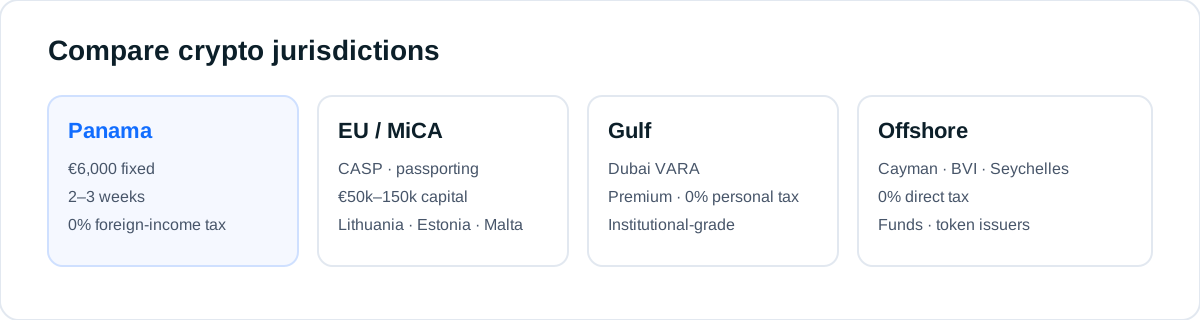
Cost is a major differentiator. Panama offers a flat EUR 6,000 company setup fee (including registered agent, corporate documentation, and initial filings). The Cayman Islands requires significantly higher investment due to licensing fees, legal costs, and compliance infrastructure. Below is a detailed comparison of typical first-year costs.
| Item | Panama (EUR) | Cayman Islands (USD) |
|---|---|---|
| Company setup fee | 6,000 (flat, all-inclusive) | 1,500 - 3,000 (incorporation only) |
| License application fee | None | 5,000 - 10,000 (non-refundable) |
| Annual license fee | None | 10,000 - 30,000 (depending on license type) |
| Legal & compliance setup | 1,000 - 2,000 (AML policy, UAF registration) | 20,000 - 50,000 (AML policy, legal opinion, etc.) |
| Bank account opening | 500 - 1,500 (if using our introduction service) | 2,000 - 5,000 (including due diligence) |
| Economic substance costs | None | 10,000 - 30,000 per year (office, staff, director) |
| Total first-year cost | 7,500 - 9,500 | 38,500 - 128,000 |
| Timeline to operation | 2 - 4 weeks | 4 - 8 months |
Exact Cayman Islands pricing depends on your business model and the complexity of your application. Consulting24 provides a detailed cost breakdown during a consultation. For Panama, the flat fee covers everything except optional bank account opening and UAF registration fees.
Capital Requirement
Panama: No minimum capital requirement for a standard corporation. You can start with USD 10,000 in authorised capital (typically USD 100 paid-up). This makes Panama extremely accessible for bootstrapped startups. There is no requirement to show capital for licensing purposes, as no license exists.
Cayman Islands: The VASP Act does not prescribe a fixed minimum capital. Instead, CIMA assesses capital adequacy on a case-by-case basis, considering the scale and risk of operations. In practice, applicants should demonstrate at least USD 100,000 - 250,000 in liquid capital to satisfy CIMA's prudential requirements. This is a major barrier for smaller firms. The capital must be held in a Cayman Islands bank account or with an approved custodian.
For firms with limited capital, Panama is clearly the more accessible option. However, if you are targeting institutional clients, the capital requirement in the Cayman Islands can be a signal of credibility.
Tax Treatment
Panama: Territorial tax system - only income sourced within Panama is taxed. Offshore income (including crypto trading profits from non-Panamanian clients) is tax-exempt. No capital gains tax, no VAT on digital services, and no withholding tax on dividends paid to non-residents. Annual corporate tax is a flat 25% on Panama-source income, but most crypto firms structure to have zero Panama-source income. Panama also does not tax foreign-source dividends or interest.
Cayman Islands: No direct taxes - no corporate income tax, capital gains tax, or withholding tax. The only government levy is the annual license fee. This zero-tax environment is a key attraction for institutional investors. However, the Cayman Islands requires economic substance: the company must have a physical office, staff, and management in the Islands, which adds cost. The Cayman Islands is also a signatory to the OECD's Common Reporting Standard (CRS) for automatic exchange of financial account information.
Both jurisdictions offer excellent tax benefits, but the substance requirements in the Cayman Islands can offset some of the tax savings. Panama's territorial system is simpler and cheaper to maintain.
Allowed Activities Under Each Regime
Panama: Virtually any crypto activity is permitted: exchange (CEX/DEX), custody, payment processing, mining, staking, DeFi protocols, and token issuance (subject to securities law if the token is deemed a security). No restrictions on operating with fiat currency, but you must register with the Financial Analysis Unit (UAF) for AML purposes if handling fiat. Panama is particularly friendly to DeFi and NFT projects.
Cayman Islands: Licensed VASPs can conduct exchange, custody, and transfer services. The VASP Act specifically excludes mining, staking, and DeFi (unless the protocol involves custody or exchange). Token issuance is regulated separately under the Securities Investment Business Act (SIBA). The Cayman Islands is more restrictive for innovative DeFi models. However, the Cayman Islands Stock Exchange (CSX) allows for token listing and trading under certain conditions.
If your business involves DeFi, mining, or staking, Panama is likely a better fit. For traditional exchange or custody services targeting institutional clients, the Cayman Islands offers a clear regulatory path.
Step-by-Step Process: Panama vs Cayman Islands
Panama (via Consulting24)
- Submit corporate documents (passport, proof of address, business plan).
- We incorporate your Panama corporation (2-3 business days).
- Open a corporate bank account (optional, 1-2 weeks).
- Register with the UAF if handling fiat (2-4 weeks).
- Begin operations immediately.
Cayman Islands (advisory only)
- Pre-application meeting with CIMA (optional but recommended).
- Prepare AML policies, business plan, financial projections, and legal opinions.
- Submit application to CIMA with non-refundable fee.
- CIMA reviews and may request additional information (3-6 months).
- If approved, pay annual license fee and maintain substance.
Consulting24 advises on both routes but only directly delivers the Panama setup. For the Cayman Islands, we coordinate with local legal partners. The entire process for Panama can be completed in under a month, while the Cayman Islands typically takes 4-8 months from start to license issuance.
Banking & Payment Processing
Panama: Panama has a well-developed banking sector with many international banks willing to work with crypto firms, provided they have proper AML compliance. Corporate bank accounts can be opened in 1-2 weeks. Some banks still have a cautious stance, but the environment is improving. Consulting24 assists with bank introductions to institutions that are crypto-friendly. Payment processing is also available through local and international providers.
Cayman Islands: Banking is more challenging. Local banks are conservative and often require the VASP license before opening an account. Many firms use international banks or payment processors. The Cayman Islands has no central bank, and the banking sector is dominated by a few large institutions. Expect a longer process (1-3 months) and higher minimum deposits (typically USD 50,000 - 100,000). Some firms opt for a multi-currency account with a fintech provider.
For startups needing quick banking access, Panama is the clear winner. For established firms that can wait, the Cayman Islands offers access to a sophisticated financial ecosystem.
Benefits of Each Jurisdiction
Panama benefits: Low cost (EUR 6,000 flat), fast setup (2-4 weeks), no dedicated crypto license, territorial tax (offshore income tax-free), no capital gains tax, no minimum capital, and a stable USD-pegged economy. Ideal for startups, trading firms, and payment processors. Panama also has a large expat community and a business-friendly legal system based on civil law.
Cayman Islands benefits: Zero direct taxes, strong regulatory reputation (CIMA is FATF-compliant), access to institutional investors and banking, legal certainty under English common law, and a well-established financial services ecosystem. Best for regulated exchanges, custodians, and funds. The Cayman Islands also has a sophisticated legal and accounting infrastructure.
Your choice should align with your business stage and target market. Consulting24 can help you weigh these benefits against your specific needs.
Compliance & Trust Considerations
Panama: While Panama has a solid AML framework, it is not a signatory to the OECD's Common Reporting Standard (CRS) for automatic tax information exchange. This can be a red flag for some partners and banks. However, for legitimate businesses with proper compliance, Panama offers a straightforward operating environment. Always implement strong AML/KYC procedures. Panama also requires registration with the UAF for any activity involving fiat currency.
Cayman Islands: CIMA is a respected regulator with high compliance standards. The Cayman Islands is a member of FATF and CRS, and licenses are recognised globally. This trust factor can open doors to banking and partnerships. However, the compliance burden is significant and ongoing. You will need a local AML officer, regular audits, and annual filings. Consulting24 recommends the Cayman Islands for firms that need a regulated status to attract institutional capital.
General guidance, not legal advice. Consult a qualified attorney for your specific situation.
Common Mistakes to Avoid
- Underestimating Cayman Islands costs: Many founders assume the application fee is the only cost, but legal, compliance, and substance requirements can push total first-year spend to USD 80,000+. Always budget for ongoing annual costs of USD 30,000 - 60,000.
- Ignoring substance in Cayman Islands: CIMA requires physical presence. A virtual office is not enough. You need a local director, office space, and staff. Failure to maintain substance can result in license revocation.
- Operating without AML in Panama: Even without a license, handling fiat requires UAF registration. Failure to comply can lead to fines or account closure. Implement AML/KYC from day one.
- Choosing based on tax alone: Both jurisdictions offer tax advantages, but the right choice depends on your business model, target market, and investor expectations. Consider the total cost of compliance and the regulatory clarity you need.
- Not consulting experts: Each jurisdiction has nuances that can trip up founders. Engaging a firm like Consulting24 can save time and money by avoiding common pitfalls.
Alternatives: Panama vs Cayman Islands vs Other Jurisdictions
Beyond Panama and the Cayman Islands, several other jurisdictions offer crypto licensing. For example, Lithuania provides a clear EU-regulated framework under MiCA, with capital requirements starting at EUR 125,000 for certain services. Estonia has a mature licensing regime with a focus on transparency and innovation. Switzerland offers a favourable regulatory environment, particularly for DeFi and blockchain projects, but with higher costs. Dubai (VARA) is a major hub for crypto with a comprehensive regulatory framework, but it requires a local presence and significant capital. Consulting24 advises on all these jurisdictions and can help you compare them against Panama and the Cayman Islands.
For founders looking for a low-cost, fast entry, Panama remains the best option. For those needing a regulated license for institutional credibility, the Cayman Islands or an EU jurisdiction may be more suitable. Consulting24's flat-fee Panama setup at EUR 6,000 is the most cost-effective way to start your crypto business.
Frequently asked questions
What is the main difference between Panama and Cayman Islands crypto licensing?
Panama does not have a dedicated crypto license; you operate under a standard corporation with AML compliance. The Cayman Islands requires a formal VASP license from CIMA. Panama is cheaper and faster (EUR 6,000, 2-4 weeks), while the Cayman Islands offers regulatory clarity and institutional trust but costs USD 40,000+ and takes 4-8 months.
Can I get a crypto license in Panama?
Panama does not issue a specific crypto license. Crypto businesses operate under a standard Panamanian corporation. You must register with the UAF for AML if handling fiat. This makes Panama a de facto unregulated environment for crypto, which is both a benefit (low cost) and a risk (regulatory uncertainty).
How much does a Panama company setup cost?
Consulting24 offers a flat fee of EUR 6,000 for a full Panama company setup, including registered agent, corporate documents, and initial filings. Additional costs may include bank account opening (EUR 500-1,500) and UAF registration (EUR 1,000-2,000). Total first-year cost is typically EUR 7,500-9,500.
What is the minimum capital for a Cayman Islands VASP license?
CIMA does not set a fixed minimum capital. In practice, applicants need to demonstrate USD 100,000-250,000 in liquid capital, depending on the scale and risk of operations. This capital must be held in a Cayman Islands bank account or with an approved custodian.
Is Panama tax-free for crypto businesses?
Panama has a territorial tax system: only income sourced within Panama is taxed. Offshore income, including crypto trading profits from non-Panamanian clients, is tax-exempt. There is no capital gains tax, no VAT on digital services, and no withholding tax on dividends. Most crypto firms structure to have zero Panama-source income.
Does the Cayman Islands require economic substance?
Yes, the Cayman Islands requires VASP license holders to have economic substance: a physical office, local staff, and management in the Islands. This adds significant ongoing costs (USD 10,000-30,000 per year). Panama has no such requirement.
Which jurisdiction is better for DeFi projects?
Panama is generally better for DeFi projects because it has no specific restrictions on DeFi, mining, or staking. The Cayman Islands VASP Act excludes these activities unless they involve custody or exchange. If your DeFi protocol involves a token that is a security, Cayman Islands may require registration under SIBA.
How long does it take to get a Cayman Islands VASP license?
The process typically takes 4-8 months from application to approval. This includes a pre-application meeting, preparation of AML policies and legal opinions, submission, and CIMA review. The timeline can vary based on the complexity of your business model and the completeness of your application.
Can Consulting24 help with Cayman Islands licensing?
Consulting24 provides advisory and coordination services for the Cayman Islands, working with local legal partners. We help you prepare the application, choose the right license type, and work through the process. However, we do not directly deliver the license; we advise and coordinate. For Panama, we handle the full company setup directly.
What are the ongoing costs for a Panama crypto company?
Ongoing costs for a Panama corporation are low: annual registered agent fee (approx. USD 300-500), government franchise tax (USD 300), and accounting/filing fees (USD 500-1,000). If you handle fiat, UAF annual renewal is around USD 500. Total annual cost is typically under USD 2,000.
Is the Cayman Islands VASP license recognized globally?
Yes, CIMA is a respected regulator and a member of FATF and IOSCO. A Cayman Islands VASP license is recognized by many international banks, exchanges, and institutional investors. This can facilitate banking relationships and partnerships. Panama, lacking a dedicated license, does not offer the same level of regulatory recognition.
Which jurisdiction is faster: Panama or Cayman Islands?
Panama is significantly faster. A Panama company can be set up in 2-4 weeks, and you can start operations immediately. The Cayman Islands VASP license takes 4-8 months. For founders who need to move quickly, Panama is the clear choice.
Official sources
Related jurisdictions

Talk to a crypto-licensing expert
500+ licenses across Estonia, Lithuania, Panama and beyond. Tell us your model and we'll map the right route, honestly.
💬 Talk to an expertFree consultationGeneral guidance, not legal advice. Rules and fees evolve, and we confirm current requirements for your case.