Crypto Staking License in Labuan (2026): Cost & Setup Staking License: Your 2026 Guide
The Labuan Financial Services Authority (LFSA) offers a dedicated licensing framework for crypto staking activities under its Digital Asset Business regime. As of 2026, this licence allows firms to legally operate staking services from Labuan, Malaysia’s international business and financial centre. With a competitive tax rate and clear regulatory expectations, the Labuan crypto staking license is an attractive option for blockchain companies seeking a well-regulated Asian hub.
Consulting24 advises and coordinates the application process for this licence. Our team works with local legal partners to ensure your submission meets LFSA requirements. Whether you are a staking pool operator, a validator node provider, or a platform offering staking-as-a-service, we help you manage the regulatory requirements efficiently. This guide covers everything you need to know about the Labuan crypto staking license, from costs and capital to step-by-step process and alternatives.
What Is the Labuan Crypto Staking License?
The Labuan crypto staking license is a regulatory authorisation issued by the LFSA under the Labuan Digital Asset Business framework. It permits companies to engage in staking activities, which involve locking cryptocurrency tokens to support blockchain network operations and earn rewards. The licence covers both proof-of-stake (PoS) validation services and delegated staking platforms.
Labuan positions itself as a mid-shore jurisdiction with a common law legal system and a tax-efficient environment. Unlike some EU member states that now apply MiCA capital tiers of EUR 50,000 to 150,000, Labuan offers a more flexible capital requirement (see below). This makes it a strong alternative for firms targeting Asian markets.
Consulting24 advises on structuring your entity to meet LFSA standards, including corporate governance, AML/CFT policies, and technology infrastructure requirements. The licence is not a separate “staking licence” but a category within the digital asset framework that explicitly covers staking. As of 2026, the LFSA confirms that staking falls under the definition of “digital asset services” in the Labuan Digital Asset Business Guidelines.
Who Needs This Licence?
The following types of businesses typically require a Labuan crypto staking license:
- Staking pool operators that aggregate user funds to validate transactions on PoS blockchains like Ethereum, Solana, or Cardano.
- Validator node providers running infrastructure to support network consensus and earn block rewards.
- Platforms offering staking-as-a-service (SaaS) to retail or institutional clients, managing delegation and reward distribution.
- DeFi protocols that facilitate staking through smart contracts, if the protocol is managed centrally or has a governance token that qualifies as a digital asset.
If your business involves holding customer crypto assets for staking, you must comply with LFSA custody rules, including segregation of client funds and regular audits. Even if you only offer non-custodial staking advice, a licence may be required if you earn fees from staking rewards or have control over private keys. Consulting24 can assess your specific business model during a consultation to determine if the Labuan crypto staking license is the right fit.
License Type and Regulator
The regulator is the Labuan Financial Services Authority (LFSA), which oversees all financial services in Labuan, including digital asset businesses. The licence type is a Labuan Digital Asset Business Licence with a scope limited to staking services. This is not a separate “staking licence” but a category within the digital asset framework that explicitly covers staking.
The LFSA requires all digital asset businesses to be incorporated as a Labuan entity (e.g., Labuan company) and to have a physical office in Labuan. The regulator focuses on investor protection, anti-money laundering (AML), and cybersecurity. As of 2026, the LFSA has not introduced a separate “staking licence” but confirms that staking falls under the definition of “digital asset services” in the Labuan Digital Asset Business Guidelines. The LFSA also requires that key personnel, such as directors and compliance officers, be fit and proper, with relevant experience in financial services or blockchain technology.
Cost and Timeline
| Item | Estimated Cost (EUR) | Notes |
|---|---|---|
| Company incorporation (Labuan entity) | 2,000 - 4,000 | Includes registration fees, name reservation, and initial filing with the Labuan Companies Commission. |
| Licence application fee | 3,000 - 6,000 | Non-refundable; paid to LFSA upon submission. |
| Legal and compliance setup | 5,000 - 10,000 | Drafting AML/CFT policies, risk assessment, compliance manual, and corporate governance documents. |
| Annual licence renewal | 2,000 - 4,000 | Subject to LFSA annual fee schedule; includes regulatory oversight. |
| Total initial outlay (approx.) | 10,000 - 20,000 | Excludes capital deposit (MYR 500,000) and professional fees for local director or office rental. |
Timeline: 4 to 8 months from incorporation to licence approval, assuming complete documentation and no regulatory queries. The process includes company incorporation (2-4 weeks), document preparation (4-6 weeks), bank account opening (2-4 weeks), and LFSA review (8-16 weeks). Consulting24 coordinates the entire process, liaising with LFSA and local legal partners. Exact pricing is confirmed in a consultation, as costs may vary based on business complexity.
Capital Requirement
The LFSA mandates a minimum paid-up capital of MYR 500,000 (approximately EUR 100,000) for digital asset businesses. This capital must be maintained in a Labuan bank account and can be in MYR or a major foreign currency (e.g., USD, EUR). The capital serves as a financial buffer and demonstrates operational substance to the regulator.
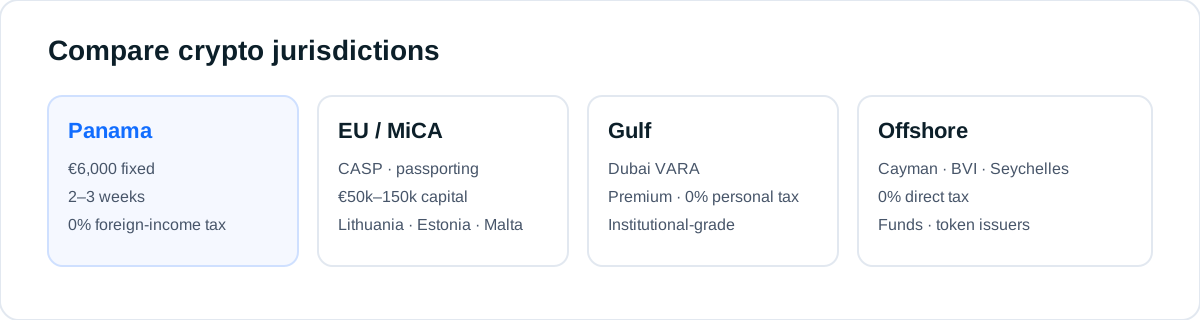
Compared to EU MiCA tiers (EUR 50,000 for custodian wallet services, EUR 125,000 for exchange and staking, EUR 150,000 for trading platforms), Labuan’s requirement is in the mid-range. However, Labuan does not impose additional capital for specific staking volumes or client asset thresholds. The capital must be fully paid up before licence issuance and cannot be withdrawn without LFSA approval. Consulting24 advises on capital structuring and bank account setup to ensure compliance with LFSA rules.
Tax Treatment
Labuan offers a favourable tax regime: the standard corporate tax rate is 3% of net audited profits for trading activities, or a flat annual fee of MYR 20,000 (approx. EUR 4,000) for non-trading entities. Digital asset businesses are generally treated as trading activities, so the 3% rate applies. There is no capital gains tax, no withholding tax on dividends, and no GST/VAT.
This tax efficiency makes Labuan attractive for staking operations where profit margins may be thin. For example, if your staking business earns EUR 500,000 in net profits, the tax would be only EUR 15,000, compared to 15-20% in many EU jurisdictions. However, you must ensure your global tax compliance (e.g., OECD CRS, FATCA). Consulting24 can recommend tax advisors familiar with Labuan regulations and double tax treaties.
Allowed Activities
The Labuan crypto staking license permits the following activities:
- Operating staking pools for proof-of-stake blockchains (e.g., Ethereum, Solana, Cardano, Polkadot).
- Running validator nodes and earning block rewards.
- Offering staking-as-a-service to third parties, including reward distribution and reporting.
- Managing staking rewards distribution to clients, including automatic compounding.
- Providing non-custodial staking infrastructure (if no control over private keys).
Activities not permitted without additional licensing: exchange trading (buying/selling crypto against fiat or other crypto), custody of fiat currencies, and issuing securities. If your business also involves a crypto exchange, you may need a separate exchange license. Consulting24 can advise on scope limitations and whether your business model requires multiple licences.
Step-by-Step Process
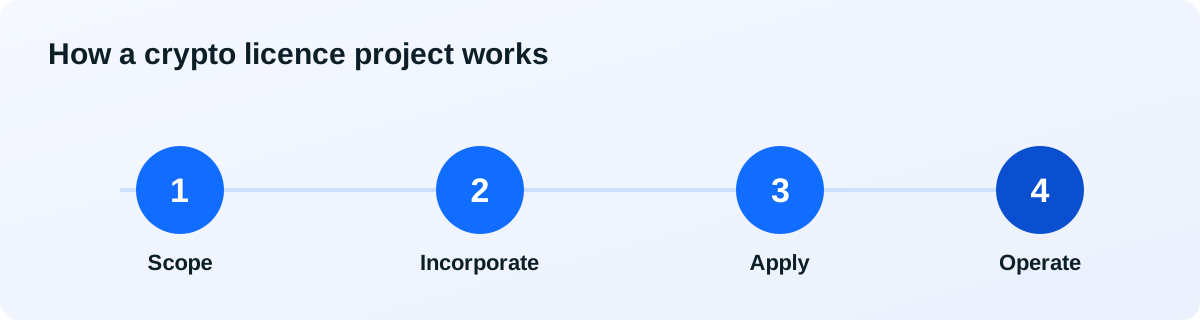
- Incorporate a Labuan company - Register a Labuan entity with a local registered address and director. Consulting24 assists with company setup.
- Prepare documentation - Draft business plan, AML/CFT policies, risk assessment, and compliance manual. These must be tailored to staking operations.
- Open a Labuan bank account - Deposit the minimum capital (MYR 500,000) and maintain it. Bank account opening can take 2-4 weeks.
- Submit licence application - File with LFSA including all supporting documents and fees. The application must include details of directors, shareholders, and beneficial owners.
- Regulatory review - LFSA conducts due diligence on directors, shareholders, and beneficial owners. This includes background checks and financial standing.
- Interview (if required) - LFSA may request a meeting with key personnel to discuss the business model and compliance framework.
- Approval and issuance - Licence granted; annual renewal required. The licence is valid for one year and must be renewed annually.
Consulting24 coordinates each step, from company setup to licence submission. We also assist with ongoing compliance and renewal.
Banking and Payments
Opening a corporate bank account in Labuan is a prerequisite for the licence. Major banks in Labuan (e.g., Maybank, CIMB, HSBC) accept digital asset businesses, but they conduct enhanced due diligence. You will need to provide the licence application proof, source of funds, and a clear business model.
Some banks may require a minimum deposit of MYR 100,000 (approx. EUR 20,000) beyond the capital. The account must be used for operational purposes, including receiving staking rewards and paying expenses. For payment processing, consider integrating with crypto-friendly payment gateways for fiat on/off ramps, such as MoonPay or Banxa. Consulting24 has relationships with local banks and can facilitate introductions. However, bank account opening is subject to the bank's own compliance policies and may take longer for crypto businesses.
Benefits of the Labuan Staking License
- Low tax rate - 3% on profits, no capital gains tax, no VAT/GST.
- Common law jurisdiction - Legal certainty for contracts and disputes, with a well-established court system.
- Strategic location - Time zone bridging Asia and Europe (UTC+8), ideal for serving clients in both regions.
- Regulatory clarity - LFSA has explicit guidelines for digital assets, including staking, reducing uncertainty.
- No VAT/GST - Reduced operational overhead compared to jurisdictions with consumption taxes.
Compared to EU licences under MiCA, Labuan offers faster processing (4-8 months vs 6-12 months) and lower ongoing compliance costs. However, it may not be suitable for firms targeting EU customers due to MiCA passporting requirements. Consulting24 can help you compare with other jurisdictions to find the best fit.
Compliance and Trust
Maintaining the licence requires ongoing compliance: annual AML training for staff, independent audit of financial statements, and submission of annual returns to LFSA. The regulator conducts periodic inspections and may request additional information on client transactions or staking operations.
Consulting24 provides compliance support, including policy updates and regulatory filings. We emphasise that this is general guidance, not legal advice. You should engage local legal counsel for binding opinions. Our role is to coordinate the process and ensure your application is complete. Failure to comply can result in fines, suspension, or licence revocation. As of 2026, the LFSA has increased scrutiny on beneficial ownership and source of funds, so maintaining proper records is critical.
Common Mistakes
- Insufficient capital - Not maintaining the MYR 500,000 minimum throughout the licence period. The capital must be fully paid up and cannot be used for operational expenses without LFSA approval.
- Poor AML documentation - Generic policies that do not reflect your specific staking operations. For example, failing to address how you monitor staking rewards for suspicious activity.
- Ignoring beneficial ownership rules - LFSA requires disclosure of all ultimate beneficial owners, including those holding shares through trusts or nominees.
- Delaying bank account opening - Without a local bank account, the licence cannot be issued. Start the bank account process early, as it can take 4-8 weeks.
- Overlooking substance requirements - A physical office and local director (or compliance officer) are mandatory. Virtual offices are not accepted.
Consulting24 helps you avoid these pitfalls by providing a checklist and regular progress reviews.
Alternatives and Comparisons
If Labuan does not fit your strategy, consider these alternatives:
- Panama - Flat fee EUR 6,000 for a crypto licence, no minimum capital, but limited regulatory clarity for staking. Best for cost-sensitive startups. Consulting24 delivers directly in Panama.
- Lithuania - Under MiCA, capital of EUR 125,000 for staking services, tax 15%, EU passporting. Consulting24 delivers directly in Lithuania. See our comparison with Lithuania.
- Estonia - MiCA-compliant licence, capital EUR 125,000, tax 20% on distributed profits. Consulting24 delivers directly in Estonia. Learn more on our Estonia crypto license page.
Each jurisdiction has trade-offs. Labuan offers low tax and Asian market access; EU licences provide passporting but higher capital. Consulting24 advises on the best fit for your business model. For a full comparison, visit our jurisdictions page.
Why Choose Consulting24?
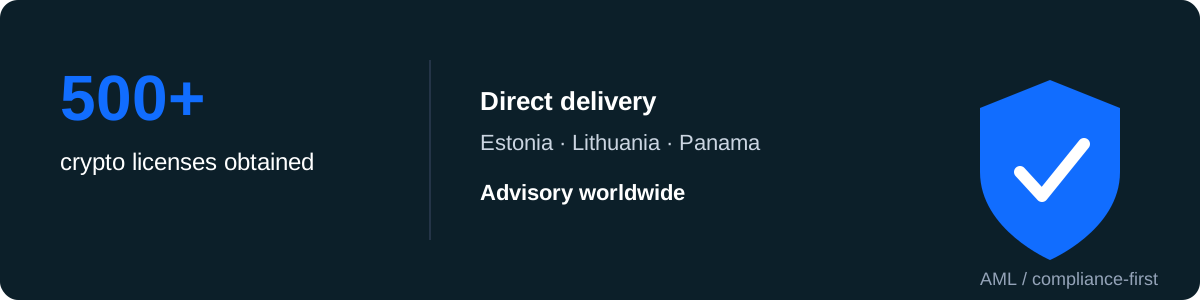
Consulting24 has obtained 500+ crypto licences across multiple jurisdictions. For Labuan, we advise and coordinate with local partners, ensuring your application meets LFSA standards. We do not guarantee approval, but our track record demonstrates a high success rate. Our services include company incorporation, document preparation, bank account introductions, and ongoing compliance support.
We also offer direct delivery for Lithuania, Estonia, and Panama. For other jurisdictions, we advise and coordinate. Contact us today to discuss your project.
Frequently asked questions
What is the Labuan crypto staking license?
It is a regulatory authorisation from the LFSA under the Digital Asset Business framework, allowing companies to offer staking services such as operating staking pools, running validator nodes, or providing staking-as-a-service.
Who needs a Labuan crypto staking license?
Any business that offers staking services to clients, including staking pool operators, validator node providers, and staking-as-a-service platforms, must hold this licence if they operate from Labuan or serve Labuan clients.
What is the minimum capital requirement for the Labuan staking license?
The LFSA requires a minimum paid-up capital of MYR 500,000 (approximately EUR 100,000), which must be maintained in a Labuan bank account throughout the licence period.
How long does it take to get the Labuan crypto staking license?
The process typically takes 4 to 8 months from company incorporation to licence approval, depending on documentation completeness and LFSA review times.
What is the tax rate for Labuan staking businesses?
Labuan offers a 3% tax on net audited profits for trading activities, with no capital gains tax, no withholding tax on dividends, and no VAT/GST.
Can I use the Labuan license to serve EU customers?
The Labuan license does not provide EU passporting under MiCA. To serve EU customers, you would need a separate MiCA-compliant license in an EU member state, such as Lithuania or Estonia.
What activities are not allowed under the Labuan staking license?
Activities such as exchange trading, custody of fiat currencies, and issuing securities are not permitted without additional licensing. The license is limited to staking-related services.
Does Consulting24 guarantee approval of the Labuan license?
No, we do not guarantee approval. We advise and coordinate the application process with local partners to maximise your chances, but the final decision rests with the LFSA.
What are the common mistakes in applying for the Labuan staking license?
Common mistakes include insufficient capital, poor AML documentation, ignoring beneficial ownership rules, delaying bank account opening, and overlooking substance requirements like a physical office.
How does the Labuan staking license compare to Panama?
Panama offers a flat fee of EUR 6,000 with no minimum capital, but less regulatory clarity for staking. Labuan has a higher capital requirement (EUR 100,000) but offers a clear regulatory framework and low tax (3%).
What ongoing compliance is required for the Labuan staking license?
Ongoing compliance includes annual AML training, independent audits, submission of financial statements, and licence renewal. The LFSA may conduct periodic inspections.
Can Consulting24 help with bank account opening in Labuan?
Yes, we can facilitate introductions to local banks and assist with the documentation required for account opening, though the final decision is at the bank's discretion.
Primary sources
This guide reflects 2026 rules. Verify current requirements with the official regulator:
Related jurisdictions

Talk to a crypto-licensing expert
500+ licenses across Estonia, Lithuania, Panama and beyond. Tell us your model and we'll map the right route, honestly.
💬 Talk to an expertFree consultationGeneral guidance, not legal advice. Rules and fees evolve, and we confirm current requirements for your case.