Estonia vs Czech Republic Crypto License: 2026 Comparison
Choosing the right jurisdiction for your crypto license is a critical decision for any founder. In 2026, Estonia and the Czech Republic offer two distinct paths under MiCA and local regimes. This page provides a detailed, factual comparison of Estonia vs Czech Republic crypto license options, covering regulator, capital requirements, tax treatment, timeline, and allowed activities. Whether you are launching a crypto exchange, wallet, or custody service, understanding these differences will help you make an informed choice.
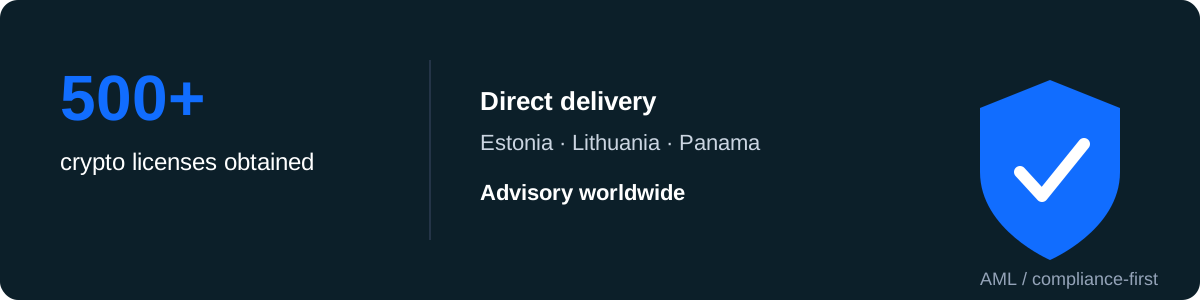
Consulting24 advises and coordinates crypto licensing in both Estonia and the Czech Republic, as well as delivering directly in Panama, Estonia, and Lithuania. Our team has secured over 500 licenses across multiple jurisdictions. We present the current 2026 facts to guide you.
This comparison is based on the fully implemented MiCA regulation, which replaced earlier national regimes. Estonia moved from a simple registration system (no minimum capital) to a full CASP license with capital tiers. The Czech Republic similarly upgraded its trade license system to MiCA compliance. Both are now aligned with EU standards, but local nuances in tax, timeline, and regulatory practice remain. We break down every factor so you can decide with confidence.
What Is the Estonia vs Czech Republic Crypto License Comparison?
This comparison examines two European crypto licensing frameworks: Estonia's MiCA-compliant CASP license and the Czech Republic's MiCA-compliant CASP license. Both are fully in force as of 2026, replacing earlier regimes. Estonia previously operated a simple registration system (no minimum capital), but now enforces MiCA tiers. The Czech Republic similarly transitioned from a trade license system to MiCA. Key differences lie in capital requirements, tax treatment, timeline, and regulatory approach.
Founders often compare these two because both are EU member states with relatively efficient processes. However, the costs, capital thresholds, and ongoing obligations vary. This page breaks down each factor so you can decide which fits your business model.
For example, a startup planning to reinvest all profits for three years might prefer Estonia's 0% tax on retained earnings, while a company expecting steady dividend distributions might choose the Czech Republic's flat 19% rate. Similarly, a firm needing fast market entry may lean toward Estonia's 3-6 month timeline, while one with a more complex service mix might accept the Czech Republic's 4-8 month process for lower professional fees. Consulting24 helps you model these scenarios.
Who Needs a Crypto License in Estonia or the Czech Republic?
Any entity providing crypto-asset services to EU residents must hold a CASP license under MiCA. This includes exchanges, wallet providers, custodians, and brokers. Both Estonia and the Czech Republic require licensing for the same MiCA-defined services. If you plan to offer services in multiple EU countries, a license from either jurisdiction grants passporting rights across the EU.
Startups and established firms alike need a license. The choice between Estonia and the Czech Republic often depends on capital availability, tax preferences, and timeline. Consulting24 advises clients on which jurisdiction aligns with their specific activities and budget.
For instance, a crypto exchange offering custody and trading platform services (Class 3) needs EUR 150,000 capital in both countries. A wallet provider (Class 1) needs only EUR 50,000. If your capital is tight, the Czech Republic's lower professional fees might make it more accessible. Conversely, if you have sufficient capital and want to minimize tax, Estonia is compelling. Consulting24 conducts a full needs analysis before recommending a jurisdiction.
License Type and Regulator
Estonia: The regulator is the Financial Supervision Authority (Finantsinspektsioon). License type: Crypto-Asset Service Provider (CASP) under MiCA. The application is submitted via the Estonian Commercial Register and Finantsinspektsioon.
Czech Republic: The regulator is the Czech National Bank (Česká národní banka, ČNB). License type: CASP under MiCA. The application is submitted directly to the ČNB.
Both regulators are competent authorities under MiCA. The Czech National Bank is known for a thorough but predictable process. Finantsinspektsioon in Estonia has a similar reputation. Neither is overly burdensome compared to larger EU regulators.
In practice, the ČNB often requests a management interview to assess fitness and propriety. Finantsinspektsioon relies more on written documentation. Both require a local AML officer and registered office. Consulting24 prepares all documentation to meet each regulator's expectations, reducing the risk of delays or rejections.
Cost and Timeline
The cost and timeline for obtaining a crypto license vary between the two jurisdictions. Below is a comparison based on 2026 data. Exact figures depend on your specific service types and application complexity. Consulting24 provides precise quotes during consultation.
| Factor | Estonia | Czech Republic |
|---|---|---|
| Application fee | EUR 3,000 - 5,000 (state fee) | Approx. EUR 2,000 - 4,000 (administrative fee) |
| Professional fees (legal, compliance) | EUR 15,000 - 25,000 | EUR 12,000 - 20,000 |
| Total estimated cost | EUR 18,000 - 30,000 | EUR 14,000 - 24,000 |
| Timeline (typical) | 3 - 6 months | 4 - 8 months |
| Ongoing annual costs | EUR 5,000 - 10,000 (compliance, audit) | EUR 4,000 - 8,000 |
Timelines are estimates and may vary. Estonia's digital infrastructure often speeds up company registration. The Czech Republic's process is also efficient but may require more documentation upfront.
For example, a simple exchange (Class 2) in Estonia might cost EUR 20,000 in total and take 4 months. The same entity in the Czech Republic might cost EUR 16,000 and take 6 months. These are typical ranges; Consulting24 can expedite with proper preparation. Ongoing costs include annual audit (EUR 2,000-5,000), AML officer salary (part-time, EUR 500-1,500/month), and regulatory filing fees.
Capital Requirement
Under MiCA, capital requirements are tiered by service class. Both Estonia and the Czech Republic apply the same MiCA tiers:
- Class 1 (e.g., reception and transmission of orders): EUR 50,000
- Class 2 (e.g., execution of orders, portfolio management): EUR 125,000
- Class 3 (e.g., custody and administration, operating a trading platform): EUR 150,000
These are minimum own funds. If your business model includes multiple service classes, the highest applicable tier applies. Estonia and the Czech Republic do not impose additional local capital requirements beyond MiCA. However, both regulators may require higher capital if your business volume exceeds certain thresholds. Consulting24 can model your capital needs based on your planned services.
For instance, a company offering both custody (Class 3) and order execution (Class 2) must hold EUR 150,000. If you also provide investment advice (Class 1), the requirement remains EUR 150,000. Capital must be held in liquid assets (cash or equivalents) and cannot be borrowed. Consulting24 helps structure your capital plan to meet regulatory scrutiny.
Tax Treatment
Estonia: Corporate income tax is 0% on retained and reinvested profits. Only distributed profits (dividends) are taxed at 20% (or 14% for regular dividends). This makes Estonia attractive for crypto companies that plan to reinvest earnings. VAT: Crypto-to-fiat transactions are generally exempt from VAT. Crypto-to-crypto transactions may be subject to VAT depending on the nature (e.g., mining vs. trading).
Czech Republic: Corporate income tax is a flat 19% on profits. No special tax regime for crypto companies. VAT: Crypto transactions are exempt from VAT under EU law. However, the Czech Republic applies standard VAT rules for ancillary services. Personal income tax for founders may be relevant if you are a sole trader.
Estonia's deferred tax system can be a significant advantage for growth-stage companies. The Czech Republic offers a straightforward, lower headline rate but immediate taxation on profits.
Consider a company earning EUR 500,000 profit annually. In Estonia, if all profits are reinvested, tax is EUR 0. In the Czech Republic, tax is EUR 95,000 (19%). Over three years, Estonia saves EUR 285,000 in tax, which can fund expansion. However, when dividends are eventually paid, Estonia's effective rate is 20% (or 14% for regular dividends), while the Czech Republic's rate on distributed profits remains 19%. Consulting24 can run tax projections for your specific business model.
Allowed Activities
Both jurisdictions license the full range of MiCA crypto-asset services. Under MiCA, the allowed activities include:
- Custody and administration of crypto-assets
- Operation of a trading platform
- Exchange of crypto-assets for fiat currency
- Exchange of crypto-assets for other crypto-assets
- Execution of orders on behalf of clients
- Placing of crypto-assets
- Reception and transmission of orders
- Portfolio management
- Investment advice
Estonia and the Czech Republic do not restrict any of these activities beyond MiCA. However, certain stablecoin services may require additional authorization under the EU's Markets in Crypto-Assets (MiCA) regulation, which is fully in force. Both regulators treat stablecoins as e-money tokens or asset-referenced tokens, subject to separate rules.
For example, if you plan to issue a stablecoin, you may need an e-money license or a separate authorization under MiCA's Title III or IV. Consulting24 can advise on the full scope of activities and any ancillary licenses needed.
Step-by-Step Application Process
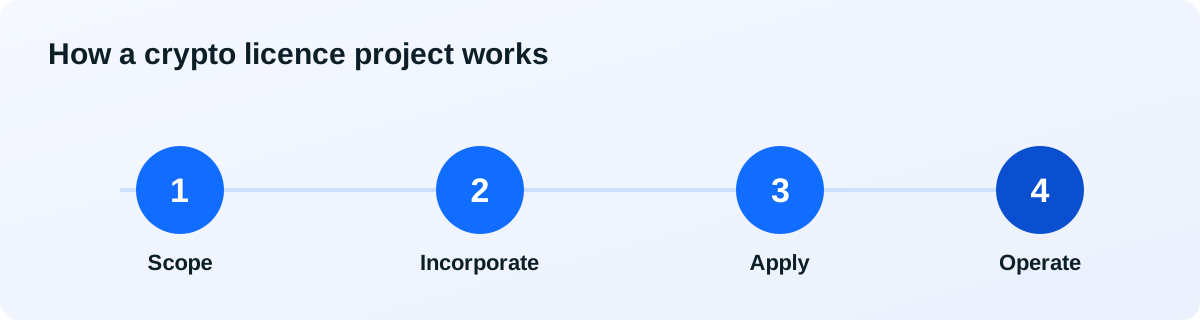
The process for obtaining a crypto license in Estonia or the Czech Republic follows similar steps, with local variations.
Estonia
- Incorporate a company in Estonia (e-residency available).
- Prepare a detailed business plan, AML/KYC policies, risk assessment, and internal procedures.
- Submit application to Finantsinspektsioon via the Commercial Register.
- Regulator reviews (3-6 months). May request additional information.
- Upon approval, license issued. Ongoing reporting obligations.
Czech Republic
- Incorporate a company in the Czech Republic (standard or s.r.o.).
- Prepare compliance documentation including AML program, business plan, and risk management.
- Submit application to the Czech National Bank.
- ČNB reviews (4-8 months). Interview with management may be required.
- License granted. Submit periodic reports.
Consulting24 advises and coordinates each step, from company formation to regulatory submission. For Estonia, we help with e-residency setup if you are not an EU resident. For the Czech Republic, we assist with local company registration and bank account opening. Our team ensures documentation meets regulatory standards, reducing the risk of rejection.
Banking and Payment Services
Access to banking is a common challenge for crypto companies. In Estonia, several traditional banks (e.g., LHV, Swedbank) and specialized fintechs offer accounts to licensed CASPs. However, banks may still conduct enhanced due diligence. Estonia's e-residency program facilitates remote banking setup.
In the Czech Republic, banks like Česká spořitelna, ČSOB, and Moneta Money Bank accept licensed crypto firms. The Czech National Bank has issued guidance encouraging banks to serve licensed entities, reducing de-risking risks. Payment services (fiat on/off ramps) are available via local payment institutions.
Both jurisdictions have a growing ecosystem of crypto-friendly banking partners. Consulting24 can introduce you to vetted banking contacts. For example, in Estonia, LHV Bank has a dedicated crypto team. In the Czech Republic, Moneta Money Bank offers accounts with integrated payment processing. We also advise on payment service provider (PSP) integration for fiat on/off ramps.
Benefits of Each Jurisdiction
Estonia: Zero tax on retained profits; e-residency for remote management; fast company registration; digital-first government; strong fintech ecosystem; passporting rights under MiCA.
Czech Republic: Stable regulatory environment; lower professional fees; central location in Europe; pragmatic regulator; no language barrier for English speakers; established banking relationships.
Your choice depends on whether you prioritize tax efficiency (Estonia) or lower upfront costs and a straightforward tax system (Czech Republic). Both offer EU passporting.
For a high-growth startup with plans to reinvest heavily, Estonia's tax deferral can be a major advantage. For a company with a lean budget and immediate profit distribution, the Czech Republic may be more cost-effective. Consulting24 can provide a side-by-side cost-benefit analysis for your specific business.
Compliance and Ongoing Obligations
Both jurisdictions require ongoing compliance under MiCA, including:
- Annual financial audits
- AML/CFT reporting to the Financial Intelligence Unit
- Capital adequacy maintenance
- Transaction monitoring and suspicious activity reporting
- Periodic regulatory filings (e.g., quarterly or annual)
Estonia requires a local AML officer and a physical address (can be virtual office). The Czech Republic also requires a local compliance officer and registered office. Non-compliance can lead to fines or license revocation. Consulting24 provides ongoing compliance support for clients in both jurisdictions.
General guidance, not legal advice. Always consult with qualified legal counsel for your specific situation.
For example, in Estonia, you must file an annual report with the Commercial Register and submit AML reports to the Financial Intelligence Unit. In the Czech Republic, you must submit quarterly data on transactions and client assets to the ČNB. Consulting24 offers a compliance package that covers these obligations, including transaction monitoring software integration and staff training.
Common Mistakes to Avoid
Founders often make these errors when choosing between Estonia and the Czech Republic:
- Ignoring capital requirements: Underestimating the needed own funds for your service class can delay approval.
- Overlooking tax implications: Estonia's 0% tax on retained profits is attractive, but if you plan to distribute dividends, the effective tax rate is 20%.
- Rushing the application: Incomplete documentation is the top reason for rejection. Both regulators expect a thorough AML program.
- Choosing based on cost alone: The Czech Republic may be cheaper upfront, but Estonia's tax deferral can save significant money over time.
- Ignoring banking access: Ensure you have a bank account lined up before applying. Some banks refuse crypto clients even with a license.
Consulting24 helps you avoid these pitfalls with a structured approach. We conduct a pre-application audit to identify gaps, prepare a comprehensive AML manual, and assist with bank introductions. Our success rate across 500+ licenses is a reflection of our methodology.
Alternatives and Comparison with Other Jurisdictions
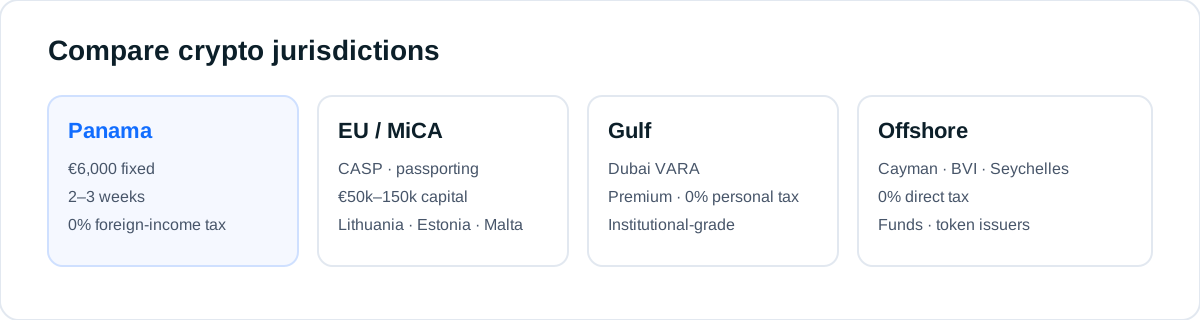
Beyond Estonia and the Czech Republic, founders often consider Panama, Lithuania, or Malta. Panama offers a flat EUR 6,000 fee with no minimum capital and no tax on foreign-source income, but it is a non-EU jurisdiction without passporting. Lithuania, like Estonia, is a Baltic state with a MiCA-compliant CASP license, but its tax rate is 15% on profits (with no deferral). Malta has a 5% effective tax rate through a refund system, but its licensing process is more complex and costly.
For EU-focused businesses, Estonia and the Czech Republic are strong contenders. For global operations, Panama's simplicity and low cost are appealing. Consulting24 delivers directly in Panama, Estonia, and Lithuania, and advises on all others. We help you compare the full environment to find the best fit.
For example, a US-based founder targeting EU customers might choose Estonia for tax deferral. A founder serving Latin American clients might prefer Panama for its territorial tax system. Consulting24 provides a comprehensive jurisdictions comparison to inform your decision.
Why Choose Consulting24 for Your Crypto License
Consulting24 has secured over 500 crypto licenses across multiple jurisdictions. We deliver directly in Estonia, Lithuania, and Panama, and advise on all others, including the Czech Republic. Our team of legal and compliance experts understands the nuances of each regulator. We provide end-to-end support: jurisdiction selection, company formation, documentation, application submission, and ongoing compliance.
Our clients appreciate our transparent pricing, realistic timelines, and hands-on approach. We do not make promises we cannot keep. Instead, we guide you through the process with clear milestones and regular updates. Contact us to discuss your project and receive a tailored proposal.
Frequently asked questions
What is the main difference between Estonia and Czech Republic crypto licenses?
The main difference is tax treatment. Estonia taxes only distributed profits (0% on retained), while the Czech Republic taxes all profits at 19%. Capital requirements under MiCA are identical. Estonia's process is slightly faster (3-6 months) and costs a bit more upfront, but tax savings can outweigh the initial cost for reinvesting companies.
Can I use e-residency to apply for an Estonian crypto license?
Yes, Estonia's e-residency program allows non-EU residents to establish a company and apply for a CASP license remotely. However, you must still appoint a local AML officer and maintain a physical address (virtual office is acceptable). Consulting24 can assist with e-residency setup and local representation.
What are the capital requirements for a crypto exchange in Estonia vs Czech Republic?
Under MiCA, a crypto exchange operating a trading platform (Class 3) requires EUR 150,000 minimum own funds in both jurisdictions. If the exchange also offers custody, the same tier applies. Lower service classes (e.g., order execution only) require EUR 125,000. The capital must be held in liquid assets and cannot be borrowed.
How long does it take to get a crypto license in Estonia and the Czech Republic?
Estonia typically takes 3-6 months from application submission. The Czech Republic takes 4-8 months. Timelines depend on application completeness and regulator workload. Consulting24 helps prepare a thorough application to minimize delays. Company registration adds 1-2 weeks in Estonia (via e-residency) and 2-4 weeks in the Czech Republic.
Do I need to be physically present in Estonia or the Czech Republic to apply?
For Estonia, you can apply remotely using e-residency, but you need a local AML officer and registered address. For the Czech Republic, you must have a local registered office and compliance officer; physical presence is not mandatory but recommended for the management interview. Consulting24 can provide local representation services.
What ongoing compliance is required after obtaining the license?
Both jurisdictions require annual audits, AML/CFT reporting, capital maintenance, transaction monitoring, and periodic regulatory filings. Estonia requires quarterly AML reports; the Czech Republic requires quarterly data submissions. Consulting24 offers ongoing compliance packages to handle these obligations.
Can I passport my license to other EU countries?
Yes, both Estonia and the Czech Republic are EU member states. A CASP license from either jurisdiction allows you to provide services across the EU under MiCA passporting rights. You must notify your home regulator and comply with host state requirements, but no additional license is needed.
Which jurisdiction is better for a startup with limited capital?
The Czech Republic may be better due to lower professional fees (EUR 12,000-20,000 vs EUR 15,000-25,000). However, capital requirements are the same. If you plan to reinvest profits, Estonia's tax deferral can offset the higher upfront cost over time. Consulting24 can model both scenarios for your budget.
Are there any restrictions on crypto-to-crypto transactions in either country?
No, both jurisdictions allow crypto-to-crypto exchange as a licensed activity under MiCA. VAT treatment may differ: Estonia may apply VAT to crypto-to-crypto transactions in certain cases (e.g., mining rewards), while the Czech Republic generally exempts them. Consulting24 can clarify your specific activity's tax treatment.
What happens if my application is rejected?
Rejection is rare with proper preparation. Common reasons include incomplete AML documentation, insufficient capital, or unfit management. If rejected, you can appeal or reapply after addressing deficiencies. Consulting24's pre-application audit minimizes rejection risk. We have a strong success record across the applications we prepare.
Can Consulting24 help with banking for my crypto company?
Yes, we provide introductions to crypto-friendly banks in both Estonia and the Czech Republic. We also advise on payment service providers for fiat on/off ramps. Our network includes LHV Bank (Estonia), Moneta Money Bank (Czech Republic), and specialized fintechs. Banking setup is part of our full-service package.
How does Panama compare to Estonia and the Czech Republic?
Panama offers a flat EUR 6,000 fee, no minimum capital, and no tax on foreign-source income, but it is a non-EU jurisdiction without passporting. Estonia and the Czech Republic provide EU market access with higher costs and capital requirements. For global operations, Panama is cost-effective; for EU-focused business, Estonia or the Czech Republic are better.
Official sources
Related jurisdictions

Talk to a crypto-licensing expert
500+ licenses across Estonia, Lithuania, Panama and beyond. Tell us your model and we'll map the right route, honestly.
💬 Talk to an expertFree consultationGeneral guidance, not legal advice. Rules and fees evolve, and we confirm current requirements for your case.