Dubai vs Cyprus Crypto License: Which Jurisdiction Fits Your Business?
Choosing between a Dubai vs Cyprus crypto license is a critical decision for any crypto founder. Both jurisdictions offer regulated pathways, but they differ significantly in cost, capital requirements, tax treatment, and operational scope. In 2026, with MiCA fully in force across the EU, Cyprus has adapted its regime to align with European standards, while Dubai (through VARA) maintains its own bespoke framework. This page provides a detailed, factual comparison to help you decide where to base your crypto business.
Consulting24 covers Dubai for comparison only - we do not file VARA applications and deliver licenses directly in Panama, Estonia, and Lithuania. For Dubai and Cyprus, we offer expert guidance to help you manage the regulatory requirements and choose the right route for your business model. Contact us for a personalised consultation.
What Is a Crypto License and Why Compare Dubai vs Cyprus?
A crypto license is a regulatory authorisation that allows a company to legally operate cryptocurrency services such as exchange, custody, wallet provision, or trading. In 2026, both Dubai and Cyprus have established clear frameworks for virtual asset service providers (VASPs). The choice between them depends on factors like target market, budget, tax strategy, and operational flexibility.
Dubai, regulated by the Virtual Assets Regulatory Authority (VARA), offers a progressive regime with a 0% corporate tax in free zones. Cyprus, as an EU member state, provides a MiCA-compliant license that grants passporting rights across the European Economic Area. This comparison covers all key aspects: cost, capital, timeline, allowed activities, and tax implications.
For founders targeting a global audience, understanding the nuances of each regime is essential. Dubai's regime is relatively new and evolving, while Cyprus benefits from the harmonised EU framework under MiCA. Both require a strong compliance infrastructure, but the operational demands differ. For example, Dubai mandates a physical office in a free zone, while Cyprus requires a local director and substance. These differences affect not only cost but also the day-to-day management of your business.
Who Needs a Crypto License in Dubai or Cyprus?
Any business offering virtual asset services to residents or clients in either jurisdiction must obtain the appropriate license. Typical applicants include:
- Cryptocurrency exchanges (centralised and decentralised)
- Digital wallet providers
- Custodians and asset managers
- OTC trading desks
- DeFi platforms (depending on structure)
- Payment service providers involving crypto
If your target market is the Middle East, Asia, or Africa, Dubai may be more strategic. If you need access to the EU single market, Cyprus is the logical choice. Many founders also consider a multi-jurisdictional approach, using a Dubai entity for non-EU clients and a Cyprus entity for EU clients. Consulting24 can help you structure such arrangements.
It is also important to consider the nature of your activities. For example, a simple exchange may find Cyprus more cost-effective, while a high-frequency trading platform might prefer Dubai's lighter capital requirements. We recommend a detailed assessment of your business model before deciding.
License Type and Regulator
| Jurisdiction | Regulator | License Type |
|---|---|---|
| Dubai (UAE) | Virtual Assets Regulatory Authority (VARA) | VASP License (multiple categories: exchange, custody, advisory, etc.) |
| Cyprus | Cyprus Securities and Exchange Commission (CySEC) | CASPs under MiCA (Crypto Asset Service Provider license, formerly CIF for crypto) |
VARA issues licenses for specific activities, while CySEC's CASP regime covers services defined under MiCA. Both require strong AML/KYC policies and fit-and-proper assessments for directors. VARA is known for its hands-on approach, conducting interviews and site visits. CySEC follows ESMA guidelines and expects a detailed compliance manual.
In Dubai, you must also register with the relevant free zone authority (e.g., DMCC, ADGM) which adds an extra layer of regulation. In Cyprus, the company is registered with the Registrar of Companies and then licensed by CySEC. The dual process in Dubai can be more complex but offers greater flexibility in activity categories.
Cost and Timeline
| Jurisdiction | Total Estimated Cost (EUR) | Timeline |
|---|---|---|
| Dubai | EUR 50,000 - 100,000+ (including setup, license fee, compliance) | 4-8 months |
| Cyprus | EUR 30,000 - 60,000+ (including setup, license fee, capital) | 6-12 months |
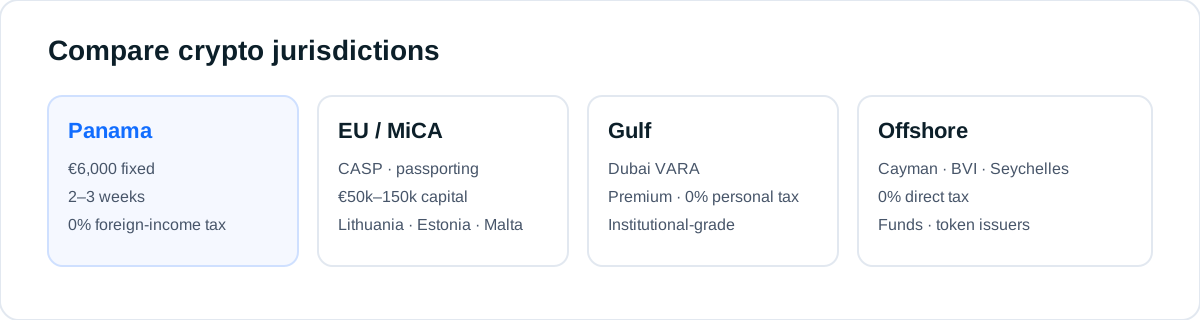
These ranges are indicative. Exact pricing depends on the specific activity license, legal structure, and professional fees. Consulting24 provides a detailed cost breakdown during consultation. For a fixed-price alternative, consider Panama at EUR 6,000 flat.
To give a more concrete example, a basic exchange license in Dubai might cost around EUR 60,000 including company setup, legal fees, and the first year's compliance costs. In Cyprus, a similar license might cost EUR 40,000 but require a higher capital commitment. The timeline in Dubai can be shorter if you use a pre-approved free zone, but VARA's review can take 3-6 months. Cyprus typically takes 6-9 months from incorporation to license approval.
Capital Requirements
Capital requirements differ significantly between Dubai and Cyprus.
- Dubai (VARA): No statutory minimum capital is publicly mandated, but VARA expects adequate financial resources. In practice, applicants should demonstrate at least EUR 100,000 - 250,000 in liquid assets to cover operational and compliance costs. Exact figures are confirmed during the licensing process.
- Cyprus (MiCA): Minimum capital tiers apply based on services: EUR 50,000 for wallet/custody, EUR 125,000 for exchange, EUR 150,000 for trading platforms. These amounts must be held as own funds.
Both jurisdictions require proof of capital from audited sources. For a comparison with other EU regimes, see our Cyprus vs Lithuania page.
It is important to note that capital requirements are just the starting point. Regulators also expect you to maintain sufficient working capital to cover ongoing expenses. In Dubai, you may need to show a business plan that demonstrates financial sustainability for at least 12 months. In Cyprus, the capital must be deposited in a local bank and cannot be used for operational purposes without prior approval.
Tax Treatment
Tax is a major differentiator in the Dubai vs Cyprus crypto license debate.
- Dubai: 0% corporate tax in most free zones (e.g., DMCC, ADGM). No VAT on crypto transactions. No capital gains tax. Personal income tax is 0%.
- Cyprus: Corporate tax at 12.5% (one of the lowest in the EU). VAT may apply to certain services. Capital gains tax on disposal of crypto assets depends on classification (trading vs investment).
Dubai offers a tax-free environment, but requires substance (office, staff). Cyprus is tax-efficient within the EU and offers double tax treaties. Always consult a tax advisor for your specific situation.
For example, if your business primarily generates income from trading fees, Dubai's 0% tax can result in significant savings. However, if you plan to hold crypto as an investment, Cyprus's capital gains tax treatment may be more favourable depending on your holding period. Additionally, Cyprus has a notional interest deduction (NID) that can reduce effective corporate tax to around 10% or less.
Allowed Activities
Both jurisdictions permit a broad range of crypto activities, but with specific licensing categories.
- Dubai: Exchange, custody, advisory, broker-dealer, lending/borrowing, token issuance (subject to VARA approval), and payment services. Each activity requires a separate license class.
- Cyprus: Exchange (fiat-to-crypto and crypto-to-crypto), custody, transfer services, order execution, portfolio management, and advice. All activities are covered under a single CASP license but must be declared.
Dubai's regime is more granular, while Cyprus offers a broader license with fewer activity restrictions. For a detailed breakdown of allowed activities in other jurisdictions, visit our jurisdictions page.
In Dubai, if you want to offer multiple services, you may need to apply for multiple license categories, each with its own fee and conditions. In Cyprus, a single CASP license can cover all services, but you must notify CySEC of any new activity. This makes Cyprus more flexible for businesses that plan to expand their service offerings over time.
Step-by-Step Application Process
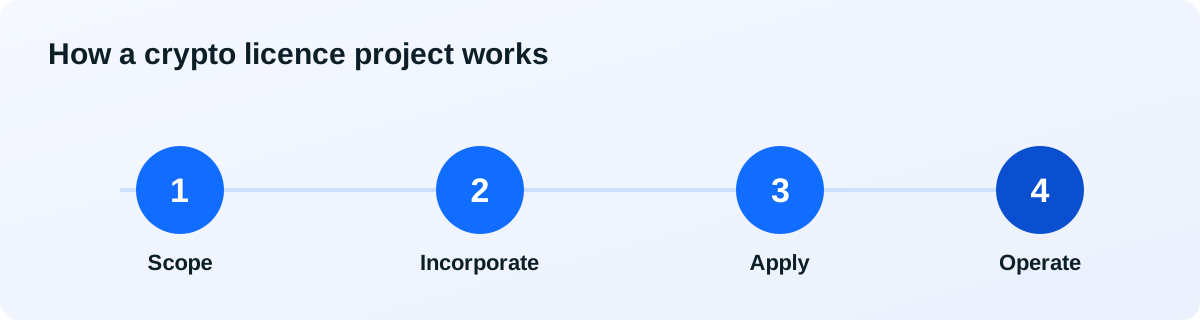
- Pre-application: Business plan, AML policies, corporate structure, and capital proof.
- Company incorporation: Register a legal entity in Dubai (free zone) or Cyprus (private limited company).
- Submit application: File with VARA or CySEC, including all documentation and fees.
- Review and interview: Regulators assess fit-and-proper, compliance, and operational readiness.
- Approval and licensing: Once approved, pay the license fee and commence operations under supervision.
- Ongoing compliance: Regular reporting, audits, and AML obligations.
Consulting24 guides you through each step. For a streamlined alternative, consider our company setup service in Panama.
The process in Dubai typically involves an initial application to VARA, followed by a preliminary approval (in-principle). You then complete the free zone setup and submit final documentation. VARA may request additional information or conduct interviews with key personnel. In Cyprus, the process is more linear: you incorporate the company, prepare the application, and submit to CySEC. CySEC may request clarifications but generally does not conduct interviews unless there are concerns.
Banking and Payment Services
Access to banking is a common challenge for crypto businesses.
- Dubai: Several local banks accept VARA-licensed firms, but onboarding can be slow. Fintech-friendly banks like RAKBANK and Mashreq are options. Crypto-to-fiat gateways are available.
- Cyprus: EU banks may be hesitant, but MiCA-licensed entities have a stronger case. Banks in Cyprus, Lithuania, and Estonia are more open. Payment institutions (e.g., EMI licenses) can facilitate fiat services.
Both jurisdictions require a local bank account. Consulting24 can introduce you to banking partners. For a banking-friendly jurisdiction, see our Lithuania page.
In practice, opening a bank account in Dubai can take 2-4 months due to enhanced due diligence. Some banks require a minimum deposit of EUR 50,000. In Cyprus, the process is generally faster (1-2 months) but banks may ask for a detailed business plan and source of funds. Alternative payment service providers (PSPs) like EMI licenses can be used to process fiat transactions, but they add an extra layer of regulation and cost.
Benefits of Each Jurisdiction
Dubai Benefits
- 0% corporate and personal tax
- Strategic location between East and West
- Progressive regulation (VARA)
- High-quality infrastructure and lifestyle
Cyprus Benefits
- EU passporting under MiCA
- Low corporate tax (12.5%)
- Established legal system
- Access to European talent pool
Your choice depends on whether you prioritise tax savings (Dubai) or EU market access (Cyprus).
Beyond these, Dubai offers a more business-friendly environment with minimal bureaucracy, while Cyprus provides legal certainty and a well-regulated financial system. For example, disputes in Dubai are resolved through the Dubai Courts or the DIFC Courts, which are based on English common law. Cyprus follows EU law, which may be more familiar to European founders.
Compliance and Trust
Both jurisdictions require strong AML/KYC procedures, transaction monitoring, and regular audits. Dubai's VARA is known for strict enforcement, while CySEC follows ESMA guidelines. General guidance: ensure your compliance officer is experienced and your policies are tailored to the regulator's expectations. This is not legal advice; always engage local counsel.
Consulting24 helps you build a compliant framework. For a jurisdiction with lower compliance overhead, consider Panama (if available) or our other offerings.
In Dubai, VARA conducts regular inspections and can impose fines for non-compliance. In Cyprus, CySEC requires quarterly reporting and annual audits. Both regimes expect you to have a local compliance officer (in Dubai) or a EU-based compliance officer (in Cyprus). The cost of compliance can be significant: expect to spend EUR 20,000-50,000 per year on external auditors, AML officers, and legal fees.
Common Mistakes When Choosing Between Dubai and Cyprus
- Underestimating capital: Both jurisdictions require significant funds; don't assume minimums are sufficient.
- Ignoring substance: Dubai requires a physical office; Cyprus requires a local director.
- Tax misclassification: Cyprus treats crypto differently for trading vs investment; get tax advice.
- Rushing the application: Incomplete documentation causes delays.
- Choosing based on cost alone: The cheapest option may not suit your business model.
Avoid these pitfalls by working with an experienced advisor like Consulting24.
Another common mistake is not planning for ongoing costs. Many founders focus on the initial license fee but forget about annual renewal fees, compliance costs, and bank charges. In Dubai, free zone renewal fees can be EUR 5,000-10,000 per year. In Cyprus, CySEC charges an annual supervision fee of around EUR 3,000-5,000. Always budget for these recurring expenses.
Alternatives and Comparison with Other Jurisdictions
If Dubai or Cyprus do not fit your needs, consider these alternatives:
- Panama: No specific crypto license but a flat EUR 6,000 company setup. Ideal for startups needing a quick, low-cost entity. See our Panama page.
- Estonia: EU license with a streamlined process; capital from EUR 12,000. More affordable than Cyprus but no passporting. Learn more on our Estonia page.
- Lithuania: MiCA-compliant with lower capital (EUR 50,000) and faster timeline. Compare with our Cyprus vs Lithuania page.
Each jurisdiction has trade-offs. Consulting24 advises across all options to find your best fit.
For example, if you are a startup with limited budget, Panama offers the lowest entry cost. If you need EU passporting but want lower capital, Lithuania may be better than Cyprus. If you prioritise tax efficiency and are not targeting the EU, Dubai is hard to beat. We recommend a comprehensive analysis of your business goals before deciding.
Why Choose Consulting24 for Your Crypto License?
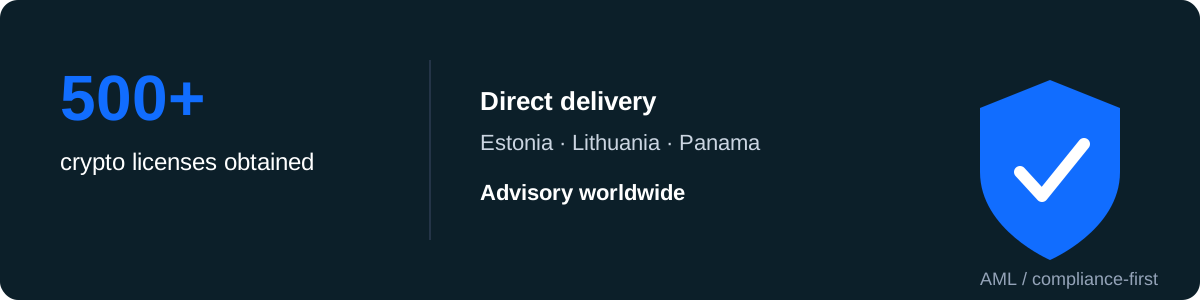
Consulting24 (X24Consulting OU) has obtained over 500 crypto licenses worldwide. Consulting24 covers Dubai for comparison only - we do not file VARA applications and deliver licenses directly in Panama, Estonia, and Lithuania. Our team of legal and compliance experts ensures your application is accurate and timely. We do not guarantee approval, but we maximise your chances.
Contact us today to book a consultation and discuss your Dubai vs Cyprus crypto license strategy.
Frequently asked questions
What is the main difference between a Dubai and Cyprus crypto license?
Dubai offers a tax-free environment (0% corporate tax) under VARA regulation, ideal for targeting Middle East and Asia. Cyprus provides an EU MiCA license with passporting rights across the EEA, but with 12.5% corporate tax. The choice depends on your target market and tax strategy.
How much does a crypto license cost in Dubai vs Cyprus?
Dubai typically costs EUR 50,000-100,000+ including setup and compliance, with a timeline of 4-8 months. Cyprus costs EUR 30,000-60,000+ and takes 6-12 months. These are indicative; exact costs depend on the specific license category and professional fees.
What are the capital requirements for a crypto license in Dubai and Cyprus?
Dubai has no statutory minimum but expects EUR 100,000-250,000 in liquid assets. Cyprus has MiCA tiers: EUR 50,000 for custody, EUR 125,000 for exchange, EUR 150,000 for trading. Both require proof of capital from audited sources.
Can I passport my Cyprus crypto license to other EU countries?
Yes, a Cyprus CASP license under MiCA allows passporting across the EEA. You can provide services in any EU member state without additional licensing, subject to notification to the host regulator.
Is a physical office required in Dubai or Cyprus?
Dubai requires a physical office in a free zone (e.g., DMCC, ADGM). Cyprus requires a registered office and a local director, but not necessarily a physical office if you can demonstrate substance through other means.
What activities are allowed under a Dubai VARA license?
Dubai allows exchange, custody, advisory, broker-dealer, lending, token issuance, and payment services. Each activity requires a separate license class. VARA also regulates virtual asset marketing and promotions.
How long does it take to get a crypto license in Cyprus?
The process typically takes 6-12 months from company incorporation to license approval. CySEC reviews applications thoroughly, and delays can occur if documentation is incomplete.
What are the ongoing compliance costs for a crypto license in Dubai?
Ongoing costs include free zone renewal fees (EUR 5,000-10,000/year), AML officer salary, audit fees, and VARA supervision fees. Total annual compliance can range from EUR 20,000 to 50,000 depending on the complexity of operations.
Can I use a Dubai crypto license to serve EU clients?
No, a Dubai license does not provide EU passporting. To serve EU clients, you need a MiCA license from an EU member state like Cyprus. However, you can use a Dubai entity for non-EU clients and a separate EU entity for EU clients.
Does Cyprus tax crypto-to-crypto trades?
Cyprus treats crypto as an asset. Trading gains may be subject to capital gains tax if held as an investment, or as income if held as trading stock. Corporate tax at 12.5% applies to profits from trading. Consult a tax advisor for your specific situation.
Which jurisdiction is better for a startup with limited budget?
For the lowest cost, consider Panama at EUR 6,000 flat. Among regulated options, Cyprus may be more affordable than Dubai if you meet the capital requirements. Estonia and Lithuania are also budget-friendly EU alternatives.
Can Consulting24 help with both Dubai and Cyprus licenses?
Consulting24 covers Dubai for comparison only - we do not file VARA applications and deliver licenses directly in Panama, Estonia, and Lithuania. We deliver directly in Estonia, Lithuania, and Panama. Contact us for a consultation to determine the best fit for your business.
Official sources
Related jurisdictions

Talk to a crypto-licensing expert
500+ licenses across Estonia, Lithuania, Panama and beyond. Tell us your model and we'll map the right route, honestly.
💬 Talk to an expertFree consultationGeneral guidance, not legal advice. Rules and fees evolve, and we confirm current requirements for your case.