Crypto Token Issuance License in BVI (2026): Cost & Setup Token Issuance License: Complete 2026 Guide
The British Virgin Islands (BVI) has emerged as a competitive jurisdiction for crypto token issuance, offering a clear regulatory framework under the Securities and Investment Business Act (SIBA) and the Virtual Asset Service Provider (VASP) regime. As of 2026, the BVI Financial Services Commission (FSC) oversees the licensing of entities that issue digital tokens, whether as security tokens, utility tokens, or stablecoins. This page provides a detailed, factual overview of the BVI crypto token issuance license, including costs, timeline, capital requirements, and how Consulting24 can assist with your application.
Whether you are a startup planning a token sale or an established firm seeking a compliant issuance platform, the BVI offers a stable, tax-neutral environment with a well-respected regulator. Consulting24 advises and coordinates licensing in the BVI, ensuring your application meets all regulatory standards. For a lower-cost alternative, consider Panama with a flat EUR 6,000 fee, or explore other jurisdictions we serve.
What is the BVI Crypto Token Issuance License?
The BVI crypto token issuance license is a regulatory authorisation granted by the BVI Financial Services Commission (FSC) that permits a company to issue digital tokens to the public. This license falls under the BVI's VASP regime, which came into full effect in 2024 and is now fully operational in 2026. The license covers the creation, sale, and distribution of tokens that are classified as virtual assets or securities under BVI law.
Key features include:
- Regulated by the BVI FSC
- Applicable to both security tokens and certain utility tokens
- Requires a minimum capital of USD 50,000 (or equivalent) for most issuers
- Subject to ongoing compliance and reporting obligations
This license is distinct from a general VASP license, as it specifically authorises token issuance activities. Consulting24 advises clients on the appropriate license type based on their token model. For example, a project issuing a stablecoin pegged to USD would typically need a Class I license, whereas a platform that also holds customer funds during a sale may require a Class II license.
Who Needs a BVI Crypto Token Issuance License?
Any entity that plans to issue digital tokens to investors or the public from within the BVI, or that targets BVI residents, typically requires this license. This includes:
- Blockchain startups conducting a token generation event (TGE) or initial coin offering (ICO)
- Companies issuing security tokens representing equity, debt, or other assets
- Stablecoin issuers whose tokens are pegged to fiat or other assets
- Utility token issuers if the token is deemed a virtual asset under BVI law
If you are unsure whether your token issuance requires a license, Consulting24 can review your project and advise on the regulatory classification. Even if your token is considered a pure utility token, the BVI FSC may still require registration or a license depending on the token's features. For instance, a token that can be traded on secondary markets or that confers profit-sharing rights is likely to be classified as a security.
License Type & Regulator
The BVI crypto token issuance license is a specific category under the BVI's Virtual Asset Service Provider (VASP) regime. The regulator is the BVI Financial Services Commission (FSC), which oversees all financial services in the territory, including virtual asset activities.
There are two main license categories relevant to token issuance:
- Class I VASP License: For token issuers that do not hold customer funds (e.g., pure token creation and sale).
- Class II VASP License: For issuers that also hold, transfer, or safeguard customer virtual assets (e.g., a platform that collects funds during a token sale).
Most token issuers will require a Class I license, but if your business model involves custody or exchange, a Class II license may be necessary. Consulting24 helps determine the correct class for your project. The FSC also publishes a list of licensed entities, which adds transparency and trust for investors.
Cost & Timeline
The cost and timeline for obtaining a BVI crypto token issuance license depend on the complexity of your application and the license class. Below is an indicative table based on 2026 data:
| Item | Estimated Cost (USD) | Timeline |
|---|---|---|
| Application fee (Class I) | 5,000 - 10,000 | Paid upfront |
| Annual license fee (Class I) | 10,000 - 20,000 | Annual renewal |
| Professional fees (legal, compliance) | 15,000 - 30,000 | Varies |
| Total setup cost (first year) | 30,000 - 60,000 | 3 - 6 months |
Exact pricing is confirmed during a consultation, as each case differs. Consulting24 provides a transparent fee structure upfront. The timeline includes company incorporation, document preparation, and FSC review. For a faster alternative, Panama offers a flat EUR 6,000 fee with a 2-4 month timeline.
Capital Requirement
The BVI FSC imposes a minimum capital requirement of USD 50,000 for Class I VASP license holders (token issuers). This capital must be maintained at all times and can be in the form of cash or liquid assets. For Class II license holders (those handling customer funds), the minimum capital is higher, typically USD 100,000 or more.
Capital requirements are designed to ensure the issuer has sufficient financial resources to operate responsibly and meet obligations. Consulting24 advises clients on structuring their capital to meet regulatory expectations. For example, the capital can be held in a BVI bank account or a trust. It is important to note that the capital must be unencumbered and readily available.
Tax Treatment
The BVI is a tax-neutral jurisdiction. There is no corporate income tax, capital gains tax, or withholding tax on income earned by BVI business companies. This makes the BVI highly attractive for token issuers, as profits from token sales are not subject to local taxation.
However, issuers must still comply with international tax reporting standards, such as the Common Reporting Standard (CRS) and anti-money laundering (AML) regulations. Consulting24 recommends consulting a tax advisor to understand your global tax obligations, as your home country may tax income from token issuance. For instance, a US-based issuer may need to report token sale income to the IRS, even if the BVI does not tax it.
Allowed Activities
With a BVI crypto token issuance license, you are permitted to:
- Create and issue digital tokens (security, utility, or stablecoins)
- Conduct token sales to the public (ICO, IEO, STO)
- Market and promote token offerings
- Manage token distribution and allocation
- Provide token-related information to investors
Activities not covered by the license include operating a cryptocurrency exchange, providing custodial wallet services, or trading on behalf of customers. These require separate VASP licenses. Consulting24 can help you structure your business to ensure all activities are properly licensed. For example, if you plan to also operate a secondary market for your token, you would need a separate exchange license.
Step-by-Step Process
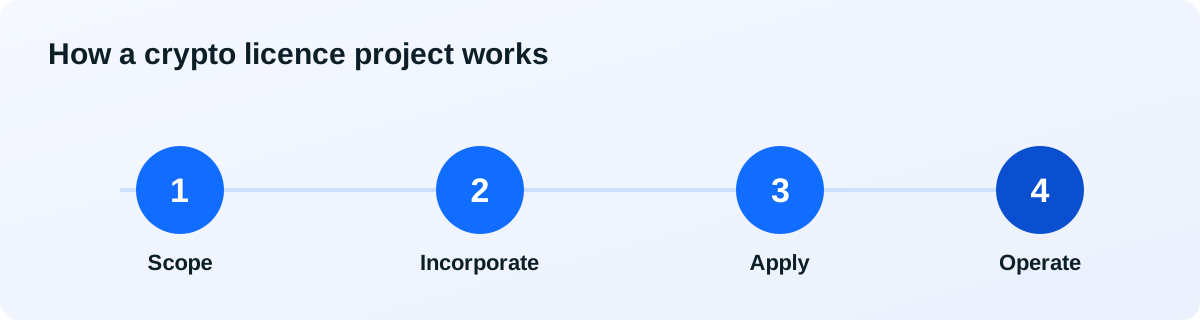
The application process for a BVI crypto token issuance license involves several stages. Consulting24 coordinates each step:
- Pre-application assessment: Review your business model, token design, and compliance readiness.
- Company incorporation: Set up a BVI business company (BC) if not yet established.
- Document preparation: Draft a business plan, AML policy, risk assessment, and token whitepaper.
- Submission: File the application with the BVI FSC, including all supporting documents and fees.
- Review & queries: The FSC reviews the application and may request additional information. This stage typically takes 2-4 months.
- Approval & licensing: Once approved, the license is issued, and you can commence token issuance.
Consulting24 manages the entire process, liaising with the FSC and local legal partners to ensure a smooth application. We also provide guidance on the application process for other jurisdictions.
Banking & Payments
Opening a bank account for a BVI token issuance entity can be challenging due to the perceived risk of the crypto sector. However, the BVI has a number of international banks and payment processors that accept VASP-licensed clients. Consulting24 assists with introductions to banking partners that are familiar with the crypto industry.
Options include:
- Traditional banks in the BVI (e.g., FirstBank, BVI Bank)
- EMI (Electronic Money Institution) accounts
- Payment processors that support fiat-to-crypto conversions
We recommend starting the banking process early, as account opening can take several weeks. Some banks require a physical presence or a minimum deposit. Consulting24 can help you prepare the necessary documentation, such as a business plan and proof of license.
Benefits of a BVI Crypto Token Issuance License
Choosing the BVI for your token issuance offers several advantages:
- Tax neutrality: No corporate tax, capital gains tax, or VAT on token sales.
- Reputable regulator: The BVI FSC is well-regarded internationally, adding credibility to your project.
- Fast turnaround: Compared to other jurisdictions, the BVI can process applications in 3-6 months.
- Flexible legal framework: The VASP regime is designed to accommodate various token types.
- Confidentiality: BVI companies offer privacy for directors and shareholders.
These benefits make the BVI a strong contender for token issuers seeking a compliant yet efficient jurisdiction. For a simpler, lower-cost option, consider Panama with a flat EUR 6,000 fee.
Compliance & Trust
Maintaining a BVI crypto token issuance license requires ongoing compliance with AML/CFT regulations. This includes:
- Appointing a Money Laundering Reporting Officer (MLRO)
- Conducting customer due diligence (CDD) on investors
- Submitting annual returns and audited financial statements
- Reporting suspicious transactions to the FSC
Consulting24 provides compliance support to ensure your license remains in good standing. Note: This is general guidance, not legal advice. Always consult a qualified legal professional for your specific situation. The FSC may conduct periodic inspections, and non-compliance can result in fines or license revocation.
Common Mistakes to Avoid
When applying for a BVI crypto token issuance license, avoid these pitfalls:
- Incorrect token classification: Misclassifying your token as a utility token when it is a security can lead to rejection.
- Inadequate AML policies: The FSC expects strong AML procedures; generic templates are not sufficient.
- Underestimating capital requirements: Ensure you have the minimum capital in place before applying.
- Ignoring ongoing obligations: Annual fees and reporting are mandatory; failure to comply can result in license revocation.
Consulting24 helps you avoid these mistakes by conducting a thorough pre-application review. For example, we can help you draft a tailored AML policy that meets FSC standards.
Alternatives & Comparison
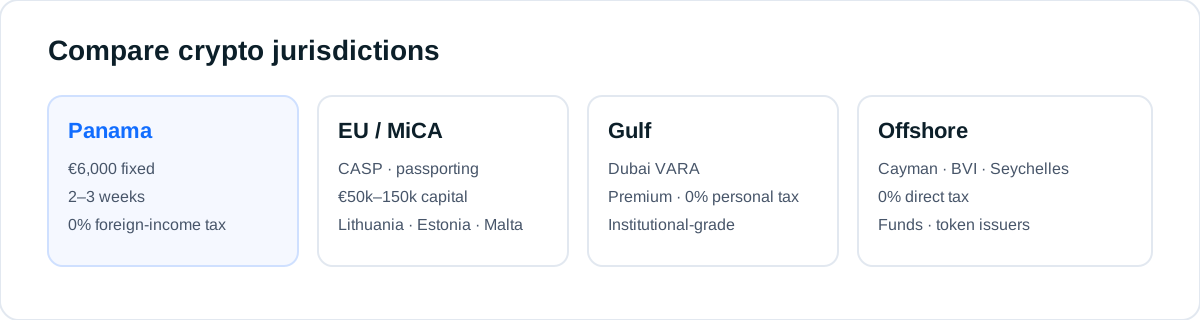
While the BVI is a strong option, other jurisdictions may suit your needs better. Here is a comparison with Panama and Lithuania:
| Jurisdiction | License Type | Min Capital | Tax | Timeline |
|---|---|---|---|---|
| BVI | VASP Class I (token issuance) | USD 50,000 | Tax-neutral | 3-6 months |
| Panama | Crypto license (flat fee) | Not specified | Territorial tax | 2-4 months |
| Lithuania | CASP (MiCA compliant) | EUR 50,000 - 150,000 | 15% corporate tax | 3-6 months |
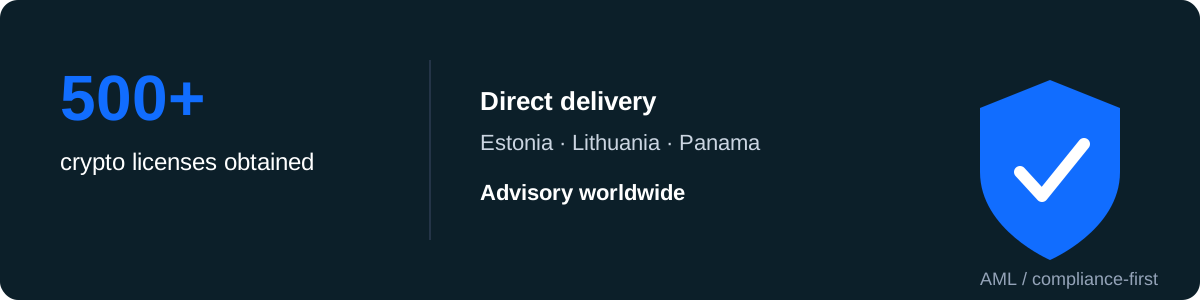
Panama offers a simpler, lower-cost option (flat EUR 6,000) but may not have the same regulatory recognition as BVI. Lithuania, as an EU member, is fully MiCA-compliant and may be preferred for European market access. Consulting24 delivers directly in Estonia, Lithuania, and Panama, and advises on others. For a detailed comparison, see our BVI vs Lithuania guide.
Frequently asked questions
What is the difference between a Class I and Class II VASP license in BVI?
A Class I license is for token issuers that do not hold customer funds, while a Class II license is for those that also hold, transfer, or safeguard customer virtual assets. Most token issuers need Class I, but if your platform collects funds during a sale, you may need Class II.
How long does it take to get a BVI crypto token issuance license?
The typical timeline is 3 to 6 months from application to approval. This includes company incorporation, document preparation, and FSC review. Consulting24 can help expedite the process by ensuring your application is complete and compliant.
What is the minimum capital requirement for a BVI token issuance license?
The minimum capital is USD 50,000 for a Class I license. This must be maintained at all times and can be in cash or liquid assets. For Class II licenses, the requirement is higher, typically USD 100,000 or more.
Can I issue utility tokens under a BVI VASP license?
Yes, but only if the utility token is classified as a virtual asset under BVI law. Pure utility tokens that do not have investment features may not require a license, but the FSC will assess each case. Consulting24 can help determine the classification.
What are the ongoing compliance obligations for a BVI token issuance license?
Obligations include appointing an MLRO, conducting customer due diligence, submitting annual returns and audited financial statements, and reporting suspicious transactions. Annual license fees also apply.
Is the BVI tax-neutral for token issuers?
Yes, the BVI has no corporate income tax, capital gains tax, or withholding tax. However, issuers must comply with international tax reporting standards and may be taxed in their home country.
Can I use a BVI company to issue tokens to US investors?
Yes, but you must comply with US securities laws, such as Regulation D or Regulation S. The BVI license does not exempt you from US regulations. Consulting24 recommends consulting a US securities lawyer.
What happens if I fail to maintain the minimum capital?
The FSC may suspend or revoke your license. It is crucial to maintain the capital at all times. Consulting24 provides compliance monitoring to help you avoid such issues.
Does the BVI FSC require a physical office?
Yes, you must have a registered office in the BVI. This can be provided by a registered agent. Consulting24 can help arrange this.
How does the BVI license compare to Panama?
Panama offers a simpler, lower-cost option with a flat EUR 6,000 fee, but the BVI has a more established regulatory framework and tax neutrality. Your choice depends on your budget and target market.
Official sources
Related jurisdictions

Talk to a crypto-licensing expert
500+ licenses across Estonia, Lithuania, Panama and beyond. Tell us your model and we'll map the right route, honestly.
💬 Talk to an expertFree consultationGeneral guidance, not legal advice. Rules and fees evolve, and we confirm current requirements for your case.