Dubai vs Switzerland Crypto License: A 2026 Comparison
Choosing between a Dubai and a Switzerland crypto license in 2026 is a strategic decision that depends on your business model, target market, and budget. Both jurisdictions offer mature regulatory frameworks, but they differ significantly in cost, capital requirements, tax treatment, and operational scope. This page provides an up-to-date comparison of the Dubai VARA (Virtual Assets Regulatory Authority) regime and the Swiss FINMA (Swiss Financial Market Supervisory Authority) licensing framework, with a focus on practical considerations for crypto founders.
Consulting24 covers Dubai for comparison only - we do not file VARA applications and deliver licenses directly in Panama, Estonia, and Lithuania. For a simpler and more cost-effective alternative, consider Panama with a flat fee of EUR 6,000. We also cover other jurisdictions such as Estonia, Lithuania, and Poland.
Overview: What Each License Covers
In Dubai, the VARA license is required for any entity conducting virtual asset activities within or from the Dubai mainland (excluding the Dubai International Financial Centre, which has its own regime). The license covers services such as exchange, custody, transfer, and advisory. In Switzerland, FINMA issues a Fintech license (banking license light) or a VASP registration for companies engaging in professional crypto trading, custody, or issuance. Both regimes are fully operational in 2026, with clear rulebooks and enforcement.
Consulting24 advises clients on the specific scope of each license and helps align your business activities with the regulatory expectations. For example, a Dubai VARA license allows you to operate an OTC desk for institutional clients, while a Swiss Fintech license permits taking public deposits up to CHF 100 million. The choice depends on whether you need retail access in the Middle East or institutional-grade services in Europe.
Who Needs a Dubai or Switzerland Crypto License?
You need a Dubai VARA license if you plan to operate a crypto exchange, wallet provider, token issuer, or advisory service targeting the UAE market or using Dubai as a regional hub. Switzerland is ideal for companies seeking a stable, crypto-friendly environment with strong banking integration, especially for institutional-grade services, custody, and tokenization projects.
- Dubai VARA: Best for retail and institutional services in the Middle East, Africa, and South Asia (MEASA) region. Example: a crypto exchange serving users from Saudi Arabia, India, and Nigeria.
- Switzerland FINMA: Best for European and global clients who value a long-established crypto hub, Zug's 'Crypto Valley', and direct access to Swiss private banking. Example: a tokenization platform for real estate assets targeting European investors.
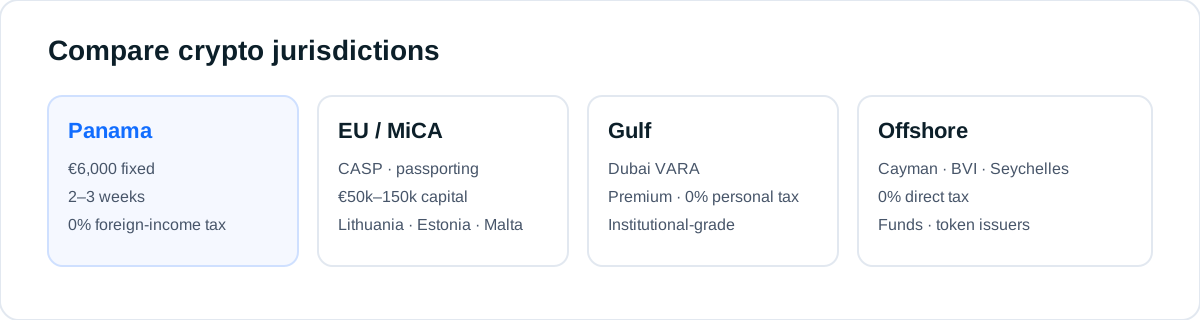
If your budget is limited or you want a quick setup, Panama offers a flat EUR 6,000 fee with no minimum capital, ideal for startups testing the waters.
License Type and Regulator
Dubai: Virtual Asset Service Provider (VASP) license issued by the Virtual Assets Regulatory Authority (VARA). VARA is the world's first dedicated virtual asset regulator, operating under Dubai Law No. 4 of 2022. The license is mandatory for any virtual asset activity in Dubai (mainland). VARA also regulates DeFi and NFT platforms, making it one of the most comprehensive regimes.
Switzerland: Fintech license (Art. 1b Banking Act) or VASP registration under the Anti-Money Laundering Act (AMLA). FINMA is the federal regulator. The Fintech license allows taking public deposits up to CHF 100 million, while VASP registration is simpler for pure trading/custody without deposit-taking. Switzerland's DLT Act (2021) provides a legal basis for tokenized securities, giving it an edge in security token offerings.
Cost and Timeline
The table below summarises the typical costs and timelines for obtaining a crypto license in Dubai and Switzerland as of 2026. Exact figures depend on the complexity of your business model and the quality of your application. Consulting24 provides a detailed cost breakdown during a consultation.
| Item | Dubai (VARA) | Switzerland (FINMA) |
|---|---|---|
| Application fee | AED 10,000 - 30,000 (EUR 2,500 - 7,500) | CHF 5,000 - 20,000 (EUR 5,000 - 20,000) |
| Professional fees (legal, compliance) | EUR 30,000 - 60,000 | EUR 50,000 - 100,000 |
| Total estimated cost | EUR 35,000 - 70,000 | EUR 55,000 - 120,000 |
| Timeline (from application to approval) | 4 - 8 months | 6 - 12 months |
| Ongoing annual costs | AED 20,000 - 50,000 (EUR 5,000 - 12,500) | CHF 10,000 - 30,000 (EUR 10,000 - 30,000) |
For comparison, Panama costs a flat EUR 6,000 with a timeline of 2-3 months, making it the cheapest and fastest option among all jurisdictions.
Capital Requirement
Dubai VARA: The minimum capital requirement varies by activity class. For an exchange or brokerage, the requirement is typically AED 500,000 - 1,000,000 (EUR 125,000 - 250,000). For custody services, it can be higher. Exact amounts are determined by VARA on a case-by-case basis. In practice, most applicants need at least EUR 150,000 in paid-up capital.
Switzerland FINMA: For the Fintech license, the minimum capital is CHF 1,000,000 (EUR 1,000,000). For VASP registration, there is no statutory minimum capital, but FINMA expects adequate capital proportionate to the business risk, typically CHF 100,000 - 300,000 (EUR 100,000 - 300,000). The high capital requirement for the Fintech license makes it suitable only for well-funded ventures.
If capital is a constraint, Panama has no minimum capital requirement, and Lithuania (EU CASP) requires EUR 50,000 for certain services.
Tax Treatment
Dubai: No corporate income tax for most businesses (0% tax rate). There is a 9% corporate tax for large companies (profit over AED 375,000), but many crypto companies can qualify for exemptions if they meet certain conditions. No VAT on crypto transactions. No capital gains tax. This makes Dubai highly attractive for crypto businesses, especially those with high margins.
Switzerland: Corporate income tax rate varies by canton, typically 12% - 18% (federal + cantonal). Crypto transactions are subject to VAT only when fiat is involved (e.g., exchange fees). Capital gains on private assets are tax-free for individuals, but for corporate entities, gains are taxed as ordinary income. Switzerland has a stable tax regime with double taxation treaties, which is beneficial for international operations.
For zero-tax jurisdictions, see Panama (no tax on offshore income) or El Salvador.
Allowed Activities
Dubai VARA: Licensed activities include: exchange (order book, OTC), custody, transfer, payment services, token issuance (including STOs), advisory, and portfolio management. VARA also regulates DeFi and NFT platforms. For example, a DeFi lending protocol must obtain a VARA license and comply with specific rules on smart contract audits and user protection.
Switzerland FINMA: The Fintech license allows: deposit-taking (up to CHF 100 million), lending, payment services, and limited trading. VASP registration covers: trading (proprietary and client), custody, transfer, and token issuance (including ICOs). Switzerland is particularly strong for tokenization of securities (DLT Act). For instance, a company issuing tokenized bonds can do so under the DLT Act without a full banking license.
For a broader range of activities at lower cost, consider Lithuania or Estonia.
Step-by-Step Application Process
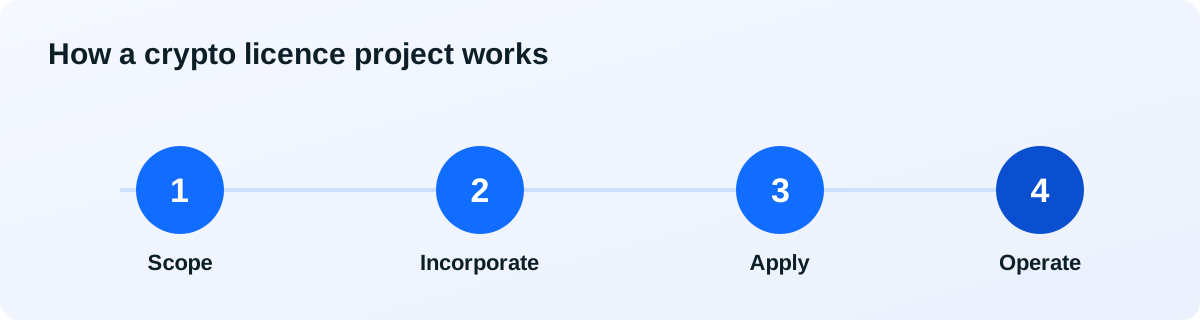
Both jurisdictions follow a structured application process. Consulting24 coordinates each step for you.
- Pre-application: Business model review, legal structuring, and preparation of compliance documentation (AML/KYC policies, risk assessment, business plan). This stage takes 1-2 months.
- Submission: File the application with VARA or FINMA, including all required forms, corporate documents, and fees. Ensure all documents are translated into English or the local language.
- Review and queries: Regulator reviews the application and may request clarifications or additional information. This stage can take 2 - 4 months. In Dubai, VARA often asks for detailed transaction flow diagrams and source of funds for shareholders.
- On-site inspection (Dubai) or interview (Switzerland): VARA may conduct an on-site inspection of your premises; FINMA may hold an interview with senior management. Prepare for questions on your business model, risk controls, and governance.
- Approval and licensing: Once satisfied, the regulator issues the license. You must maintain ongoing compliance and submit periodic reports (e.g., quarterly AML reports to VARA, annual audits to FINMA).
For a faster process, Panama can be completed in 2-3 months with minimal documentation.
Banking and Payment Integration
Dubai: Banking relationships are improving but can still be challenging. Many UAE banks are cautious with crypto companies. Consulting24 can help you approach banks that are open to VARA-licensed entities, such as Mashreq, RAKBANK, and some international banks. You will need to provide your license, compliance manual, and proof of capital. Some banks require a minimum deposit of AED 100,000.
Switzerland: Switzerland has a well-established banking infrastructure for crypto companies. Banks like SEBA, Sygnum, and many cantonal banks offer accounts and services to FINMA-licensed firms. Swiss banks provide fiat on/off ramps, custody, and even crypto-backed lending. The application process is smoother if you have a Swiss license, but expect due diligence to take 2-4 weeks.
For banking in other jurisdictions, see our blog on crypto-friendly banking.
Benefits of Each Jurisdiction
- Dubai: Zero corporate tax, fast-growing ecosystem, strategic location bridging East and West, supportive government, and a dedicated crypto regulator (VARA). The UAE also offers a golden visa for investors.
- Switzerland: Stable legal framework, deep liquidity, strong banking relationships, Zug's Crypto Valley network, and a mature regulatory environment that is respected globally. Switzerland also has a high quality of life and a skilled workforce.
For a balance of cost and credibility, Lithuania offers an EU CASP license with capital from EUR 50,000.
Compliance and Trust Considerations
Both VARA and FINMA are strict on AML/CFT compliance. You must have strong KYC, transaction monitoring, and suspicious activity reporting. In Dubai, VARA requires a local office and a compliance officer based in the UAE. In Switzerland, you need a local director or authorised representative. Consulting24 provides ongoing compliance support to ensure your license remains in good standing. This is general guidance, not legal advice.
Key compliance requirements include: appointing a Money Laundering Reporting Officer (MLRO), conducting regular risk assessments, and maintaining records for at least 5 years. Failure to comply can result in fines, suspension, or revocation of the license.
Common Mistakes When Applying
- Underestimating the time and cost - many founders assume a faster, cheaper process. Budget at least 6 months and EUR 50,000 for Dubai, and 9 months and EUR 80,000 for Switzerland.
- Incomplete or poorly drafted compliance documentation. Regulators reject applications with generic AML policies. Tailor them to your specific business model.
- Choosing the wrong license type for the intended activities. For example, applying for a VASP registration in Switzerland when you plan to take deposits, which requires a Fintech license.
- Not having a local presence or adequate capital. VARA requires a physical office lease; FINMA expects a substantive local team.
- Ignoring ongoing reporting obligations after obtaining the license. Late filings can trigger penalties.
Alternatives: Panama and Other Jurisdictions
If Dubai or Switzerland seem too costly or complex, consider Panama (flat EUR 6,000, no minimum capital, no tax on offshore income) or Lithuania (EU CASP license, capital from EUR 50,000, lower cost than Switzerland). Consulting24 also advises on other jurisdictions such as Estonia, Poland, and the Czech Republic, each with distinct advantages.
For a detailed comparison of Dubai vs Switzerland vs Panama, see our blog on crypto licensing strategy. Panama is ideal for startups and small businesses, while Lithuania offers EU passporting rights.
Why Work with Consulting24?
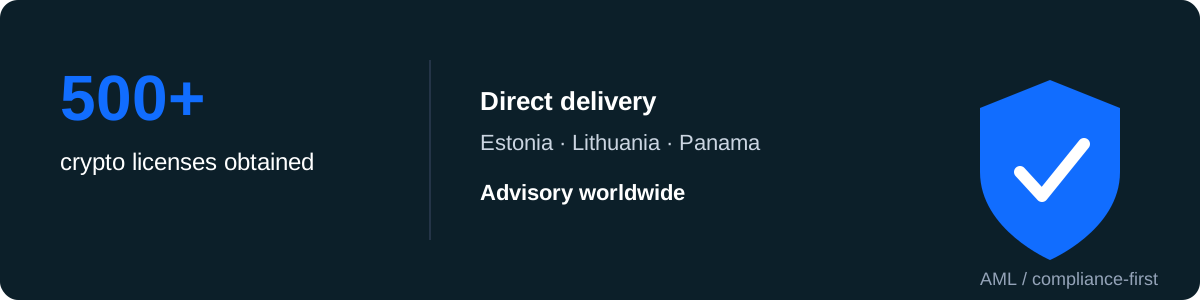
Consulting24 has obtained over 500 crypto licenses across multiple jurisdictions. Consulting24 covers Dubai for comparison only - we do not file VARA applications and deliver licenses directly in Panama, Estonia, and Lithuania. Our team of legal and compliance experts ensures your application is prepared to the highest standard, reducing the risk of rejection. We provide end-to-end support, from company formation to banking introductions.
Contact us via WhatsApp or book a consultation to discuss your project. We will help you choose the right jurisdiction and guide you through the entire process.
Frequently asked questions
What is the main difference between Dubai VARA and Swiss FINMA licenses?
Dubai VARA is a dedicated virtual asset regulator with a focus on the MEASA region, offering zero corporate tax. Swiss FINMA is a federal regulator with a broader financial services scope, higher capital requirements, and a stable tax environment (12-18%). The choice depends on your target market and budget.
How long does it take to get a Dubai crypto license?
Typically 4 to 8 months from application to approval, depending on the completeness of your documentation and VARA's workload. Consulting24 helps streamline the process.
Is a Swiss crypto license cheaper than Dubai?
No, Switzerland is generally more expensive. Total costs for a Swiss license can range from EUR 55,000 to 120,000, while Dubai ranges from EUR 35,000 to 70,000. However, Switzerland offers stronger banking integration.
Do I need a physical office in Dubai or Switzerland?
Yes. VARA requires a physical office in Dubai mainland. Switzerland requires a registered office and a local director or authorised representative. Consulting24 can help arrange both.
Can I apply for both licenses at the same time?
Technically yes, but it is resource-intensive. Most founders choose one jurisdiction based on their primary market. Consulting24 advises on the best fit.
What are the ongoing compliance obligations after obtaining a license?
Both regulators require periodic AML reports, annual audits, and notification of material changes. In Dubai, you must submit quarterly reports to VARA. In Switzerland, FINMA requires annual audited financial statements and AML reports.
Can I use a Dubai license to serve European customers?
Not directly. A Dubai VARA license does not provide EU passporting rights. For EU customers, you need an EU CASP license (e.g., Lithuania) or a Swiss license (which has bilateral agreements with some EU countries).
What is the minimum capital for a Swiss VASP registration?
There is no statutory minimum, but FINMA expects adequate capital proportionate to risk, typically CHF 100,000 - 300,000. For the Fintech license, the minimum is CHF 1,000,000.
Does Dubai VARA regulate DeFi and NFTs?
Yes, VARA has specific regulations for DeFi platforms and NFT marketplaces. DeFi protocols must comply with rules on smart contract audits, user protection, and AML. NFT platforms must verify the identity of creators and buyers for high-value transactions.
How does Panama compare to Dubai and Switzerland?
Panama is much cheaper (EUR 6,000 flat) and faster (2-3 months), with no minimum capital and no tax on offshore income. However, it has less regulatory prestige and no EU passporting. It is ideal for startups or as a holding company.
Can Consulting24 help with banking for my crypto company?
Yes, we provide introductions to crypto-friendly banks in Dubai, Switzerland, and other jurisdictions. We also help prepare the necessary documentation for bank account applications.
Official sources
- Dubai Virtual Assets Regulatory Authority (VARA)
- Swiss Financial Market Supervisory Authority (FINMA)
Related jurisdictions

Talk to a crypto-licensing expert
500+ licenses across Estonia, Lithuania, Panama and beyond. Tell us your model and we'll map the right route, honestly.
💬 Talk to an expertFree consultationGeneral guidance, not legal advice. Rules and fees evolve, and we confirm current requirements for your case.