Crypto Fund License Kazakhstan: Complete 2026 Guide
Kazakhstan has emerged as a competitive hub for crypto funds, offering a clear regulatory framework under the Astana Financial Services Authority (AFSA). The crypto fund license Kazakhstan is a specific authorization for managing collective investment schemes focused on digital assets. This page provides a factual, up-to-date overview of the license type, capital requirements, tax treatment, and step-by-step application process as of 2026.
Whether you are launching a venture capital fund, a hedge fund, or a tokenized fund, the Kazakhstan regime offers a balanced mix of regulatory clarity and operational flexibility. Consulting24 advises and coordinates the application process, helping you manage the requirements and compare options across jurisdictions such as Panama, Lithuania, and others.
What is the Crypto Fund License Kazakhstan?
The crypto fund license Kazakhstan is a regulatory authorization issued by AFSA that allows a legal entity to operate a collective investment scheme (CIS) investing primarily in crypto assets. This license is part of the Astana International Financial Centre (AIFC) framework, which operates on English common law principles. The license covers both open-ended and closed-ended funds, and it is designed to attract international fund managers.
Key characteristics include:
- Regulated by AFSA under the AIFC Collective Investment Schemes Rules.
- Available for both retail and professional investor funds.
- Requires a licensed fund manager (often a separate entity).
- Assets must be held with a qualified custodian.
The license is distinct from a general crypto exchange or payment license. It focuses on pooled investment vehicles, making it ideal for fund managers seeking to raise capital from investors for crypto strategies. For example, a manager launching a Bitcoin-focused hedge fund would need this license to accept investor funds and trade on behalf of the fund. The AIFC regime also allows for umbrella funds with multiple sub-funds, each with its own investment strategy.
Who Needs This License?
The crypto fund license Kazakhstan is essential for any entity that wishes to manage a collective investment scheme investing in digital assets within or from the AIFC. This includes:
- Venture capital funds investing in blockchain startups.
- Hedge funds trading cryptocurrencies and derivatives.
- Tokenized real estate or asset funds.
- Index funds tracking crypto benchmarks.
If you are a fund manager currently operating in a less regulated environment, or if you are launching a new fund, obtaining a license in Kazakhstan can provide credibility and access to international investors. The license also allows the fund to be marketed to professional investors in the AIFC and, through passporting, to other financial centres. For example, a manager with an existing fund in the Cayman Islands might consider Kazakhstan for a new crypto fund to benefit from the tax incentives and regulatory clarity. Consulting24 can help you assess whether this license fits your business model.
License Type & Regulator
The crypto fund license Kazakhstan is issued by the Astana Financial Services Authority (AFSA), the independent regulator of the AIFC. AFSA oversees all financial services activities within the AIFC, including fund management, custody, and investment services.
There are two main categories for crypto funds:
- Recognised Fund: For funds that are already regulated in another jurisdiction and seek recognition in the AIFC.
- Authorised Fund: For new funds established within the AIFC that require full authorisation.
The applicable rulebook is the AIFC Collective Investment Schemes Rules, which align with international standards such as IOSCO principles. The license is not a MiFID passport but is recognised by several other financial centres. AFSA also requires that the fund manager, if separate, holds a license under the AIFC Asset Management Rules. This dual-license structure ensures that both the fund and its manager meet regulatory standards.
Cost & Timeline
The cost and timeline for obtaining a crypto fund license Kazakhstan vary depending on the complexity of the fund structure and the completeness of the application. Below is an indicative table based on 2026 figures:
| Item | Estimated Cost (USD) | Timeline |
|---|---|---|
| Application fee (AFSA) | 5,000 - 10,000 | Paid upfront |
| Legal & advisory fees | 15,000 - 30,000 | Ongoing |
| Fund manager setup (if applicable) | 10,000 - 20,000 | 4-6 weeks |
| Total estimated cost | 30,000 - 60,000 | 3-6 months |
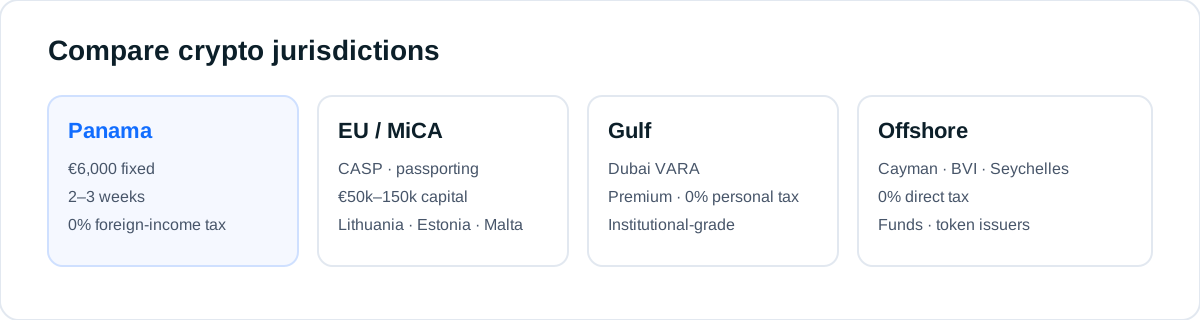
Exact pricing depends on the fund's size, number of investors, and whether a local fund manager is required. Consulting24 provides a detailed cost breakdown during the initial consultation. The timeline from preparation to license issuance is typically 3-6 months, though complex structures may take longer. For comparison, setting up a similar fund in Panama costs a flat EUR 6,000 for the company, but the regulatory framework is less specific to crypto funds. In Lithuania, a crypto fund may require a separate license under MiCA, with capital thresholds of EUR 125,000-150,000.
Capital Requirement
The minimum capital requirement for a crypto fund license Kazakhstan depends on the type of fund and whether it is marketed to retail or professional investors. As of 2026, the following thresholds apply:
- Retail fund: Minimum capital of USD 125,000 (or equivalent in KZT).
- Professional investor fund: Minimum capital of USD 50,000.
- Fund manager (separate entity): Minimum capital of USD 50,000.
Capital must be held in liquid assets and maintained at all times. It can be in the form of cash or cash equivalents. The capital requirement is lower than in many EU jurisdictions (which under MiCA require EUR 125,000-150,000 for similar activities), making Kazakhstan attractive for smaller fund managers. For example, a professional fund with USD 50,000 capital can start operations, whereas in Lithuania under MiCA the same activity would require at least EUR 125,000. This difference can be a deciding factor for early-stage fund managers.
Tax Treatment
The AIFC offers a favourable tax regime for licensed entities. Key tax benefits include:
- Corporate income tax: 0% on income derived from AIFC activities for the first 10 years (subject to extension).
- Withholding tax: 0% on dividends and interest paid to non-residents.
- VAT: 0% on most financial services.
- Capital gains: Exempt for gains on disposal of investments.
These incentives make Kazakhstan one of the most tax-efficient jurisdictions for crypto funds globally. However, fund managers should seek local tax advice to ensure compliance with their home country tax obligations. For example, a US-based manager may still be subject to US tax on global income, but the Kazakhstan entity itself pays no local tax. This structure can be combined with tax treaties to optimize overall tax liability.
Allowed Activities
A crypto fund license Kazakhstan permits the following activities:
- Establishing and managing collective investment schemes that invest in crypto assets.
- Accepting contributions from investors in fiat or crypto.
- Investing in a diversified portfolio of digital assets, including tokens, stablecoins, and crypto derivatives.
- Engaging in staking, lending, and yield farming as part of the fund's strategy.
- Issuing fund units or tokens representing ownership.
The license does not cover direct exchange services (buying/selling crypto for fiat) or custody services for third parties, which require separate licenses. However, the fund can use third-party exchanges and custodians. For example, a fund might delegate trading to a licensed exchange in the AIFC and use a qualified custodian for asset safekeeping. The fund's prospectus must clearly outline the permitted investment strategies and risk factors.
Step-by-Step Application Process
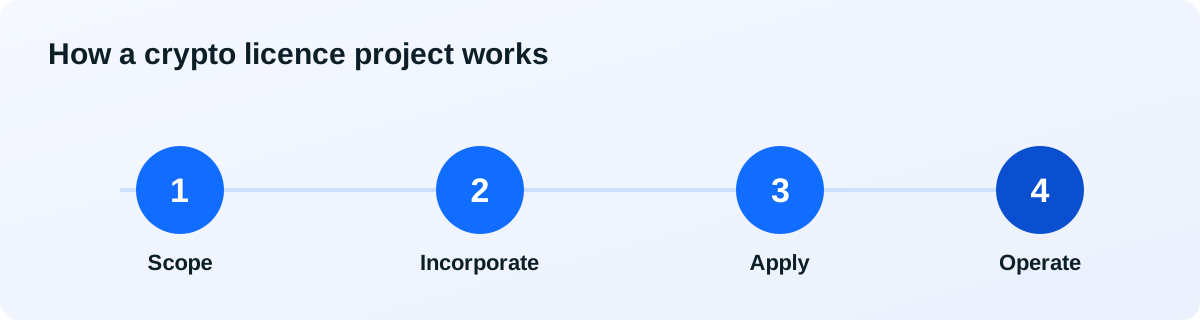
The process for obtaining a crypto fund license Kazakhstan involves the following steps:
- Pre-application consultation: Engage with Consulting24 to review your fund structure and determine the appropriate license category.
- Incorporation: Register a legal entity in the AIFC (typically a private company limited by shares).
- Appoint service providers: Engage a licensed fund administrator, custodian, and auditor.
- Prepare application documents: Including a business plan, fund prospectus, compliance manual, and AML policies.
- Submit to AFSA: File the application along with the fee. AFSA will conduct a fit and proper assessment of directors and shareholders.
- Review and approval: AFSA may request additional information. The process typically takes 3-6 months.
- Post-license compliance: Ongoing reporting, audits, and capital maintenance.
Consulting24 advises and coordinates each step, ensuring a smooth process. For example, we help draft the business plan to include detailed investment strategies, risk management, and projected financials. We also assist with the fit and proper declarations for all key individuals.
Banking & Payment Partners
Opening a bank account for a crypto fund in Kazakhstan can be challenging due to the perceived risk. However, the AIFC has partnerships with several local and international banks that accept licensed funds. Options include:
- Local Kazakh banks with AIFC branches (e.g., Halyk Bank, Kaspi Bank).
- International banks with presence in the AIFC (e.g., Standard Chartered, Citibank).
- EMI (Electronic Money Institution) accounts for faster onboarding.
Funds can also hold crypto assets with AFSA-licensed custodians. Consulting24 can introduce you to banking partners that have experience with crypto funds. For instance, we have worked with banks that accept fiat deposits from investors and allow the fund to transfer funds to exchanges. It is important to establish banking relationships early, as the due diligence process can take several weeks.
Benefits of the Kazakhstan Crypto Fund License
Choosing Kazakhstan for your crypto fund offers several advantages:
- Regulatory clarity: AFSA provides a clear rulebook based on English common law.
- Tax incentives: 0% corporate tax for 10 years, no capital gains tax.
- Cost efficiency: Lower setup and operating costs compared to EU or US jurisdictions.
- Time to market: 3-6 months is competitive globally.
- International recognition: The AIFC is a member of the International Association of Insurance Supervisors (IAIS) and has mutual recognition agreements.
For fund managers looking to launch a crypto fund with a solid regulatory foundation, Kazakhstan is a compelling option. Compared to Panama, which offers a simpler company setup at EUR 6,000 but lacks a specific crypto fund framework, Kazakhstan provides a tailored regime. Similarly, Lithuania under MiCA requires higher capital and more complex compliance, making Kazakhstan a middle ground in terms of cost and regulatory burden.
Compliance & Ongoing Obligations
Holding a crypto fund license Kazakhstan requires ongoing compliance. Key obligations include:
- Annual audit: By an AFSA-approved auditor.
- Regular reporting: Monthly, quarterly, and annual reports to AFSA on fund performance, NAV, and investor composition.
- AML/CFT compliance: Implement and maintain AML policies, conduct customer due diligence, and report suspicious transactions.
- Capital maintenance: Ensure minimum capital is always met.
- Fit and proper: Directors and senior management must remain fit and proper.
Non-compliance can result in fines, suspension, or revocation of the license. Consulting24 provides ongoing compliance support to help you meet these requirements. For example, we assist with drafting AML policies tailored to crypto assets, which must address risks like anonymity-enhanced cryptocurrencies and mixers. We also help prepare periodic reports to AFSA, ensuring they are accurate and submitted on time. This is general guidance, not legal advice; always consult a qualified lawyer for your specific situation.
Common Mistakes to Avoid
Applicants often make the following mistakes when applying for a crypto fund license Kazakhstan:
- Incomplete documentation: Failing to provide a detailed business plan or prospectus.
- Underestimating capital requirements: Not having sufficient liquid capital at the time of application.
- Choosing the wrong fund structure: Selecting a retail fund when a professional fund would be more appropriate.
- Ignoring AML requirements: Not having strong AML policies in place.
- Not engaging experienced advisors: Trying to do it alone can lead to delays and rejections.
Consulting24 helps you avoid these pitfalls by providing expert guidance from the start. For instance, we review your business plan to ensure it includes a clear investment strategy, risk management framework, and realistic financial projections. We also conduct a pre-assessment of your capital position to confirm you meet the minimum requirements before submission.
Alternatives: Kazakhstan vs Panama vs Lithuania
When considering a crypto fund license, it is useful to compare Kazakhstan with other popular jurisdictions.
| Jurisdiction | Regulator | Min Capital | Tax | Setup Cost | Timeline |
|---|---|---|---|---|---|
| Kazakhstan (AIFC) | AFSA | USD 50,000-125,000 | 0% for 10 years | USD 30,000-60,000 | 3-6 months |
| Panama | No specific crypto fund license | USD 10,000 (general) | 0% offshore | EUR 6,000 flat | 2-4 weeks |
| Lithuania (MiCA) | Bank of Lithuania | EUR 125,000-150,000 | 15% corporate tax | EUR 15,000-25,000 | 4-8 months |
Kazakhstan offers a dedicated crypto fund regime with low tax and moderate capital requirements. Panama is cheaper and faster but lacks a specific framework, which may deter institutional investors. Lithuania, under MiCA, provides EU passporting but at higher cost and capital. Your choice depends on your target investors, budget, and timeline. Consulting24 can help you compare these options and decide which jurisdiction best suits your fund.
How Consulting24 Can Help
Consulting24 advises and coordinates the crypto fund license Kazakhstan application. Our services include:
- Initial consultation to assess your fund structure and eligibility.
- Preparation of all application documents, including business plan and AML policies.
- Liaison with AFSA and local service providers.
- Ongoing compliance support after license issuance.
We also assist with comparing jurisdictions such as Panama, Lithuania, and others. Contact us via WhatsApp to book a consultation and discuss your project.
Frequently asked questions
What is the minimum capital for a crypto fund license in Kazakhstan?
The minimum capital is USD 50,000 for professional investor funds and USD 125,000 for retail funds. If a separate fund manager is required, that entity also needs USD 50,000 capital. Capital must be held in liquid assets.
How long does it take to get a crypto fund license in Kazakhstan?
The typical timeline is 3 to 6 months from application to issuance, depending on the complexity of the fund and the completeness of documentation. Pre-application preparation can add 4-8 weeks.
What taxes apply to a crypto fund in Kazakhstan?
Licensed AIFC entities enjoy 0% corporate income tax for the first 10 years, 0% withholding tax on dividends and interest to non-residents, and 0% VAT on financial services. Capital gains are also exempt.
Can I manage a crypto fund from outside Kazakhstan?
Yes, the fund manager can be located outside Kazakhstan, but the fund itself must be established in the AIFC. The manager may need to be licensed if it provides services from within the AIFC. Consulting24 can advise on the optimal structure.
What activities are allowed under the crypto fund license?
The license allows managing collective investment schemes investing in crypto assets, accepting investor contributions, trading digital assets, staking, lending, and issuing fund units. Direct exchange or third-party custody services require separate licenses.
Is the Kazakhstan crypto fund license recognized internationally?
The AIFC is recognized by several financial centres and is a member of IAIS. However, it does not provide an EU passport. Many institutional investors accept AIFC regulation as equivalent to other common law jurisdictions.
What are the ongoing compliance requirements?
Ongoing obligations include annual audits, monthly/quarterly reporting to AFSA, AML/CFT compliance, capital maintenance, and fit and proper assessments for directors. Non-compliance can lead to fines or license revocation.
Can I convert an existing offshore fund to a Kazakhstan license?
Yes, you can apply for a Recognised Fund license if your fund is already regulated in another jurisdiction. This involves a lighter application process. Consulting24 can assist with the conversion.
How does Kazakhstan compare to Panama for crypto funds?
Panama offers a simpler company setup at EUR 6,000 flat with no specific crypto fund license, but it lacks regulatory clarity for crypto. Kazakhstan provides a dedicated framework with tax benefits, higher credibility, and a longer timeline. The choice depends on your investor base and regulatory needs.
What documents are needed for the application?
Key documents include a business plan, fund prospectus, compliance manual, AML policies, financial projections, and fit and proper declarations for directors and shareholders. Consulting24 helps prepare these documents.
Official sources
Related jurisdictions

Talk to a crypto-licensing expert
500+ licenses across Estonia, Lithuania, Panama and beyond. Tell us your model and we'll map the right route, honestly.
💬 Talk to an expertFree consultationGeneral guidance, not legal advice. Rules and fees evolve, and we confirm current requirements for your case.