Crypto Stablecoin License in Poland (2026): Cost & Setup Stablecoin License Poland: A Complete 2026 Guide
Poland has emerged as a competitive jurisdiction for crypto businesses, including stablecoin issuers, under the EU's Markets in Crypto-Assets (MiCA) regulation. As of 2026, the Polish Financial Supervision Authority (KNF) oversees the licensing of crypto-asset service providers (CASPs) under a fully implemented MiCA framework. For founders seeking a crypto stablecoin license Poland, the process involves meeting capital requirements, demonstrating strong compliance, and handling the application process.
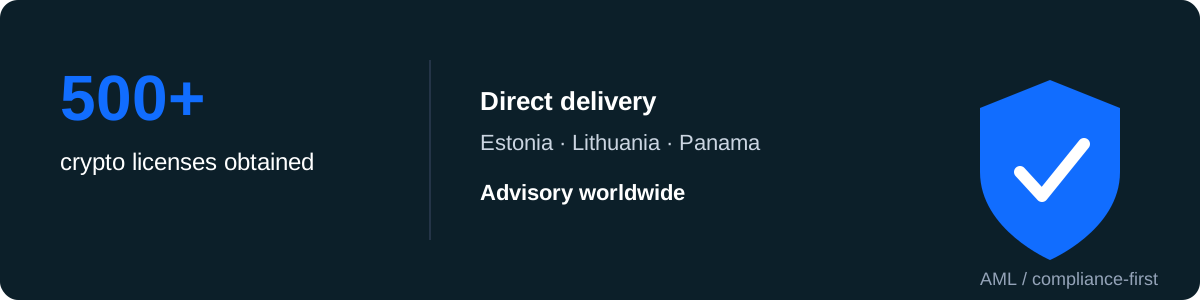
Consulting24 advises and coordinates applications for the Polish crypto license, using our experience across multiple jurisdictions. While we deliver directly in Estonia, Lithuania, and Panama, for Poland we provide expert advice and coordination, ensuring your application meets all regulatory standards. This guide covers everything you need to know about obtaining a crypto stablecoin license in Poland in 2026.
What Is the Crypto Stablecoin License Poland?
The crypto stablecoin license in Poland is a regulatory authorization under MiCA that allows companies to issue and manage stablecoins (asset-referenced tokens or e-money tokens) and provide related crypto-asset services. The license is granted by the KNF and is required for any entity offering stablecoin services to Polish or EU residents. It covers activities such as issuing stablecoins, custody, exchange, and transfer of crypto-assets.
Poland's framework is fully aligned with MiCA, meaning that a Polish license is recognized across the EU, providing passporting rights. This makes it an attractive option for stablecoin projects aiming for a European market. The license requires a minimum capital of EUR 150,000 for stablecoin issuance (the highest MiCA tier), along with comprehensive AML/KYC policies and operational safeguards. Unlike the pre-MiCA registration regime, the 2026 framework demands a full license application with detailed documentation, including a business plan, risk assessment, governance structure, and capital proof. The KNF conducts thorough background checks on key personnel and may require interviews. Consulting24 advises on structuring your application to meet these requirements efficiently.
Who Needs a Crypto Stablecoin License in Poland?
Any business that intends to issue stablecoins (e.g., asset-referenced tokens or e-money tokens) or provide crypto-asset services involving stablecoins in Poland or to Polish residents must obtain this license. This includes:
- Stablecoin issuers (e.g., companies creating a token pegged to fiat or commodities)
- Exchanges listing stablecoins
- Custodians holding stablecoins on behalf of clients
- Payment processors using stablecoins
- DeFi protocols with stablecoin exposure (if they fall under CASP definition)
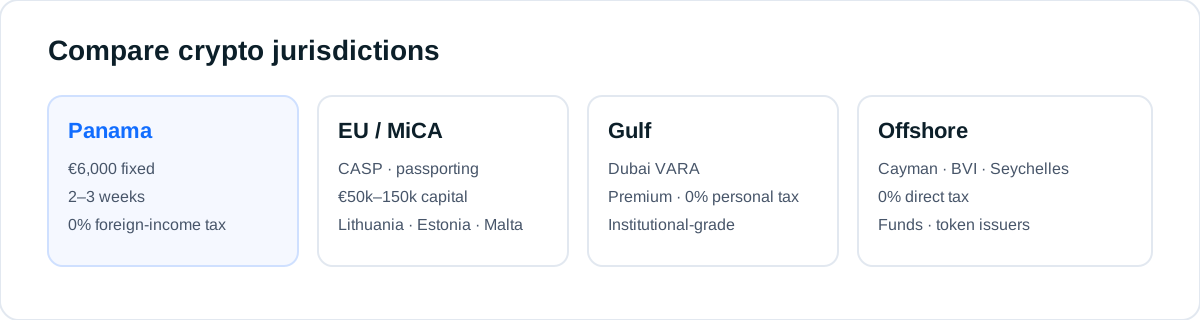
Even if your project is based outside Poland, if you target Polish customers, you need to comply. For example, a US-based stablecoin issuer offering services to Polish residents must obtain a Polish CASP license or rely on an EU passport from another member state. Consulting24 helps determine if your activities require licensing and advises on the best route, including alternative jurisdictions like Lithuania or Panama. In Panama, no specific stablecoin license exists, but a general business license with a flat fee of EUR 6,000 may suffice for certain operations, though without EU passporting.
License Type and Regulator
The relevant license is the Crypto-Asset Service Provider (CASP) license under MiCA, specifically for stablecoin-related services. The regulator is the Polish Financial Supervision Authority (Komisja Nadzoru Finansowego, KNF). The KNF is responsible for authorizing CASPs, supervising compliance with MiCA, and enforcing AML/CTF regulations. The KNF operates under the Polish Act on Crypto-Assets and the EU MiCA regulation, which came into full force in 2025.
Unlike the pre-MiCA era where Poland had a simple registration regime with no minimum capital, the 2026 framework requires a full license application. The KNF has published guidelines on fit-and-proper tests, governance, and risk management. Key personnel, including board members and the AML officer, must pass background checks. The license is valid across the EU via passporting, meaning a Polish CASP can serve clients in any EU member state without additional licensing. Consulting24 advises on meeting KNF's expectations and preparing the required documentation, such as the business plan, AML policy, and operational risk assessment.
Cost and Timeline of the Polish Stablecoin License
The cost and timeline for obtaining a crypto stablecoin license in Poland depend on the complexity of your business model and the completeness of your application. Below is an indicative table based on 2026 figures:
| Item | Estimated Cost (EUR) | Timeline |
|---|---|---|
| Application fee to KNF | 5,000 - 10,000 | Paid upfront |
| Legal and compliance advisory (Consulting24) | 15,000 - 30,000 | Ongoing |
| Capital requirement (minimum) | 150,000 | Must be held throughout |
| Total setup cost (excl. capital) | 20,000 - 40,000 | 3-6 months |
Exact pricing is confirmed in a consultation. The timeline from application to approval typically ranges from 3 to 6 months, assuming all documents are in order. Delays can occur if the KNF requests additional information or if background checks reveal issues. For comparison, a Panama stablecoin license costs a flat EUR 6,000 with a faster setup of 2-4 weeks, but it does not provide EU passporting. Consulting24 can help you decide which jurisdiction fits your business goals.
Capital Requirement for Stablecoin Issuers in Poland
Under MiCA, the minimum capital requirement for stablecoin issuers is EUR 150,000. This is the highest tier, applicable to asset-referenced tokens and e-money tokens. For other CASP services (e.g., exchange, custody), the requirement is lower: EUR 50,000 for basic services and EUR 125,000 for more complex ones. However, if you issue stablecoins, the EUR 150,000 applies. Capital must be held in liquid assets, such as cash or government bonds, and maintained throughout the license period. The KNF may require additional capital based on risk assessment, for example, if the stablecoin's reserve assets are volatile or if the business model involves high transaction volumes.
Consulting24 advises on structuring your capital to meet regulatory expectations. For example, you might need to demonstrate that the capital is unencumbered and available for operational risks. In contrast, Panama has no minimum capital requirement for stablecoin businesses, making it a lower-cost option. However, the absence of a dedicated crypto regulator in Panama means less regulatory clarity, which may affect investor confidence.
Tax Treatment for Stablecoin Businesses in Poland
Poland's tax treatment of crypto-assets, including stablecoins, is evolving. As of 2026, corporate income tax (CIT) applies to profits from stablecoin activities at the standard rate of 19% (or 9% for small taxpayers with revenues under EUR 2 million). VAT treatment depends on the nature of services; stablecoin issuance may be exempt from VAT under certain conditions, while exchange services may be subject to VAT. Personal income tax (PIT) for individuals trading stablecoins is 19% on capital gains, with a tax-free allowance of EUR 1,000. The Polish tax authority (KAS) has issued clarifications on crypto taxation, but the rules can be complex, especially for stablecoin issuers that earn fees from transaction volumes or interest on reserves.
It is crucial to get tailored tax advice, as the Polish tax authority (KAS) has issued clarifications on crypto taxation. Consulting24 can connect you with local tax experts who specialize in crypto. For comparison, Panama offers territorial taxation, meaning only income sourced in Panama is taxed, and there is no capital gains tax on crypto, which can be advantageous for stablecoin issuers with global operations.
Allowed Activities Under the Polish Stablecoin License
The Polish CASP license under MiCA allows the following activities related to stablecoins:
- Issuance of asset-referenced tokens and e-money tokens
- Custody and administration of stablecoins on behalf of clients
- Operation of a trading platform for stablecoins
- Exchange of stablecoins for fiat currency or other crypto-assets
- Execution of orders on behalf of clients
- Transfer services for stablecoins
- Advice and portfolio management involving stablecoins
Each activity must be specified in the license application. The KNF may impose additional conditions for stablecoin issuers, such as reserve asset requirements (e.g., holding reserves in a segregated account with a qualified custodian) and redemption policies (e.g., ensuring holders can redeem stablecoins at par at any time). For example, a stablecoin issuer must publish a white paper detailing the token's features, reserve composition, and redemption rights. Consulting24 helps you define the scope of activities and prepare the necessary documentation to avoid scope creep during the application.
Step-by-Step Process to Obtain a Crypto Stablecoin License in Poland
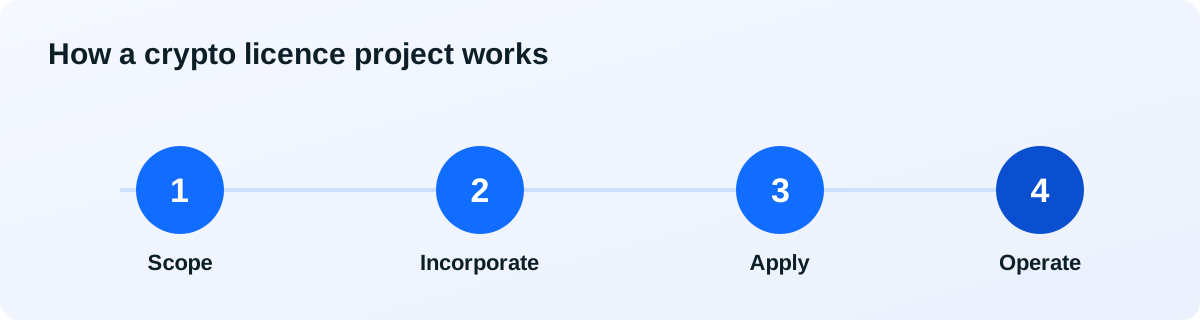
The application process involves several stages, typically taking 3-6 months. Consulting24 advises and coordinates each step:
- Pre-application preparation: Define your business model, identify applicable services, and prepare documentation (business plan, AML policy, risk assessment, governance structure). This stage includes drafting the white paper for the stablecoin, if applicable.
- Capital deposit: Ensure the minimum capital of EUR 150,000 is held in a Polish bank account or equivalent. The KNF requires proof of capital availability, such as a bank statement or a letter from the bank.
- Submission to KNF: File the application with all required documents and pay the application fee. The KNF may request additional information within 30 days.
- Review and queries: The KNF reviews the application, may request additional information, and conducts background checks on key personnel. This can take 2-3 months.
- Interview: In some cases, the KNF may interview management to assess suitability, including questions about business model, compliance understanding, and financial stability.
- Decision: Approval or rejection within 3 months of submission (extendable by 3 months). The KNF must issue a decision within 6 months at most.
- Post-licensing compliance: Ongoing reporting, audits, and compliance with MiCA requirements, including annual AML audits and quarterly financial reports.
Consulting24 ensures your application is complete and compliant, reducing the risk of delays. For a faster and simpler option, consider Panama where the process is streamlined with no minimum capital and a flat fee of EUR 6,000, but without EU passporting.
Banking and Payment Services for Stablecoin Licenses in Poland
Access to banking is critical for stablecoin issuers. Polish banks are generally cautious with crypto-related businesses, but a licensed CASP status helps. Many banks require a license before opening accounts, and they may conduct enhanced due diligence. Consulting24 assists in identifying crypto-friendly banks in Poland and the EU, such as those that have specific policies for regulated crypto firms. For example, some banks in Lithuania and Estonia are more open to crypto businesses, but they may require a local license.
Payment services, including fiat on-ramps and off-ramps, can be integrated through licensed EMI or payment institutions. Some stablecoin issuers partner with banks to hold reserve assets. The KNF requires that reserve assets be held in segregated accounts with a qualified custodian, such as a bank or a licensed crypto custodian. Consulting24 can recommend payment service providers that support stablecoin businesses. In Panama, banking is generally more accessible for crypto firms, but the lack of a dedicated regulatory framework may lead to higher scrutiny from international correspondent banks.
Benefits of a Polish Crypto Stablecoin License
Obtaining a Polish stablecoin license offers several advantages:
- EU passporting: Once licensed, you can operate across all EU member states without additional licensing, giving you access to a market of over 450 million consumers.
- Regulatory clarity: MiCA provides a clear legal framework for stablecoins, reducing uncertainty about legal treatment and investor protection.
- Access to EU market: Poland is a gateway to the European crypto market, with a large user base and a growing crypto ecosystem.
- Reputation: A regulated status enhances trust with partners, investors, and customers, which is especially important for stablecoin issuers that need to maintain confidence in the peg.
- Tax benefits: Competitive corporate tax rates compared to some EU countries like France or Germany, with a standard rate of 19% and a reduced rate of 9% for small businesses.
However, the process is more complex and costly than in jurisdictions like Panama, where a flat fee of EUR 6,000 applies with no minimum capital. Consulting24 can help you weigh the benefits of EU passporting against the simplicity of Panama.
Compliance and Trust: Meeting KNF Standards
Compliance is at the heart of the Polish stablecoin license. The KNF expects strong AML/KYC procedures, risk management, and operational resilience. Key requirements include:
- Appointment of a compliance officer and MLRO (Money Laundering Reporting Officer) who are resident in Poland or the EU.
- Implementation of transaction monitoring systems that can detect suspicious activity, such as large transfers or rapid trading patterns.
- Regular audits and reporting to KNF, including annual AML audits and quarterly financial reports.
- Secure custody of client assets and reserve funds, with segregation of client assets from the company's own funds.
- Business continuity and disaster recovery plans, including backup systems and data protection measures.
Consulting24 advises on building a compliance framework that meets KNF expectations. For example, we can help you draft an AML policy that covers customer due diligence, enhanced due diligence for high-risk customers, and ongoing monitoring. Note: this is general guidance, not legal advice. Always consult with a qualified lawyer. For a less demanding compliance environment, Panama may be more suitable, as it does not have a dedicated crypto regulator and imposes lighter AML requirements for general business licenses.
Common Mistakes in the Polish Stablecoin License Application
Many applicants face delays or rejection due to avoidable errors. Common mistakes include:
- Incomplete documentation, especially the business plan and risk assessment. The business plan must include detailed financial projections, market analysis, and a description of the stablecoin's mechanism.
- Underestimating capital requirements (EUR 150,000 is mandatory for issuers). Some applicants try to use borrowed funds or assets that are not liquid, which the KNF may reject.
- Poorly defined AML policies that do not align with MiCA standards. For example, failing to include procedures for freezing assets or reporting suspicious transactions to the Polish Financial Intelligence Unit.
- Lack of substance in Poland (e.g., no real office or local staff). The KNF requires a physical presence in Poland, including a registered office and key personnel based in the country.
- Ignoring the KNF's expectations on governance and fit-and-proper tests. Key personnel must have relevant experience and a clean criminal record.
Working with an experienced advisor like Consulting24 helps avoid these pitfalls. We also recommend comparing with Panama for a simpler alternative, where substance requirements are minimal and the application process is faster.
Alternatives and Comparison: Poland vs. Panama and Lithuania
When choosing a jurisdiction for your stablecoin license, consider the following comparison:
| Factor | Poland (MiCA) | Panama | Lithuania (MiCA) |
|---|---|---|---|
| Regulator | KNF | No dedicated crypto regulator (general financial) | Bank of Lithuania |
| License type | CASP under MiCA | General business license | CASP under MiCA |
| Minimum capital | EUR 150,000 (stablecoin issuance) | None | EUR 150,000 (stablecoin issuance) |
| Setup cost (excl. capital) | EUR 20,000 - 40,000 | EUR 6,000 flat | EUR 15,000 - 30,000 |
| Timeline | 3-6 months | 2-4 weeks | 3-6 months |
| EU passporting | Yes | No | Yes |
| Tax | CIT 19% (9% for small) | Territorial, no capital gains | CIT 15% |
Poland offers EU passporting and a strong regulatory framework, but at a higher cost and longer timeline. Panama provides a low-cost, fast option with no minimum capital, but lacks EU passporting and regulatory clarity. Lithuania is similar to Poland but with a slightly lower corporate tax rate and a more streamlined application process. Consulting24 delivers directly in Lithuania and Panama, and advises on Poland. For more comparisons, see our Poland vs Lithuania page.
Frequently asked questions
What is the minimum capital for a stablecoin license in Poland?
The minimum capital for stablecoin issuance (asset-referenced tokens or e-money tokens) is EUR 150,000 under MiCA. This must be held in liquid assets and maintained throughout the license period. For other CASP services, the requirement is lower: EUR 50,000 for basic services and EUR 125,000 for more complex ones.
How long does it take to get a Polish stablecoin license?
The typical timeline is 3 to 6 months from submission to approval, assuming all documents are complete. The KNF has up to 3 months to review the application, extendable by another 3 months. Delays can occur if additional information is requested or if background checks raise issues.
Can I passport a Polish stablecoin license to other EU countries?
Yes. Under MiCA, a CASP license issued by the KNF is valid across all EU member states via passporting. This means you can offer services in any EU country without additional licensing, subject to notification requirements.
What are the tax rates for stablecoin businesses in Poland?
Corporate income tax (CIT) is 19% (or 9% for small taxpayers with revenues under EUR 2 million). VAT treatment varies; stablecoin issuance may be exempt, while exchange services may be taxable. Personal income tax on crypto gains is 19%. Consult a tax advisor for specifics.
Does Poland require a physical office for a stablecoin license?
Yes. The KNF expects a physical presence in Poland, including a registered office and key personnel (e.g., compliance officer, MLRO) based in the country. This is part of the substance requirements under MiCA.
What activities are allowed under a Polish stablecoin license?
Allowed activities include issuance of stablecoins, custody, exchange, transfer, order execution, and advice. Each activity must be specified in the application. Stablecoin issuers must also comply with reserve and redemption requirements.
Is it difficult to open a bank account for a Polish stablecoin company?
It can be challenging, as Polish banks are cautious with crypto. A CASP license helps, but some banks may still refuse. Consulting24 can assist in identifying crypto-friendly banks in Poland and the EU.
What are the common reasons for rejection of a Polish stablecoin license?
Common reasons include incomplete documentation, insufficient capital, poor AML policies, lack of substance, and failure of fit-and-proper tests. Working with an advisor reduces these risks.
How does Panama compare to Poland for a stablecoin license?
Panama offers a flat fee of EUR 6,000, no minimum capital, and a 2-4 week timeline, but no EU passporting and less regulatory clarity. Poland provides EU passporting and a clear framework but at higher cost and longer timeline.
Can Consulting24 help with the Polish stablecoin license application?
Yes. Consulting24 advises and coordinates applications for the Polish crypto license, using our experience across jurisdictions. We deliver directly in Estonia, Lithuania, and Panama. For Poland, we provide expert advice and coordination.
Official sources
Related jurisdictions

Talk to a crypto-licensing expert
500+ licenses across Estonia, Lithuania, Panama and beyond. Tell us your model and we'll map the right route, honestly.
💬 Talk to an expertFree consultationGeneral guidance, not legal advice. Rules and fees evolve, and we confirm current requirements for your case.