UAE vs Panama for a Crypto Company: Which to Choose in 2026

Choosing the right jurisdiction for your crypto company is one of the most critical decisions you will make. In 2026, two very different but attractive options are the United Arab Emirates (UAE) and Panama. Each offers distinct advantages: the UAE provides a regulated, globally respected framework with a clear path to licensing, while Panama offers a low-cost, tax-neutral environment with a straightforward company setup. This page compares UAE vs Panama for a crypto company, helping you decide which jurisdiction aligns with your business model, budget, and compliance needs. We examine the regulatory framework, costs, capital requirements, tax treatment, and practical steps for both, drawing on our experience helping founders work through these choices.
Whether you are launching a crypto exchange, a DeFi project, or a blockchain advisory firm, understanding the trade-offs between these two jurisdictions is essential. Consulting24 delivers crypto licensing directly in Estonia, Lithuania, and Panama, and advises on all other jurisdictions including the UAE. For the UAE, we provide advisory and coordination services; we do not directly file for UAE licenses. Our goal is to give you an honest, factual comparison so you can make an informed decision. Let's dive into the key factors.
Overview: UAE vs Panama for Crypto Companies
The UAE has emerged as a leading global hub for crypto and blockchain innovation, with a mature regulatory framework centered around the Virtual Assets Regulatory Authority (VARA) in Dubai and the Financial Services Regulatory Authority (FSRA) in Abu Dhabi Global Market (ADGM). These bodies offer comprehensive licensing for virtual asset service providers (VASPs), including exchanges, custodians, and brokers. The UAE's approach is rigorous, requiring substantial capital, compliance infrastructure, and operational presence.
Panama, by contrast, has no specific crypto licensing regime. Instead, crypto companies operate under general corporate and tax laws, with no dedicated regulator for virtual assets. Panama offers a flat EUR 6,000 company setup fee, zero corporate income tax on foreign-source income, and no capital gains tax on crypto. This makes it an attractive base for trading, holding, or mining, but it lacks the regulatory stamp of approval that the UAE provides. For businesses that need to bank with traditional financial institutions or serve institutional clients, the UAE's regulated environment may be essential.
The choice between the two depends on your priorities: regulatory clarity and prestige (UAE) versus cost efficiency and simplicity (Panama). Below we break down each factor in detail.
Who Needs a Crypto License in the UAE or Panama?
In the UAE, any business providing virtual asset services must obtain a license from the relevant authority. This includes cryptocurrency exchanges, wallet providers, custody services, token issuers, and payment service providers using digital assets. The regime applies to both Dubai mainland and free zones, with VARA overseeing all activities within Dubai (except ADGM). ADGM’s FSRA also licenses crypto activities within its jurisdiction.
In Panama, there is no mandatory crypto license. However, companies that engage in activities such as money transmission, payment processing, or holding customer funds may need to comply with anti-money laundering (AML) regulations under the Financial Analysis Unit (UAF). For most crypto startups, a standard Panama corporation (Sociedad Anónima) suffices, provided they implement appropriate compliance measures voluntarily. This lack of a specific license can be a double-edged sword: it reduces upfront costs but may hinder access to banking and institutional partnerships.
Typical entities that benefit from Panama include individual traders, crypto mining operations, blockchain consulting firms, and projects that do not require a regulated status. The UAE is better suited for companies that need to prove regulatory compliance to partners, investors, or regulators in other jurisdictions.
License Type and Regulator
UAE (Dubai VARA): VARA issues several categories of licenses for virtual asset service providers, including:
- Exchange License (for trading platforms)
- Broker-Dealer License
- Lending and Borrowing License
- Advisory and Custody Services License
Each category has specific requirements, including minimum capital (see below), AML/KYC policies, and technology standards. VARA also requires a physical office in Dubai and a local compliance officer.
UAE (Abu Dhabi ADGM): ADGM’s FSRA offers a similar framework under its Financial Services Permission (FSP), which includes categories for operating a multilateral trading facility (MTF), custody, and asset management. ADGM is often preferred for its common law legal system and strong regulatory reputation.
Panama: No specific crypto regulator. Companies are subject to general corporate law (Law 32 of 1927) and AML oversight by the UAF. There is no licensing for crypto activities per se, but companies must register with the Public Registry and obtain a tax ID (RUC). For crypto-related activities, no additional permit is required, but voluntary compliance with FATF recommendations is advisable.
Cost and Timeline Comparison
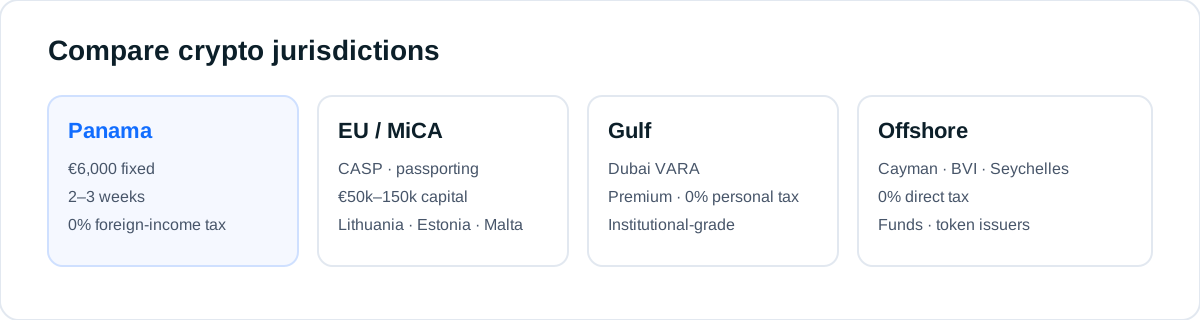
Cost is a major differentiator between the UAE and Panama. The UAE requires significant upfront investment, while Panama offers a flat, low-cost setup. Below is a comparison table based on typical figures as of 2026 (exact costs may vary; contact Consulting24 for a personalised quote).
| Item | UAE (Dubai VARA) | Panama |
|---|---|---|
| Company setup fee (approx.) | EUR 15,000 - 30,000 (including license application) | EUR 6,000 (flat fee, all inclusive) |
| Minimum capital requirement | EUR 100,000 - 500,000 (depending on license type) | None (but recommended EUR 10,000 for substance) |
| Annual renewal / compliance costs | EUR 20,000 - 50,000 (including office rent, compliance officer, audit) | EUR 1,500 - 3,000 (registered agent, annual fees) |
| Timeline to operational | 4 - 8 months (longer for complex licenses) | 2 - 4 weeks |
| Bank account opening | Difficult, but possible with regulated license; 2-4 months | Moderate difficulty; 1-2 months for crypto-friendly banks |
Panama's EUR 6,000 flat fee covers company incorporation, registered agent, and initial documentation. The UAE's costs are substantially higher, reflecting the regulatory overhead and physical presence requirements.
Capital Requirement
UAE: The minimum capital requirement depends on the license type and regulator. For VARA, typical minimums are:
- Exchange License: EUR 500,000 (or equivalent in AED)
- Broker-Dealer: EUR 250,000
- Custody: EUR 100,000
- Advisory: EUR 50,000
ADGM has similar tiers, with the highest being for operating an MTF (EUR 500,000). Capital must be paid up and maintained in a UAE bank account.
Panama: There is no legal minimum capital requirement for a standard corporation. However, for substance and credibility, we recommend a paid-up capital of at least EUR 10,000. Some banks may require a higher amount to open a corporate account. No capital needs to be deposited with any regulator.
Tax Treatment
UAE: The UAE has a federal corporate tax rate of 9% on taxable income exceeding EUR 100,000. However, free zones (including ADGM) often offer 0% corporate tax for qualifying activities, subject to meeting substance requirements. There is no personal income tax, no capital gains tax, and no VAT on crypto transactions. The UAE has signed double taxation treaties with many countries.
Panama: Panama operates a territorial tax system. Corporate income tax is 25% on Panama-source income only. Foreign-source income (including most crypto trading profits) is tax-exempt. There is no capital gains tax, no VAT, and no withholding tax on dividends paid to non-residents. Panama also has no central bank and the US dollar is legal tender, eliminating currency risk. For crypto companies that earn income from outside Panama, the tax burden can be zero.
Both jurisdictions offer favourable tax treatment, but Panama's territorial system is simpler and may result in zero tax for many crypto businesses, whereas the UAE's free zone regime requires careful structuring and substance.
Allowed Activities
UAE: Licensed VASPs can conduct a wide range of activities, including:
- Operating a crypto exchange (spot, derivatives with approval)
- Providing custody and wallet services
- Brokerage and dealing in virtual assets
- Lending and borrowing of virtual assets
- Token issuance (subject to additional regulation)
- Payment services using virtual assets
Activities must be strictly within the scope of the license. Unlicensed activities are illegal and can result in fines or imprisonment.
Panama: Since there is no specific crypto license, companies can legally engage in any crypto activity that does not violate general laws (e.g., fraud, money laundering). Common activities include:
- Trading and investing (proprietary)
- Running a crypto exchange (but unregulated, so no protection for users)
- Mining and staking
- Blockchain development and consulting
- Token sales (subject to securities laws if tokens are deemed securities)
However, operating a public exchange in Panama without a regulatory framework may be risky if the platform serves retail customers, as there is no investor protection. Many Panama companies operate exchanges from Panama but target non-Panamanian clients, relying on the territorial tax system.
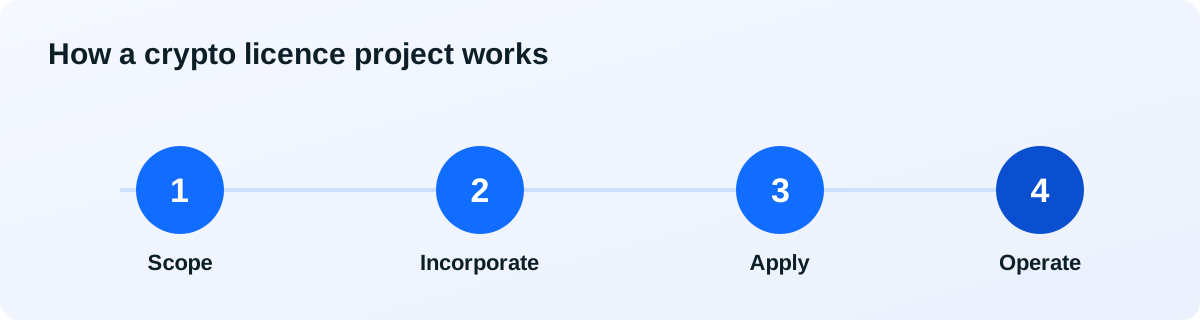
Step-by-Step Process: UAE vs Panama
UAE (Dubai VARA) Process:
- Pre-application consultation with VARA (or ADGM) to determine license type.
- Prepare business plan, AML/KYC policies, and risk assessment.
- Incorporate a company in a free zone (e.g., DMCC, ADGM) with a physical office.
- Submit license application with all supporting documents, including capital proof.
- VARA review and interview (may take 2-4 months).
- Upon approval, pay license fee and obtain operational license.
- Open a corporate bank account in the UAE (can take 1-3 months).
Panama Process:
- Choose a company name and reserve it with the Public Registry.
- Submit incorporation documents (articles of incorporation, registered agent acceptance).
- Pay the EUR 6,000 flat fee to Consulting24 (includes all government fees and registered agent for the first year).
- Receive company documents (Poder, certificate of incorporation, etc.) within 2-4 weeks.
- Obtain tax ID (RUC) and open a corporate bank account (we can assist).
- Implement AML compliance voluntarily (recommended).
Panama's process is significantly faster and simpler, with no regulatory approval needed for crypto activities.
Banking and Payment Services
UAE: Opening a bank account for a crypto company is challenging but possible with a regulated license. Major UAE banks (e.g., Emirates NBD, Mashreq) may accept VARA-licensed firms, but they require extensive due diligence. Some digital banks like Zand Bank and Al Maryouh Community Bank are more crypto-friendly. The process typically takes 2-4 months.
Panama: Panama has several banks that accept crypto-related companies, especially if the company has a clean record and strong compliance policies. Banks like Banco General, Banistmo, and Credicorp Bank are open to crypto businesses, though they may request detailed information about the business model and source of funds. Account opening usually takes 1-2 months. Some Panama companies also use international payment processors like Airwallex or Mercury.
For both jurisdictions, having a regulated license (UAE) or a strong compliance framework (Panama) improves banking success. Consulting24 can introduce you to banking partners in both regions.
Benefits of Each Jurisdiction
UAE Benefits:
- World-class regulatory framework that enhances credibility and trust.
- Access to a growing crypto ecosystem, including investors, partners, and talent.
- High-quality banking and payment infrastructure.
- Strategic location between East and West.
- No personal income tax and low corporate tax (0% in free zones).
Panama Benefits:
- Extremely low setup cost (EUR 6,000 flat).
- No minimum capital requirement.
- Territorial tax system: zero tax on foreign-source income.
- Fast incorporation (2-4 weeks).
- US dollar as legal tender, no currency risk.
- No specific crypto regulation means no compliance burden (but also no protection).
Panama is ideal for cost-conscious founders who want a simple structure, while the UAE is for those who need regulatory credibility and are willing to invest in it.
Compliance and Trust Considerations
Compliance is a key differentiator. The UAE's VARA regime requires strong AML/KYC programs, regular audits, and reporting. This gives clients and partners confidence that the company operates under a trusted regulatory framework. For businesses dealing with institutional investors or seeking to list on major exchanges, a UAE license is often a prerequisite.
Panama, while not requiring a crypto license, still expects companies to comply with AML laws. The UAF requires reporting of suspicious transactions. However, without a dedicated crypto regulator, there is no official stamp of approval. Some counterparties may view a Panama entity as higher risk, especially if it lacks a clear regulatory status. To mitigate this, Panama companies should voluntarily implement strong compliance measures, including KYC, transaction monitoring, and annual audits. Consulting24 can help design a compliance framework that meets international standards.
We provide general guidance, not legal advice. Always consult with a qualified lawyer for your specific situation.
Common Mistakes to Avoid
UAE:
- Underestimating the time and cost of the licensing process.
- Choosing the wrong license type (e.g., applying for an exchange license when a broker-dealer would suffice).
- Failing to secure a physical office before applying.
- Not preparing a comprehensive business plan and AML policies.
Panama:
- Assuming no regulation means no compliance needed - AML laws still apply.
- Using Panama for activities that require a regulated license in other jurisdictions (e.g., serving EU customers under MiCA).
- Neglecting to open a corporate bank account early (can delay operations).
- Choosing a cheap but unreliable registered agent.
Both jurisdictions require careful planning. Work with an experienced advisor like Consulting24 to avoid pitfalls.
Alternatives and Comparison with Other Jurisdictions
Beyond the UAE and Panama, crypto founders often consider Estonia, Lithuania, or Malta. Estonia and Lithuania offer EU-regulated licenses under MiCA, with capital requirements starting at EUR 50,000. They provide access to the European market but require substance and compliance. Malta is another EU option with a well-established framework.
For a low-cost alternative similar to Panama, the Cayman Islands and El Salvador are worth exploring. The Cayman Islands has a new VASP law, while El Salvador offers a Bitcoin-friendly environment with no capital gains tax.
If you are comparing Lithuania vs Panama, the choice often comes down to EU market access versus cost. Similarly, Czech Republic and Poland offer lower-cost EU options but with less regulatory clarity.
Ultimately, the best jurisdiction depends on your target market, budget, and long-term goals. Consulting24 can help you evaluate all options and choose the right path. For jurisdictions we do not directly serve, we provide advisory and coordination services.
Why Choose Consulting24 for Your Crypto Company Setup?
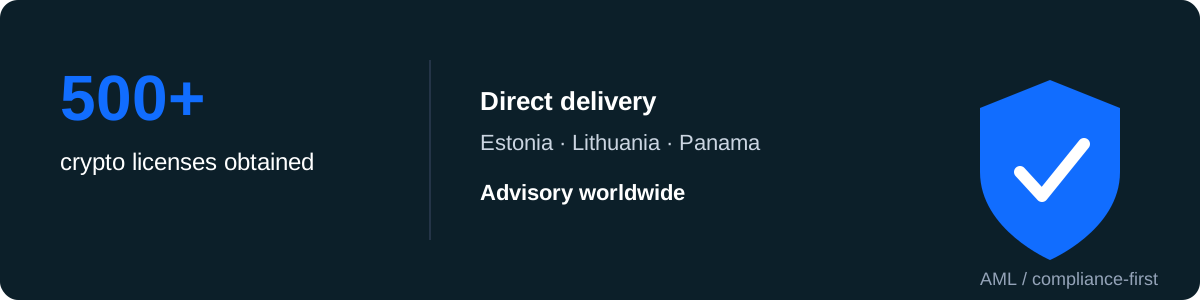
Consulting24 (X24Consulting OU, Tallinn, Estonia) has obtained over 500 crypto licenses worldwide. We deliver directly in Estonia, Lithuania, and Panama, and advise on all other jurisdictions including the UAE. Our team of experts provides end-to-end support, from company incorporation to license application, compliance setup, and banking introductions.
For Panama, we offer a flat EUR 6,000 package that includes company formation, registered agent, and initial documentation. For the UAE, we advise on the best free zone and license type, prepare your application, and coordinate with local partners. We do not file UAE licenses directly, but our network ensures a smooth process.
We pride ourselves on honest, transparent advice. We will not recommend a jurisdiction that does not fit your needs. Contact us today to discuss your project.
Frequently asked questions
What is the main difference between UAE and Panama for a crypto company?
The UAE offers a regulated environment with a specific crypto license (VARA or ADGM), high credibility, and access to institutional banking, but at a high cost and long timeline. Panama provides a simple, low-cost company setup with no specific crypto regulation, zero tax on foreign income, and fast incorporation, but lacks regulatory oversight.
Is Panama good for a crypto exchange?
Panama can be used for a crypto exchange, but it will be unregulated. This may be acceptable for a proprietary trading platform or a exchange targeting non-Panamanian clients. However, if you need to serve retail customers or require banking relationships, a regulated license in the UAE or an EU jurisdiction may be necessary.
How much does it cost to set up a crypto company in Panama?
Consulting24 offers a flat fee of EUR 6,000 for Panama company setup, which includes incorporation, registered agent, and initial documentation. There are no hidden costs. Annual maintenance is approximately EUR 1,500-3,000.
What is the minimum capital for a UAE crypto license?
Minimum capital depends on the license type. For a VARA exchange license, it is EUR 500,000; for broker-dealer, EUR 250,000; for custody, EUR 100,000; and for advisory, EUR 50,000. ADGM has similar tiers. Capital must be paid up and maintained in a UAE bank account.
Do I need to live in the UAE to get a crypto license?
Yes, you need a physical office in the UAE (in a free zone) and a local compliance officer. However, you do not need to be a resident yourself; you can appoint a local manager. Some free zones offer flexi-desk options, but VARA requires a dedicated office.
Can I bank in Panama with a crypto company?
Yes, several Panamanian banks accept crypto-related companies, including Banco General, Banistmo, and Credicorp Bank. They will require detailed due diligence on your business model and source of funds. Account opening typically takes 1-2 months.
Is Panama tax-free for crypto?
Panama has a territorial tax system: income sourced outside Panama is tax-exempt. For most crypto trading and investment activities, if you are not dealing with Panamanian clients, your income is foreign-source and thus tax-free. There is no capital gains tax on crypto.
How long does it take to get a UAE crypto license?
The process typically takes 4-8 months from application to operational license. This includes company incorporation, regulatory review, and bank account opening. The timeline can be longer for complex license types.
Can Consulting24 help me get a UAE crypto license?
Consulting24 advises and coordinates for UAE licenses, but does not directly file them. We can help you choose the right free zone, prepare your application, and connect you with local partners. For direct delivery, we offer Estonia, Lithuania, and Panama.
Which is better for a startup with limited budget: UAE or Panama?
Panama is significantly cheaper and faster. With EUR 6,000 you can have a company in 2-4 weeks. The UAE requires at least EUR 100,000 in capital plus high setup costs. Panama is better for bootstrapped startups, while the UAE suits well-funded projects needing regulatory credibility.
What activities are allowed in Panama without a license?
Any crypto activity not prohibited by general law is allowed, including trading, mining, staking, development, and consulting. Operating a public exchange or handling customer funds is legal but unregulated, so you assume the risk. Token sales may be subject to securities laws.
Does Panama have any crypto regulation?
Panama does not have a specific crypto law. However, the UAF (Financial Analysis Unit) oversees AML compliance, and companies must report suspicious transactions. There is no licensing requirement for virtual asset service providers as of 2026.
Official sources
- Dubai Virtual Assets Regulatory Authority (VARA)
- Abu Dhabi Global Market (ADGM) Financial Services Regulatory Authority
- Panama Public Registry (Registro Público de Panamá)
Related jurisdictions

Talk to a crypto-licensing expert
500+ licenses across Estonia, Lithuania, Panama and beyond. Tell us your model and we'll map the right route, honestly.
💬 Talk to an expertFree consultationGeneral guidance, not legal advice. Rules and fees evolve, and we confirm current requirements for your case.