Crypto Fund License in Georgia (2026): Cost & Setup Georgia: Your Guide to Licensing a Crypto Fund in Georgia
Georgia has emerged as a competitive jurisdiction for crypto fund licensing, offering a streamlined regulatory framework, favorable tax treatment, and low capital requirements. The crypto fund license in Georgia allows fund managers to operate legally, manage third-party assets, and attract investors globally. As of 2026, the National Bank of Georgia (NBG) oversees virtual asset service providers (VASPs), including fund managers, under the Law on Combating Money Laundering and the Financing of Terrorism. This page provides a comprehensive overview of the crypto fund license Georgia, covering who needs it, the regulator, costs, timeline, and step-by-step process.
Consulting24 advises and coordinates crypto fund licensing in Georgia, using our expertise across multiple jurisdictions. While we deliver directly in Estonia, Lithuania, and Panama, for Georgia we provide strategic advice and coordination with local partners. Whether you are launching a venture capital fund, a hedge fund, or a private equity fund focused on digital assets, understanding the Georgian licensing market is critical. Our team helps you handle the requirements, avoid common pitfalls, and achieve compliance efficiently.
What is a Crypto Fund License in Georgia?
A crypto fund license in Georgia is a regulatory authorization issued by the National Bank of Georgia (NBG) that permits a legal entity to manage, administer, or operate a collective investment scheme focused on crypto assets. This license is part of Georgia's broader VASP registration regime, which came into full effect in 2023 and has been refined through 2026. The license covers activities such as portfolio management, fund administration, and the offering of fund shares to qualified investors.
Unlike some EU jurisdictions that require a minimum capital of EUR 125,000 or more under MiCA, Georgia's capital requirement is significantly lower, typically around GEL 100,000 (approximately EUR 30,000) for fund managers. This makes Georgia an attractive entry point for smaller fund managers. The license does not fall under MiCA, as Georgia is not an EU member, but it aligns with FATF recommendations. Consulting24 advises clients on structuring their fund to meet NBG requirements, including having a local registered office, a compliance officer, and a board of directors with relevant experience.
Who Needs a Crypto Fund License in Georgia?
The crypto fund license in Georgia is required for any entity that manages a pool of crypto assets on behalf of investors, whether as a closed-end fund, open-end fund, or a special purpose vehicle. This includes:
- Venture capital funds investing in crypto startups
- Hedge funds trading digital assets
- Private equity funds focusing on blockchain companies
- Fund of funds that allocate to other crypto funds
Exemptions may apply for funds with fewer than 20 investors or where all investors are professional and the fund is not publicly marketed. However, most commercial fund structures will require a license. Consulting24 recommends a preliminary assessment to determine if your fund model falls under NBG's scope. Even if exempt, many funds choose to license voluntarily to signal credibility to investors and banks.
License Type & Regulator
The primary regulator for crypto fund licenses in Georgia is the National Bank of Georgia (NBG). The NBG registers VASPs, including fund managers, under the AML/CFT framework. There is no separate securities regulator for crypto funds; the NBG handles both AML supervision and licensing. The license type is a "VASP registration with fund management authorization." This is not a full investment firm license but a tailored regime for digital asset funds.
As of 2026, the NBG requires fund managers to submit a detailed business plan, AML policies, and proof of capital. The regulator also conducts a fit-and-proper test on directors and beneficial owners. Georgia's approach is principles-based, allowing flexibility in fund structures. However, the NBG expects a local presence, including a physical office and a local compliance officer. Consulting24 coordinates with Georgian legal counsel to prepare the application package and liaise with the NBG.
Cost & Timeline for a Crypto Fund License in Georgia
The cost of obtaining a crypto fund license in Georgia varies based on complexity and service providers. Below is an indicative table based on 2026 market rates. Exact pricing is confirmed in a consultation with Consulting24.
| Item | Cost (EUR) |
|---|---|
| Government application fee | 500 - 1,000 |
| Legal and compliance setup | 3,000 - 6,000 |
| Local registered office (annual) | 1,000 - 2,000 |
| AML software and policies | 1,500 - 3,000 |
| Consulting24 advisory fee | From 5,000 |
| Total estimated | 11,000 - 17,000 |
The timeline from engagement to license issuance is typically 3 to 6 months, depending on the completeness of the application and the NBG's workload. Pre-submission preparation takes 4-8 weeks, followed by a 2-4 month review period. Consulting24's coordination helps reduce delays by ensuring all documents are in order upfront.
Capital Requirement
The minimum capital requirement for a crypto fund license in Georgia is GEL 100,000 (approximately EUR 30,000 as of 2026). This capital must be fully paid up in cash and held in a Georgian bank account. The NBG may require higher capital if the fund's assets under management exceed a certain threshold, but the baseline is low compared to EU standards. For comparison, Lithuania requires EUR 125,000 for CASP licenses under MiCA, and Estonia requires EUR 100,000. Georgia's lower barrier makes it accessible for early-stage fund managers.
Capital must be maintained throughout the license period. It can be used for operational expenses but must be replenished if it falls below the minimum. Consulting24 advises on capital planning and ensures that the source of funds is documented to satisfy NBG's AML checks.
Tax Treatment for Crypto Funds in Georgia
Georgia offers a highly attractive tax regime for crypto funds. Corporate income tax is 15%, but there is a territorial tax system: income earned outside Georgia is not taxed if not repatriated. For fund managers, management fees are subject to 15% corporate tax, but capital gains from crypto trading may be exempt if the fund is structured as a foreign entity. Additionally, Georgia has no VAT on financial services, and no capital gains tax for individuals. The Estonian-style deferred tax system (tax on distributed profits only) applies to many Georgian companies, including fund management companies.
Consulting24 recommends structuring the fund as a limited partnership or a joint stock company to optimize tax. A tax ruling from the Georgian Revenue Service can provide certainty. As of 2026, Georgia has not introduced a specific crypto tax law, so general corporate and income tax rules apply. This creates opportunities for tax planning but requires careful documentation.
Allowed Activities Under the Crypto Fund License
Holders of a crypto fund license in Georgia are permitted to engage in the following activities:
- Managing portfolios of crypto assets for investors
- Issuing fund shares or units to qualified investors
- Administering the fund, including valuation and reporting
- Investing in initial coin offerings (ICOs) and security token offerings (STOs)
- Staking and lending crypto assets as part of fund strategy
- Providing custody of crypto assets for the fund (if licensed separately or outsourced)
Activities that require additional licensing include direct retail brokerage, exchange services, or proprietary trading outside the fund. The NBG prohibits fund managers from commingling fund assets with their own. Consulting24 helps define the scope of activities in the application to avoid regulatory breaches.
Step-by-Step Process to Obtain a Crypto Fund License in Georgia
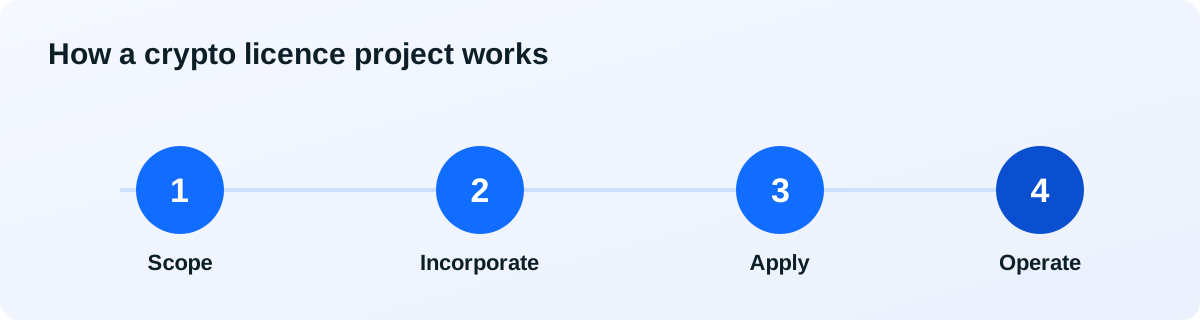
The process involves several stages, which Consulting24 coordinates with local partners:
- Initial consultation: Assess your fund structure and determine suitability for Georgia.
- Company incorporation: Register a Georgian company (usually a LLC or JSC) with the National Agency of Public Registry. Minimum share capital GEL 100,000.
- Document preparation: Draft AML/KYC policies, business plan, risk assessment, and fund prospectus.
- Appoint local representatives: Hire a compliance officer and a board of directors with relevant experience.
- Open a bank account: Deposit the minimum capital in a Georgian bank.
- Submit application: File with the NBG, including all documents and the application fee.
- NBG review: The regulator conducts fit-and-proper checks and may request additional information.
- License issuance: Once approved, you receive a VASP registration with fund management authorization.
- Ongoing compliance: Submit annual AML reports, maintain capital, and update the NBG on material changes.
Consulting24 guides you through each step, ensuring timely submissions and liaising with the NBG.
Banking & Payment Solutions for Crypto Funds in Georgia
Opening a bank account for a crypto fund in Georgia is challenging but feasible. Major banks like TBC Bank and Bank of Georgia accept VASP clients, but they require the license or a proof of application. As of 2026, banks conduct enhanced due diligence, including source of funds checks and interviews. Consulting24 recommends starting the banking process early. Alternative options include payment institutions or e-money institutions that offer crypto-friendly accounts.
For international wire transfers, Georgian banks are SWIFT-connected. Some fintechs like Revolut Business may also serve crypto funds, but they often require a license from a reputable jurisdiction. Consulting24 provides introductions to banking partners and advises on structuring accounts to avoid freezes.
Benefits of a Crypto Fund License in Georgia
Georgia offers several advantages for crypto fund managers:
- Low capital requirement: GEL 100,000 (approx. EUR 30,000) versus EUR 125,000 in Lithuania or EUR 150,000 in Malta.
- Favorable tax regime: Territorial taxation, no VAT on financial services, and deferred corporate tax.
- Fast licensing timeline: 3-6 months, faster than many EU jurisdictions.
- Flexible fund structures: No prescriptive investment limits, allowing diverse strategies.
- Growing ecosystem: Supportive government, low corruption, and a developing fintech hub.
- Strategic location: Bridge between Europe and Asia, with access to Eurasian markets.
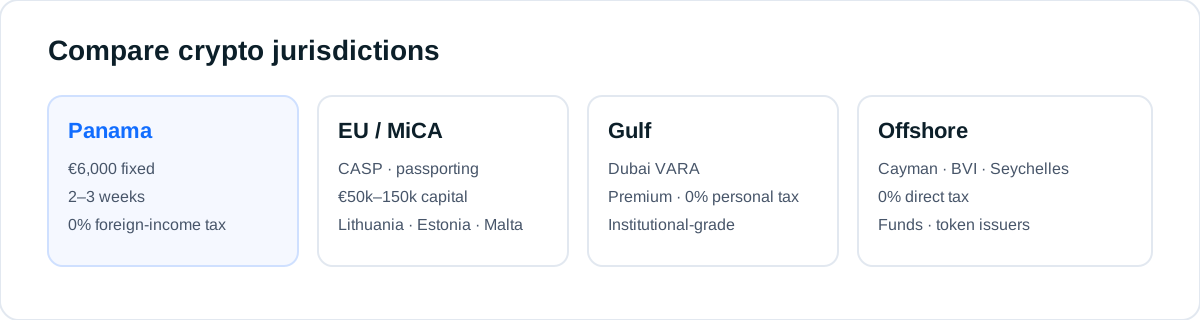
Compared to Panama (flat fee EUR 6,000 but no dedicated fund license), Georgia offers a regulated fund framework that institutional investors require. Consulting24 helps you weigh these benefits against other jurisdictions.
Compliance & Trust: Ongoing Obligations
Maintaining a crypto fund license in Georgia requires ongoing compliance. Fund managers must:
- Submit annual AML reports to the NBG
- Conduct regular risk assessments and update policies
- Maintain minimum capital at all times
- Ensure directors and compliance officers undergo fit-and-proper re-evaluations
- Report suspicious transactions to the Financial Monitoring Service
Failure to comply can result in fines, suspension, or revocation of the license. Consulting24 provides ongoing compliance support, including AML training, policy updates, and regulatory reporting. Note: This is general guidance, not legal advice. Always consult a qualified Georgian lawyer for your specific situation.
Common Mistakes When Applying for a Crypto Fund License in Georgia
Many applicants encounter pitfalls that delay or derail their license. Common mistakes include:
- Insufficient local presence: The NBG expects a physical office and local staff. Virtual offices are not accepted.
- Poorly drafted AML policies: Generic templates without specific procedures for crypto funds are rejected.
- Unclear source of funds: The NBG requires detailed documentation for all capital contributions.
- Ignoring fit-and-proper requirements: Directors with criminal records or lack of experience are disqualified.
- Underestimating timeline: Rushing the application leads to errors and requests for information.
Consulting24's advisory helps you avoid these errors by preparing a strong application package and conducting pre-submission reviews.
Alternatives and Comparison: Georgia vs. Other Jurisdictions
When considering a crypto fund license, Georgia competes with several jurisdictions. Below is a comparison with Panama and Lithuania:
| Factor | Georgia | Panama | Lithuania |
|---|---|---|---|
| License type | VASP registration (fund management) | No dedicated fund license; general corporate | CASP under MiCA (EUR 125,000 capital) |
| Minimum capital | GEL 100,000 (EUR 30,000) | None (but EUR 6,000 company setup) | EUR 125,000 |
| Tax | 15% corporate, territorial | 0% offshore income | 15% corporate, standard |
| Timeline | 3-6 months | 2-4 weeks (company only) | 3-6 months |
| Regulator | National Bank of Georgia | No specific crypto regulator | Bank of Lithuania |
| Institutional trust | Moderate | Low (no license) | High (EU MiCA) |
For fund managers seeking a regulated framework with low capital, Georgia is a strong choice. Panama offers speed and cost savings but lacks a fund license, which may deter institutional investors. Lithuania provides EU passporting but at higher cost. Consulting24 advises on the best fit based on your investor base and strategy. For other options, see our jurisdictions page.
Why Choose Consulting24 for Your Crypto Fund License in Georgia?
Consulting24 has extensive experience in crypto licensing across multiple jurisdictions, including Estonia, Lithuania, and Panama. For Georgia, we provide advisory and coordination services, working with vetted local lawyers and compliance experts. Our team understands the NBG's expectations and can streamline the application process. We offer:
- Pre-assessment of your fund structure
- End-to-end application management
- AML policy drafting tailored to crypto funds
- Ongoing compliance support
- Banking introductions
While we do not deliver the Georgia license directly, we ensure you have the right partners and documentation. Contact us for a consultation to discuss your project.
Frequently asked questions
What is the minimum capital for a crypto fund license in Georgia?
The minimum capital is GEL 100,000 (approximately EUR 30,000 as of 2026). This must be fully paid up in cash and held in a Georgian bank account. Higher capital may be required for larger funds.
How long does it take to get a crypto fund license in Georgia?
The typical timeline is 3 to 6 months from engagement to license issuance. This includes 4-8 weeks for preparation and 2-4 months for NBG review. Consulting24 helps expedite the process.
What activities are allowed under the Georgia crypto fund license?
License holders can manage crypto asset portfolios, issue fund shares, administer the fund, invest in ICOs/STOs, and engage in staking or lending as part of fund strategy. Retail brokerage or exchange services require separate licenses.
Is Georgia part of the EU's MiCA framework?
No, Georgia is not an EU member and is not subject to MiCA. Its crypto fund licensing is based on its own AML/CFT law and FATF recommendations, offering more flexibility than EU jurisdictions.
What are the tax benefits for crypto funds in Georgia?
Georgia has a territorial tax system: income earned outside Georgia is not taxed unless repatriated. Corporate tax is 15% on distributed profits, and there is no VAT on financial services. Capital gains for individuals are tax-free.
Do I need a physical office in Georgia for the license?
Yes, the NBG requires a local registered office and a physical presence. Virtual offices are not accepted. Consulting24 can help arrange office space and local staff.
Can I use the Georgia license to passport services to other countries?
No, Georgia does not offer EU passporting. However, the license may be recognized in some Eurasian Economic Union countries. For EU market access, consider Lithuania or Estonia.
What are the ongoing compliance requirements?
License holders must submit annual AML reports, maintain minimum capital, conduct regular risk assessments, and report suspicious transactions. The NBG may conduct periodic inspections.
How much does Consulting24 charge for advisory services?
Consulting24's advisory fee for Georgia starts from EUR 5,000, depending on the complexity of the fund structure and services required. Exact pricing is confirmed in a consultation.
What happens if my application is rejected?
The NBG may reject applications due to incomplete documentation, insufficient capital, or unfit directors. Consulting24 conducts a pre-submission review to minimize rejection risk. You can reapply after addressing deficiencies.
Official sources
Related jurisdictions

Talk to a crypto-licensing expert
500+ licenses across Estonia, Lithuania, Panama and beyond. Tell us your model and we'll map the right route, honestly.
💬 Talk to an expertFree consultationGeneral guidance, not legal advice. Rules and fees evolve, and we confirm current requirements for your case.