Romania vs Panama for a Crypto Company: Which Should You Choose?

Choosing between Romania and Panama for your crypto company is a pivotal decision. Both jurisdictions offer distinct advantages, but they cater to different business models and regulatory appetites. Romania, as an EU member, now operates under the full MiCA framework, requiring a CASP license with capital tiers of EUR 50,000 to EUR 150,000. Panama, by contrast, offers a lighter regulatory touch with a flat EUR 6,000 company setup and no specific crypto licensing regime. This page provides a detailed, factual comparison to help you decide which route aligns with your goals.
At Consulting24, we have obtained over 500 crypto licenses globally. We deliver directly in Estonia, Lithuania, and Panama, and advise on all other jurisdictions. Our team can guide you through the nuances of each market, ensuring you make an informed choice. Whether you prioritise regulatory clarity or operational flexibility, understanding the trade-offs is essential.
This guide covers licensing types, costs, timelines, tax treatment, banking options, and common pitfalls. We also include a step-by-step process for each jurisdiction and answer frequently asked questions. By the end, you will have a clear picture of which jurisdiction suits your crypto venture in 2026.
Overview: What Is the Choice Between Romania and Panama for a Crypto Company?
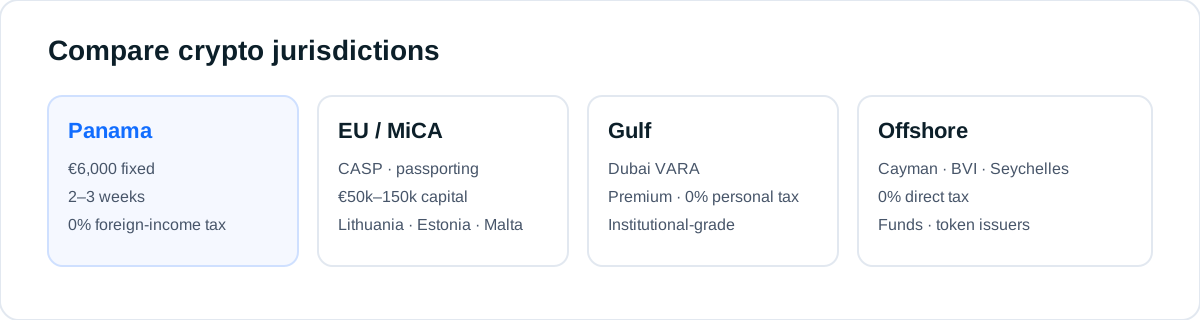
Romania and Panama represent two fundamentally different approaches to crypto regulation. Romania, as an EU member state, has transposed the Markets in Crypto-Assets (MiCA) regulation into national law. This means any crypto asset service provider (CASP) must obtain a license from the Romanian Financial Supervisory Authority (ASF) or the National Bank of Romania, depending on the service. The regime is comprehensive, with minimum capital requirements ranging from EUR 50,000 for simple exchange services to EUR 150,000 for more complex activities like custody and trading platforms.
Panama, on the other hand, has not enacted a specific crypto licensing law. Crypto businesses operate under general corporate and commercial laws, with no dedicated regulator. This creates a more flexible environment but also carries higher risk due to regulatory uncertainty. Panama's company setup cost is a flat EUR 6,000, making it an attractive entry point for startups testing the waters.
The choice between the two hinges on your target market, compliance appetite, and long-term strategy. If you need an EU passport to serve clients across Europe, Romania is the clear path. If you prioritise speed and low cost without immediate regulatory scrutiny, Panama may be suitable. Consulting24 can help you weigh these factors based on your specific business model.
Who Needs a Crypto License in Romania vs Panama?
In Romania, any entity providing crypto asset services to EU residents must hold a CASP license under MiCA. This includes exchanges, wallet providers, custodian services, and trading platforms. Even if your company is based outside the EU, if you target EU customers, you need a license in an EU member state like Romania. The Romanian regulator requires a physical presence, including a registered office and local management.
In Panama, there is no mandatory crypto license. However, businesses that engage in money transmission or payment services may fall under the purview of the Superintendencia de Bancos de Panamá (SBP) if they touch fiat currency. Pure crypto-to-crypto operations generally do not require a license. Nonetheless, many banks and payment processors require proof of regulatory compliance, so voluntary registration or a legal opinion is often advisable.
Founders who plan to raise funds from EU investors or serve EU clients should strongly consider Romania. Those focused on non-EU markets or who want to minimise upfront compliance costs may find Panama more appealing. Consulting24 advises clients on the best fit based on their target jurisdictions and business activities.
License Type and Regulator
Romania: The primary regulator is the Financial Supervisory Authority (ASF) for most crypto services, while the National Bank of Romania (BNR) oversees stablecoin issuance and payment-related activities. The license is a CASP (Crypto Asset Service Provider) authorization under MiCA. It is a single license that covers multiple service classes, but capital requirements vary by class.
Panama: There is no dedicated crypto regulator. The Superintendencia de Bancos de Panamá (SBP) regulates banks and financial institutions, but crypto exchanges and wallet providers are not directly supervised. Companies typically operate under a standard corporation (Sociedad Anónima) with no specific crypto license. However, if you engage in fiat on/off ramps, you may need a money services business license from the SBP.
Consulting24 delivers directly in Panama (company setup) and advises on Romanian licensing through local partners. We recommend that founders consider the regulatory clarity of Romania versus the flexibility of Panama.
Cost and Timeline Comparison
| Item | Romania (CASP License) | Panama (Company Setup) |
|---|---|---|
| Initial setup cost | EUR 5,000 - 10,000 (consulting + legal fees) | EUR 6,000 flat (Consulting24 fee) |
| Government fees | EUR 2,000 - 5,000 | Minimal (registration fees ~EUR 500) |
| Minimum capital | EUR 50,000 - 150,000 (depending on services) | None (no legal requirement) |
| Timeline | 3-6 months | 2-4 weeks |
| Ongoing costs | EUR 10,000 - 20,000/year (compliance, audit, legal) | EUR 1,500 - 3,000/year (registered agent, tax filing) |
Note: Exact pricing for Romania depends on the complexity of your application and the service classes you apply for. Panama costs are fixed at EUR 6,000 for company setup, but additional costs may apply for bank account opening or legal opinions. Consulting24 provides transparent quotes during your consultation.
Capital Requirements
Romania: Under MiCA, capital requirements are tiered by service class. For exchange services (buying/selling crypto against fiat), the minimum is EUR 50,000. For custody and wallet services, it is EUR 125,000. For trading platforms and complex services, it is EUR 150,000. Capital must be maintained as equity and cannot be used for operational expenses. Proof of capital is required at application and on an ongoing basis.
Panama: There is no statutory minimum capital for a standard corporation. However, banks may require a minimum deposit (typically USD 5,000 - 25,000) to open a corporate account. For practical purposes, founders often capitalise with USD 10,000 - 50,000 to demonstrate substance.
Romania's capital requirements are higher but provide a regulated status that facilitates banking and partnerships. Panama's low barrier is attractive for early-stage projects but may limit access to financial services.
Tax Treatment
Romania: Corporate income tax is 16% on profits. Crypto gains are treated as income and subject to standard corporate tax. VAT applies to services provided to EU customers (19% standard rate). There is no specific crypto tax regime; general tax rules apply. Romania has double tax treaties with many countries, which can reduce withholding taxes on dividends.
Panama: Panama operates a territorial tax system: income sourced outside Panama is not taxed. For a crypto company serving international clients, this often means 0% corporate tax on foreign-sourced income. Local-source income is taxed at 25%. Panama has no capital gains tax and no VAT. This can be highly advantageous for global crypto businesses.
However, tax residency rules matter: if your company is managed and controlled from Panama, worldwide income may become taxable. Proper structuring is essential. Consulting24 advises clients on tax-efficient setups in both jurisdictions.
Allowed Activities
Romania (CASP License): The license covers a broad range of activities, including:
- Exchange of crypto assets for fiat currency
- Exchange of crypto assets for other crypto assets
- Custody and administration of crypto assets on behalf of clients
- Operation of a trading platform
- Execution of orders on behalf of clients
- Placement of crypto assets
- Receiving and transmitting orders
- Providing advice on crypto assets
Panama: As there is no specific license, any crypto activity is technically allowed, including exchange, custody, mining, and DeFi. However, activities that involve fiat money (e.g., payment processing) may require a money services business license. Pure crypto-to-crypto services face no restrictions. Panama is also a popular jurisdiction for token issuance and DAO setups.
Romania offers a clear legal framework for regulated activities, while Panama provides maximum flexibility but less legal certainty.
Step-by-Step Process for Romania and Panama
Romania (CASP License)
- Pre-application: Define service classes, prepare business plan, AML policies, and governance documents.
- Company incorporation: Register a Romanian limited liability company (SRL) with a local registered office and director.
- Capital deposit: Deposit the required minimum capital in a Romanian bank account.
- Application submission: Submit the application to ASF (or BNR for stablecoin activities) with all supporting documents.
- Regulatory review: ASF reviews the application within 3 months (extendable). They may request additional information.
- On-site inspection: ASF may conduct an on-site visit to verify premises and compliance.
- License issuance: Upon approval, you receive a CASP license, which is valid across the EU.
Panama (Company Setup)
- Choose company name and structure (usually a Sociedad Anónima).
- Engage a registered agent (required by law).
- Submit incorporation documents to the Public Registry.
- Obtain tax ID (RUC) and open a corporate bank account (optional but recommended).
- Apply for any necessary permits (e.g., money services license if dealing with fiat).
- Maintain annual filings (registered agent, tax returns).
Consulting24 handles the entire Panama setup and coordinates Romanian licensing with local partners.
Banking and Payment Processing
Romania: Banks in Romania are generally open to crypto businesses that hold a CASP license. Major banks like Banca Transilvania and BRD accept licensed crypto companies, though they conduct thorough due diligence. Payment processors like Stripe and PayPal are available but may have restrictions on crypto-related transactions. A local bank account is mandatory for capital deposit and operational fiat handling.
Panama: Banking in Panama is more challenging for crypto companies due to de-risking by international banks. Local banks like Banco General and Towerbank may open accounts for crypto firms with strong compliance documentation, but many require a minimum deposit of USD 10,000 or more. Some crypto-friendly banks in Panama include Banco Atlántico and Multibank. Alternatively, many Panama companies use EMI (electronic money institution) accounts or crypto-friendly payment processors like BitPay or Coinbase Commerce.
Consulting24 can assist with bank introductions in both jurisdictions, but we recommend that Panama clients prepare a strong compliance pack.
Benefits of Romania vs Panama for a Crypto Company
Romania Benefits:
- EU passport: Serve all 27 EU member states with one license.
- Regulatory clarity: MiCA provides a clear legal framework, reducing legal risk.
- Access to EU banking and payment systems.
- Ability to partner with EU financial institutions.
- Skilled tech workforce and competitive operational costs.
Panama Benefits:
- Low setup cost: EUR 6,000 flat fee.
- No minimum capital requirement.
- Territorial tax: 0% tax on foreign-source income.
- Quick incorporation: 2-4 weeks.
- No specific crypto licensing, reducing regulatory burden.
- Privacy-friendly corporate structure.
Both jurisdictions have unique advantages. Romania is ideal for founders seeking legitimacy and EU market access. Panama suits those who prioritise cost efficiency and tax optimisation.
Compliance and Trust Considerations
Romania: Compliance is rigorous. You must implement AML/KYC procedures, appoint a compliance officer, conduct regular audits, and report suspicious transactions. The ASF has enforcement powers and can impose fines or revoke licenses. This high standard builds trust with clients and partners. Romania is a member of FATF and follows EU anti-money laundering directives.
Panama: Compliance is lighter but not absent. Panama has AML laws that apply to designated non-financial businesses and professions (DNFBPs), but crypto companies are not specifically covered. However, banks and payment processors will impose their own AML requirements. Panama is on the FATF grey list (as of 2026), which may affect international transactions. This grey-listing status can create friction with correspondent banks and may require enhanced due diligence.
General guidance: This information is for educational purposes and does not constitute legal advice. Always consult with a qualified attorney for your specific situation.
Common Mistakes When Choosing Between Romania and Panama
1. Assuming Panama is fully tax-free: Panama's territorial tax only exempts foreign-source income. If your company has local operations or clients, tax may apply. Also, grey-listing can complicate banking.
2. Underestimating Romania's capital requirements: EUR 50,000 minimum is a significant commitment. Some startups fail to maintain the capital or use it for expenses, leading to license revocation.
3. Ignoring substance requirements: Romania requires a physical office and local director. Panama requires a registered agent but no physical presence. However, substance is increasingly scrutinised by banks and regulators.
4. Overlooking banking challenges: Even with a license, banking can be difficult. In Panama, many crypto companies struggle to open accounts. In Romania, banks may still reject unlicensed entities.
5. Not considering target market: If your clients are in the EU, Panama is not a viable option without a licensed EU entity. Conversely, if your clients are in Asia or the Americas, Panama may be more suitable.
Consulting24 helps founders avoid these pitfalls by providing a structured comparison and personalised advice.
Alternatives and Comparisons
vs Lithuania: Lithuania was a popular EU jurisdiction for crypto before MiCA. Now, it has transposed MiCA with capital requirements similar to Romania. However, Lithuania's application process is faster (2-3 months) and costs are slightly lower (EUR 2,500 - 5,000 in government fees). Compare Lithuania vs Panama.
vs Estonia: Estonia was an early mover with its own VASP license, but MiCA has replaced it. Estonia now issues CASP licenses under MiCA with capital of EUR 50,000 - 150,000. Estonia has a strong e-residency program and digital infrastructure. Learn about Estonia.
vs Panama (as baseline): Panama remains the lowest-cost option with no capital requirement. However, it lacks regulatory clarity and EU market access. For founders who need an EU license, Romania or Lithuania are better choices. For those who want a simple, low-cost structure, Panama is hard to beat.
Consulting24 also advises on other jurisdictions such as Malta, Switzerland, and Dubai, depending on your needs.
Why Consulting24?
Consulting24 (X24Consulting OU, Tallinn, Estonia) has obtained over 500 crypto licenses worldwide. We deliver directly in Estonia, Lithuania, and Panama, and advise on all other jurisdictions. Our team provides end-to-end support, from company formation to license application and bank account opening.
We understand the nuances of both Romania and Panama. For Romania, we partner with local law firms to handle the CASP application. For Panama, we provide a flat EUR 6,000 company setup service that includes incorporation, registered agent, and tax ID. We also offer ongoing compliance support.
Every CTA on this page points to a free consultation where we can discuss your specific situation. Contact us via WhatsApp or book a call to get started.
Frequently asked questions
What is the main difference between Romania and Panama for a crypto company?
Romania requires a CASP license under MiCA with capital of EUR 50,000-150,000, offering EU passporting rights. Panama has no specific crypto license, low setup cost (EUR 6,000), and territorial tax, but lacks regulatory clarity and EU market access.
How much does it cost to set up a crypto company in Panama?
Consulting24 offers Panama company setup for a flat EUR 6,000. This includes incorporation, registered agent, and tax ID. Additional costs may apply for bank account opening or legal opinions.
Is Panama on the FATF grey list in 2026?
Yes, as of 2026, Panama remains on the FATF grey list. This can affect international banking relationships and may require enhanced due diligence. It does not prohibit crypto operations but adds friction.
Can I serve EU clients from a Panama crypto company?
Technically yes, but you would be unregulated in the EU. Under MiCA, any service to EU residents requires a CASP license. Operating without one risks legal action and banking issues. For EU clients, a licensed EU entity like Romania is recommended.
What are the capital requirements for a Romanian CASP license?
Capital requirements are tiered: EUR 50,000 for exchange services, EUR 125,000 for custody, and EUR 150,000 for trading platforms. Capital must be maintained as equity and cannot be used for operational expenses.
How long does it take to get a Romanian crypto license?
The application process typically takes 3-6 months. This includes company incorporation, document preparation, and regulatory review. The timeline can vary based on the completeness of your application and ASF's workload.
Does Panama tax crypto profits?
Panama taxes only locally-sourced income. If your crypto company serves international clients and has no local operations, profits are generally tax-free. However, if you have a physical office or local clients, tax may apply.
Which jurisdiction is better for a startup with limited budget?
Panama is more budget-friendly with a flat EUR 6,000 setup cost and no capital requirement. Romania requires significant capital (EUR 50,000+) and higher ongoing costs. However, Panama may limit access to banking and EU markets.
Can Consulting24 help with Romanian licensing?
Yes, Consulting24 advises and coordinates Romanian CASP applications through local partners. We do not deliver directly in Romania, but we manage the process and ensure compliance with MiCA requirements.
What activities are allowed under a Romanian CASP license?
The license covers exchange (fiat-crypto and crypto-crypto), custody, trading platform operation, order execution, placement, and advice. Stablecoin issuance and DeFi may require additional approvals.
Official sources
Related jurisdictions

Talk to a crypto-licensing expert
500+ licenses across Estonia, Lithuania, Panama and beyond. Tell us your model and we'll map the right route, honestly.
💬 Talk to an expertFree consultationGeneral guidance, not legal advice. Rules and fees evolve, and we confirm current requirements for your case.