AML/KYC Requirements for a Cyprus Crypto Company

Cyprus has long been a hub for crypto businesses due to its progressive regulatory environment. As of 2026, the European Union's Markets in Crypto-Assets Regulation (MiCA) is fully in force, and Cyprus has transposed it into national law. This means that any crypto asset service provider (CASP) operating in or from Cyprus must comply with strict Anti-Money Laundering (AML) and Know Your Customer (KYC) requirements. These rules are enforced by the Cyprus Securities and Exchange Commission (CySEC), which now oversees crypto licensing under MiCA.
If you are a crypto founder considering Cyprus as your base, understanding the AML/KYC framework is critical. This page provides a detailed, factual breakdown of what you need to implement, the costs involved, and how Consulting24 can help you manage the process. We deliver directly in Estonia, Lithuania, and Panama, and for Cyprus we advise and coordinate with local experts to ensure your compliance setup meets all regulatory standards.
What Are AML/KYC Requirements for a Cyprus Crypto Company?
AML/KYC requirements refer to the legal obligations that crypto companies must follow to prevent money laundering and terrorist financing. In Cyprus, these are derived from the EU's Anti-Money Laundering Directive (AMLD5/6) and the MiCA regulation. The key components include:
- Customer due diligence (CDD) - verifying the identity of clients before providing services. This includes collecting government-issued ID, proof of address, and beneficial ownership information.
- Ongoing monitoring of transactions and business relationships. You must screen transactions against sanctions lists and detect unusual patterns, such as rapid in-and-out movements or structuring.
- Reporting suspicious transactions to the Cyprus Unit for Combating Money Laundering (MOKAS). Reports must be filed within 15 days of suspicion.
- Appointing a compliance officer and a board member responsible for AML. The compliance officer must be a Cyprus resident with relevant experience.
- Maintaining records of all CDD and transactions for at least five years, even after the business relationship ends.
These requirements apply to all CASPs, including exchanges, wallet providers, and custodians. Failure to comply can result in fines, license revocation, or criminal liability. CySEC expects firms to implement risk-based procedures, meaning higher-risk clients (e.g., from non-EU countries) require enhanced due diligence (EDD).
Who Needs a Cyprus Crypto License?
Any entity providing crypto asset services in or from Cyprus must obtain a CASP license from CySEC. This includes:
- Cryptocurrency exchanges (both fiat-to-crypto and crypto-to-crypto).
- Wallet providers (custodial and non-custodial).
- Brokers and dealers in crypto assets.
- Platforms for initial coin offerings (ICOs) or security token offerings (STOs).
- Any service that involves custody, transfer, or exchange of crypto assets on behalf of clients.
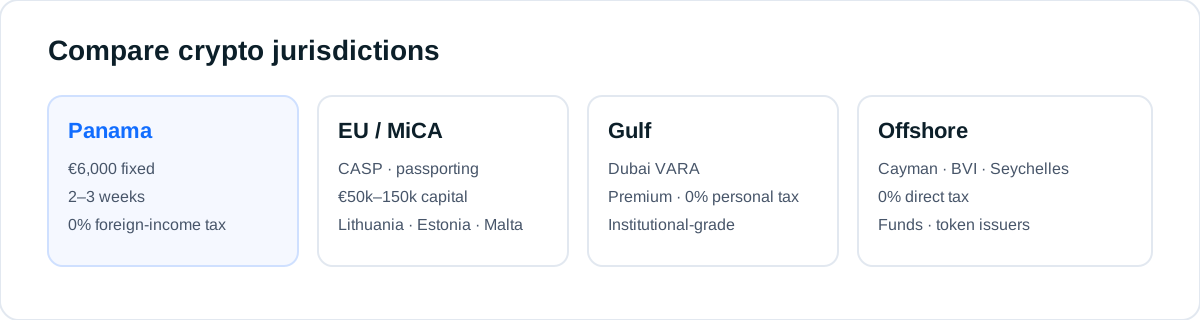
If you are targeting the EU market, Cyprus offers a passportable license under MiCA, allowing you to serve clients across all 27 member states. This makes it an attractive alternative to jurisdictions like Panama, which does not offer EU passporting. For a broader comparison, see our jurisdictions page. However, if your business is purely non-EU, Panama's flat EUR 6,000 cost may be more cost-effective.
License Type and Regulator
The Cyprus crypto license is a CASP license regulated by the Cyprus Securities and Exchange Commission (CySEC). Under MiCA, there are three categories of CASP licenses based on the services offered:
- Class 1: Basic services (e.g., execution of orders, placement of crypto assets) - minimum capital EUR 50,000.
- Class 2: Custody and transfer services - minimum capital EUR 125,000.
- Class 3: Full services including exchange and trading platforms - minimum capital EUR 150,000.
CySEC is known for its rigorous enforcement of AML rules. The regulator expects firms to have strong internal policies, a local compliance officer, and regular external audits. Consulting24 advises on the appropriate class based on your business model and coordinates with Cyprus-based legal partners for the application. For example, a simple order-execution service would fall under Class 1, while a full-exchange platform requires Class 3.
Cost and Timeline
| Item | Estimated Cost (EUR) |
|---|---|
| Application fee (CySEC) | 5,000 - 10,000 |
| Legal and compliance setup | 15,000 - 30,000 |
| AML/KYC software and procedures | 5,000 - 15,000 |
| Annual supervisory fee | 2,000 - 5,000 |
| Ongoing compliance costs (per year) | 10,000 - 25,000 |
The total setup cost for a Cyprus crypto license typically ranges from EUR 25,000 to 60,000, depending on the complexity of your services. The timeline from application to approval is 6 to 12 months, but this can be longer if CySEC raises questions on your AML framework. For a fixed-price alternative, consider Panama at EUR 6,000 flat - see our cost page for details. Note that these figures are estimates; exact pricing is confirmed in a consultation.
Capital Requirement
Under MiCA, the minimum capital requirement for a Cyprus CASP is tiered by service class:
- Class 1 (basic services): EUR 50,000.
- Class 2 (custody/transfer): EUR 125,000.
- Class 3 (full services): EUR 150,000.
This capital must be held in a Cyprus bank account and be fully paid up before license issuance. It can be used for operational expenses but must be maintained at the required level at all times. If your business grows, you may need to increase capital. Consulting24 can help you structure your capital planning. For comparison, Estonia has no minimum capital but requires a higher compliance burden. In practice, many founders choose Class 2 or 3 to allow for future expansion without re-licensing.
Tax Treatment
Cyprus offers a favourable tax regime for crypto companies:
- Corporate income tax: 12.5% (one of the lowest in the EU).
- No withholding tax on dividends paid to non-residents.
- No capital gains tax on the sale of crypto assets held as investments (subject to conditions).
- VAT: Crypto-to-fiat transactions are exempt from VAT; crypto-to-crypto may be subject to VAT depending on the service.
It is essential to have a tax advisor familiar with crypto to optimise your structure. Cyprus also has a wide network of double tax treaties, which can reduce withholding taxes on cross-border payments. For a jurisdiction with no corporate tax, see our Panama page. However, Panama's 0% corporate tax comes without EU passporting, so the choice depends on your target market.
Allowed Activities Under the Cyprus Crypto License
A Cyprus CASP license permits the following activities:
- Execution of orders for crypto assets on behalf of clients.
- Placing of crypto assets.
- Reception and transmission of orders.
- Custody and administration of crypto assets on behalf of clients.
- Operation of a trading platform for crypto assets.
- Exchange of crypto assets for fiat currency or other crypto assets.
- Provision of transfer services for crypto assets.
- Advice on crypto assets.
Note that certain activities, such as operating a crypto ATM or mining, may not require a license or may fall under different regulations. Always verify with CySEC or your legal advisor. For a full list of activities, see our exchange license page. If you plan to offer staking or lending, check whether those fall under MiCA's scope or require additional authorisation.
Step-by-Step Application Process
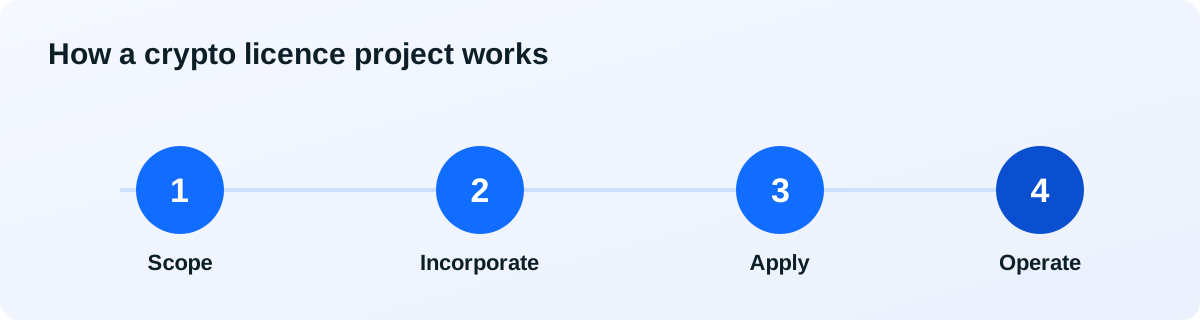
- Pre-application preparation: Define your business model, choose the appropriate license class, and prepare a detailed business plan and AML/KYC policy. This includes a risk assessment document covering customer types, products, and geographic exposure.
- Company incorporation: Register a Cyprus company with a local registered office and directors (at least one Cyprus resident). The company name must not include 'bank' or 'trust' without permission.
- Capital deposit: Open a Cyprus bank account and deposit the required minimum capital. The bank will conduct its own AML checks.
- Submit application: File the application with CySEC, including all supporting documents (e.g., AML manual, risk assessment, compliance officer CV, organisational chart).
- CySEC review: The regulator will review your application, conduct background checks on directors and shareholders, and may request additional information. This stage typically takes 3-6 months.
- On-site inspection: CySEC may visit your premises to verify your operational readiness, including IT systems and physical security.
- License issuance: Once approved, you receive the CASP license and can begin operations. You must then submit regular reports to CySEC, including quarterly transaction reports and annual AML audits.
Consulting24 coordinates with local legal partners to handle each step. For a simpler process, consider our direct delivery in Lithuania or Panama.
Banking and Payment Solutions
Opening a bank account for a crypto company in Cyprus is challenging but possible. Many traditional banks are wary of crypto due to AML risks. Options include:
- Cyprus-based banks (e.g., Bank of Cyprus, Hellenic Bank) - require a strong AML framework and a personal meeting. They often ask for a minimum deposit of EUR 50,000 and proof of license application.
- EMI (Electronic Money Institution) accounts - more crypto-friendly but may have transaction limits (e.g., EUR 100,000 per month) and higher fees.
- International banks with a Cyprus presence, such as Revolut Business or Paysera, which offer multi-currency accounts.
You will need to provide your AML/KYC policy, proof of license application, and details of your compliance officer. Consulting24 can introduce you to banking partners we have vetted. For jurisdictions with easier banking, see our Switzerland page. In practice, many Cyprus license holders use a combination of a local bank for capital and an EMI for daily operations.
Benefits of a Cyprus Crypto License
- EU passporting: Serve clients across all 27 EU member states with a single license.
- Low corporate tax: 12.5% corporate income tax, with no withholding tax on dividends.
- Skilled workforce: Access to English-speaking professionals in legal, compliance, and finance.
- Stable regulatory environment: CySEC is a respected EU regulator, enhancing credibility with partners and investors.
- No capital gains tax: On certain crypto holdings, if held as investments.
These benefits make Cyprus a strong choice for EU-focused crypto businesses. However, the AML/KYC requirements are strict and require ongoing investment. For a lower-cost alternative with no capital gains tax, consider Panama. Panama offers a flat EUR 6,000 cost and 0% corporate tax, but without EU passporting.
Compliance and Trust
Compliance is not optional. Cyprus regulators conduct periodic inspections and expect firms to maintain up-to-date AML/KYC procedures. Key compliance requirements include:
- Annual external audit of AML controls by a certified auditor.
- Submission of suspicious transaction reports (STRs) to MOKAS within 15 days of suspicion.
- Regular staff training on AML/KYC, at least once a year, with records kept.
- Independent audit of financial statements annually.
Failure to comply can lead to fines of up to EUR 5 million or 10% of annual turnover, and directors may face personal liability. This is general guidance, not legal advice. Always consult with a qualified lawyer. Consulting24 can help you build a compliance framework that meets CySEC standards. For a jurisdiction with lighter compliance, see our El Salvador page, but note that El Salvador does not offer EU passporting.
Common Mistakes to Avoid
- Underestimating AML/KYC costs: Many founders think they can handle compliance cheaply, but CySEC expects professional-grade systems. Budget at least EUR 10,000 for software and procedures.
- Incomplete documentation: Missing or poorly written AML policies are a top reason for rejection. Ensure your AML manual covers all required elements, including risk assessment, CDD procedures, and reporting.
- Ignoring local presence requirements: You need a Cyprus resident director and a registered office. Virtual offices are often not accepted; you may need a physical lease.
- Choosing the wrong license class: Opting for a class that doesn't match your activities can lead to delays or rejection. If in doubt, choose a higher class to allow for future expansion.
- Delaying bank account opening: Banks take 2-4 months to open accounts for crypto firms. Start the process early, even before submitting the license application.
Alternatives and Comparison
Cyprus is not the only option for crypto licensing. Here is how it compares to other jurisdictions:
| Jurisdiction | Setup Cost (EUR) | Corporate Tax | EU Passporting | Minimum Capital |
|---|---|---|---|---|
| Cyprus | 25,000-60,000 | 12.5% | Yes | 50,000-150,000 |
| Panama | 6,000 flat | 0% | No | None |
| Lithuania | 15,000-30,000 | 15% | Yes | 40,000-125,000 |
| Estonia | 10,000-20,000 | 20% (distributed profits) | Yes | None |
Panama is the cheapest option but lacks EU passporting. Lithuania offers a faster process (3-6 months) with lower costs than Cyprus. Estonia has no minimum capital but a higher tax burden on dividends. Your choice depends on your target market, budget, and timeline. Consulting24 can help you compare and choose the best fit.
Frequently asked questions
What is the minimum capital for a Cyprus crypto license?
Under MiCA, the minimum capital is tiered: EUR 50,000 for Class 1 (basic services), EUR 125,000 for Class 2 (custody/transfer), and EUR 150,000 for Class 3 (full services). This capital must be deposited in a Cyprus bank account before license issuance.
How long does it take to get a Cyprus crypto license?
The timeline from application to approval is typically 6 to 12 months. Delays can occur if CySEC requests additional information on your AML/KYC framework. Pre-application preparation takes 1-2 months. Consulting24 can help streamline the process.
Can I passport my Cyprus license to other EU countries?
Yes, under MiCA, a Cyprus CASP license is passportable across all 27 EU member states. This allows you to serve clients throughout the EU without obtaining separate licenses in each country.
What are the ongoing compliance costs for a Cyprus crypto company?
Ongoing costs include annual supervisory fees (EUR 2,000-5,000), AML/KYC software subscriptions (EUR 5,000-15,000 per year), compliance officer salary (EUR 30,000-60,000), and external audit fees (EUR 5,000-10,000). Total annual compliance costs range from EUR 10,000 to 25,000.
Do I need a local director in Cyprus?
Yes, CySEC requires at least one director who is a Cyprus resident. This director must have a clean criminal record and relevant experience. Consulting24 can help find a suitable candidate.
Is Cyprus tax-friendly for crypto companies?
Yes, Cyprus offers a 12.5% corporate tax rate, no withholding tax on dividends, and no capital gains tax on certain crypto holdings. It also has a wide network of double tax treaties. However, tax advice specific to your situation is recommended.
What happens if I fail AML/KYC compliance in Cyprus?
Non-compliance can result in fines up to EUR 5 million or 10% of annual turnover, license suspension or revocation, and personal liability for directors. CySEC conducts regular inspections and expects strong AML controls at all times.
Can I use an EMI for my Cyprus crypto company's banking?
Yes, EMIs like Revolut Business or Paysera are often more crypto-friendly than traditional banks. However, they may impose transaction limits and higher fees. Many companies use a combination of a local bank for capital and an EMI for daily operations.
How does Cyprus compare to Panama for crypto licensing?
Panama offers a flat EUR 6,000 cost and 0% corporate tax, but no EU passporting. Cyprus costs EUR 25,000-60,000 and has 12.5% tax, but allows EU-wide operations. Your choice depends on whether you need access to the EU market.
What activities are not covered by a Cyprus CASP license?
Activities like crypto mining, operating a crypto ATM, or providing non-custodial wallet software may not require a CASP license. However, if you hold client funds or execute orders, you likely need a license. Always check with CySEC or a legal advisor.
Official sources
Related jurisdictions

Talk to a crypto-licensing expert
500+ licenses across Estonia, Lithuania, Panama and beyond. Tell us your model and we'll map the right route, honestly.
💬 Talk to an expertFree consultationGeneral guidance, not legal advice. Rules and fees evolve, and we confirm current requirements for your case.