Switzerland Crypto Company Costs: A Complete 2026 Breakdown

If you are a crypto founder considering Switzerland as your base, you need a clear picture of the costs involved. Switzerland has long been a hub for blockchain innovation, but its regulatory framework and associated expenses are often misunderstood. This guide provides a transparent breakdown of Switzerland crypto company costs in 2026, covering licensing, capital requirements, taxes, and operational expenses.
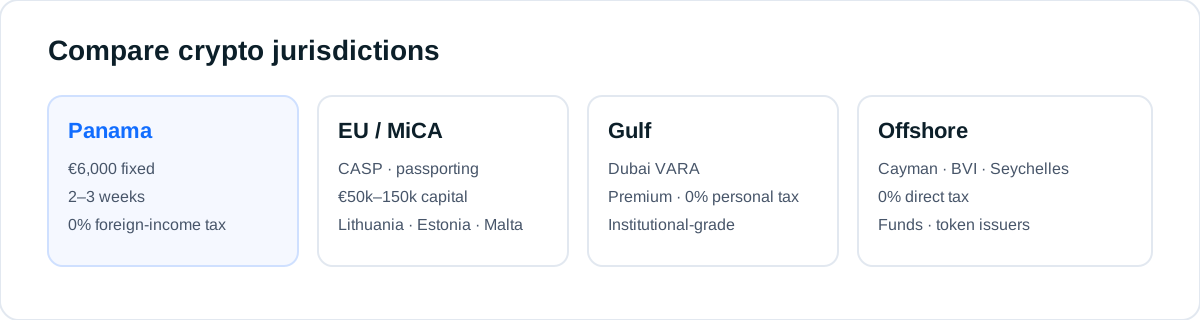
Switzerland offers a mature regulatory environment under FINMA, with a clear distinction between payment tokens, utility tokens, and asset tokens. However, the cost structure can be significantly higher than in other jurisdictions. For comparison, a Panama crypto license is available at a flat EUR 6,000, making it a popular alternative for cost-conscious founders. Consulting24 delivers directly in Estonia, Lithuania, and Panama, and advises on all other jurisdictions including Switzerland.
What Is a Switzerland Crypto Company and Its Costs?
A Switzerland crypto company is typically a corporation (AG or GmbH) that engages in blockchain-related activities such as trading, custody, or token issuance. The costs include company formation, regulatory licensing, ongoing compliance, and operational expenses. In 2026, the Swiss Financial Market Supervisory Authority (FINMA) requires a license for most crypto activities under the Financial Services Act (FinSA) and Anti-Money Laundering Act (AMLA).
Key cost components include:
- Company registration and notary fees: CHF 5,000-10,000
- Regulatory application fees: CHF 10,000-50,000
- Minimum capital requirements: CHF 100,000-500,000 depending on activity
- Annual compliance costs: CHF 20,000-100,000
- Office and staff costs: variable
Total first-year costs typically range from CHF 150,000 to over CHF 500,000. For a cost-effective alternative, explore our Panama crypto license at a flat EUR 6,000.
To give a concrete example, a startup offering crypto custody and exchange services would need a banking license, requiring CHF 500,000 capital and likely CHF 200,000 in first-year legal and compliance fees. In contrast, a token issuance project might only need a FinTech license with CHF 100,000 capital and CHF 100,000 in setup costs. These figures highlight the importance of matching your business model to the right license type.
Who Needs a Switzerland Crypto Company?
Switzerland attracts crypto startups seeking regulatory clarity, a skilled workforce, and a stable economy. You need a Swiss crypto company if you plan to:
- Operate a cryptocurrency exchange or trading platform
- Provide custody services for digital assets
- Issue tokens through an ICO or STO
- Run a blockchain-based payment system
- Offer crypto asset management or advisory services
However, the high cost may not suit early-stage projects. Many founders start in lower-cost jurisdictions like Panama or Lithuania and later expand to Switzerland. Consulting24 helps you compare options across jurisdictions. For example, a startup with limited funding might first obtain a Panama license for EUR 6,000, establish a track record, and then apply for a Swiss license when revenue allows.
License Type and Regulator
In Switzerland, the regulator is FINMA (Swiss Financial Market Supervisory Authority). Crypto activities fall under two main license categories:
- FinTech License: For deposit-taking up to CHF 100 million, with lighter requirements. Minimum capital CHF 100,000.
- Banking License: For full-scale banking activities including crypto custody and trading. Minimum capital CHF 500,000.
Additionally, asset managers and advisors need a license under the Financial Services Act (FinSA). For pure crypto exchange or custody, a banking license is typically required. The application process is rigorous, taking 6-12 months. For a faster, simpler process, consider our Lithuania crypto license, which operates under MiCA with a capital requirement of EUR 50,000 for CASP services.
Cost and Timeline Breakdown
| Item | Cost (CHF) | Timeline |
|---|---|---|
| Company formation (AG/GmbH) | 5,000-10,000 | 2-4 weeks |
| Regulatory application fee | 10,000-50,000 | 6-12 months |
| Minimum capital (FinTech) | 100,000 | At formation |
| Minimum capital (Banking) | 500,000 | At formation |
| Annual compliance (AML, audit) | 20,000-100,000 | Ongoing |
| Legal and advisory fees | 30,000-100,000 | First year |
Total first-year costs: CHF 150,000-500,000. For a fixed price of EUR 6,000, our Panama crypto license includes company setup and license. Exact pricing for Switzerland is confirmed in a consultation. The timeline for Switzerland is longer due to FINMA's thorough review, which often includes multiple rounds of questions. In contrast, Panama licenses are typically issued within 4-6 weeks.
Capital Requirement
Switzerland imposes minimum capital requirements based on the license type:
- FinTech License: CHF 100,000 (approx. EUR 95,000) - must be fully paid in cash.
- Banking License: CHF 500,000 (approx. EUR 475,000) - for full banking activities.
- Asset Manager: No fixed minimum but must have sufficient equity for operations.
Capital must be deposited in a Swiss bank account and cannot be withdrawn without FINMA approval. This is a significant barrier for startups. In contrast, Panama requires no minimum capital for a crypto license, and our package is EUR 6,000 all-in. Compare more on our cost page. For example, a startup needing a banking license would have to lock CHF 500,000, which could otherwise be used for product development.
Tax Treatment
Switzerland has a favorable tax regime for crypto companies. Key points:
- Corporate income tax: Effective rate 12-21% depending on canton (e.g., Zug ~12%, Zurich ~21%).
- VAT: 7.7% standard; crypto transactions may be exempt if considered payment tokens.
- Wealth tax: Cantonal, typically 0.1-0.5% on net assets.
- Stamp duty: 1% on equity issuance over CHF 1 million.
Switzerland does not tax capital gains for private individuals, but corporate gains are taxed. For tax optimization, many founders combine a Swiss holding company with an operating entity in a lower-tax jurisdiction like Panama, which has 0% corporate tax on foreign income. See our comparison with Lithuania for more details. For instance, a Swiss company earning CHF 1 million in profit would pay around CHF 120,000 in tax in Zug, while a Panama company would pay 0% on non-Panama-source income.
Allowed Activities
With a Swiss banking or FinTech license, you can:
- Operate a crypto exchange (spot and derivatives)
- Provide custody and wallet services
- Issue and trade tokens (security, utility, payment)
- Offer crypto lending and borrowing
- Manage crypto assets for third parties
- Run a blockchain-based payment system
Activities must be strictly within the license scope. Unlicensed activities like taking deposits without a banking license are prohibited. For a broader range of activities with lower costs, consider our Estonia crypto license. Under MiCA, Estonia allows CASP services with a capital requirement of EUR 50,000, covering exchange, custody, and transfer services.
Step-by-Step Process
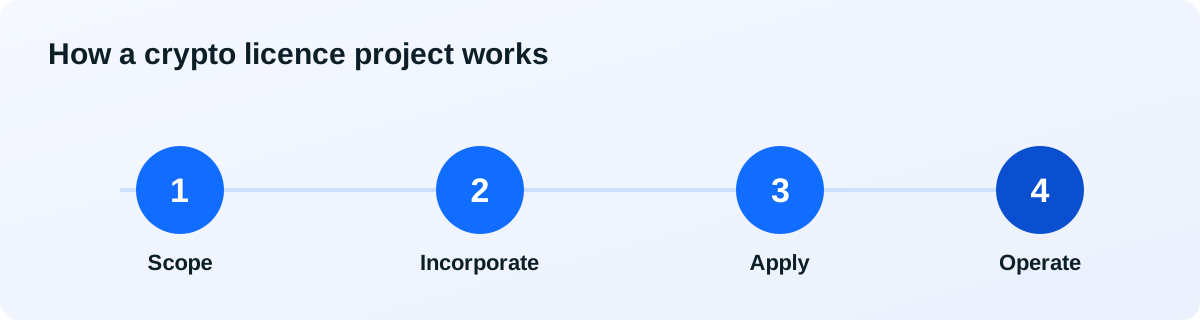
- Pre-assessment: Define business model and activities. Consulting24 provides a free initial consultation.
- Company incorporation: Register an AG or GmbH with the commercial register. Minimum capital deposited.
- Regulatory preparation: Prepare AML policies, risk management, and business plan for FINMA.
- Application submission: Submit to FINMA with required documents and fees.
- Review and audit: FINMA reviews application; may request changes. Expect 6-12 months.
- License issuance: Once approved, you can operate. Ongoing compliance required.
For a faster route, our application process page details how we handle Panama and Lithuania licenses in weeks. In Panama, the process is streamlined: company formation takes 1-2 weeks, license application 2-3 weeks, and total cost is EUR 6,000 flat.
Banking and Payments
Switzerland has a well-developed banking sector, but crypto companies face challenges opening accounts. Many traditional banks (UBS, Credit Suisse) are cautious. Specialized crypto-friendly banks include:
- SEBA Bank - licensed crypto bank
- Sygnum Bank - digital asset bank
- FlowBank - offers crypto services
Account opening requires a valid license and due diligence. Minimum deposits range from CHF 50,000-200,000. For payment processing, Swiss companies can use SEPA and SWIFT. In Panama, our license includes access to a corporate bank account with no minimum balance. Learn more on our company setup page. For example, a Swiss crypto exchange might need to maintain a CHF 100,000 minimum deposit at SEBA Bank, while a Panama company can open an account with zero deposit.
Benefits of a Switzerland Crypto Company
- Regulatory clarity: FINMA provides clear guidelines for crypto activities.
- Reputation: Swiss license is globally respected.
- Stable economy: Strong banking system and currency (CHF).
- Skilled workforce: Zug's Crypto Valley has a talent pool.
- Tax advantages: Low corporate tax in some cantons.
However, these benefits come at a high cost. For founders who prioritize speed and affordability, Panama offers a flat EUR 6,000 license with no capital requirement and 0% tax on foreign income. Compare on our homepage. The Swiss license is best for established firms that can afford the upfront investment and value the prestige.
Compliance and Trust
Switzerland has a strong compliance framework. Ongoing obligations include:
- AML/CFT procedures: KYC, transaction monitoring, reporting to MROS.
- Audit: Annual financial and regulatory audit by a licensed auditor.
- Reporting: Periodic reports to FINMA on financial health and compliance.
- Capital adequacy: Maintain minimum capital at all times.
Failure to comply can result in fines or license revocation. We recommend engaging a local compliance officer. This is general guidance, not legal advice. For a simpler compliance regime, consider Panama or Lithuania. See our requirements page for details. In Panama, compliance is lighter: annual renewal and basic AML procedures, with no capital maintenance requirement.
Common Mistakes
- Underestimating costs: Many founders assume CHF 50,000 is enough; actual costs are 3-10x higher.
- Ignoring capital requirements: Minimum capital must be deposited and locked.
- Choosing wrong license type: FinTech vs Banking - get it wrong and you face delays.
- Inadequate AML policies: FINMA rejects applications with weak compliance.
- Not planning for ongoing costs: Annual compliance can exceed CHF 100,000.
To avoid these, consult with experts. Consulting24 helps you choose the right jurisdiction. Read more on our blog. For example, a startup that applied for a banking license when a FinTech license would have sufficed wasted 6 months and CHF 30,000 in fees.
Alternatives and Comparison
Switzerland is not the only option. Here is a comparison with two popular alternatives:
| Jurisdiction | Cost (First Year) | Capital Requirement | Timeline | Tax |
|---|---|---|---|---|
| Switzerland | CHF 150,000-500,000 | CHF 100,000-500,000 | 6-12 months | 12-21% CIT |
| Panama | EUR 6,000 flat | None | 4-6 weeks | 0% on foreign income |
| Lithuania | EUR 5,000-15,000 | EUR 50,000 (MiCA) | 2-4 months | 15% CIT |
Panama is the most cost-effective, with no capital requirement and fast setup. Lithuania is a good EU option under MiCA. Switzerland is best for high-budget projects needing prestige. Compare more on our vs Lithuania page. For a startup with a budget under EUR 50,000, Panama or Lithuania are more realistic.
Why Choose Consulting24?
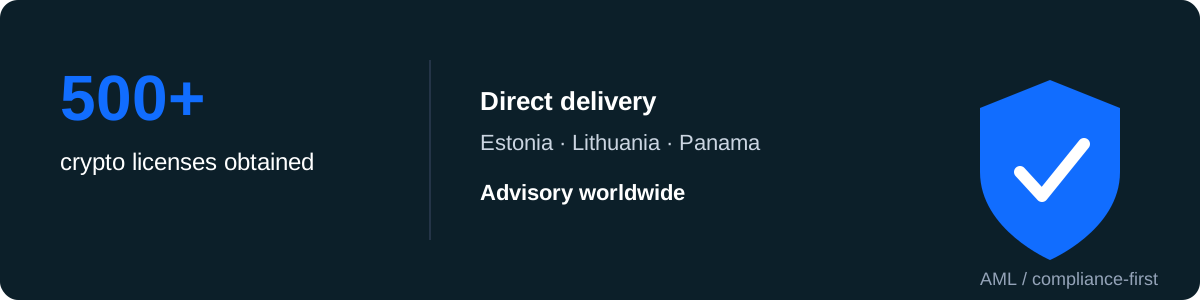
Consulting24 has obtained over 500 crypto licenses worldwide. We deliver directly in Estonia, Lithuania, and Panama, and advise on all other jurisdictions including Switzerland. Our flat fee for Panama is EUR 6,000, covering company setup and license. We provide honest, transparent guidance to help you choose the right jurisdiction for your business. Contact us for a free consultation to discuss your project and get a tailored cost estimate.
Frequently asked questions
What is the total cost to set up a crypto company in Switzerland in 2026?
First-year costs typically range from CHF 150,000 to CHF 500,000, including company formation, regulatory fees, minimum capital, and compliance. Exact figures depend on the license type and business model. A consultation with Consulting24 can provide a precise estimate.
What is the minimum capital required for a Swiss crypto license?
For a FinTech license, CHF 100,000; for a banking license, CHF 500,000. Capital must be fully paid in cash and deposited in a Swiss bank account. It cannot be withdrawn without FINMA approval.
How long does it take to get a Swiss crypto license?
The process takes 6-12 months, depending on the complexity of the application and FINMA's workload. Preparation of documents and AML policies can add 2-3 months before submission.
What activities are allowed under a Swiss crypto license?
Licensed activities include operating a crypto exchange, custody services, token issuance, crypto lending, asset management, and payment systems. Activities must be within the license scope; unlicensed deposit-taking is prohibited.
What are the tax rates for crypto companies in Switzerland?
Corporate income tax is 12-21% depending on the canton. VAT is 7.7% but crypto transactions may be exempt. Wealth tax applies at 0.1-0.5%. No capital gains tax for individuals, but corporate gains are taxed.
Can I open a bank account for my Swiss crypto company easily?
It is challenging. Traditional banks are cautious; specialized crypto banks like SEBA or Sygnum require a valid license and due diligence. Minimum deposits range from CHF 50,000 to CHF 200,000.
What are the ongoing compliance obligations for a Swiss crypto company?
Ongoing obligations include AML/CFT procedures, annual audit, periodic reporting to FINMA, and maintaining minimum capital. Annual compliance costs typically range from CHF 20,000 to CHF 100,000.
How does Switzerland compare to Panama for crypto licensing?
Switzerland offers prestige and regulatory clarity but costs CHF 150,000+ and takes 6-12 months. Panama costs EUR 6,000 flat, has no capital requirement, and takes 4-6 weeks. Panama also offers 0% tax on foreign income.
Is a Swiss crypto license recognized internationally?
Yes, a Swiss license is highly respected globally due to FINMA's rigorous standards. However, it does not automatically grant passporting rights in the EU; separate compliance with MiCA may be needed.
What are common mistakes when applying for a Swiss crypto license?
Common mistakes include underestimating costs, choosing the wrong license type, inadequate AML policies, and not planning for ongoing compliance. Consulting24 can help avoid these pitfalls.
Can Consulting24 help me obtain a Swiss crypto license?
Consulting24 advises and coordinates for Switzerland, using our experience from 500+ licenses. We deliver directly in Estonia, Lithuania, and Panama. Contact us for a consultation to explore the best jurisdiction for your project.
What is the difference between a FinTech license and a banking license in Switzerland?
A FinTech license allows deposit-taking up to CHF 100 million with lighter requirements and CHF 100,000 capital. A banking license is for full banking activities, including custody and trading, with CHF 500,000 capital and stricter oversight.
Official sources
Related jurisdictions

Talk to a crypto-licensing expert
500+ licenses across Estonia, Lithuania, Panama and beyond. Tell us your model and we'll map the right route, honestly.
💬 Talk to an expertFree consultationGeneral guidance, not legal advice. Rules and fees evolve, and we confirm current requirements for your case.