Crypto License Requirements in Cayman Islands: Full Checklist 2026

The Cayman Islands have established themselves as a leading jurisdiction for virtual asset service providers (VASPs), offering a clear regulatory framework under the Virtual Asset Service Provider Act (VASP Act). For crypto founders seeking a reputable, compliant base, understanding the crypto license requirements in Cayman Islands is essential. This checklist covers every step, from registration to ongoing compliance, and compares the Cayman route with alternatives like Panama and other jurisdictions we serve.
Whether you are launching an exchange, custody service, or DeFi platform, the Cayman Islands Monetary Authority (CIMA) demands rigorous due diligence, capital adequacy, and anti-money laundering (AML) controls. This guide presents the facts as of 2026, drawing on Consulting24's expertise in crypto licensing across multiple jurisdictions. We deliver directly in Estonia, Lithuania, and Panama, and advise on others including the Cayman Islands.
Below, you will find a detailed breakdown of license types, costs, timelines, tax treatment, and step-by-step procedures. Use this as your starting point for a successful application.
What Is a Crypto License in the Cayman Islands?
The Cayman Islands regulate virtual asset service providers under the VASP Act, administered by CIMA. A crypto license (or VASP registration) authorises entities to conduct activities such as exchanging virtual assets, transferring them, or providing custody. The regime is designed to align with FATF recommendations and international standards, making it attractive for institutional-grade operations.
Key features include a risk-based approach, mandatory AML/CFT programmes, and a requirement for physical presence (a registered office and local directors or managers). The Cayman Islands do not impose income tax, capital gains tax, or VAT, which is a significant draw for crypto businesses.
Consulting24 helps founders work through this process through our advisory and coordination services, while we directly handle licensing in Estonia, Lithuania, and Panama. For a faster and simpler alternative, consider Panama with a flat EUR 6,000 company setup.
Who Needs a Cayman Islands Crypto License?
Any entity providing virtual asset services in or from the Cayman Islands must register with CIMA. This includes:
- Virtual asset exchanges (centralised and decentralised)
- Custodial wallet providers
- Virtual asset transfer services (including OTC desks)
- Issuers of virtual assets (if engaged in exchange or transfer)
- Financial intermediaries dealing with virtual assets
Exemptions exist for certain non-profit tokens, closed-loop systems, and software development not involving custody or exchange. However, most commercial crypto businesses fall under the VASP Act. If you are unsure, a consultation with our team can clarify your obligations. For example, a DeFi protocol that only provides a trading interface without holding client funds may still be considered a VASP if it facilitates exchange.
License Type and Regulator
The Cayman Islands Monetary Authority (CIMA) is the sole regulator for VASPs. There is one main license type: the VASP registration. Unlike some jurisdictions (e.g., Lithuania with its multiple classes), the Cayman Islands offer a single authorisation that covers all virtual asset activities, subject to conditions.
CIMA classifies VASPs into two categories based on the nature of services: Class A (allowing all activities) and Class B (limited to specific activities, often with lower capital). However, as of 2026, most applicants pursue full registration. The regulator conducts a thorough assessment of the business model, source of funds, and governance.
Consulting24 advises clients on the appropriate classification and prepares applications for CIMA submission. For comparison, Lithuania offers a more structured multi-class system under MiCA.
Cost and Timeline
The cost of obtaining a VASP registration in the Cayman Islands includes government fees, professional fees, and ongoing compliance costs. Below is an indicative table based on 2026 data. Exact figures are confirmed during a consultation.
| Item | Estimated Cost (EUR) |
|---|---|
| Application fee (CIMA) | 5,000 - 10,000 |
| Legal and compliance advisory | 15,000 - 30,000 |
| Registered office (annual) | 2,000 - 5,000 |
| Local director/manager (annual) | 10,000 - 20,000 |
| Ongoing compliance (annual) | 5,000 - 15,000 |
| Total first year | 37,000 - 80,000 |
Timeline: 4-8 months from application to approval, assuming complete documentation. CIMA aims to process within 90 days, but delays occur if additional information is requested. Compare this to Panama's flat EUR 6,000 company setup and faster turnaround. For a cost-effective alternative, see our cost page.
Capital Requirement
The Cayman Islands VASP Act does not prescribe a fixed minimum capital amount. Instead, CIMA requires that the applicant maintain adequate financial resources proportionate to the nature, scale, and complexity of its business. This is assessed on a case-by-case basis.
As a rule of thumb, applicants should demonstrate at least EUR 50,000 in liquid capital for a basic operation, with higher amounts (EUR 100,000 - 500,000) expected for exchanges or custodians handling significant volumes. The capital must be held in a Cayman Islands bank account or equivalent.
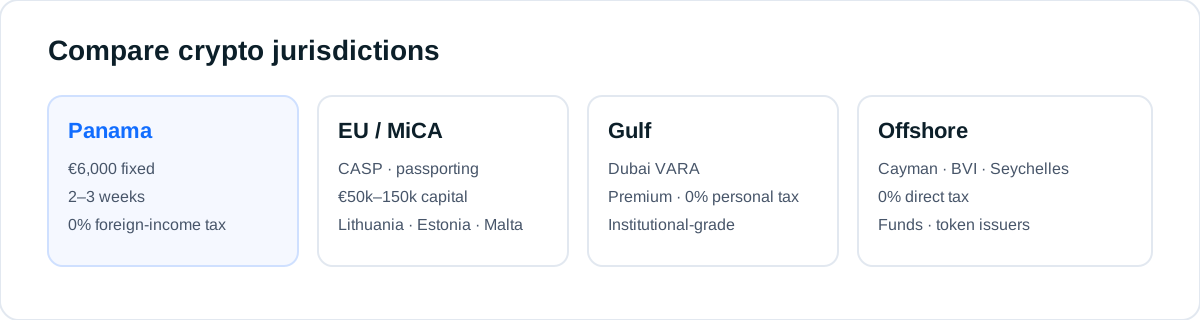
For comparison, Panama has no minimum capital requirement for crypto companies, while EU jurisdictions under MiCA mandate EUR 50,000 / 125,000 / 150,000 depending on service class. Check our requirements page for more details.
Tax Treatment
The Cayman Islands impose no direct taxes: no corporate income tax, capital gains tax, withholding tax, or VAT. This is a major advantage for crypto businesses. The only taxes are stamp duties on certain documents (minimal) and import duties on goods.
However, companies must pay annual registration fees to the Cayman Islands General Registry and CIMA. These are modest (typically EUR 2,000 - 5,000). The tax-neutral environment makes the Cayman Islands ideal for holding and trading virtual assets.
Consulting24 can help structure your entity to optimise tax efficiency, in coordination with your tax advisors. For a tax-free alternative with lower setup costs, consider Panama.
Allowed Activities Under the VASP License
A registered VASP in the Cayman Islands can conduct the following activities:
- Exchange between virtual assets and fiat currencies
- Exchange between one or more virtual assets
- Transfer of virtual assets (on behalf of clients)
- Custody and administration of virtual assets (including private keys)
- Participation in and provision of financial services related to an issuer's offer or sale of virtual assets
Activities not covered include mining, staking as a service (if not involving custody), and pure software development. The license does not permit banking or deposit-taking. If you plan to offer staking or lending, ensure your business model fits within the VASP definition. For example, a platform that stakes client tokens while holding private keys would likely require custody authorisation.
Step-by-Step Application Process
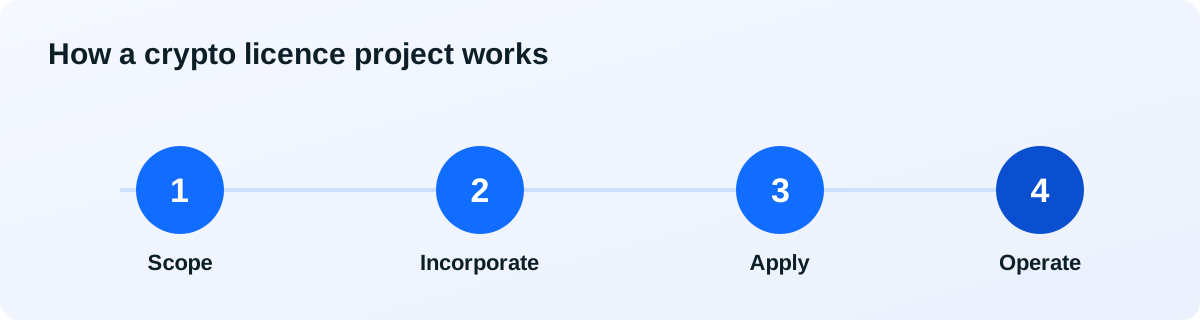
Obtaining a VASP registration involves several stages. Consulting24 coordinates each step for clients.
- Pre-application assessment: Review business model, source of funds, and suitability. Determine if Cayman is the right jurisdiction.
- Company incorporation: Register a Cayman Islands exempted company (or limited liability company) with a registered office.
- Appoint local directors/manager: At least one individual resident in Cayman (or a licensed corporate services provider).
- Prepare AML/CFT policies: Draft a comprehensive AML programme, risk assessment, and procedures.
- Compile application pack: Include business plan, financial projections, organisational chart, due diligence on directors and shareholders, and source of funds.
- Submit to CIMA: Pay application fee and submit online or in paper.
- Respond to queries: CIMA may request clarifications or additional documents within 30-60 days.
- Approval and post-licensing: Once approved, pay annual fees and commence operations under CIMA supervision.
Typical timeline: 4-8 months. For a faster and simpler alternative, consider Panama (EUR 6,000 flat, no capital requirement). See our application process page for more.
Banking and Payment Services
Opening a bank account in the Cayman Islands for a VASP can be challenging due to perceived risks. Many international banks are cautious. Options include:
- Cayman-based banks (e.g., Butterfield, Cayman National Bank) that accept VASPs after due diligence
- International banks with Cayman branches
- Fintech and EMI accounts (e.g., Wirex, Mercury) for fiat on/off ramps
We recommend starting the banking process early, as it can take 2-4 months. Consulting24 can introduce you to banking partners we work with. For a jurisdiction with easier banking access, consider Estonia or Panama.
Benefits of a Cayman Islands Crypto License
The Cayman Islands offer several advantages for crypto businesses:
- Tax neutrality: No corporate tax, capital gains tax, or VAT.
- Reputation: CIMA is a respected regulator, enhancing credibility with partners and investors.
- Flexible capital: No fixed minimum, tailored to business needs.
- Common law framework: Familiar legal system for international investors.
- No exchange controls: Free movement of capital.
However, costs are higher than in Panama or Lithuania. For founders seeking a cost-effective entry, Panama offers a flat EUR 6,000 company setup and a simpler regulatory environment. Explore our jurisdictions page for a full comparison.
Compliance and Ongoing Obligations
After registration, VASPs must comply with continuous obligations under the VASP Act and AML regulations. These include:
- Annual renewal with CIMA (fee payable)
- Submission of audited financial statements (if required)
- Ongoing AML/CFT monitoring and reporting of suspicious transactions
- Maintenance of records for at least 5 years
- Notification of material changes (e.g., new directors, change of business model)
Failure to comply can result in fines, suspension, or revocation of the license. Consulting24 provides ongoing compliance support for clients in jurisdictions we serve directly. This is general guidance, not legal advice.
Common Mistakes in the Application Process
Founders often make these errors when applying for a Cayman Islands VASP registration:
- Insufficient source of funds documentation: CIMA requires clear evidence of the origin of capital. Vague explanations lead to rejection.
- Lack of local substance: Having a registered office is not enough; you need local directors or a manager who are actively involved.
- Incomplete AML policies: Generic templates are not accepted. Policies must be tailored to your specific business.
- Underestimating timeline: Many assume 2-3 months; realistic is 4-8 months.
- Choosing the wrong jurisdiction: Cayman may be overkill for a small startup. Panama or Lithuania might be more suitable.
Consulting24 helps avoid these pitfalls through our advisory services. For a simpler option, see our company setup page.
Alternatives and Comparison
While the Cayman Islands offer a strong framework, other jurisdictions may better suit your needs. Here is a comparison with Panama and Lithuania:
| Factor | Cayman Islands | Panama | Lithuania (MiCA) |
|---|---|---|---|
| Cost (first year) | EUR 37,000 - 80,000 | EUR 6,000 flat | EUR 15,000 - 30,000 |
| Capital requirement | Case-by-case (min ~EUR 50,000) | None | EUR 50,000 / 125,000 / 150,000 |
| Timeline | 4-8 months | 1-2 months | 3-6 months |
| Tax | 0% corporate tax | 0% offshore tax | 15% corporate tax |
| Regulator | CIMA | No specific crypto regulator | Bank of Lithuania |
Panama is ideal for startups seeking low cost and speed. Lithuania offers EU passporting under MiCA. For more comparisons, see our vs Lithuania page and blog.
Frequently asked questions
What is the minimum capital requirement for a Cayman Islands crypto license?
There is no fixed minimum capital under the VASP Act. CIMA assesses capital adequacy on a case-by-case basis. Typically, applicants need at least EUR 50,000 in liquid capital for basic operations, with higher amounts for exchanges or custodians. Panama has no capital requirement.
How long does it take to get a crypto license in the Cayman Islands?
The process takes 4-8 months from application to approval. CIMA aims to process within 90 days, but delays occur if additional information is requested. Pre-application preparation can add 1-2 months. Panama offers a faster 1-2 month timeline.
What are the tax benefits of a Cayman Islands crypto license?
The Cayman Islands impose no corporate income tax, capital gains tax, withholding tax, or VAT. This tax-neutral environment is a major advantage for crypto businesses. Only annual registration fees and minimal stamp duties apply.
Can I operate an exchange with a Cayman Islands VASP registration?
Yes, a VASP registration allows exchange between virtual assets and fiat, and between virtual assets. Both centralised and decentralised exchanges are covered, provided they meet AML/CFT requirements. Custody services are also permitted.
Do I need local directors in the Cayman Islands?
Yes, the VASP Act requires at least one local director or manager who is a resident of the Cayman Islands. Alternatively, you can use a licensed corporate services provider. This ensures physical presence and regulatory oversight.
How does the Cayman Islands compare to Panama for crypto licensing?
Panama offers a flat EUR 6,000 company setup with no capital requirement and faster turnaround (1-2 months). The Cayman Islands have higher costs (EUR 37,000-80,000) and longer timelines but provide a stronger regulatory reputation and tax neutrality.
What are the ongoing compliance obligations after obtaining a VASP registration?
Obligations include annual renewal with CIMA, submission of audited financial statements if required, ongoing AML/CFT monitoring, record keeping for 5 years, and notification of material changes. Failure to comply can lead to fines or license revocation.
Can Consulting24 help with a Cayman Islands crypto license application?
Consulting24 advises and coordinates on Cayman Islands applications, using our experience in crypto licensing. We directly handle licensing in Estonia, Lithuania, and Panama. Contact us for a consultation to discuss your specific needs.
What activities are not allowed under a Cayman Islands VASP license?
Activities not covered include mining, staking as a service (if not involving custody), pure software development, and banking or deposit-taking. The license is limited to virtual asset exchange, transfer, custody, and related financial services.
Is the Cayman Islands crypto license recognized internationally?
Yes, CIMA is a respected regulator and the regime aligns with FATF standards. This enhances credibility with international partners, investors, and banks. However, it does not provide EU passporting like MiCA licenses in Lithuania.
Related jurisdictions

Talk to a crypto-licensing expert
500+ licenses across Estonia, Lithuania, Panama and beyond. Tell us your model and we'll map the right route, honestly.
💬 Talk to an expertFree consultationGeneral guidance, not legal advice. Rules and fees evolve, and we confirm current requirements for your case.