Crypto Banking and Payment Rails in Abu Dhabi: What to Expect in 2026

Abu Dhabi has emerged as a leading hub for crypto banking and payment rails, offering a regulated environment under the Financial Services Regulatory Authority (FSRA) of the Abu Dhabi Global Market (ADGM). For crypto founders seeking to integrate digital asset payments into their operations, understanding the local framework is essential. This guide provides a detailed overview of the licensing, costs, and operational realities in Abu Dhabi, with comparisons to other jurisdictions like Panama.
As of 2026, the ADGM's regime is mature, with clear rules for virtual asset service providers. However, the process can be complex and costly. Consulting24, with direct delivery in Estonia, Lithuania, and Panama, advises and coordinates on licensing in other jurisdictions, helping founders choose the right path. This article focuses on what to expect when setting up crypto banking and payment rails in Abu Dhabi.
What Are Crypto Banking and Payment Rails?
Crypto banking and payment rails refer to the infrastructure that enables the transfer, storage, and conversion of digital assets. In Abu Dhabi, this includes services like fiat-to-crypto on-ramps, crypto payment processing, and custodial wallets. The ADGM provides a legal framework that allows licensed firms to offer these services under the FSRA's oversight.
Key components include:
- Virtual asset exchange and custody
- Payment token services
- Fiat-crypto conversion
- Blockchain-based payment settlement
For founders, integrating these rails means faster cross-border transactions and access to a global customer base. However, regulatory compliance is non-negotiable. The FSRA requires all licensed entities to implement strong AML/CFT controls, including transaction monitoring and suspicious activity reporting. Without proper compliance, firms risk fines or license revocation. Consulting24 helps founders understand these requirements and prepare accordingly.
Who Needs a Crypto Banking License in Abu Dhabi?
Any business planning to offer virtual asset services in or from Abu Dhabi must obtain a license from the FSRA. This includes startups, fintech companies, and established financial institutions. Typical applicants include:
- Crypto exchanges (spot and derivatives)
- Payment processors accepting digital assets
- Custodial wallet providers
- Token issuers and fund managers
If your business model involves handling customer funds or facilitating crypto payments, you likely fall under the FSRA's scope. The regulator also covers activities like staking and lending if they involve custody or transfer of assets. Consulting24 helps founders assess whether Abu Dhabi or a simpler jurisdiction like Panama is more suitable for their needs. For example, a small payment processor with low transaction volumes might find Panama's flat fee of EUR 6,000 far more cost-effective than Abu Dhabi's high setup costs.
License Type and Regulator
The primary regulator is the Financial Services Regulatory Authority (FSRA) of the Abu Dhabi Global Market (ADGM). The main license is the Virtual Asset Service Provider (VASP) license, which covers multiple activities. There is no single "crypto banking" license; instead, firms apply for specific categories such as:
- Operating a Virtual Asset Exchange
- Providing Custody Services
- Facilitating Virtual Asset Transfers
- Virtual Asset Payment Services
Each category has its own requirements. The FSRA is known for its rigorous approach, requiring detailed business plans, AML/CFT policies, and a physical presence in ADGM. The regulator also conducts background checks on all key personnel, including directors and beneficial owners. This thoroughness adds to the timeline but ensures high standards. Consulting24 can coordinate with local legal partners to prepare a strong application package.
Cost and Timeline
Obtaining a VASP license in Abu Dhabi is expensive and time-consuming. Below is a summary of typical costs and timelines as of 2026. Exact figures vary by activity and complexity.
| Item | Estimated Cost (EUR) | Timeline |
|---|---|---|
| Application fee | 15,000 - 30,000 | 1-2 months |
| Legal and advisory fees | 50,000 - 100,000 | Ongoing |
| Capital requirement | 125,000 - 150,000 | Upfront |
| Annual compliance costs | 30,000 - 80,000 | Yearly |
| Total setup (first year) | 150,000 - 300,000 | 6-12 months |
For comparison, Panama offers a flat fee of EUR 6,000 for a crypto license, with no minimum capital and faster processing. Consulting24 delivers directly in Panama and can advise on Abu Dhabi through coordination. The high cost in Abu Dhabi often deters early-stage startups, but for well-funded projects targeting the Middle East market, the investment can be worthwhile.
Capital Requirement
The FSRA imposes capital requirements based on the type of activities. For payment services and exchange operations, the minimum capital is typically EUR 150,000 (or equivalent in AED). Custody services may require EUR 125,000, while simpler activities like advisory might be lower. These figures are subject to change and are confirmed during the application process.
In contrast, Panama has no minimum capital requirement for its crypto license, making it a more accessible option for early-stage projects. The capital must be held in a liquid form, such as cash or highly liquid assets, and cannot be used for operational expenses. This requirement can strain cash flow, especially for startups. Consulting24 advises clients on structuring their capital to meet FSRA standards while maintaining operational flexibility.
Tax Treatment
Abu Dhabi offers a favorable tax environment. The ADGM is a zero-tax jurisdiction for most business activities, including virtual asset services. There is no corporate income tax, no capital gains tax, and no VAT on crypto transactions. However, firms must comply with international tax reporting standards (e.g., CRS) and may be subject to a 9% corporate tax if they operate outside the free zone.
For founders, this tax neutrality is a major draw. But the high setup and compliance costs can offset the benefits. Consulting24 often compares this with Panama, which also offers territorial taxation and no capital gains tax. For example, a company generating EUR 500,000 in annual profit would pay zero tax in both ADGM and Panama (if Panama's territorial rules apply), but the Panama license costs a fraction of Abu Dhabi's. The choice depends on the target market and regulatory needs.
Allowed Activities Under the License
A VASP license in Abu Dhabi permits a range of activities, subject to approval. Common activities include:
- Exchange between virtual assets and fiat currencies
- Exchange between one or more virtual assets
- Transfer of virtual assets
- Custody and administration of virtual assets
- Participation in and provision of financial services related to an issuer's offer or sale of virtual assets
Each activity requires a separate authorization. The FSRA may impose conditions, such as limits on use or client types. It is important to define your business model clearly in the application. For instance, if you plan to offer both exchange and custody, you must apply for both categories. Consulting24 helps clients map their activities to the correct license categories to avoid delays.
Step-by-Step Application Process
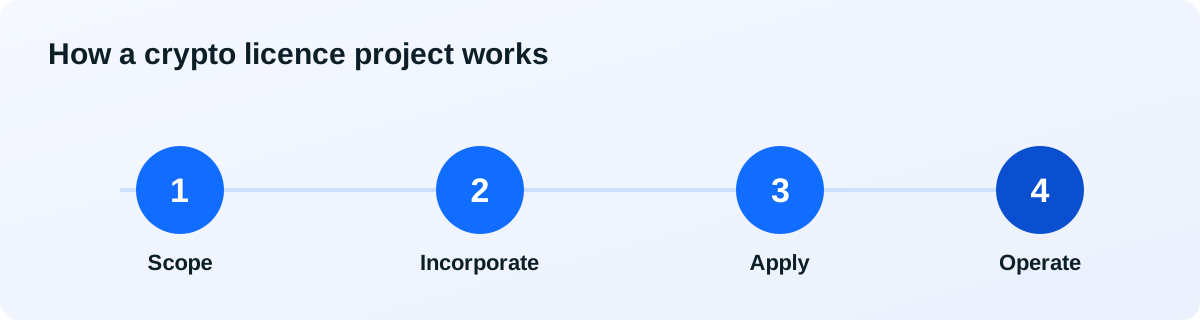
The process for obtaining a VASP license in Abu Dhabi involves several stages:
- Pre-application: Engage legal advisors, prepare business plan, AML/CFT policies, and corporate structure. This stage typically takes 1-2 months.
- Submit application: File with the FSRA, including all supporting documents and fee. The FSRA reviews completeness within 2-4 weeks.
- Review and due diligence: The FSRA conducts background checks on directors and shareholders. This can take 2-4 months.
- In-principle approval: If successful, you receive an IPA, allowing you to set up the operational infrastructure (office, technology, staff). This stage may take 2-3 months.
- Final approval: After meeting all conditions, the license is granted. This final step can take 1-2 months.
This process typically takes 6-12 months. Consulting24 can coordinate with local partners to streamline the journey, ensuring all documentation is in order and timelines are managed.
Banking and Payment Partnerships
Opening a bank account in Abu Dhabi for crypto businesses is challenging. Most traditional banks are cautious. However, the ADGM has a dedicated ecosystem with licensed digital banks and payment processors. Options include:
- ADGM-based banks like Abu Dhabi Commercial Bank (ADCB) and First Abu Dhabi Bank (FAB) offer accounts to licensed VASPs.
- Specialized crypto-friendly banks such as Zand Bank and Al Maryah Community Bank.
- Payment rails via ADGM's regulatory sandbox for innovative solutions.
Founders should prepare for extensive due diligence, including source of funds and business model explanations. Consulting24 advises clients on banking strategies, often recommending Panama for simpler banking access. In Panama, licensed crypto firms can open accounts with local banks more easily, and the licensing cost is a fraction of Abu Dhabi's.
Benefits of Abu Dhabi for Crypto Banking
Abu Dhabi offers several advantages for crypto banking and payment rails:
- Clear regulatory framework under FSRA
- Zero corporate tax in ADGM
- Access to Middle East and Asian markets
- High credibility with investors and partners
- Advanced infrastructure for digital assets
However, these benefits come at a high cost. For many startups, the expense and complexity outweigh the advantages. Consulting24 helps founders weigh these factors against simpler alternatives like Panama or other jurisdictions. For example, a crypto payment gateway targeting global clients might find Panama's low cost and fast setup more attractive, while a large exchange seeking institutional investors may prefer Abu Dhabi's regulatory prestige.
Compliance and Trust Considerations
Compliance is paramount in Abu Dhabi. Licensees must adhere to strict AML/CFT regulations, including customer due diligence, transaction monitoring, and reporting. The FSRA conducts regular audits and may impose penalties for non-compliance. Trust is built through transparency and adherence to international standards.
This is general guidance, not legal advice. Consulting24 recommends engaging local legal counsel for specific compliance obligations. For instance, firms must appoint a Money Laundering Reporting Officer (MLRO) and maintain a compliance manual. The FSRA also requires annual external audits. These ongoing costs can add EUR 30,000-80,000 per year. Consulting24 helps clients budget for these expenses and implement compliance systems from day one.
Common Mistakes to Avoid
Founders often make these errors when pursuing an Abu Dhabi license:
- Underestimating the cost and timeline. Many expect a 3-month process but face delays.
- Applying without a clear business model. The FSRA requires detailed operational plans.
- Neglecting to appoint a local director or compliance officer. ADGM mandates a physical presence.
- Inadequate AML/CFT policies. Generic templates are rejected.
- Choosing Abu Dhabi when a simpler jurisdiction like Panama would suffice. For early-stage projects, the high cost can be prohibitive.
Consulting24 helps clients avoid these pitfalls by providing expert guidance from the outset. We conduct a preliminary assessment to determine if Abu Dhabi is the right fit, and if not, we recommend alternatives like Panama, Estonia, or Lithuania.
Alternatives and Comparison: Abu Dhabi vs Panama and Others
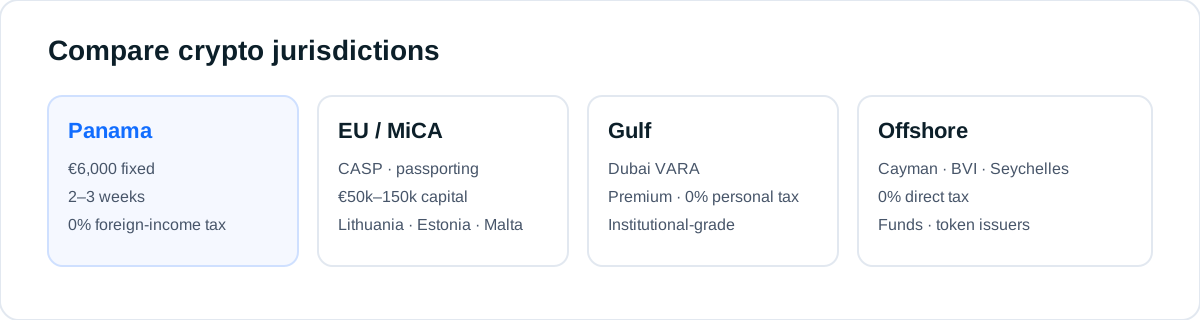
Abu Dhabi is not the only option for crypto banking licenses. Below is a comparison with Panama and two other common jurisdictions.
| Jurisdiction | Cost (EUR) | Capital Requirement | Timeline | Tax |
|---|---|---|---|---|
| Abu Dhabi (ADGM) | 150,000 - 300,000 | 125,000 - 150,000 | 6-12 months | 0% corporate tax in ADGM |
| Panama | 6,000 flat | None | 2-4 weeks | Territorial tax |
| Estonia | ~10,000 | None (MiCA: 50,000 - 150,000) | 2-4 months | 20% corporate tax on distributed profits |
| Lithuania | ~8,000 | None (MiCA: 50,000 - 150,000) | 2-3 months | 15% corporate tax |
Panama stands out for its low cost and speed. Consulting24 delivers directly in Panama, Estonia, and Lithuania, and advises on Abu Dhabi through coordination. For most startups, Panama offers the best balance of affordability and regulatory clarity. However, if your target market is the Middle East or you need a high regulatory standing, Abu Dhabi may be worth the investment.
How Consulting24 Can Help
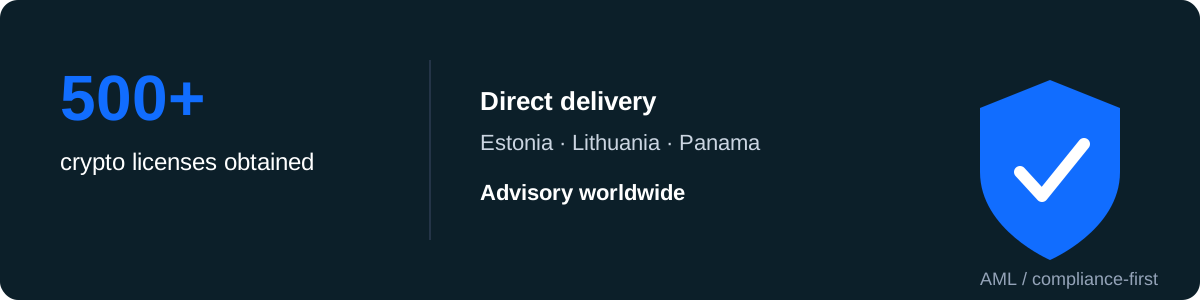
Consulting24 has obtained over 500 crypto licenses worldwide. We deliver directly in Estonia, Lithuania, and Panama, and advise on other jurisdictions like Abu Dhabi. Our services include:
- Jurisdiction selection based on your business model
- Full license application management
- Company setup and banking introductions
- Ongoing compliance support
Contact us via WhatsApp to discuss your project. We help you choose the right route and set up where we operate. Whether you need a cost-effective Panama license or a prestigious Abu Dhabi license, we guide you through every step.
Frequently asked questions
What is the cost of a crypto banking license in Abu Dhabi?
The total cost for a VASP license in Abu Dhabi typically ranges from EUR 150,000 to 300,000 in the first year, including application fees, legal costs, and capital. Exact pricing is confirmed during consultation.
How long does it take to get a license in Abu Dhabi?
The process usually takes 6 to 12 months from application to final approval. This includes pre-application preparation, FSRA review, due diligence, and meeting conditions like office setup.
What is the minimum capital requirement for a VASP license in Abu Dhabi?
The minimum capital is typically EUR 125,000 for custody services and EUR 150,000 for exchange or payment services. These figures are subject to FSRA approval and may vary based on the business model.
Can I use a Panama license instead of Abu Dhabi for crypto payments?
Yes, Panama offers a crypto license for a flat EUR 6,000 with no minimum capital and faster processing. It is suitable for global payment rails, though it may not carry the same regulatory prestige as Abu Dhabi.
What activities are allowed under an Abu Dhabi VASP license?
Allowed activities include virtual asset exchange (fiat and crypto), custody, transfers, payment services, and token issuance. Each activity requires separate authorization from the FSRA.
Is Abu Dhabi tax-free for crypto businesses?
Yes, within the ADGM free zone, there is zero corporate income tax, no capital gains tax, and no VAT on crypto transactions. However, operations outside the free zone may be subject to 9% corporate tax.
How do I open a bank account for a crypto business in Abu Dhabi?
Licensed VASPs can open accounts with ADGM-based banks like ADCB or FAB, or crypto-friendly banks like Zand Bank. Expect extensive due diligence on source of funds and business model.
What are the ongoing compliance costs in Abu Dhabi?
Annual compliance costs typically range from EUR 30,000 to 80,000, covering AML/CFT audits, MLRO salary, and regulatory filings. These are mandatory and can be significant.
Can Consulting24 help with an Abu Dhabi license application?
Consulting24 advises and coordinates on Abu Dhabi licensing through local partners. We do not deliver directly but provide expert guidance and jurisdiction comparison, with direct delivery in Panama, Estonia, and Lithuania.
What are common mistakes when applying for an Abu Dhabi license?
Common mistakes include underestimating costs and timelines, applying without a clear business model, neglecting local director requirements, and using generic AML policies. Consulting24 helps avoid these pitfalls.
Related jurisdictions

Talk to a crypto-licensing expert
500+ licenses across Estonia, Lithuania, Panama and beyond. Tell us your model and we'll map the right route, honestly.
💬 Talk to an expertFree consultationGeneral guidance, not legal advice. Rules and fees evolve, and we confirm current requirements for your case.