Cost of a Crypto License in Czech Republic 2026: Full Breakdown

If you are a crypto founder evaluating European jurisdictions for licensing in 2026, the Czech Republic offers a pragmatic path under the EU's Markets in Crypto-Assets Regulation (MiCA). Understanding the full cost of a crypto license in Czech Republic is essential for budgeting and compliance. This guide provides a detailed breakdown of fees, capital requirements, timelines, and tax implications, drawing on the latest regulatory framework.
While the Czech National Bank (CNB) is the primary regulator for crypto-asset service providers (CASPs), the licensing process involves multiple steps and costs. We cover everything from application fees to ongoing compliance expenses, and compare the Czech approach with other jurisdictions like Panama, where Consulting24 can deliver a flat-fee license for EUR 6,000. Whether you are a startup or an established exchange, this breakdown helps you make an informed decision.
What Is a Crypto License in the Czech Republic?
A crypto license in the Czech Republic is an authorization granted by the Czech National Bank (CNB) to provide crypto-asset services under MiCA. As of 2026, all EU member states have transposed MiCA into national law, replacing previous fragmented regimes. The Czech license allows firms to operate across the EU via passporting, covering services such as exchange, custody, and transfer of crypto-assets.
The CNB oversees compliance with anti-money laundering (AML) and prudential requirements. Unlike some jurisdictions, the Czech Republic has a well-defined application process with clear cost structures. For founders, this means predictable expenses and a regulated environment that enhances trust with partners and clients. The license is a single authorization that can include multiple service classes, each with specific capital tiers. The CNB is known for its thorough but fair approach, with application review typically taking 3-6 months. Key regulatory references include Act No. 253/2008 Coll. on AML (as amended), MiCA Regulation (EU) 2023/1114, and CNB decree on prudential requirements for CASPs.
Who Needs a Crypto License in the Czech Republic?
Any entity offering crypto-asset services in or from the Czech Republic must hold a CASP license. This includes crypto exchanges (fiat-to-crypto and crypto-to-crypto), custodial wallet providers, brokers and dealers in crypto-assets, platforms facilitating crypto transfers, and advisors or portfolio managers dealing with crypto. If you plan to serve Czech clients or passport services to other EU states, licensing is mandatory.
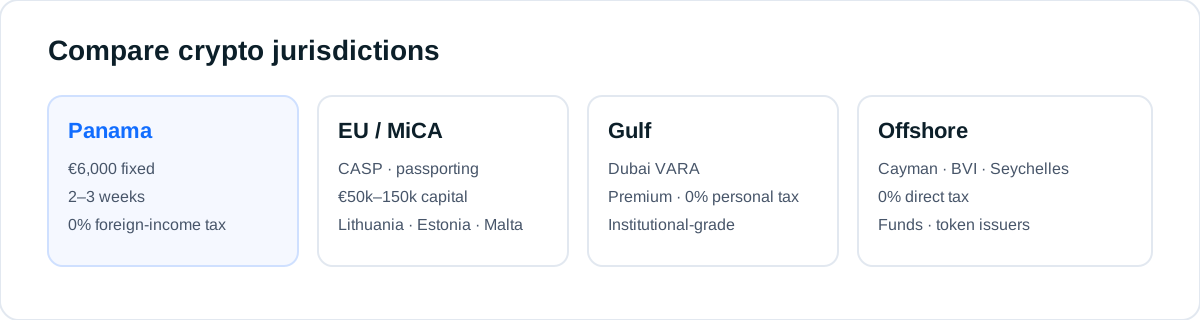
Even non-EU firms targeting the European market often establish a Czech entity to benefit from the single market passport. For example, a US-based exchange wanting to offer services in Germany, France, and Italy can set up in Prague and passport across the EU. However, the capital and compliance costs can be significant. For a simpler and faster alternative, consider Panama, where Consulting24 offers a flat EUR 6,000 license with no capital requirement. Compare options on our jurisdictions page.
License Type and Regulator
The Czech National Bank (CNB) is the competent authority for crypto-asset service providers under MiCA. The license is a single authorization covering multiple service classes, each with specific capital tiers. The CNB is known for its thorough but fair approach, with application review typically taking 3-6 months.
Key regulatory references:
- Act No. 253/2008 Coll. on AML (as amended)
- MiCA Regulation (EU) 2023/1114
- CNB decree on prudential requirements for CASPs
For a comparison with other EU regulators, see our Czech Republic license page. The CNB requires that all key personnel pass fit and proper tests, and the firm must have a local registered office and a compliance officer resident in the EU.
Cost and Timeline: Detailed Breakdown
The total cost of a crypto license in Czech Republic includes state fees, professional services, and capital requirements. Below is a summary table. Note that exact figures may vary; we recommend a consultation for precise quotes.
| Cost Item | Amount (EUR) | Notes |
|---|---|---|
| Application fee to CNB | 1,000 - 2,000 | One-time, non-refundable |
| Legal and compliance setup | 5,000 - 15,000 | Includes drafting policies, AML program, and representation |
| Company incorporation (if new) | 1,000 - 3,000 | Including registered address and notary |
| Minimum capital (tier 1) | 50,000 | For exchange and custody services |
| Minimum capital (tier 2) | 125,000 | For trading platforms with order matching |
| Minimum capital (tier 3) | 150,000 | For services involving client funds |
| Ongoing annual compliance | 3,000 - 10,000 | AML officer, audits, reporting |
| Total estimated first-year cost | 60,000 - 180,000 | Depends on service class and complexity |
Timeline: Application preparation 1-2 months, CNB review 3-6 months, total 4-8 months. For a faster and cheaper alternative, Panama offers a license in 4-6 weeks at a flat EUR 6,000. See our cost comparison page.
Capital Requirements
Under MiCA, capital requirements are tiered based on the type of service. For the Czech Republic, the CNB applies the standard EU thresholds:
- Tier 1 (EUR 50,000): Custody and transfer services
- Tier 2 (EUR 125,000): Exchange services (including order matching)
- Tier 3 (EUR 150,000): Services involving client money or crypto (e.g., margin trading)
Capital must be held as equity or equivalent, and cannot be withdrawn during operation. This is a significant cost compared to Panama, which has no minimum capital requirement. For more details, visit our requirements page. The capital must be maintained at all times; if it falls below the threshold, the CNB may suspend or revoke the license.
Tax Treatment of Crypto in the Czech Republic
The Czech Republic has a favourable tax regime for crypto. Corporate income tax is a flat 19% on profits. Crypto-to-crypto trades are generally exempt from VAT, and capital gains from crypto held for more than 3 years are tax-free for individuals. For companies, crypto is treated as intangible assets or inventory depending on business model.
Key points:
- No withholding tax on dividends (subject to conditions)
- Transfer pricing rules apply for related-party transactions
- VAT exemption for exchange and transfer services
Always consult a tax advisor. For a jurisdiction with zero corporate tax, consider Panama. Learn more on our blog. The Czech tax authorities have issued guidance on crypto taxation, which provides clarity for businesses.
Allowed Activities Under the License
A Czech CASP license permits the following activities under MiCA:
- Exchange of crypto-assets for fiat currency
- Exchange of crypto-assets for other crypto-assets
- Custody and administration of crypto-assets
- Transfer of crypto-assets on behalf of clients
- Placing of crypto-assets (underwriting)
- Execution of orders on behalf of clients
Additional services like staking or lending may require separate authorization. The license does not cover security tokens or e-money, which fall under other regimes. For a broader scope, Panama allows all crypto activities without restriction. Compare on our Panama page.
Step-by-Step Application Process
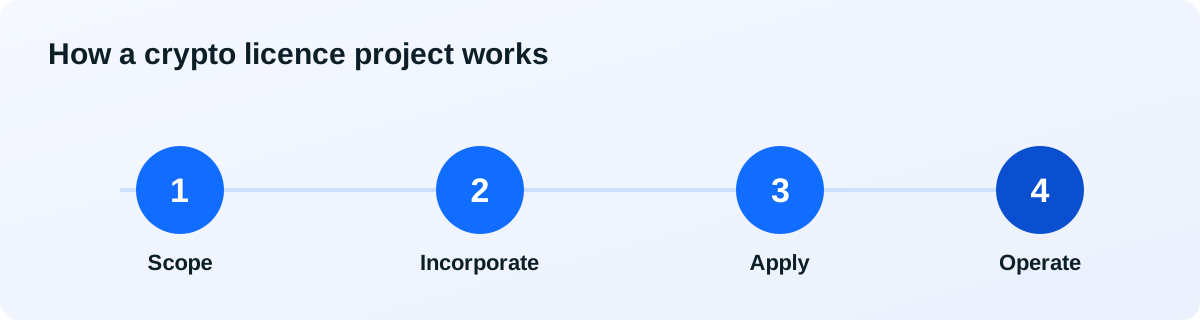
Obtaining a crypto license in the Czech Republic involves these steps:
- Pre-incorporation: Register a Czech company (s.r.o.) with a registered address and director.
- Prepare documentation: Draft AML/KYC policies, risk assessment, business plan, and internal controls.
- Appoint local agents: AML officer, compliance officer, and board members (may be non-resident).
- Submit application: File with CNB via their electronic system, including all supporting documents and proof of capital.
- CNB review: The regulator assesses fit and proper tests, AML compliance, and capital adequacy. They may request additional information.
- Approval: Once granted, you can begin operations. You must notify CNB of any material changes.
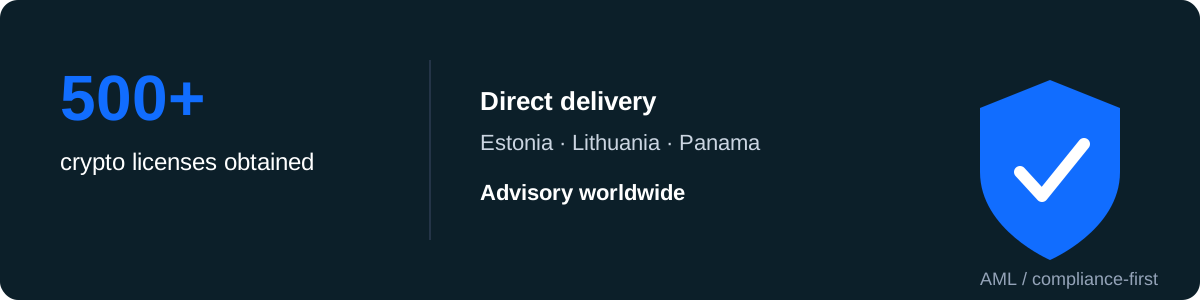
Consulting24 advises and coordinates applications for Czech Republic. For direct delivery, we offer licenses in Estonia, Lithuania, and Panama. See our application process guide. The CNB typically takes 3-6 months for review, but complex cases may take longer.
Banking and Payment Services
Opening a corporate bank account for a crypto business in the Czech Republic can be challenging but is feasible. Major banks like CSOB, Komercni Banka, and Moneta have crypto-friendly policies, though they require proof of licensing and strong AML controls. Some fintechs like Revolut Business or Airwallex offer alternatives.
Key considerations:
- Banks often require a minimum deposit (EUR 10,000-50,000)
- Transaction monitoring and reporting are mandatory
- Some banks restrict crypto-related transfers
It is advisable to open the account before applying for the license, as the CNB may ask for proof of banking. Panama offers easier banking integration with no restrictions. Compare banking options on our company setup page. Payment processors like Simplex or MoonPay can also be integrated for fiat on-ramps.
Benefits of a Czech Crypto License
Despite the costs, the Czech license offers several advantages:
- EU passport: Operate across all 27 EU member states without additional licenses.
- Regulatory clarity: MiCA provides a harmonised framework, reducing legal uncertainty.
- Tax efficiency: 19% corporate tax and tax-free gains for individuals after 3 years.
- Skilled workforce: Prague has a strong tech and finance talent pool.
- Stable economy: Czech Republic is a developed, politically stable country.
For a lower-cost entry, Panama offers similar benefits with no capital requirement and faster setup. Explore both on our jurisdictions page. The Czech license also enhances credibility with partners and investors.
Compliance and Ongoing Obligations
After licensing, firms must maintain ongoing compliance:
- Annual AML audit and reporting to CNB
- Quarterly transaction monitoring and suspicious activity reports
- Capital maintenance (cannot fall below minimum)
- Fit and proper updates for key personnel
- Data protection under GDPR
Non-compliance can result in fines or license revocation. Consulting24 provides compliance advisory for Czech license holders. For a simpler compliance regime, Panama requires only annual renewal. This is general guidance, not legal advice. Firms must also appoint an internal auditor and maintain records for at least 5 years.
Common Mistakes to Avoid
Founders often make these errors when applying for a Czech crypto license:
- Underestimating capital: Ensure you have the full amount in liquid assets before applying.
- Poor AML documentation: CNB scrutinises AML policies; generic templates are rejected.
- Ignoring fit and proper tests: Directors with criminal records or bankruptcies may be disqualified.
- Delaying bank account opening: Start the process early to avoid delays.
- Not planning for ongoing costs: Budget for annual compliance and audits.
Learn from others' experiences on our blog. Another common mistake is assuming the license covers all crypto activities; check the scope carefully.
Alternatives and Comparison: Czech Republic vs Panama and Others
Comparing the Czech Republic with other jurisdictions helps you choose the best fit:
| Jurisdiction | Cost (First Year) | Capital | Timeline | Tax |
|---|---|---|---|---|
| Czech Republic | EUR 60,000 - 180,000 | EUR 50,000 - 150,000 | 4-8 months | 19% corporate tax |
| Panama | EUR 6,000 flat | None | 4-6 weeks | 0% corporate tax |
| Lithuania | EUR 15,000 - 30,000 | EUR 50,000 - 125,000 | 3-6 months | 15% corporate tax |
| Estonia | EUR 10,000 - 25,000 | EUR 50,000 - 125,000 | 2-4 months | 20% corporate tax |
For a detailed comparison with Lithuania, see our vs Lithuania page. If you value speed and low cost, Panama is the clear winner. For EU passporting, the Czech Republic is a solid choice despite higher costs.
How Consulting24 Can Help
Consulting24 delivers crypto licenses directly in Estonia, Lithuania, and Panama. For the Czech Republic, we advise and coordinate the entire process, from company incorporation to application submission. Our team has handled over 500 licenses across multiple jurisdictions.
We offer a free initial consultation to assess your needs and recommend the best jurisdiction. Whether you choose the Czech Republic for its EU passport or Panama for its simplicity, we guide you through every step. Contact us via WhatsApp or book a consultation to discuss your project.
Frequently asked questions
What is the total cost of a crypto license in the Czech Republic in 2026?
The total first-year cost ranges from EUR 60,000 to EUR 180,000, including application fees, legal setup, and minimum capital. Ongoing annual compliance costs EUR 3,000 to EUR 10,000. For a fixed price alternative, Panama offers a license for EUR 6,000 with no capital requirement.
How long does it take to get a crypto license in the Czech Republic?
The process takes 4 to 8 months: 1-2 months for preparation and 3-6 months for CNB review. Delays can occur if documentation is incomplete. Panama is faster at 4-6 weeks.
What are the capital requirements for a Czech crypto license?
Capital is tiered under MiCA: EUR 50,000 for custody/transfer, EUR 125,000 for exchange services, and EUR 150,000 for services involving client funds. Capital must be maintained at all times.
Can I passport my Czech license to other EU countries?
Yes, the Czech CASP license allows passporting across all 27 EU member states under MiCA. You can provide services in other EU countries without additional licenses.
What is the corporate tax rate for crypto businesses in the Czech Republic?
The corporate income tax rate is a flat 19%. Crypto-to-crypto trades are VAT-exempt, and capital gains for individuals are tax-free after holding for more than 3 years.
Is a Czech crypto license cheaper than a Panama license?
No, Panama is significantly cheaper at EUR 6,000 flat with no capital requirement. The Czech license costs EUR 60,000 to EUR 180,000 in the first year. However, the Czech license offers EU passporting.
What activities are allowed under a Czech crypto license?
Allowed activities include exchange (fiat and crypto), custody, transfer, placing of crypto-assets, and order execution. Staking and lending may require additional authorization.
Do I need to be resident in the Czech Republic to apply?
No, you can be a non-resident. However, you must appoint a local compliance officer and have a registered office in the Czech Republic. Directors can be non-resident.
What are the ongoing compliance obligations after obtaining the license?
Ongoing obligations include annual AML audits, quarterly transaction monitoring, capital maintenance, fit and proper updates for key personnel, and GDPR compliance. Non-compliance can lead to fines or revocation.
Can Consulting24 help with the Czech crypto license application?
Yes, Consulting24 advises and coordinates applications for the Czech Republic. We also deliver directly in Estonia, Lithuania, and Panama. Contact us for a free consultation.
Official sources
Related jurisdictions

Talk to a crypto-licensing expert
500+ licenses across Estonia, Lithuania, Panama and beyond. Tell us your model and we'll map the right route, honestly.
💬 Talk to an expertFree consultationGeneral guidance, not legal advice. Rules and fees evolve, and we confirm current requirements for your case.