Canada vs Panama for a Crypto Company: Which to Choose in 2026

Choosing the right jurisdiction for your crypto company is a critical decision that affects your regulatory burden, tax exposure, and operational flexibility. In 2026, Canada and Panama offer two very different paths for crypto founders. Canada has a mature but complex regulatory framework under provincial securities regulators and the Bank of Canada, while Panama provides a streamlined, cost-effective licensing regime with no capital gains tax on crypto. This guide compares Canada vs Panama for a crypto company across key factors to help you decide which jurisdiction aligns with your business goals.
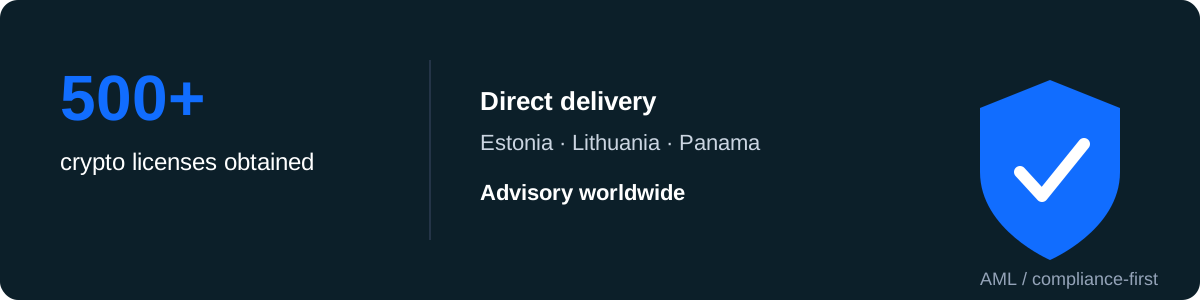
Panama has emerged as a leading hub for crypto businesses, with a flat EUR 6,000 license fee, no minimum capital requirement, and a clear legal framework. Canada, by contrast, imposes provincial registration, high compliance costs, and significant capital requirements. Whether you are a startup, an exchange, or a DeFi project, understanding these differences is essential. Consulting24 has obtained over 500 crypto licenses worldwide, including direct delivery in Estonia, Lithuania, and Panama, and advises on all other jurisdictions. For a deeper dive into Panama's advantages, visit our Panama page or explore other options on our jurisdictions page.
What is the Canada vs Panama for a Crypto Company Comparison?
This comparison evaluates the regulatory, financial, and operational environments for crypto companies in Canada and Panama as of 2026. Canada treats crypto assets as securities under provincial laws, requiring registration with securities commissions like the Ontario Securities Commission (OSC) or the British Columbia Securities Commission (BCSC). Panama, on the other hand, has no enacted crypto law yet (a draft, Anteproyecto 314, is pending); crypto activity runs through a Panama company with an AML/CTF programme. The choice between the two depends on your target market, risk tolerance, and budget.
Key differences include:
- Regulatory clarity: Panama offers a single, national framework; Canada has 13 provincial regulators with varying rules.
- Cost: Panama's flat EUR 6,000 vs Canada's CAD 50,000+ in legal and compliance fees.
- Tax: Panama has no capital gains tax on crypto; Canada taxes crypto as income or capital gains.
- Speed: Panama license can be obtained in 3-6 months; Canada can take 12-18 months.
For a practical example, consider a startup exchange processing EUR 10 million monthly. In Panama, the annual compliance cost might be EUR 15,000-25,000 including the license fee amortized. In Canada, the same exchange could face CAD 80,000-150,000 in legal fees, AML officer salary, and audit costs. The difference is stark and grows with transaction volume.
Who Needs to Choose Between Canada and Panama?
This comparison is relevant for:
- Crypto exchanges looking for a stable, regulated home base with global reach.
- DeFi projects that need legal clarity on token issuance and trading without heavy securities classification.
- Payment processors handling crypto-to-fiat conversions, especially those targeting Latin American or global markets.
- Investment funds managing digital asset portfolios seeking tax efficiency.
- Startups seeking a cost-effective jurisdiction with low capital requirements to preserve runway.
If your primary market is North America, Canada may offer easier access to Canadian investors and banking relationships. However, Panama provides a more flexible platform for global operations, particularly if you plan to serve customers outside Canada. Consulting24 helps founders assess their target markets and choose the right path. For a detailed breakdown of Panama's requirements, see our requirements page.
License Type and Regulator
Panama: There is no crypto regulator or VASP licensing in Panama today; a draft framework (Anteproyecto 314) is pending. The license is a single category for all crypto services, including exchange, custody, and transfer. There is no distinction between service types, simplifying the application. Panama's AML supervisor for non-financial businesses (casinos, real-estate agents, precious-metals dealers) does not cover crypto companies, which fall outside its scope unless they also fit one of those categories.
Canada: There is no federal crypto license. Instead, crypto businesses must register as a Money Services Business (MSB) with FINTRAC and comply with provincial securities laws. Some provinces, like Ontario, require registration with the OSC and adherence to the Canadian Securities Administrators (CSA) guidance. The rules is fragmented and evolving, with each province potentially imposing additional requirements. For example, Quebec's Autorité des marchés financiers (AMF) has its own guidance on crypto assets, adding complexity for nationwide operations.
For a comparison with other EU jurisdictions, see our vs Lithuania page.
Cost and Timeline
| Factor | Panama | Canada |
|---|---|---|
| License fee | EUR 6,000 (flat, one-time) | CAD 10,000-50,000+ (provincial registration + legal fees) |
| Annual compliance | EUR 2,000-5,000 (estimated, including AML officer and audit) | CAD 20,000-100,000 (legal, audit, AML officer, surety bond) |
| Timeline | 3-6 months | 12-18 months |
| Setup costs | EUR 1,000-3,000 (company formation, registered agent) | CAD 2,000-5,000 (incorporation, initial legal fees) |
| Total first-year cost (estimated) | EUR 9,000-14,000 | CAD 32,000-155,000 |
These figures are based on typical scenarios for a mid-size exchange. Exact pricing is confirmed in a consultation with Consulting24. Panama's flat fee is a clear advantage for startups, especially those with limited budgets. For a detailed cost analysis, visit our cost page.
Capital Requirement
Panama: No minimum capital requirement. The company must have sufficient capital to operate, but there is no statutory minimum. This makes Panama ideal for early-stage projects that want to preserve capital for development and marketing. In practice, banking partners expect a reasonable amount based on business volume, assessed case-by-case.
Canada: No federal minimum capital, but provincial regulators may impose capital requirements based on business volume. For example, the OSC may require a minimum of CAD 100,000 for certain activities, especially if handling client funds. Additionally, FINTRAC requires a surety bond or trust account for MSBs, which can cost CAD 5,000-20,000 annually depending on transaction volume. These requirements can be a barrier for smaller firms.
Panama's flexibility is a major draw for bootstrapped startups. For more on capital requirements globally, see our requirements page.
Tax Treatment
Panama: No capital gains tax on crypto transactions. Income tax applies only to Panama-sourced income, and crypto gains from foreign sources are generally tax-exempt. Panama also has no VAT on crypto services. This is a significant advantage for crypto companies, as it allows them to reinvest profits without immediate tax leakage. For example, a trading firm with annual profits of USD 500,000 would pay zero capital gains tax in Panama, versus up to CAD 150,000 in Canada.
Canada: Crypto is treated as a commodity. Trading gains are taxed as capital gains (50% inclusion rate) or as business income (100% inclusion) depending on frequency. Mining is taxed as income. HST/GST applies to crypto transactions in some cases. The effective tax rate can exceed 30% for high earners, and compliance requires detailed record-keeping of every transaction. Additionally, Canada's tax treaties may affect cross-border payments.
For a comparison with other tax-friendly jurisdictions, see our El Salvador page.
Allowed Activities
Panama: The VASP license covers: exchange of virtual assets for fiat or other virtual assets, custody, transfer, and participation in ICOs/STOs. No restrictions on DeFi or NFT platforms, provided they comply with AML/CFT rules. This broad scope allows companies to innovate without seeking additional approvals. For example, a DeFi protocol offering lending and staking can operate under the same license.
Canada: Allowed activities depend on provincial registration. Typically: exchange, payment processing, and custody. However, stablecoins and DeFi are under increased scrutiny. The CSA has warned that many DeFi protocols may be securities offerings, requiring prospectus-level compliance. This has led to some projects avoiding Canada altogether. Additionally, margin trading and derivatives may require separate registration with the Canadian Investment Regulatory Organization (CIRO).
Panama offers broader freedom for crypto-native business models. For a full list of permitted activities in Panama, visit our application process page.
Step-by-Step Process for Obtaining a License
Panama:
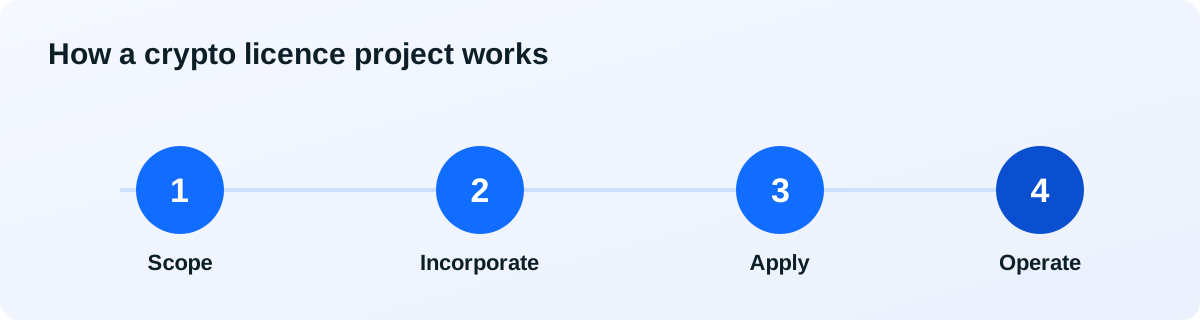
- Incorporate a Panama corporation (can be done remotely in 1-2 weeks).
- Prepare AML/KYC policies and appoint a compliance officer (may require hiring a local AML expert).
- Prepare the company file with business plan, financials, background checks, and proof of office address.
- Pay the EUR 6,000 fee.
- Await approval (3-6 months). During this period, the registered agent or your bank may request additional documentation or clarifications.
- Once approved, maintain ongoing compliance: file annual reports, conduct AML training, and undergo periodic audits.
Canada:
- Incorporate federally or provincially (1-2 weeks).
- Register with FINTRAC as an MSB (requires a compliance program, which can take 2-3 months to prepare).
- Apply for provincial securities registration (e.g., OSC, BCSC) if dealing in crypto securities. This involves a detailed application, including disclosure of all beneficial owners.
- Meet capital and surety bond requirements (may require depositing funds or obtaining a bond from a Canadian insurer).
- Ongoing reporting and audits: quarterly transaction reports, annual audited financial statements, and compliance reviews.
Consulting24 handles the entire Panama process, from company formation to license approval. For a step-by-step guide, see our application process page.
Banking and Payments
Panama: Panama has a well-developed banking sector with many banks open to crypto businesses, especially those with a VASP license. However, banking relationships can take time to establish. Some banks require a minimum deposit of USD 5,000-10,000 and may request a copy of the license and AML policies. Payment processors like Stripe and PayPal are available but may restrict crypto-related transactions. Local banks such as Banco General and Banistmo have been known to accept crypto clients, though due diligence is required.
Canada: Major banks (RBC, TD, BMO) have restrictive policies on crypto. Many refuse to bank crypto companies outright due to regulatory uncertainty and reputational risk. Fintechs like PayTrie and Coinberry offer payment solutions, but traditional banking remains challenging. Some crypto companies resort to using credit unions or smaller regional banks, which may have more flexible policies but limited services.
Panama generally offers better banking access for crypto firms, particularly for those with a local license. For more on banking, see our blog.
Benefits of Panama Over Canada
- Cost: EUR 6,000 flat fee vs CAD 50,000+ in first-year costs.
- Speed: 3-6 months vs 12-18 months to operational license.
- Tax: No capital gains tax on crypto, zero VAT on crypto services.
- Regulatory clarity: Single national framework vs 13 provincial regulators with conflicting rules.
- Capital: No minimum capital requirement, ideal for startups.
- Banking: More accessible banking for crypto firms, with several local banks accepting VASP licensees.
- Flexibility: Single license covers exchange, custody, transfer, and participation in token offerings.
Panama is particularly attractive for startups and SMEs seeking to minimize overhead and maximize operational freedom. For a deeper comparison, see our jurisdictions page.
Compliance and Trust
Panama: Panama enforces AML/CFT compliance in line with FATF recommendations. Licensees must conduct KYC, transaction monitoring, and report suspicious activities. Panama is not on the FATF grey list as of 2026, which enhances its reputation. However, due diligence on service providers is essential, as some third-party compliance firms may not meet international standards. Consulting24 recommends engaging a local compliance officer with experience in crypto.
Canada: Canada has a strong AML regime under FINTRAC and provincial securities commissions. Compliance costs are high, but the regulatory framework is well-established and trusted by investors. Canada is a FATF member with a strong reputation for enforcement. However, the fragmented provincial system can lead to inconsistent application of rules.
Both jurisdictions require rigorous compliance. Consulting24 provides compliance support for Panama licensees, including AML policy templates and ongoing advisory. This is general guidance, not legal advice. Always consult a qualified lawyer for your specific situation.
Common Mistakes When Choosing a Jurisdiction
- Ignoring tax implications: Canada's high tax burden can erode profits. A founder earning CAD 200,000 in crypto gains could pay over CAD 50,000 in taxes, whereas in Panama the same gains would be tax-free.
- Underestimating compliance costs: Canada's provincial requirements add significant expense. One exchange reported spending CAD 120,000 in legal fees just to work through Ontario's registration.
- Choosing based on hype: Some jurisdictions offer low costs but poor banking access or reputational risks. Panama has a solid track record as a corporate domicile for crypto companies.
- Not considering target market: If your customers are in Canada, a Canadian license may be necessary to avoid regulatory action. However, you can also serve Canadians from Panama if you comply with Canadian securities laws through an exemption.
- Failing to plan for growth: Panama's flat fee allows scaling without additional licensing costs, while Canada's costs increase with transaction volume.
Consulting24 helps founders avoid these pitfalls through personalized advisory. For a consultation, reach out via WhatsApp or book a meeting.
Alternatives and Comparisons
Beyond Canada and Panama, other jurisdictions worth considering include:
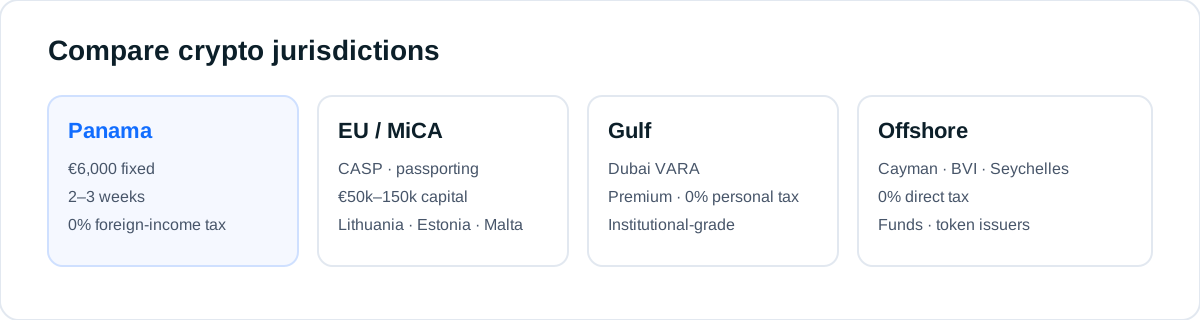
- Estonia: EU member with a mature e-residency and crypto licensing regime. However, MiCA now applies, with minimum capital of EUR 50,000-150,000. See our Estonia page for details.
- Lithuania: Another EU option with a clear licensing process under the Bank of Lithuania. Capital requirements start at EUR 125,000 under MiCA. More on our Lithuania page.
- Dubai: VARA regulates crypto in Dubai, with a strong framework but higher costs (USD 50,000+). For a comparison, see our Dubai page.
Each jurisdiction has trade-offs. Panama remains the most cost-effective for startups, while EU licenses offer passporting rights within the EU. Consulting24 advises on all these options to help you choose the best fit.
Frequently asked questions
What is the main advantage of Panama over Canada for a crypto company?
The main advantage is cost and tax efficiency. Panama charges a flat EUR 6,000 license fee with no minimum capital, while Canada can cost CAD 50,000+ in first-year compliance. Panama also has no capital gains tax on crypto, whereas Canada taxes gains at up to 30%.
Can I serve Canadian customers from a Panama-licensed company?
Yes, but you must ensure compliance with Canadian securities laws. If your activities involve soliciting Canadian investors, you may need to register provincially or rely on exemptions. Consulting24 recommends legal advice for cross-border operations.
How long does it take to get a Panama crypto license?
Typically 3-6 months from application submission. The timeline depends mainly on the completeness of your documentation and company-registry processing. Consulting24 can expedite the process by preparing a thorough application.
Does Panama require a physical office for the crypto license?
Yes, you need a registered office address in Panama. This can be provided by a local service provider. Consulting24 can arrange this as part of the company formation package.
What are the ongoing compliance costs for a Panama VASP license?
Estimated at EUR 2,000-5,000 annually, covering AML officer fees, audit, and regulatory filings. This is significantly lower than Canada's CAD 20,000-100,000.
Is Panama on any FATF grey or black list?
As of 2026, Panama is not on the FATF grey list. It has made progress in AML compliance, though some concerns remain. This enhances the reputation of Panama-licensed entities.
Can I apply for a Panama crypto license remotely?
Yes, the entire process can be handled remotely, including company incorporation and license application. Consulting24 provides full remote support.
What types of crypto activities are allowed under the Panama VASP license?
The license covers exchange (crypto-to-fiat and crypto-to-crypto), custody, transfer, and participation in ICOs/STOs. DeFi and NFT platforms are also permitted if they comply with AML rules.
How does MiCA affect the comparison between Canada and Panama?
MiCA does not directly affect Canada or Panama. However, if you are considering EU expansion, Panama offers a non-EU alternative with lower costs. EU licenses under MiCA require higher capital (EUR 50,000-150,000).
What happens if I operate a crypto business in Canada without registration?
Operating without registration can lead to enforcement actions, fines, and even criminal charges. The OSC and FINTRAC actively monitor and penalize non-compliant entities. It is safer to either register in Canada or choose a jurisdiction like Panama.
Official sources
- Financial Transactions and Reports Analysis Centre of Canada (FINTRAC)
- Ontario Securities Commission (OSC)
Related jurisdictions

Talk to a crypto-licensing expert
500+ licenses across Estonia, Lithuania, Panama and beyond. Tell us your model and we'll map the right route, honestly.
💬 Talk to an expertFree consultationGeneral guidance, not legal advice. Rules and fees evolve, and we confirm current requirements for your case.