UAE Crypto Tax Explained for Founders

The United Arab Emirates has positioned itself as a global hub for cryptocurrency and blockchain innovation. For founders considering setting up a crypto business in the UAE, understanding the tax environment is crucial. This guide provides a clear, accurate overview of UAE crypto tax as of 2026, covering corporate tax, VAT, and how the regime compares to other jurisdictions like Panama.
Whether you are launching a crypto exchange, a DeFi protocol, or a blockchain startup, the UAE offers a compelling tax environment. However, the rules are nuanced, and compliance requirements vary by emirate and business activity. Consulting24 helps you work through these complexities, offering direct licensing in Estonia, Lithuania, and Panama, and coordinating advice for the UAE.
What Is the UAE Crypto Tax Regime?
The UAE does not impose a federal corporate income tax on most business activities. However, a federal corporate tax (CT) was introduced effective June 1, 2023, applying a 9% rate on taxable profits exceeding AED 375,000 (approximately EUR 95,000). For crypto businesses, the tax treatment depends on whether the activity is considered a qualifying business under the UAE's economic substance regulations and the specific free zone rules.
Importantly, the UAE has no capital gains tax on the sale of crypto assets held as investments. For trading businesses, profits may be subject to CT. VAT at 5% applies to taxable supplies of goods and services, but crypto-to-crypto transactions are generally outside the scope of VAT. The Central Bank of the UAE and the Securities and Commodities Authority (SCA) regulate crypto activities, and tax compliance is enforced by the Federal Tax Authority (FTA).
Founders must also consider the economic substance requirements: any entity conducting crypto-related activities must demonstrate adequate physical presence, employees, and expenditure in the UAE. Failure to comply can result in penalties.
Who Needs to Understand UAE Crypto Tax?
This guide is essential for crypto founders, CFOs, and compliance officers considering a UAE presence. Specifically:
- Exchange founders operating trading platforms for crypto-to-crypto or fiat-to-crypto pairs.
- DeFi and NFT project founders earning fees or royalties from digital assets.
- Mining and staking pool operators generating income from validation rewards.
- Venture capitalists investing in crypto startups and tokens.
- Service providers offering custody, wallet, or advisory services.
Even if you are not a UAE resident, setting up a UAE entity for your crypto business may offer tax advantages, but you must comply with local tax laws and substance requirements.
License Type & Regulator
The UAE does not have a single federal crypto license. Instead, regulation is fragmented across emirates and free zones. The main regulators are:
- Securities and Commodities Authority (SCA) - federal regulator for securities tokens and virtual asset platforms.
- Dubai Virtual Assets Regulatory Authority (VARA) - regulates virtual asset activities in Dubai (excluding DIFC).
- Abu Dhabi Global Market (ADGM) Financial Services Regulatory Authority (FSRA) - regulates crypto activities within ADGM.
- Dubai Financial Services Authority (DFSA) - regulates within the Dubai International Financial Centre (DIFC).
Each regulator issues specific licenses: VARA issues Virtual Asset Service Provider (VASP) licenses; ADGM FSRA issues Financial Services Permissions for crypto; SCA issues licenses for crowdfunding and token offerings. The type of license you need depends on your business model and chosen jurisdiction within the UAE.
Cost & Timeline for UAE Crypto Licensing
Costs and timelines vary significantly by emirate and free zone. Below is a general estimate for 2026. Exact pricing is confirmed through consultation.
| Item | Estimated Cost (EUR) | Timeline |
|---|---|---|
| Company setup (free zone) | 5,000 - 15,000 | 2-4 weeks |
| VARA license (Dubai mainland) | 50,000 - 100,000 | 3-6 months |
| ADGM FSRA permission | 30,000 - 80,000 | 3-6 months |
| SCA license | 20,000 - 50,000 | 2-4 months |
| Legal & compliance setup | 5,000 - 15,000 | 1-2 months |
| Ongoing annual costs (compliance, audit, office) | 10,000 - 30,000 | Annual |
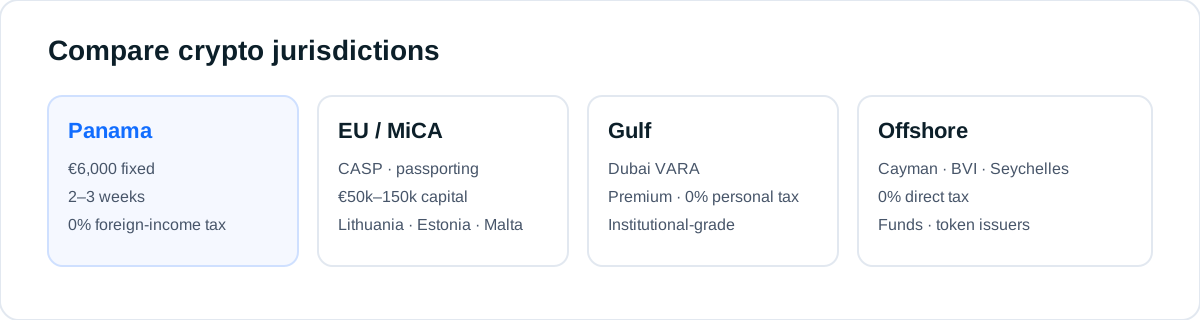
For comparison, a Panama crypto license is a flat EUR 6,000, with a faster setup of 4-6 weeks. Consulting24 can handle your Panama setup directly and advise on UAE coordination.
Capital Requirement
The UAE does not have a uniform minimum capital requirement for crypto businesses. Each regulator sets its own rules:
- VARA (Dubai): Minimum paid-up capital of AED 500,000 (approx. EUR 125,000) for most VASP activities.
- ADGM FSRA: Capital requirements vary by activity; typically AED 500,000 - AED 1,000,000 (EUR 125,000 - 250,000).
- SCA: Minimum capital of AED 2,000,000 (approx. EUR 500,000) for crowdfunding platforms.
- DIFC DFSA: Capital requirements depend on the license category, often starting at AED 1,000,000 (EUR 250,000).
These capital requirements are higher than in some other jurisdictions. For example, Panama has no minimum capital requirement for its crypto license. Consulting24 can help you evaluate which jurisdiction offers the best balance of cost, regulation, and tax.
Tax Treatment of Crypto in the UAE
The UAE tax regime for crypto is favorable but requires careful structuring. Key points:
- No capital gains tax on the sale of crypto assets held as investments.
- Corporate tax at 9% on net profits exceeding AED 375,000 (EUR 95,000) for qualifying businesses. Crypto trading and exchange fees are generally subject to CT.
- VAT at 5% applies to fiat-based services (e.g., trading commissions), but crypto-to-crypto transactions are outside VAT scope.
- Withholding tax: None on dividends, interest, or royalties paid to non-residents (subject to substance).
- Economic substance: Crypto businesses must demonstrate real activity in the UAE to avoid being treated as tax resident elsewhere.
It is critical to obtain a tax residency certificate and maintain proper transfer pricing documentation if you have related parties. Consulting24 can coordinate with local tax advisors to ensure compliance.
Allowed Activities Under a UAE Crypto License
The scope of activities depends on the license obtained. Typically, a UAE crypto license allows:
- Operating a crypto exchange (order book or OTC)
- Providing custody and wallet services
- Facilitating token issuance (STO or ICO)
- Running a crypto ATM network
- Offering advisory and asset management services for digital assets
- Mining and staking as a service
Some licenses restrict activities to specific tokens or require segregation of client assets. Always confirm with the regulator. For activities not covered, you may need additional approvals. Consulting24 can help you map your business model to the right license type.
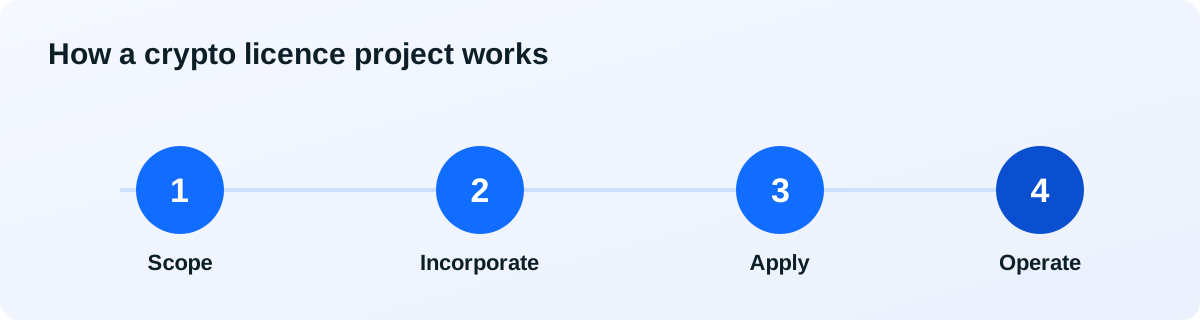
Step-by-Step Process to Obtain a UAE Crypto License
- Define your business model and choose the emirate/free zone (e.g., Dubai, ADGM, DIFC).
- Engage a local sponsor or free zone authority - mainland requires a local partner (51% ownership) unless exempted.
- Prepare legal documents: business plan, AML/KYC policies, risk assessment, financial projections.
- Submit the license application to the relevant regulator (VARA, FSRA, SCA, or DFSA).
- Undergo due diligence and background checks on founders and key personnel.
- Meet capital requirements and deposit the minimum capital in a UAE bank account.
- Set up physical office and hire staff to satisfy economic substance.
- Obtain final approval and pay license fees.
- Register for VAT and corporate tax with the Federal Tax Authority.
This process typically takes 3-6 months. For a faster and simpler alternative, consider Panama where Consulting24 can deliver a license in 4-6 weeks for a flat fee of EUR 6,000.
Banking & Payment Services for Crypto Businesses in the UAE
Banking remains one of the biggest challenges for crypto founders in the UAE. Many traditional banks are reluctant to open accounts for crypto companies due to compliance risks. However, several options exist:
- Digital banks: Zand Bank, Al Maryah Community Bank, and others offer accounts for regulated VASPs.
- Free zone banks: ADGM and DIFC have licensed banks that accept crypto businesses.
- Payment processors: Companies like Checkout.com and Stripe (limited) support crypto payments.
- Stablecoin on-ramps: Use regulated stablecoin issuers like Circle (USDC) for fiat conversion.
You will need a valid crypto license and a clean compliance record to open an account. Consulting24 can introduce you to banking partners in jurisdictions where we operate directly, such as Lithuania and Estonia, where bank account access is more straightforward.
Benefits of the UAE Crypto Tax Regime
- No capital gains tax on crypto investments - ideal for holding tokens long-term.
- Low corporate tax rate of 9% only on profits above AED 375,000 - many startups fall below this threshold.
- No withholding tax on dividends or interest paid to non-residents.
- Extensive double tax treaty network - the UAE has treaties with over 100 countries, reducing cross-border tax.
- Free zones offer 0% corporate tax for up to 50 years (e.g., ADGM, DIFC) for qualifying activities.
- VAT exemption on crypto-to-crypto transactions.
These benefits make the UAE attractive, but the cost and complexity of licensing are high. For founders seeking a simpler, cost-effective entry, Panama offers a flat EUR 6,000 license with no capital gains tax and no minimum capital.
Compliance & Trust: Staying on the Right Side of UAE Tax Law
Compliance is non-negotiable. The UAE Federal Tax Authority (FTA) has increased audits and penalties for non-compliance. Key requirements:
- Maintain proper accounting records and file corporate tax returns annually.
- Submit VAT returns quarterly or monthly, depending on turnover.
- Economic substance filing annually to prove real activity.
- AML/CFT compliance under UAE Cabinet Resolution No. 10 of 2019, including suspicious transaction reporting.
- Transfer pricing documentation for transactions with related parties.
This is general guidance, not legal advice. Always consult a qualified UAE tax advisor. Consulting24 can coordinate with local experts to ensure your compliance framework is strong. For a less burdensome compliance environment, consider jurisdictions like Lithuania or Estonia, where Consulting24 provides direct licensing.
Common Mistakes Founders Make with UAE Crypto Tax
- Assuming all free zones are tax-free - free zones offer 0% CT only for qualifying activities; crypto trading may not qualify.
- Ignoring economic substance - a mailbox company will be deemed tax resident elsewhere, triggering higher taxes.
- Failing to register for VAT - if your taxable supplies exceed AED 375,000, you must register.
- Not obtaining a tax residency certificate - needed to claim treaty benefits.
- Mixing personal and business crypto transactions - creates audit red flags.
- Initial consultation to identify the best jurisdiction for your business model.
- Full company setup and license application in Panama (flat EUR 6,000) and other direct jurisdictions.
- Coordination with local lawyers and tax advisors in the UAE.
- Ongoing compliance support and AML/KYC documentation.
- Banking introductions where we operate.
- UAE Federal Tax Authority
- Dubai Virtual Assets Regulatory Authority (VARA)
- Securities and Commodities Authority (SCA)
These mistakes can lead to penalties or loss of license. Consulting24 helps you avoid them by providing a clear roadmap and connecting you with vetted advisors.
Alternatives to UAE: Panama vs. Lithuania vs. Dubai (Comparison)
For crypto founders, several jurisdictions offer favorable tax and regulatory regimes. Here is a comparison:
| Jurisdiction | Corporate Tax | Capital Gains Tax | License Cost (EUR) | Setup Time | Min. Capital |
|---|---|---|---|---|---|
| UAE (Dubai) | 0-9% | 0% | 50,000 - 100,000 | 3-6 months | 125,000+ |
| Panama | 0% (territorial) | 0% | 6,000 flat | 4-6 weeks | None |
| Lithuania | 15% (0% for small companies) | 15% | 2,500 - 5,000 | 2-3 months | 2,500 |
| Estonia | 20% (0% on retained earnings) | 0% | 3,000 - 5,000 | 1-2 months | 2,500 |
Panama stands out for its low cost and speed. Lithuania and Estonia are strong EU options with clear MiCA compliance. Consulting24 delivers directly in Panama, Lithuania, and Estonia, and advises on UAE and other jurisdictions.
How Consulting24 Can Help You
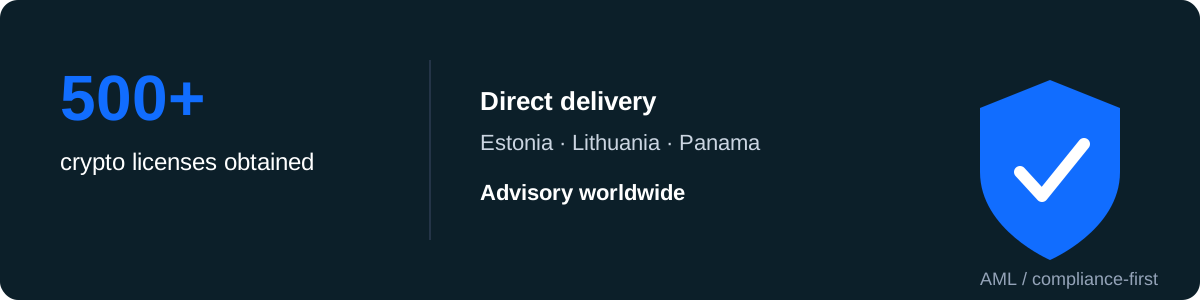
Consulting24 has obtained over 500 crypto licenses worldwide. We deliver directly in Estonia, Lithuania, and Panama, and advise on all other jurisdictions including the UAE. Our services include:
Contact us via WhatsApp or book a consultation to discuss your project. We do not guarantee approval but we maximize your chances with expert preparation.
Frequently asked questions
What is the corporate tax rate for crypto businesses in the UAE?
The UAE imposes a 9% corporate tax on net profits exceeding AED 375,000 (approx. EUR 95,000). Free zones may offer 0% for qualifying activities, but crypto trading often falls outside this exemption.
Is there capital gains tax on crypto in the UAE?
No, the UAE does not levy capital gains tax on the sale of crypto assets held as investments. However, profits from trading as a business are subject to corporate tax.
Do I need to register for VAT if I run a crypto exchange in the UAE?
Yes, if your taxable supplies (e.g., trading commissions in fiat) exceed AED 375,000 annually, you must register for VAT at 5%. Crypto-to-crypto transactions are generally outside VAT scope.
What is the minimum capital requirement for a crypto license in Dubai?
For VARA licenses, the minimum paid-up capital is typically AED 500,000 (approx. EUR 125,000). ADGM and DIFC have similar or higher requirements.
How long does it take to get a UAE crypto license?
The process usually takes 3-6 months, depending on the regulator and completeness of your application. Panama and Lithuania offer faster timelines.
Can I set up a crypto business in the UAE without a local partner?
In mainland Dubai, a local sponsor with 51% ownership is generally required unless you qualify for a professional license exemption. Free zones allow 100% foreign ownership.
What are the economic substance requirements for crypto companies in the UAE?
You must have a physical office, at least one full-time employee, and adequate expenditure in the UAE. Annual filings are required to demonstrate substance.
Is Panama a better option than the UAE for crypto tax?
Panama offers a flat EUR 6,000 license cost, no corporate tax on foreign-source income, no capital gains tax, and no minimum capital. It is simpler and cheaper, but lacks the UAE's treaty network and regional market access.
Does the UAE have a double tax treaty with my country?
The UAE has over 100 double tax treaties. You should check the specific treaty with your country of residence to avoid double taxation.
What happens if I don't comply with UAE tax laws?
Non-compliance can result in penalties, fines, license revocation, and potential criminal charges. It is essential to engage a local tax advisor.
Can Consulting24 help me get a UAE crypto license?
Consulting24 advises and coordinates for UAE licensing, but we do not directly file. We can connect you with vetted local partners. We directly deliver licenses in Panama, Lithuania, and Estonia.
What is the cost of a Panama crypto license?
The Panama crypto license is a flat EUR 6,000, including company setup. There are no hidden fees. Consulting24 handles the entire process.
Official sources
Related jurisdictions

Talk to a crypto-licensing expert
500+ licenses across Estonia, Lithuania, Panama and beyond. Tell us your model and we'll map the right route, honestly.
💬 Talk to an expertFree consultationGeneral guidance, not legal advice. Rules and fees evolve, and we confirm current requirements for your case.